


ULPGM-V3 is a lightweight, UAV-launched precision-guided missile developed by India's Defence Research and Development Organisation (DRDO) for the Indian Army, and is generally classed alongside loitering munitions in Indian defense procurement because it fills the same tactical niche: a small, drone-delivered munition that finds and strikes a specific target with minimal collateral risk.1,2 Unlike a soldier-carried, canister-launched loitering munition such as the AeroVironment Switchblade, ULPGM-V3 is a missile round released from a separate carrier unmanned aerial vehicle rather than a self-contained flying munition; that architectural distinction is worth stating plainly, since Indian press coverage frequently blurs the two categories.3 The 12.5 kg weapon carries a dual-channel imaging infrared seeker plus laser guidance, is described as fire-and-forget, and is intended for both air-to-ground strikes against tanks and bunkers and air-to-air engagement of enemy drones and helicopters.1,4
- Modular warhead options (anti-armor, bunker-penetrating, anti-personnel) from one airframe
- Dual-mode air-to-ground and air-to-air engagement demonstrated in trials
- Fully indigenous supply chain involving 30+ Indian MSMEs and startups
- Fire-and-forget imaging infrared/laser guidance reduces operator exposure
- Two domestic production lines (BDL, Adani) reduce single-point manufacturing risk
- Requires a separate carrier UAV and ground control station, adding cost and a jammable data link
- Publicly reported range and accuracy figures conflict across official-adjacent sources
- Combat employment claims (e.g., during Operation Sindoor) are asserted by some outlets without independent confirmation
- Still transitioning from trials to volume production as of mid-2026
- Effective range (single-digit km) is short next to Western and Israeli rivals
The program is led by the Research Centre Imarat (RCI) in Hyderabad, working with the Defence Research and Development Laboratory (DRDL), the Terminal Ballistics Research Laboratory (TBRL) in Chandigarh, and the High Energy Materials Research Laboratory (HEMRL) in Pune.2,5 ULPGM-V3 is the third generation of the family, following the smaller ULPGM-V1 and ULPGM-V2, and completed its final development trials in May 2026, after which it was cleared for mass production.6,7 Production is being carried out jointly by Bharat Dynamics Limited (BDL) and Adani Defence & Aerospace under a Development-cum-Production Partner arrangement, and the Indian Army has already placed emergency-procurement orders for earlier variants.8,9
Sources disagree, sometimes within the same article cycle, on what the acronym even stands for. DRDO's own press release calls it the "Unmanned Aerial Vehicle Launched Precision Guided Missile," and most Indian outlets follow that form, but other reports render it "Ultra-Light Precision Guided Munition" or similar variants — none of which use the "Ultra Low-weight" wording sometimes seen in secondary summaries.1,2,10 This article treats the DRDO/PIB rendering as authoritative and flags the alternate names where they appear, consistent with how inconsistently Indian defense press has covered the program's naming and timeline.
The ULPGM family has grown substantially across three generations. The baseline ULPGM-V1 weighed about 5 kg, measured roughly 680–690 mm long and 100 mm in diameter, and had no propulsion of its own: it was released from an altitude of 750 m to 2 km and glided onto the target, giving it a strike range of only 1.5–2 km.3 It used an uncooled imaging infrared seeker and carried a 2 kg warhead available in pre-fragmented (anti-personnel), explosively formed penetrator (anti-armor standoff), or bunker-penetrating configurations rated to defeat roughly six inches of reinforced concrete.3
ULPGM-V2 added a small dual-thrust solid rocket motor with thrust vectoring, pushing weight to about 8.5 kg and length to 890 mm, and extending range to 4–6 km.3,11 The bigger addition was a two-way S-band datalink, which let an operator update or correct the target mid-flight rather than committing to a fixed aim point at launch — a meaningful jump in flexibility over the unpowered V1.3,11
ULPGM-V3, also referred to as ULM-ER (extended range), is the version most current reporting refers to simply as "ULPGM." It weighs 12.5 kg and is propelled by a dual-thrust solid motor, giving day and night engagement figures reported as 4 km by day and 2.5 km at night in most technical summaries — though several outlets separately state the range has been "increased to 10 km," without clarifying whether that describes a software/propulsion update to the same airframe or a distinct sub-variant.1,4,6 Guidance combines a high-definition dual-channel imaging infrared seeker with laser guidance and passive homing, intended to support both day and night, GPS-degraded operation.1,2 Reported accuracy is similarly inconsistent across sources: one account gives a 1-meter circular error probable, while another states 10 cm CEP — a tenfold discrepancy that open Indian defense reporting has not reconciled, and which this article is not able to resolve from public material.4,12
Warhead options carried over from earlier variants include a tandem-charge or explosively formed penetrator configuration for defeating explosive-reactive-armor-protected tanks via top attack, a penetration-cum-blast warhead for bunkers, and a pre-fragmented warhead for anti-personnel use.1,4 The missile is integrated with an unmanned aerial platform built by the Bengaluru startup Newspace Research and Technologies, and DRDO has separately solicited industry proposals to integrate ULPGM-class munitions onto the larger, longer-endurance Archer-NG and Tapas-BH-201 UAVs.7,13
Development is led by RCI at the Dr. A.P.J. Abdul Kalam Missile Complex in Hyderabad, in cooperation with DRDL, TBRL, HEMRL, and the Defence Electronics Research Laboratory, with contributions from more than 30 Indian small and medium enterprises and startups — a deliberate attempt to build an indigenous precision-munitions supply chain rather than rely on a single prime contractor.2,5 The extended-range V3/ULM-ER variant was publicly displayed at Aero India 2025.3

Flight trials of the anti-armor configuration were carried out on 25 July 2025 at the National Open Area Range near Kurnool, Andhra Pradesh, with the missile launched from a hexacopter platform.6,14 Final development trials, validating both air-to-ground (anti-tank) and air-to-air (counter-drone/counter-helicopter) modes using an integrated ground control system, were completed at the same Kurnool range on 19–20 May 2026 (reports differ by a day), after which DRDO declared the missile cleared for mass production.7,15 Defence Minister Rajnath Singh called the result "a strategic milestone in India's journey towards Aatmanirbharta in defence," and DRDO chairman Dr. Samir V. Kamat described it as a "major technological breakthrough in precision-guided weapon systems."15
On the industrial side, the Indian Army placed an emergency order for ULPGM with Adani Defence & Aerospace in August 2023 under Ministry of Defence emergency procurement powers, and separately, in the 2023–24 fiscal year, awarded Bharat Dynamics Limited a ₹105 crore (roughly $11 million) contract to manufacture 220 ULPGM-V2 units at about ₹4.77 million (roughly $50,000) apiece.8,9 Adani has since inaugurated a dedicated serial production line for ULPGM and its Long Range Glide Bomb at its Adani Missiles Manufacturing facility in Hyderabad.16 Deliveries to the Army reportedly began in 2024, and in May 2026 Adani Defence delivered a further batch of ULPGM rounds together with Agnikaa VTOL-1 kamikaze drones to the Army's Western Command as part of a sixth round of emergency procurement.9,17 Exact cumulative delivered quantities are not consistently reported across sources and should be treated as approximate.
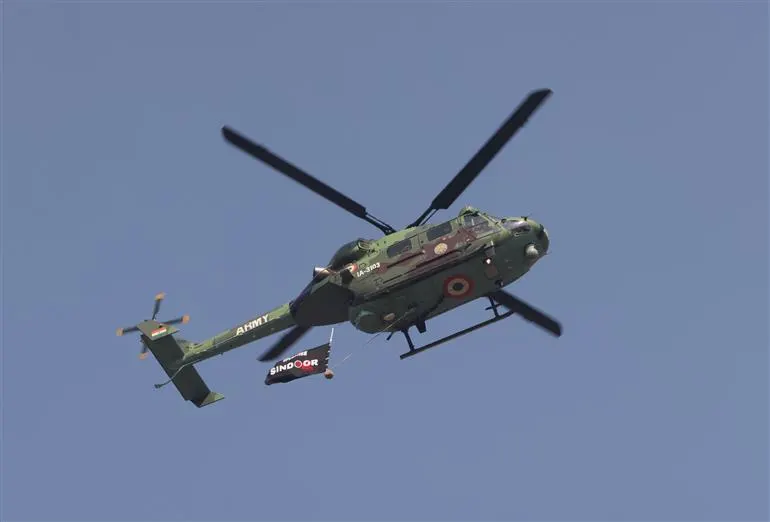
Some Indian defense outlets have reported that ULPGM was fielded during Operation Sindoor in May 2025 — India's cross-border strike campaign against targets in Pakistan and Pakistan-administered Kashmir — with one describing its fielding as "the fastest operationalization of any Indian missile."17 That claim traces to a single tier of Indian defense-news aggregators rather than DRDO, the Ministry of Defence, or the independent post-operation assessments this research reviewed, none of which name ULPGM specifically among the systems used in the strikes.18,19 Given how recently the missile cleared trials relative to the operation, and the absence of corroboration in more rigorous accounts of Sindoor, this article treats the combat-use claim as reported but unverified rather than established fact.
A separate line of commentary has been openly critical of the program's underlying approach. An op-ed response to the May 2026 trial announcement argued that ULPGM's reliance on a ground control station and a dedicated carrier drone runs against the lesson of the Russia-Ukraine war, where cheap, mass-produced, largely autonomous drones have proven more decisive than smaller numbers of expensive, centrally-controlled systems; the piece also noted that the missile's ~10–15 km effective engagement envelope (accounting for launch-platform proximity) leaves it vulnerable to being outranged or jammed before it can be brought to bear.12
| Variant | Weight | Range | Propulsion | Notable feature |
|---|---|---|---|---|
| ULPGM-V1 | ~5 kg | 1.5–2 km | Unpowered glide | Baseline, uncooled IIR seeker3 |
| ULPGM-V2 | ~8.5 kg | 4–6 km | Dual-thrust solid motor | Two-way S-band datalink3,11 |
| ULPGM-V3 / ULM-ER | 12.5 kg | 2.5–4 km (reported up to 10 km) | Dual-thrust solid motor | Laser + dual-channel IIR seeker, air-to-air mode1,4,6 |
Indian trade press has also reported plans for a further-extended-range derivative, quoted at up to 18 km, aimed at eventual deployment from helicopters as well as UAVs; that figure comes from a single specialist outlet and has not been independently corroborated in DRDO or PIB material reviewed for this article.7 Beyond the numbered generations, DRDO and its industry partners have used "ULM-ER" interchangeably with "ULPGM-V3" in different releases, which has added to the naming confusion around the program.3,6


India is the only confirmed operator. The Indian Army ordered ULPGM under emergency procurement powers starting in August 2023, with Bharat Dynamics Limited contracted the same fiscal year to build 220 ULPGM-V2 rounds, and Adani Defence & Aerospace supplying rounds under a parallel emergency-procurement track.8,9 Deliveries have continued in tranches, including a May 2026 handover to the Army's Western Command, though public reporting does not give a reliable running total of units fielded.17 No export sales or foreign operators have been reported as of mid-2026.
Set against the two loitering munitions most often invoked as reference points — the U.S. AeroVironment Switchblade 600 and Poland's WB Electronics Warmate — ULPGM-V3 sits at the light end of the weight scale but is architecturally distinct from both. Switchblade 600 is a genuine loitering munition: a 22.7 kg airframe (about 54.5 kg including its launch tube and fire-control unit) that flies itself to the target area, loiters for up to 40 minutes, and carries a Javelin-derived anti-armor warhead out to a stated 80 km operational range.20 The original Warmate is smaller still — a 5.3 kg maximum-takeoff-weight airframe with up to 70 minutes of endurance and a direct-link range of about 15 km (extendable to roughly 80 km with relay), carrying interchangeable thermobaric, fragmentation, or shaped-charge warheads of a few hundred grams.21
ULPGM-V3, by contrast, is not launched by a soldier and does not loiter under its own power searching for a target; it is a 12.5 kg round released from a separate carrier UAV, with day/night engagement ranges reported between roughly 2.5 and 10 km depending on the source.1,4,6 That makes it more comparable in role to an air-launched precision-guided missile — akin to a scaled-down Hellfire or Spike — than to the fully autonomous, expendable airframes that define Switchblade or Warmate, even though Indian procurement and media coverage group all three under the "loitering munition" or "precision-strike drone munition" umbrella.12 Where Switchblade and Warmate trade a certain amount of standoff range for genuine one-man portability and no dependence on a separate aircraft, ULPGM shifts that cost onto the carrier drone and its ground control link, at the benefit of a smaller, cheaper expendable round per engagement — though as the Ukraine-lessons critique above argues, that dependency is also its principal vulnerability.12


What does ULPGM stand for?
Most current reporting, including DRDO's own press materials, expands it as "Unmanned Aerial Vehicle Launched Precision Guided Missile."1,2 Some outlets have used "Ultra-Light Precision Guided Munition" or similar alternate expansions; the underlying acronym and program are the same, but the full-form wording is genuinely inconsistent across Indian defense media.10
What are the ULPGM-V3 specifications?
ULPGM-V3 weighs 12.5 kg, uses a dual-thrust solid rocket motor, and combines a dual-channel imaging infrared seeker with laser guidance for fire-and-forget day/night targeting. Reported day/night engagement range runs from about 2.5–4 km up to a separately claimed 10 km, and warhead options include anti-armor, bunker-penetrating, and anti-personnel configurations.1,4,6
What is the range of ULPGM-V3?
Sources disagree: technical summaries typically cite 4 km by day and 2.5 km at night, while other reporting states the range has been extended to 10 km. No single consolidated DRDO specification sheet reconciling the two figures was found in public reporting as of mid-2026.1,4,6
How much does ULPGM cost?
The only firm public figure is for the ULPGM-V2 production contract: ₹105 crore (about $11 million) for 220 units, or roughly ₹4.77 million (about $50,000) per round. A confirmed per-unit price for the V3 configuration has not been published.9
Is ULPGM in service with the Indian Army?
Yes, in limited and expanding numbers. The Indian Army ordered ULPGM-V2 rounds from Bharat Dynamics Limited and Adani Defence & Aerospace beginning in 2023, with deliveries continuing into 2026, including a batch handed to Western Command in May 2026. ULPGM-V3 completed final trials and was cleared for mass production in May 2026, but has not yet been confirmed as fully fielded at scale.7,9,17
How does ULPGM compare to Switchblade or Warmate?
ULPGM is lighter and shorter-ranged than the Switchblade 600, and architecturally different from both Switchblade and Warmate in that it is launched from a separate carrier drone rather than being a self-contained, soldier-launched loitering airframe.1,20,21
Who makes ULPGM?
DRDO's Research Centre Imarat leads development, with Bharat Dynamics Limited and Adani Defence & Aerospace serving as production partners, and the Bengaluru startup Newspace Research and Technologies supplying the carrier UAV used in trials.2,7,9
- "ULPGM-V3 Missile: Features, DRDO UAV-Launched Precision Guided Missile & Significance", InsightsOnIndia — insightsonindia.com ↩
- "DRDO conducts successful flight-trials of Advanced Unmanned Aerial Vehicle Launched Precision Guided Missile-V3", Press Information Bureau, Government of India — pib.gov.in ↩
- "ULPGM", Wikipedia — en.wikipedia.org ↩
- "India's ULPGM-V3 ready for mass production after final development trials", Army Technology — army-technology.com ↩
- "UAV-launched Precision Guided Missile (ULPGM)-V3", Khan Global Studies — currentaffairs.khanglobalstudies.com ↩
- "DRDO's ULPGM V3 hits Bull's Eye: All you need to know about India's new anti tank missile", Business Today — businesstoday.in ↩
- "DRDO's ULPGM V3 Set for Airborne Deployment on Helicopters, UAVs; Future Variant to Feature 18km Range", Indian Defence Research Wing (IDRW) — idrw.org ↩
- "Adani Defence Set To Commence Delivery of DRISHTI-10, ULPGM and VSHORADS to Indian Army", Indian Defence News — indiandefensenews.in ↩
- "UAV Launched Precision Guided Munition (ULPGM) family: Updates & Discussions", Strategic Front Forum — strategicfront.org ↩
- "DRDO's ULPGM V3 hits Bull's Eye", Business Today (alternate acronym rendering "Ultra-Light Precision Guided Munition") — businesstoday.in ↩
- "ULPGM", Wikipedia (ULPGM-V2 specifications) — en.wikipedia.org ↩
- "India's DRDO Hails Successful Trials of ULPGM-V3 Counter-Drone System Ignoring Key Lessons From Ukraine War: OPED", Eurasian Times — eurasiantimes.com ↩
- "DRDO Seeks Drone Manufacturers for Precision-Guided Munition Integration on UAV Platforms", Indian Defence Research Wing (IDRW) — idrw.org ↩
- "From flying snacks to striking targets: India tests missile-capable drones", Business Standard — business-standard.com ↩
- "DRDO completes development trials of ULPGM-V3", Overt Defense — overtdefense.com ↩
- "Adani Defence's Kanpur facility strengthening India's quest for self-reliance", The Tribune — tribuneindia.com ↩
- "Indian Army Inducts Indigenous ULPGM And AGNIKAA VTOL-1 FPV Kamikaze Drones Under Emergency Procurement", Indian Defence News — indiandefensenews.in ↩
- "Military Lessons from Operation Sindoor", Carnegie Endowment for International Peace — carnegieendowment.org ↩
- "Operation Sindoor: Military Performance and Effectiveness", Observer Research Foundation — orfonline.org ↩
- "Switchblade 600", AeroVironment — avinc.com ↩
- "WB Electronics Warmate", Wikipedia — en.wikipedia.org ↩