

The AeroVironment Switchblade 300 is a man-portable, tube-launched loitering munition developed in the United States by AeroVironment.1 It belongs to the broader family of loitering munitions, small precision-strike systems that combine a reconnaissance drone's sensor and flight endurance with an integral warhead, so a single round can search, identify, and destroy a target without a separate launch platform or fire-support asset.1 The system traces to a 2004 U.S. Army requirement for a drone that could be fired from a standard 105 mm mortar tube to assess battle damage after an artillery strike; that requirement was merged with a parallel Defense Advanced Research Projects Agency and Air Force Research Laboratory effort called Close Combat Lethal Reconnaissance, aimed at giving small infantry units their own precision-strike capability.1,2
- Complete round weighs about 5.5 lb (2.5 kg); launch by one soldier in under two minutes[^6][^7]
- No runway, catapult, or separate launch vehicle required; fits in a standard ALICE pack[^6]
- EO/IR seeker and autonomous flight modes give squad-level units their own precision-strike capability[^1]
- Fielded and combat-tested since 2011, with reported strikes described by commanders as effective in Afghanistan[^3][^4]
- Wide and growing export base across NATO and Indo-Pacific partners as of 2024–2026[^13][^15][^16]
- Roughly 10 km range and about 15 minutes of loiter endurance, short next to larger loitering munitions[^1]
- No laser designator, SAR/GMTI radar, or satellite (BLOS) link fitted[^1]
- Reported vulnerability to electronic-warfare jamming and incomplete-penetration strikes in Ukraine[^8][^10]
- Unit cost estimated at roughly $60,000–$80,000, far above small commercial FPV drones[^8]
- Frequently confused in press coverage with the larger, longer-ranged Switchblade 600[^1]
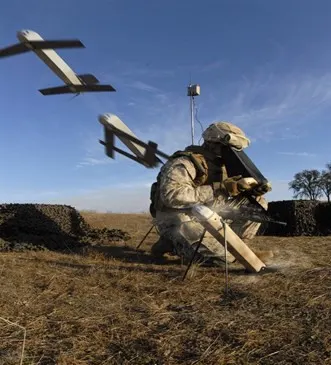
The Switchblade 300's defining characteristic is its doctrine of employment rather than any single performance figure: the all-up round fits inside a standard ALICE pack, and a two-man or even single-soldier team can unpack, assemble, and launch it in under two minutes, without a runway, catapult, or dedicated support vehicle.6,7 That combination, infantry-portable, individually launched, armed with its own warhead, was intended to give a rifle squad or small special-operations team an organic precision-strike capability that had previously required calling in artillery, close air support, or a larger unmanned system flown by a separate crew.6 The U.S. Air Force Special Operations Command funded Switchblade development from 2006, and the U.S. Army placed its first orders by 2010, ahead of a rapid-fielding contract that sent the system to Afghanistan the following year.1,2
The Switchblade 300 is built around a small, wing-folded electric airframe about 0.495 m long, with an empty and maximum takeoff weight both listed at roughly 2.5 kg for the flight vehicle itself; the packaged all-up round, including its launch tube and battery, is heavier, reported at about 7.2 lb (3.3 kg) for the original variant and up to about 8 lb (3.6 kg) for the later Block 20.6,7 It is not designed for low observability, relying instead on small size, low acoustic signature, and short exposure time to avoid detection.1
Propulsion is a single electric motor driving a pusher propeller, a configuration chosen for low noise and mechanical simplicity rather than raw performance.1 Reported top speed is about 100 mph (161 km/h), with a cruise speed closer to 63 mph (101 km/h); service ceiling is limited to roughly 500 ft (152 m) above the operator, consistent with a system meant to stay under the radar and sensor horizon of most air-defense networks rather than operate at altitude.1 Range and combat radius are both listed at about 10 km, and loiter endurance is approximately 15 minutes, short next to larger loitering munitions but adequate for the close direct-fire-support role the system was designed to fill.1
The payload consists of an electro-optical/infrared (EO/IR) sensor that streams live video to the operator's fire-control unit, letting the operator identify, track, and, if the mission is aborted, wave off a target before impact.1 The Switchblade 300 does not carry a laser designator, synthetic-aperture or ground-moving-target-indication radar, signals-intelligence payload, or communications-relay function, and it has no satellite (beyond-line-of-sight) datalink, limiting it to direct radio-frequency control within its roughly 10 km operating radius.1 Its warhead is described in official and open-source material simply as a high-explosive charge; unlike anti-armor loitering munitions such as the Switchblade 600, the 300 series is optimized against personnel and light, unarmored targets rather than armored vehicles.1
Control is entirely tube-launched: the round is ejected from its launch tube, deploys its wings automatically, and transitions to powered flight, after which the operator can fly it manually or let it loiter autonomously over a search area using GPS/INS navigation before committing to a terminal dive.1 The system supports automatic takeoff-equivalent launch and can fly pre-programmed waypoints, though it does not support cooperative swarming with other rounds.1 AeroVironment has continued to iterate the design, and the manufacturer's own product literature lists three variants under the Switchblade 300 designation, reflecting incremental Block upgrades to the airframe, warhead, and fire-control system since the type's original fielding.7
The Switchblade's origin lies in two separate U.S. military efforts that converged in the mid-2000s. The first was a 2004 Army requirement for a small drone that could be fired from an existing 105 mm mortar tube to provide immediate battle-damage assessment after an artillery mission, without waiting for a larger reconnaissance asset to arrive on station.1 The second was Close Combat Lethal Reconnaissance, a DARPA and Air Force Research Laboratory program exploring a loitering munition that could give small dismounted units their own organic precision-strike weapon.1,2 AeroVironment, already established as a maker of small hand-launched reconnaissance drones such as the Raven, combined these threads into a single tube-launched, armed design; the Air Force Special Operations Command funded development starting in 2006, and the U.S. Army had placed its own orders by 2010.1,2
Fielding followed quickly once the design matured. The U.S. Army awarded AeroVironment a $4.9 million rapid-fielding contract on 29 July 2011 specifically to rush Switchblade units into Afghanistan, and by late 2012 roughly 75 systems had been delivered to deployed forces.3,4 Field reports in early 2013 described early combat strikes as effective according to commanders on the ground, and reporting on the program's cumulative use states that more than 4,000 Switchblade rounds were expended by the end of Operation Enduring Freedom.3,4
The informal nicknames "kamikaze drone" and "suicide drone," commonly attached to the Switchblade in press coverage because the airframe itself is expended in every strike, are journalistic shorthand rather than official designations; the terms saw a renewed surge in usage after the system's transfer to Ukraine in 2022 drew wide international media attention.5
The Switchblade 300's combat record begins with its 2011–2014 deployment to Afghanistan as part of Operation Enduring Freedom, where U.S. forces used it for the close, precision direct-fire-support role it was designed for; unit commanders described early strikes as effective, and the type's cumulative wartime use there is reported at more than 4,000 rounds expended.3,4
The system's most closely scrutinized combat use has come in Ukraine following Russia's 2022 invasion. Independent reporting documented operator complaints of jamming-related failures and strikes that did not achieve full penetration against intended targets, problems attributed in large part to intensifying Russian electronic-warfare coverage over the front line.8,10 Those operational shortcomings, combined with a per-unit cost estimated at roughly $60,000 to $80,000 against commercial first-person-view (FPV) racing drones adapted for strikes at closer to $400 each, are widely cited as a driver of Ukraine's documented shift toward cheap, expendable commercial FPV drones for many of the same close-range strike missions the Switchblade was originally supplied to fill.8,9 Coverage on the subject has cautioned against treating every reported Switchblade failure as representative, noting that loitering-munition performance in Ukraine has been shaped heavily by jamming intensity specific to sectors of the front and by the difficulty of confirming strike outcomes from open-source video alone.8

| Year | Buyer | Quantity | Amount | Present Value (2025) |
|---|---|---|---|---|
| 2024 |  Taiwan | 720 | $60.2 M | $61.8 M |
| 2024 |  Romania | 25 | — | — |
| 2024 |  United States | — | $990.0 M | $1.02 Mr |
| 2022 |  Ukraine | 700 | — | — |
As of the mid-2020s, confirmed Switchblade 300 operators include the United States, the United Kingdom, Ukraine, Canada (from 2025), Australia (from 2024), Sweden (from 2024), Lithuania (from 2022), Greece (from 2024), New Zealand, France (from 2023), Romania (from 2024, 25 systems), and Taiwan (from 2024).11,13,15,16,18 Most of these acquisitions followed the surge of international interest in small loitering munitions after Ukraine's combat use of the type became public in 2022, and the majority moved through the U.S. Foreign Military Sales process described above rather than direct commercial export.13,16
The Switchblade 300's closest sibling is AeroVironment's own Switchblade 600, a larger, heavier system built around an anti-armor warhead and a substantially longer range and endurance than the 300's roughly 10 km and 15 minutes; the two are frequently conflated in casual press coverage despite serving different roles, the 300 against personnel and light targets at short range, the 600 against armored vehicles at longer standoff distances.1 The August 2024 U.S. Army contract and several export deals, including Romania's 2024 purchase, bundle both variants together, reinforcing the confusion between the two in public reporting.15,19
| SPEC | AeroVironment Switchblade 300 | AeroVironment Switchblade 600 | ZALA Lancet | HESA Shahed 136 |
|---|---|---|---|---|
| Range | 10 km | 40 km | 40 km | 2500 km |
| Endurance | 0.25 h | 0.667 h | 0.67 h | — |
| Max Takeoff Weight | 2.5 kg | 15 kg | 12 kg | — |
Against foreign systems, the Russian ZALA Lancet, credited with a higher overall score of 73 versus the Switchblade 300's 58 in this database's scoring model, is generally reported with greater range and a heavier warhead, reflecting its design emphasis on striking armored and high-value targets at standoff distance rather than the close, infantry-portable role the Switchblade 300 fills.1 Iran's HESA Shahed 136 and its smaller siblings, the Shahed 101 and Shahed 107, are one-way attack drones optimized for long-range strikes against fixed infrastructure rather than man-portable, squad-level use, making them a poor direct comparison despite the shared "loitering munition" and "suicide drone" labeling in popular coverage.1 Within the same portable, infantry-launched niche, Israel's Spike Firefly and Poland's WB Electronics Warmate occupy a similar role to the Switchblade 300, trading off broadly comparable range and endurance figures against differences in warhead type and guidance.1


Ukraine received its first Switchblade 300 rounds not through a commercial sale but under U.S. Presidential Drawdown Authority: 100 units were announced on 16 March 2022 as part of an $800 million military aid package, followed by approximately 600 more in April 2022, for a cumulative total above 700 delivered to Ukraine that year.11,12 A separate December 2024 Department of Defense drawdown accounting listed 102 combined Switchblade 300 and 600 units in one specific aid tranche; that figure describes a distinct accounting window and should not be added to, or confused with, the roughly 700-plus cumulative 2022 total.11,12
Export sales through the U.S. Foreign Military Sales process followed as the Ukraine war drove wider international interest in loitering munitions. Taiwan's sale was approved around 2 July 2024, covering 720 all-up rounds (including 35 fly-to-buy rounds for training and testing) and 101 fire-control systems, valued at approximately $60.2 million.13,14 Romania signed for 25 Switchblade 300 systems in July 2024, worth 176 million Romanian lei, as part of a broader contract that also included an unspecified quantity of the larger Switchblade 600.15 Lithuania and Sweden were named recipients under a 26 September 2024 U.S. Army Foreign Military Sales and indefinite-delivery/indefinite-quantity contract action that raised AeroVironment's cumulative Switchblade contract ceiling to $743 million; per-country quantities of the 300 variant specifically were not itemized in public reporting, and Lithuania's earlier, separately confirmed December 2022 purchase was for the larger Switchblade 600 rather than the 300.16,17 France and the United Kingdom have been reported as approved Switchblade recipients under U.S. Army foreign sales contract actions since 2022, though no publicly confirmed quantity or contract value specific to either country has been disclosed.18
Domestically, the U.S. Army itself remains the type's largest customer. In August 2024, AeroVironment won a roughly five-year, approximately $990 million indefinite-delivery/indefinite-quantity contract covering both the Switchblade 300 and Switchblade 600 for the Army's own inventory, separate from any export sale; the first delivery order under that ceiling, worth about $186 million, was placed around February 2026.19,20
What is the difference between the Switchblade 300 and the Switchblade 600?
The Switchblade 300 is the smaller of AeroVironment's two current Switchblade variants, built for use against personnel and light targets at a range and endurance of roughly 10 km and 15 minutes. The Switchblade 600 is a larger, longer-ranged, anti-armor system. Press coverage and even some official contract and export documents frequently bundle or conflate the two, so specifications and deal figures should be checked against the specific variant named.1,15,19
Is the Switchblade 300 a "suicide drone" or "kamikaze drone"?
Those are informal press labels, not official U.S. military terminology, applied because the airframe is destroyed in every strike along with its target. The nicknames are accurate in the narrow sense that the drone does not return from a strike, but they are journalistic shorthand rather than a designation used by AeroVironment or the U.S. Army.5
Has the Switchblade 300 seen combat?
Yes. It was fielded to Afghanistan starting in 2011, with more than 4,000 rounds reportedly expended by the end of Operation Enduring Freedom, and it has been supplied to and used by Ukraine since March 2022, where operators have also reported jamming-related failures and incomplete-penetration strikes tied to Russian electronic-warfare activity.3,4,8,10
How much does a Switchblade 300 cost, and why did Ukraine shift toward commercial drones instead?
Per-unit cost has been estimated at roughly $60,000 to $80,000. That figure, combined with reported reliability problems under heavy jamming, is cited as a major reason Ukrainian forces increasingly turned to commercial first-person-view (FPV) drones, adapted for strikes at a cost closer to $400 each, for many close-range attack missions.8,9
Which countries operate or have ordered the Switchblade 300?
Confirmed operators or purchasers include the United States, the United Kingdom, Ukraine, Canada, Australia, Sweden, Lithuania, Greece, New Zealand, France, Romania, and Taiwan, with most orders placed since 2022 through the U.S. Foreign Military Sales process.11,13,15,16,18
- "Switchblade", Designation Systems — designation-systems.net ↩
- "The Switchblade: How A Loitering Munition Changed Modern Warfare", 19FortyFive — 19fortyfive.com ↩
- "Switchblade 300", War History Online — warhistoryonline.com ↩
- "Switchblade Drones Explained", Popular Science — popsci.com ↩
- "AeroVironment Switchblade: Drones or 'Suicide Drones'?", The Drone U — thedroneu.com ↩
- "Switchblade 300", Combat Operators — combatoperators.com ↩
- "Switchblade 300 Block 20", AeroVironment — avinc.com ↩
- "Failure Or Savior? Busting Myths About Switchblade Loitering Munitions In Ukraine", Forbes — forbes.com ↩
- "Ukrainian Drones Beating US Switchblades", DroneXL — dronexl.co ↩
- "Small American-made Drones Fail in Ukraine: WSJ", Defense Mirror — defensemirror.com ↩
- "U.S. sends 100 'killer drones' called Switchblades to Ukraine", CNBC — cnbc.com ↩
- "Pentagon official says US sending Ukraine Switchblade drones", The Hill — thehill.com ↩
- "Taiwan to Receive AV's Switchblade 300 Loitering Munition Systems", AeroVironment — avinc.com ↩
- "US approves Switchblade loitering munition sales to Taiwan", Army Technology — army-technology.com ↩
- "AeroVironment secures contract expansion to supply Switchblade systems to U.S. Army and European countries", Defence Industry Europe — defence-industry.eu ↩
- "AeroVironment Receives $743M Army Contract Ceiling Increase for Switchblade Systems", GovConWire — govconwire.com ↩
- "AeroVironment secures third US Army contract for Switchblade", Calibre Defence — calibredefence.co.uk ↩
- "AeroVironment awarded Foreign Military Sales contract by US Army for Switchblade 300", Army Technology — army-technology.com ↩
- "AeroVironment wins nearly $1B to supply Switchblade munitions to Army", Defense News — defensenews.com ↩
- "US Army orders more Switchblade munitions from AeroVironment", The Defense Post — thedefensepost.com ↩