

The Antonov An-196 Liutyi is a Ukrainian long-range, one-way attack drone developed by the Antonov aircraft design bureau together with the state defense conglomerate Ukroboronprom, and fielded by Ukraine since 2024 as a deep-strike weapon against targets deep inside Russia.1,2 The name Liutyi (Лютий) translates as "fierce" or "furious" — it is also the traditional Ukrainian name for the month of February.1 Anyone searching for AN-196 Liutyi drone specifications will find a piston-engined, propeller-driven aircraft with a V-tail, conventional fixed landing gear, and a rolling takeoff more akin to a light aircraft than to a catapult-launched munition.2,3
- Demonstrated strike range exceeding 1,700 km against hardened Russian energy infrastructure
- AI-assisted terminal guidance reported to resist Russian jamming better than pure GPS/INS designs
- Larger warhead (up to 75 kg) than most rival Ukrainian long-range drones
- Domestic production with growing foreign co-funding (Germany)
- Established, repeated combat record since January 2024
- Slow (~160 km/h), propeller-driven airframe vulnerable to short-range air defense if detected
- Unit cost (~$200,000) far above cheaper rivals like Fire Point's FP-1
- Range and payload figures are inconsistent across official and press sources
- Production scale remains far below Russia's Shahed/Geran output
Development began in October 2022, after then-commander-in-chief Valerii Zaluzhnyi set requirements in August 2022 for a drone able to strike targets more than 1,000 kilometers away.3 The program has since become the backbone of Ukraine's campaign against Russian oil refineries, fuel depots, and defense-industrial plants, with dozens of documented Liutyi refinery strikes reported between January 2024 and mid-2026.3,4
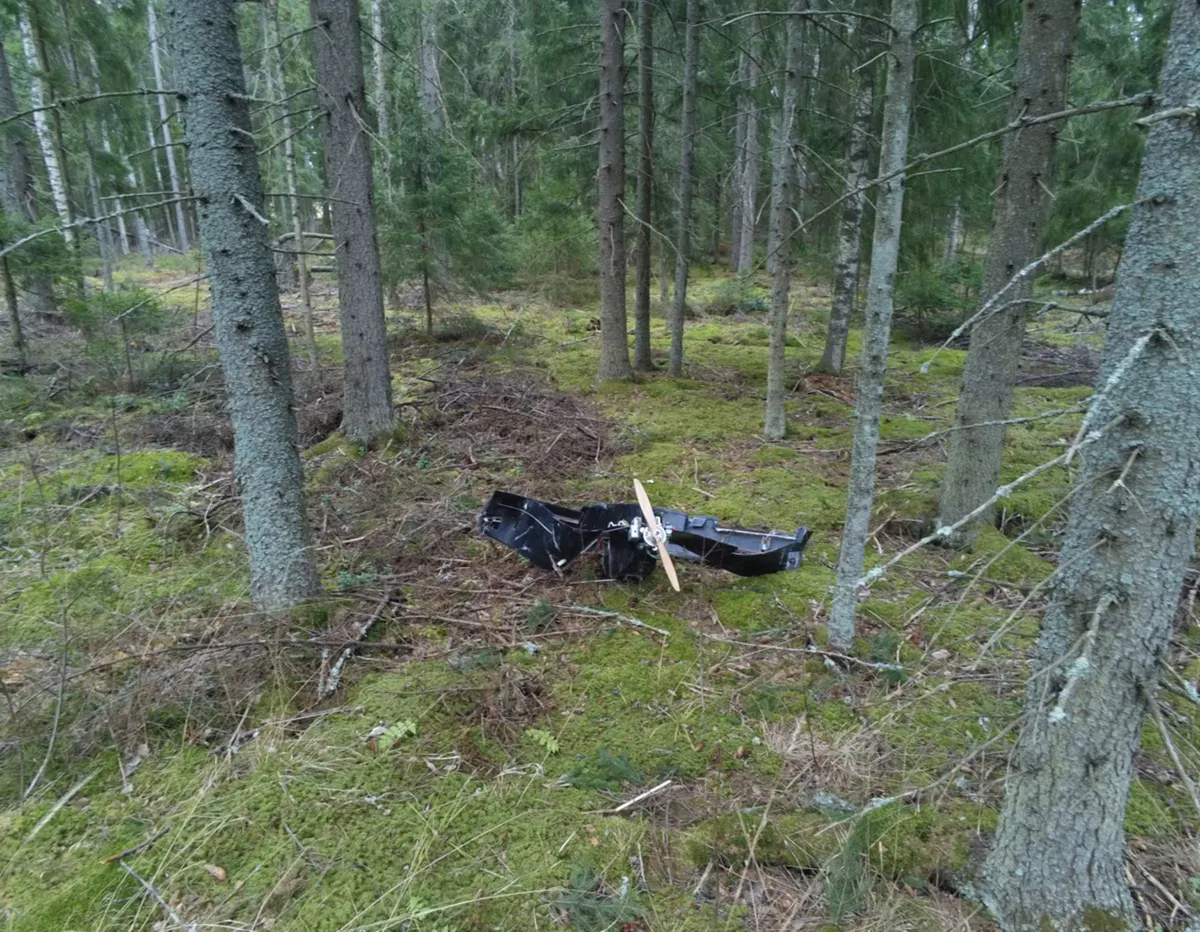
Classification of the Liutyi is not entirely settled. Most catalogs and Ukrainian officials describe it as a one-way attack drone (OWA-UAV) rather than a true loitering munition: it is launched against pre-planned coordinates and uses AI-assisted terminal guidance to find its aimpoint, but it does not loiter over a target area under a human operator's control the way a classic loitering munition does.5 It sits at the edge of the loitering munitions category commonly used to group long-range strike drones, alongside faster-reacting battlefield systems, even though its mission profile — a single long transit followed by a terminal dive — has more in common with a small cruise missile.
Reported performance figures for the Liutyi vary considerably by source and by date, which matters for anyone trying to pin down AN-196 range or payload numbers. Early production aircraft were credited with roughly 1,000 km of range and a 50-kilogram warhead; by 2025 the same program was described as trading payload for range, or vice versa, depending on the mission profile, with figures anywhere from 1,000 km to 2,000 km appearing across defense trade press.2,6 Unit cost is most commonly cited around $200,000, well above a Shahed-136/Geran-2 but far below a cruise missile.2
The Liutyi is a mid-size airframe by drone-warfare standards: reported at 250–300 kg maximum takeoff weight, 4.4 meters long, with a 6.7-meter wingspan.2,3 It is built around a fiberglass-composite airframe reinforced with metal mesh, giving a modular structure that can reportedly be broken down for transport.2 Propulsion comes from a single air-cooled piston engine — wreckage recovered in Russia has shown cylinder heads and mounts closely resembling the commercial German Hirth F-23 aviation engine (roughly 50 horsepower), though Ukraine has never officially confirmed the exact power plant.7 The engine drives a three-blade pusher propeller mounted at the rear of the fuselage, behind a distinctive V-shaped tail.2,3
Guidance combines satellite navigation (GPS/GLONASS) with an inertial navigation system for the long transit phase, reportedly supplemented by an AI-assisted machine-vision system for the terminal approach that lets the drone fly evasive paths and correct for jamming near the target.2 Ukrainian officials have said the system is deliberately hardened against Russian electronic warfare, which is one reason strikes have continued to land on heavily defended refineries well inside Russian territory.4
Compared with Russia's mass-produced Shahed-136/Geran-2, the Liutyi is a heavier, costlier, aircraft-style design rather than a molded-composite delta-wing airframe built for cheap serial production — a distinction discussed in more depth in the Comparison section below. Maximum reported speed is about 160 km/h, slower than the Geran-2's roughly 185 km/h cruise, reflecting the Liutyi's larger frame and heavier warhead options.2,8
The project traces conceptually to an earlier, unsuccessful Antonov effort: the AN-BK-1 Horlytsia ("Turtledove"), a reconnaissance-strike drone first flown in November 2017 using an off-the-shelf hobbyist radio-control system, which never reached operational status before the full-scale invasion.9,10 Photographic evidence after the 2022 invasion showed the new long-range drone sharing visible structural similarities with the Horlytsia airframe, suggesting Antonov reused earlier engineering rather than starting from nothing.9
Formal development began in October 2022, with Ukroboronprom and Antonov working to a requirement — set a couple of months earlier by then-commander-in-chief Valerii Zaluzhnyi — for a drone capable of hitting targets over 1,000 km away.3 Testing proceeded through the winter of 2022–2023, including electronic-warfare resistance trials.3 In late April 2023, during a combat trial aimed at Snake Island, the drone's autopilot malfunctioned and turned the armed aircraft — carrying roughly 50 kg of explosives — back toward its own launch and observation point on the Odesa coast; Ukraine's air force commander ordered fighter jets scrambled to shoot it down before operators regained control about 30 km offshore.11 The project nearly collapsed afterward, with one defense-committee member later recalling that "nobody really believed in this drone."11
That first confirmed strike came on May 3, 2023, against an oil depot at Volna on Russia's Taman Peninsula, followed by a successful 1,000-km-range trial in June 2023.3,11 The drone was first shown publicly as a model in November 2023, when Deputy Minister of Strategic Industries Hanna Hvozdiar published a photo of a mockup marked "Liutyi" and numbered "02," alongside the start of low-rate production at "tens per month."1 Mass operational strikes followed from January 2024 onward, described in detail below.
Foreign backing followed as the program's combat record grew. In July 2025, Germany announced it would fund production of 500 additional Liutyi drones through a contract worth more than €100 million ($110 million-plus), explicitly citing the type's repeated hits on Russian refineries and defense plants.12,13 Ukrainian President Volodymyr Zelensky has also shown the Liutyi production line to visiting NATO officials, including the chairman of NATO's Military Committee, underscoring the program's shift from a secretive project to a showcase domestic weapon.2 Individuals connected to the program have reportedly been placed under Russian sanctions over their role in strikes reaching over 1,000 km into Russian territory.14
Opening the refinery campaign (January-March 2024)
Mass Liutyi strikes on Russian oil infrastructure began in earnest in early 2024. Reported strikes include an oil depot near St. Petersburg on January 18; the vacuum distillation unit at the Tuapse refinery on January 25; the Ilsky and Afipsky refineries in Krasnodar region plus an oil depot near Oryol on February 9; oil depots near Kursk on February 14 and March 6; multiple refineries across the Nizhny Novgorod and Ryazan regions on March 12–13; further refinery hits in Kaluga, Slavyansk, and Samara oblast on March 15–17; and the Novokuibyshevsk refinery in Samara Oblast on March 23.3 The Ilsky refinery — one of six primary-processing units in the region, with a combined roughly 6.6 million tons/year capacity — caught fire and lost part of its primary processing capability in the February strike.15 Reuters later calculated that the nearby Kuibyshevsky refinery lost about half its processing capacity after a similar attack that month.16
Extending the range record (2024-2026)
Strikes progressively reached farther into Russia as the program matured. On November 25, 2024, a Liutyi fitted with the newer 75 kg warhead struck an oil refinery in Saratov, described at the time as more than 600 km from the Ukrainian border.4 Attacks on the Orsk refinery and an associated radar facility, roughly 1,500 km from Ukraine, were reported through 2025, including further hits in October–November of that year.17 On February 12, 2026, drones — reported as Liutyi — struck the Lukoil-Ukhtaneftepererabotka refinery in Ukhta, in Russia's Komi Republic, a straight-line distance of about 1,700 km from Ukraine, setting a new distance record for the campaign and putting the fire under thick black smoke that lasted for hours.18 The Saratov refinery was struck again on October 13, 2025, and a Lukoil oil platform in the Caspian Sea was hit on December 14, 2025.1
Strikes on defense-industrial targets
Not every Liutyi strike has targeted fuel infrastructure. On July 5, 2025, at least two drones hit the VNIIR-Progress plant in Cheboksary, roughly 975 km from the Ukrainian border, a facility that manufactures electronic components for Su-34 fighter-bombers, S-300 air defense systems, and T-90M and T-14 tanks.1 The same plant was struck again on May 5, 2026.1
Aggregate campaign effect
Independent analysts, using Reuters refining-capacity data, have estimated that the combined Ukrainian drone campaign against Russian refineries — in which the Liutyi has played a leading role — cut Russian refining capacity by roughly 17%, or about 1.1 million barrels per day, at points during 2024–2026.15 Ukrainian officials and open-source trackers have separately suggested the Liutyi accounted for up to 80% of Ukraine's successful long-range strikes on Russian territory in 2024.13
Public reporting on Russian air defense's response to Liutyi strikes specifically is thin; most detailed accounts of interceptor use (Pantsir, Buk-M3, S-300 batteries) describe broader mixed drone raids rather than isolated Liutyi engagements, and Russian claims of shootdown totals are not independently verified.
The clearest documented variant split is between the baseline long-range configuration, carrying a 50 kg warhead over a nominal 1,000-2,000 km depending on source, and an up-armed configuration carrying a 75 kg warhead first confirmed in combat in late 2024, which multiple outlets describe as costing roughly 400 km of range compared with the lighter-warhead version.4,6
| Configuration | Warhead | Reported range | Source |
|---|---|---|---|
| Baseline (2023-2024) | ~50 kg | ~1,000-2,000 km | 3,2 |
| Up-armed (from late 2024) | ~75 kg | ~600-1,700 km demonstrated | 4,18 |
No externally distinct sub-models (e.g., reconnaissance-only or training variants) have been publicly confirmed; the German-funded batch announced in 2025 is a production/funding arrangement rather than a technical variant.12,13

| Year | Buyer | Quantity | Amount | Present Value (2025) |
|---|---|---|---|---|
| 2025 |  Ukraine | — | — | — |
Ukraine is the sole confirmed operator. The Armed Forces of Ukraine, coordinated with the Defense Intelligence Directorate (HUR) and specialized unmanned-systems units, has operated the Liutyi in combat since January 2024, with individual strike missions publicly credited to units such as the 14th Unmanned Systems Regiment.1 Total delivered quantities are not publicly disclosed; Germany's 2025 funding commitment covers production of 500 additional airframes for Ukrainian use rather than for a separate operator.12,13
The most natural comparison for the Liutyi is Russia's own long-range one-way attack drone, the Iranian-designed Shahed-136, built in Russia as the Geran-2.19 Both are propeller-driven, warhead-carrying aircraft flown one-way against fixed coordinates, but the resemblance mostly ends there. The Geran-2 is a cheaper, faster-to-build delta-wing airframe with open-source cost estimates around $20,000-$80,000 per unit versus the Liutyi's roughly $200,000, reflecting Russia's much larger production runs.2,19 Reported warhead weight for the Geran-2 ranges from 40 kg up to a 90 kg "heavy" option introduced from mid-2024, bracketing the Liutyi's 50-75 kg envelope, while the Geran-2's claimed range (estimates run from roughly 1,500 km up to 2,000-2,500 km in various sources) is, like the Liutyi's, disputed rather than officially fixed.19 Where the two differ most is airframe philosophy: the Geran-2 is a molded-composite, mass-manufacturable shape built for saturation attacks in the hundreds per night, while the Liutyi is closer to a light aircraft, built in far smaller numbers for precision hits on individual high-value plants.
Within Ukraine's own set of long-range strike drones, Fire Point's FP-1 is the sharpest point of contrast. The FP-1 is credited with roughly 1,600 km of range on a 50 kg warhead — extendable to as much as 2,700 km in a deep-strike configuration with an enlarged fuel tank — and a maximum warhead of about 120 kg, all at a reported unit cost near $55,000, roughly a quarter of the Liutyi's price.5 That cost gap has driven Ukrainian officials toward Fire Point for scaling up drone production even as the Liutyi retains the older and more internationally publicized combat record, plus the German co-funding that has not (as of mid-2026) been matched for Fire Point.12,13 Ukrjet's smaller UJ-26 Bober, by comparison, trades reach and payload for cost, with a reported range of 600-1,000 km, a roughly 20 kg shaped-charge warhead, and a unit price closer to $100,000 — a cheaper, shorter-legged complement to the Liutyi rather than a direct substitute.20


What are the AN-196 Liutyi drone's specifications? Reported figures are a 250-300 kg maximum takeoff weight, 4.4 m length, 6.7 m wingspan, a single piston engine driving a three-blade rear pusher propeller, a V-tail, top speed of about 160 km/h, and a 50-75 kg warhead, with range disputed across sources.2,3
What is the Liutyi drone's actual range? There is no single confirmed figure. Early reporting cited about 1,000 km; later reporting on the up-armed 75 kg-warhead version cited a roughly 400 km reduction from a longer baseline; and strikes as far as 1,700 km from Ukraine (the Ukhta refinery, February 2026) have been publicly documented, implying an effective range near or above that distance on lighter loads.4,6,18
How much does the Liutyi drone cost? Open-source estimates most commonly put the unit cost around $200,000, well above cheaper Ukrainian rivals like the Fire Point FP-1 (~$55,000) or Bober (~$100,000), but still far below a cruise missile.2,5,20
Which refineries and Liutyi drone strikes have been documented? Publicly reported targets include refineries or depots near St. Petersburg, Tuapse, Ilsky, Afipsky, Oryol, Kursk, Nizhny Novgorod, Ryazan, Kaluga, Slavyansk, Samara/Novokuibyshevsk, Saratov, Orsk, Ukhta, and the VNIIR-Progress defense-industrial plant in Cheboksary, among others, from January 2024 through mid-2026.3,4,1
Who makes the Liutyi drone? The Antonov aircraft design bureau developed it together with Ukraine's state defense conglomerate Ukroboronprom, beginning in October 2022; the design reportedly draws on an earlier, unsuccessful Antonov reconnaissance-drone effort, the AN-BK-1 Horlytsia.3,9
Is the Liutyi a loitering munition or a one-way attack drone? Functionally it is a one-way attack drone: it flies a pre-planned route to a fixed target and uses AI-assisted terminal guidance rather than loitering under continuous human control, even though it is often grouped with loitering munitions in general catalogs.5
How does the Liutyi compare to the Shahed-136/Geran-2? The Liutyi is costlier and slower than Russia's Shahed-136/Geran-2 but carries a comparable or larger warhead on a more aircraft-like, piston-engine airframe rather than a cheap, mass-produced delta-wing shape; Russia builds far more Geran-2s than Ukraine builds Liutyis.2,19
- "Liutyi", Wikipedia — en.wikipedia.org ↩
- "The Liutyi Drone: Ukraine's Response To Russia's Shaheds", Forbes — forbes.com ↩
- "Meet 'Liutyi,' Ukraine's homegrown drone behind strikes on Russian oil refineries", Euromaidan Press — euromaidanpress.com ↩
- "Ukraine's Liutyi drone warhead grew by 50%—at the cost of 400 km of range", Euromaidan Press — euromaidanpress.com ↩
- "Fire Point FP-1", Wikipedia — en.wikipedia.org ↩
- "In-Depth Analysis of Ukraine's Liutyi Drone", Airmobi UAV — airmobi.com ↩
- "An-196 Liutyi: Military Drones Specs & Operators", GlobalMilitary.net — globalmilitary.net ↩
- "Shahed drones", Wikipedia — en.wikipedia.org ↩
- "Guide To Ukraine's Long Range Attack Drones", Covert Shores (H. I. Sutton) — hisutton.com ↩
- "Antonov unveils new 'Horlytsia' unmanned combat air vehicle", Defence Blog — defence-blog.com ↩
- "Now-famous Liutyi Ukrainian drone narrowly hit own command centre during first trials", Ukrainska Pravda — pravda.com.ua ↩
- "Germany to Fund Production of 500 Liutyi Drones", Militarnyi — militarnyi.com ↩
- "One Ukrainian drone keeps smashing Russia's top war factories—so Germany's paying for 500 more", Euromaidan Press — euromaidanpress.com ↩
- "Sanctioned for targets 1000 km away. Story of Liutyi (Fierce) Ukrainian long-range drone which burns Russian refineries", Ukrainska Pravda — pravda.com.ua ↩
- "Ukraine striking Russian oil infrastructure – a significant problem for Russia?", Adapt Institute — adaptinstitute.org ↩
- "Russia's Kuibyshev oil refinery lost half of its capacity after the last drone attack — Reuters", Euromaidan Press — euromaidanpress.com ↩
- "Another Long-Range Strike: Ukrainian Liutyi Drones Reach Deep into russia, Hitting Orsk Oil Refinery 1,500 km Away", Defense Express — en.defence-ua.com ↩
- "Ukraine flew drones almost to the Urals — and hit an oil refinery at a record 1,700 km Russia thought was out of reach", Euromaidan Press — euromaidanpress.com ↩
- "Geran-2: One-way attack drone — Specs, Combat Record & Analysis", MissileStrikes.com — missilestrikes.com ↩
- "Bober (drone)", Wikipedia — en.wikipedia.org) ↩