

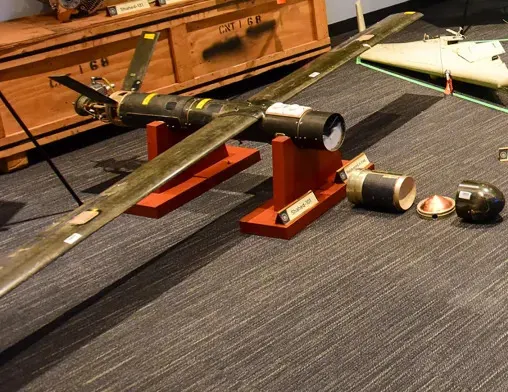

The Shahed-101 is a small, cylindrical-fuselage loitering munition built by Iran Aircraft Manufacturing Industrial Company (HESA) and the Shahed Aviation Industries Research Center in Iran.1 It belongs to the loitering munitions category, one-way weapons that combine an expendable airframe with an integrated warhead rather than a reusable aircraft carrying a separate munition. Reported figures place the type at about 1.6 m long with a 2.5 m wingspan and a total launch weight in the range of 26 to 45 kg, depending on payload configuration, carrying a warhead of roughly 8 to 9 kg.2
- Smaller and more easily concealed or transported than the long-range Shahed-136/131 series
- Confirmed launch platforms include fixed rail/catapult sites and a demonstrated small-boat launch
- Reported range of 600-800 km still exceeds most tactical loitering munitions of comparable weight
- Low unit weight and simple construction ease production and distribution to proxy forces
- Basic technical figures (weight, range, engine power) vary sharply between sources
- No confirmed onboard seeker; guidance is inferred as inertial/GPS rather than sensor-homing
- No independently verified date for its original unveiling or Iranian service entry
- No confirmed satellite (BLOS) uplink for in-flight retasking, unlike current-production Shahed-136/Geran-2
Iran fields the Shahed-101 alongside the much larger Shahed-136, a delta-wing airframe reported at around 3.5 m long and roughly 200 kg empty weight with a warhead of up to 50 kg.3 The two occupy different roles rather than different points on a single size scale: the Shahed-136 is built for long-range, standoff saturation strikes against fixed infrastructure, with a stated range up to 2,500 km, while the Shahed-101 is sized for shorter-range, tactical strikes, a category some analysts term "middle-strike" munitions aimed at targets 100 to 300 km behind a front line, or for direct proxy use at much shorter range.4 Iran fields both types in parallel because each addresses a distinct requirement rather than one representing an upgrade of the other.
The airframe's cylindrical composite fuselage, straight wings set toward the rear, and X-shaped tail are consistently described across combat wreckage examinations and technical reporting on the type.2 The baseline production model uses a rear-mounted, gasoline-fueled piston engine turning a pusher propeller, launched from a catapult or rail launcher; a front-mounted electric-motor version, described further under Variants below, has also been documented.5 No independently verified date exists for the type's original unveiling or entry into Iranian service; a first-flight year is sometimes cited for the type, but no supporting source could be identified for it, and this article treats that date as unconfirmed.
Documented combat use spans four separate contexts: a July 2024 Hezbollah strike into northern Israel, repeated attacks by Iran-aligned Iraqi militias against Eilat since 2024, and wreckage recovered in the Russia-Ukraine war in late 2025. Each incident is addressed individually under Conflicts below, since the pattern across them is better described as confirmed, repeated, tactical-scale use rather than the mass, nightly-raid employment documented for the Shahed-136/Geran-2 in Ukraine.6
The database groups the Shahed-101's recorded specifications into general classification, airframe, powerplant, performance, payload/sensors, armament, control/autonomy, and service status. Several of the stored numeric values in these groups conflict with the figures found in combat-wreckage reporting and technical coverage of the type, detailed group by group below.
The type is classified as a loitering munition in a tactical role. A first-flight and service-entry year of 2011 is recorded in the database, but no source reviewed for this article documents an unveiling or introduction date for the Shahed-101 specifically; the figure should be read as unconfirmed rather than sourced.
Reported airframe dimensions are 1.6 m in length and a 2.5 m wingspan.2 Total launch weight is reported in the range of roughly 26 kg for a baseline configuration up to about 45 kg depending on payload, figures well below the empty and maximum-takeoff weights recorded in the database, which appear closer to the much larger Shahed-131/136 airframe class than to this smaller design.2,7
Power on the baseline production model comes from a rear-mounted, gasoline-fueled two-stroke piston engine turning a pusher propeller, cruising at roughly 120 km/h.2 Open-source ordnance cataloguing describes the engine as a small two-cylinder unit of about 111cc displacement producing roughly 8.3 kW (11.2 hp), a figure this article treats with medium confidence since it could not be confirmed against a second independently fetched source; it nonetheless sits far below the output recorded in the database.16
At 120 km/h cruise and a reported service ceiling of about 3,000 m, the Shahed-101 is credited with a range of 600 to 800 km in the most consistently cited reporting on the type, though some outlets, citing a single analyst source, claim figures as high as 900 to 1,500 km for the newer electric-propulsion variant; this article treats the higher figures as disputed rather than confirmed.2,7 An endurance consistent with that range and cruise speed would fall around 5 to 7 hours, well short of the 24-hour figure recorded in the database.
Guidance is not confirmed to include an onboard optical seeker; open-source analysis instead infers an inertial-plus-GPS navigation solution supported by a four-element CRPA (controlled-reception-pattern) antenna of Iranian origin observed in recovered airframes.8 The database's recorded electro-optical/infrared sensor flag has not been independently corroborated by the sourcing reviewed for this article.
The Shahed-101 carries a single integrated warhead of roughly 8 to 9 kg, described in wreckage examinations as cylindrical and combining a shaped-charge and fragmentation effect, with one recovered example containing a powdered metallic substance consistent with an incendiary component.9 It does not carry separate hardpoint-mounted munitions; the airframe itself is the weapon, expended on impact.
Control is by radio link for the baseline model, with no confirmed satellite (beyond-line-of-sight) uplink of the kind fielded on current-production Shahed-136/Geran-2 airframes.2 Launch is by catapult or rail launcher in the documented majority of cases, though a boat-based launch has also been demonstrated, described under Conflicts below.
The type remains in production and in active use as of the most recent combat-wreckage examinations available.6
Public documentation of the Shahed-101's origin is limited. It is generally attributed to HESA and the Shahed Aviation Industries Research Center as part of Iran's broader catalog of small, low-cost, one-way attack drones developed alongside the longer-range Shahed-131/136 line.1 No primary source establishing a specific unveiling date was identified; the 2011 first-flight and service-entry year recorded in the database could not be corroborated and may describe a related or earlier Iranian program rather than the Shahed-101 itself.
The most recently documented change to the type came in March 2026, when open-source analysts, most prominently Mohammed al-Basha, identified a modified Shahed-101 variant fitted with a nose-mounted electric motor pulling a forward propeller in place of the baseline model's rear-mounted gasoline engine and pusher propeller.5 The report was picked up across multiple outlets citing the same original source, and describes the change as a propulsion modification rather than a new Iranian type designation.
Beyond the propulsion change, the Shahed-101's broader combat record, summarized under Conflicts below, has expanded steadily since mid-2024 across three separate operational contexts, without the kind of large, coordinated raid packages documented for the Shahed-136/Geran-2 in Ukraine.6
Documented combat use of the Shahed-101 spans four discrete, individually attributed incidents rather than a single sustained campaign. On July 11, 2024, Hezbollah launched a wave of drones into northern Israel near Kibbutz Kabri; Sgt. First Class (res.) Valeri Chefonov of the 228th "Alon" Brigade was killed in the attack, which Israeli military correspondents reported as an early Hezbollah use of the Shahed-101 against Israeli territory, though the specific drone-type identification carries some open question in Israeli source reporting rather than universal confirmation.10,11
Iran-aligned Iraqi militias operating under the "Islamic Resistance in Iraq" umbrella, most visibly the faction Saraya Awliya al-Dam, have repeatedly targeted the Israeli city of Eilat since 2024, with the Shahed-101's distinctive X-tail described as the most commonly documented drone type in these attacks, alongside occasional use of the KAS-04 and Shahed-136.12 Saraya Awliya al-Dam publicly claimed Shahed-101 strikes on four separate dates in May and June 2024 alone. On November 19, 2024, the same faction released footage of a Shahed-101 launched from an ordinary motorboat roughly 15 feet in length, the first documented instance of an Iraqi-aligned group using a waterborne launch platform for the type; analysts could not confirm whether the footage was filmed on an Iraqi lake or elsewhere, including possible cooperation with Yemen's Houthi forces.13
The Russia-Ukraine war provides the most recently documented recovery of the type. Ukrainian examination of wreckage in November 2025 confirmed a Shahed-101 airframe built entirely from Iranian-sourced, Iranian-marked components, in a role Ukrainian analysts describe as "middle-strike," hitting logistics and supply targets roughly 100 to 300 km behind the front line.9 Unlike the Shahed-136/Geran-2, which Russia has manufactured domestically at the Alabuga complex since 2023, no evidence of Russian localization of the Shahed-101 has been documented; the examined airframes were physically supplied rather than built under license.9
Two propulsion configurations of the Shahed-101 are documented. The baseline model uses a rear-mounted, gasoline-fueled piston engine turning a pusher propeller; this is the configuration present in the Hezbollah, Iraqi-militia, and Ukrainian-wreckage incidents detailed above.2,9 A second configuration, identified by open-source analysts in March 2026, replaces the rear engine with a nose-mounted electric motor pulling a forward propeller.5 As noted under History above, Israeli reporting on Hezbollah's July 2024 batch already described an electric-powered Shahed-101 nearly two years before the March 2026 report characterized the front-propeller electric configuration as a new modification, a discrepancy this article states rather than resolves. No additional named variants or child weapon entries for the Shahed-101 are recorded in this database.


Iran is the Shahed-101's manufacturer and primary state operator, with production credited to HESA and the Shahed Aviation Industries Research Center.1 Beyond Iran, three additional user groups are documented with varying degrees of confirmation. Hezbollah, operating from Lebanon as a non-state armed group rather than the Lebanese state itself, has used the Shahed-101 against Israeli territory since at least July 2024.10 Iran-aligned Iraqi militias, likewise non-state actors operating from Iraq rather than under Iraqi government direction, have used the type repeatedly against Eilat since 2024.12,13 Russia has employed the Shahed-101 since at least November 2025, based on wreckage recovered in Ukraine; unlike the Shahed-136/Geran-2, no evidence has been found of Russian domestic manufacture of the type, indicating a supplied rather than a licensed-production relationship.9
A fourth possible operator, Yemen's Houthi movement, is plausible given the broader pattern of Iranian drone transfers to Houthi forces and a possible connection to the November 2024 Iraqi boat-launch incident, but no single, clearly sourced Houthi strike specifically attributed to the Shahed-101, as distinct from the Houthis' broader use of other Iranian-designed drones, was identified for this article. Houthi/Yemen use should be read as reported and plausible rather than confirmed.
Within the loitering-munitions category, the Shahed-101 sits in a similar tactical weight class to the Russian ZALA Lancet and Poland's Warmate 2, both single-digit-to-low-teens-kilogram-warhead systems built for engaging individual point targets rather than area saturation.14 Against the Israeli-built Elbit Systems SkyStriker, an electric, precision-guided design with a reported maximum takeoff weight of about 40 kg and a 5 or 10 kg warhead option, the Shahed-101 is comparable in total weight but relies on inertial/GPS routing rather than a confirmed onboard terminal seeker.15 The clearest differentiator across this peer group is range: the Shahed-101's reported 600-800 km is roughly 3 to 20 times the 30-240 km figures listed for the Lancet, Warmate 2, and SkyStriker above, at the cost of the terminal-guidance precision those Western and Israeli systems carry.
| System | Launch weight | Warhead | Range | Cruise speed |
|---|---|---|---|---|
| Shahed-101 | ~26-45 kg | ~8-9 kg | 600-800 km | ~120 km/h |
| ZALA Lancet (Lancet-3) | ~12 kg | 1-3 kg | ~40 km typical, ~70 km confirmed | ~110 km/h |
| WB Electronics Warmate 2 | ~30 kg | ~5 kg | 30-240 km | not publicly specified |
| Elbit Systems SkyStriker | ~40 kg | 5 or 10 kg | 100-200+ km | electric, ~1-2 hr endurance |
| HESA Shahed-136 | ~200 kg empty | up to 50 kg | up to 2,500 km | ~185 km/h |
Against its own larger counterpart, the Shahed-136, the size and range gap is substantial: the Shahed-136's empty weight of roughly 200 kg is four to eight times the Shahed-101's total launch weight, and its stated 2,500 km range is three to four times the Shahed-101's reported 600-800 km figure. That gap reflects the two weapons' separate roles within Iran's drone catalog, long-range saturation strikes for the Shahed-136 against shorter-range tactical and proxy use for the Shahed-101, rather than one design representing a smaller version of the other.

What is the difference between the Shahed-101 and the Shahed-136?
The Shahed-101 is a separate, smaller design, reported at about 1.6 m long with a 26-45 kg total launch weight and an 8-9 kg warhead, built for shorter-range tactical strikes. The Shahed-136 is a larger delta-wing airframe, roughly 3.5 m long with an empty weight near 200 kg and a warhead of up to 50 kg, built for long-range saturation strikes at up to 2,500 km.2,3
Has the Shahed-101 been used in combat?
Yes, in four separately documented contexts: a Hezbollah strike into northern Israel on July 11, 2024; repeated Iran-aligned Iraqi militia attacks on Eilat since 2024, including a November 2024 boat-launched attack; and wreckage recovered from Russian use in Ukraine beginning in November 2025.10,12,13,9
Does Russia manufacture the Shahed-101 domestically, like the Shahed-136/Geran-2?
No evidence of domestic Russian manufacture of the Shahed-101 has been documented. A November 2025 technical examination of recovered wreckage found the airframe built entirely from Iranian-sourced, Iranian-marked components, indicating a supplied rather than a licensed-production relationship, unlike the Shahed-136/Geran-2, which Russia has produced domestically at the Alabuga complex since 2023.9
Is the Shahed-101 electric or gasoline-powered?
Both configurations are documented. The baseline production model uses a rear-mounted gasoline piston engine and pusher propeller. A nose-mounted electric-motor, front-propeller configuration was reported by open-source analysts in March 2026, though Israeli reporting describes an electric-powered Shahed-101 used by Hezbollah as early as July 2024, a timeline this article states without resolving.2,5,10
Has Iran signed any export deal for the Shahed-101?
No formal, signed export contract for the Shahed-101 has been identified. The closest documented physical transfer is the wreckage recovered from Russian use in Ukraine since November 2025, which confirms delivery occurred but does not constitute a priced or publicly announced sales agreement.9
- "Shahed-136", Wikipedia — en.wikipedia.org ↩
- "Focused on Logistics: Russia Increased the Number of Attacks with Iranian Shahed-101 Drones", Militarnyi — militarnyi.com ↩
- "Russia's Iranian-Made UAVs: A Technical Profile", RUSI — rusi.org ↩
- "Ukraine Inspects Russia's New Shahed-101 and Finds Every Part Is Iranian", Euromaidan Press — euromaidanpress.com ↩
- "Iranian Shahed-101 Gets an Electric Motor and Propeller", Militarnyi — militarnyi.com ↩
- "Iran Deploys Electric Shahed-101 Kamikaze Drones for Silent Saturation Attacks Across Gulf States", Army Recognition — armyrecognition.com ↩
- "Iran Deploys Electric Shahed-101 Kamikaze Drones for Silent Saturation Attacks Across Gulf States", Army Recognition — armyrecognition.com ↩
- "Ukraine Inspects Russia's New Shahed-101 and Finds Every Part Is Iranian", Euromaidan Press — euromaidanpress.com ↩
- "Ukraine Inspects Russia's New Shahed-101 and Finds Every Part Is Iranian", Euromaidan Press — euromaidanpress.com ↩
- "Man Critically Hurt as Hezbollah Launches Wave of Drone Attacks on Northern Israel", The Times of Israel — timesofisrael.com ↩
- "Hezbollah UAV Attack in the Kabri Area: Was There Use of a Shahed-101?", Alma Research and Education Center — israel-alma.org ↩
- "Iraqi Groups and Yemen's Houthis Claim More Joint Attacks on Israel", The Washington Institute for Near East Policy — washingtoninstitute.org ↩
- "Iraqi Militias Unveil 'SAD Aircraft Carrier'", The Washington Institute for Near East Policy — washingtoninstitute.org ↩
- "Russia's Iranian-Made UAVs: A Technical Profile", RUSI — rusi.org ↩
- "Focused on Logistics: Russia Increased the Number of Attacks with Iranian Shahed-101 Drones", Militarnyi — militarnyi.com ↩
- "Shahed-101 (Ghods-related loitering munition)", CAT-UXO — cat-uxo.com ↩