


The Shahed-236 is an electro-optically and thermally guided derivative of the standard HESA Shahed-136 airframe, built in Iran by HESA under the same production program that produces the base drone for the IRGC Aerospace Force.1 It belongs to the loitering munitions class of one-way strike drones, and it reuses the base airframe's delta wing, pusher-prop layout, and ground-rail launch method; the modification is concentrated in the nose and the control link.1 The standard Shahed-136 flies a pre-set GPS/inertial route to a fixed set of coordinates with no way to redirect once launched. The Shahed-236 carries a modified nose housing an electro-optical seeker, and an operator watching its video feed through a ground control station and a signal-relay drone can choose among several candidate targets while the munition is still airborne.1
- Operator-in-the-loop optical guidance permits retargeting after launch, unlike the base Shahed-136's fixed pre-flight route
- Reuses a combat-proven, license-producible airframe and launch infrastructure
- Thermal/IR-equipped later batches add night and low-visibility targeting
- Claimed terminal accuracy of 3-5 m against an operator-selected target
- Confirmed combat use limited to a single downed unit as of mid-2026
- No independently confirmed government export contract; only leaked pricing data
- Same roughly 185 km/h piston cruise speed as the base Shahed-136, with no evasive capability
- Controlled range under the relay-drone/control-station link falls well short of the airframe's raw fuel range
Public evidence on the Shahed-236 specifically is thin next to the extensively documented base Shahed-136 program. Leaked internal documents place the earliest description of the concept, then labeled "MC-236," in November 2022, and Russian state media first showed a physical unit publicly on 19 September 2024, during a visit by President Vladimir Putin to a drone-production facility in St. Petersburg.4,1 A hacked cache of pricing and localization documents sits between those two dates and is, at the time of writing, the single richest source on the type's early history, discussed under History below.4
Guidance is the Shahed-236's defining departure from its parent airframe. The operator selects among as many as four candidate targets identified in flight, a mode reportedly tested against 6-by-3-meter shipping containers standing in for real targets, with a claimed terminal accuracy of 3 to 5 meters.1 Later-recovered examples add a thermal/infrared camera alongside the daylight optical sensor and an onboard computer for AI-assisted target lock, a combination described further under Conflicts.6
The database classifies the Shahed-236 within the general loitering-munition category and records it as in service in an attack role.1 Two of the stored dates need correction. First-flight and service-entry years of 2012 and 2015 read as generic Shahed-program dates rather than figures documented for this seeker-equipped variant. No source located for this article places an "MC-236"/Shahed-236 concept earlier than November 2022, and the first physical, publicly shown example dates to 19 September 2024; both dates below should be weighed against those two points rather than the stored 2012/2015 values.4,1
Airframe dimensions carry over unchanged from the base Shahed-136: a 3.5 m length, 2.5 m wingspan, and a maximum takeoff weight of about 200 kg.1 None of the three figures has been independently confirmed for the Shahed-236 specifically; each is inferred from the shared airframe rather than measured on a seeker-equipped example, making this the weakest-sourced part of the specification set.
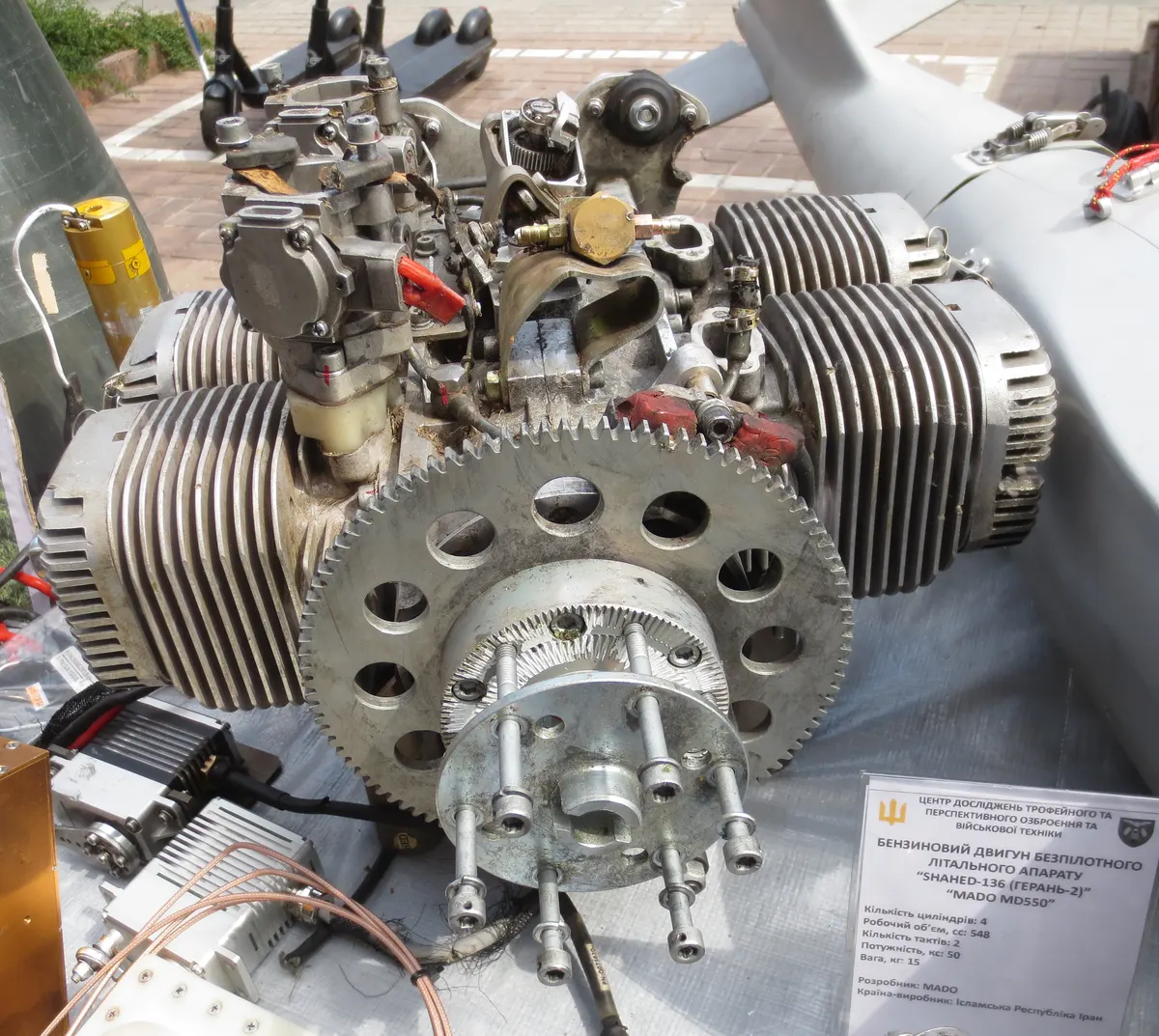
Propulsion is a single piston engine turning a rear-mounted pusher propeller, the same powerplant class fitted to the standard Shahed-136.1 Leaked pricing documents apply the internal label "Shahed-236" to a turbojet sub-variant as well, priced separately from the piston version. Public reporting has since separated that turbojet system out under the Shahed-238 designation; the specs recorded below describe the piston airframe alone.2,4
Stored performance figures, a 185 km/h top speed, 180 km/h cruise, 2,000 km range, and a 50 kg maximum payload, describe the airframe's flight envelope rather than what an operator can reach under live control.1 Reported range for the full man-in-the-loop system, drone plus relay drone plus control station, is closer to 220 km; beyond that distance the optical retargeting link the Shahed-236 exists to provide stops functioning, even though the airframe could physically continue further on a pre-set route.1
The warhead is recorded at up to 50 kg, matching the base Shahed-136's payload class rather than a purpose-built anti-armor or shaped charge.1
The database marks the type autonomous-capable, reflecting its shared inertial/GPS navigation base. The feature that actually defines the Shahed-236 runs the other direction: a human operator, not onboard logic, makes the final targeting decision through the video-relay link described above.1
The stored unit price of 48,000 USD does not match any Shahed-236-specific source found for this article. Leaked internal Sahara Thunder pricing documents instead price the type at approximately 900,000 USD per unit for the piston/optical-seeker configuration covered here, and roughly 1.4 million USD for the turbojet sub-variant that public reporting has since separated out as the Shahed-238.4,5 Both figures come from a hacked internal pricing sheet rather than a published government contract and should be read with that caveat, not treated as a confirmed sale price. The stored operators_count value of two also does not match the single Iran entry in the database's own operator table, an inconsistency addressed under Operators below.
Operational status is recorded as in service, consistent with the September 2024 public demonstration and the June 2025 combat wreckage discussed under Conflicts.6
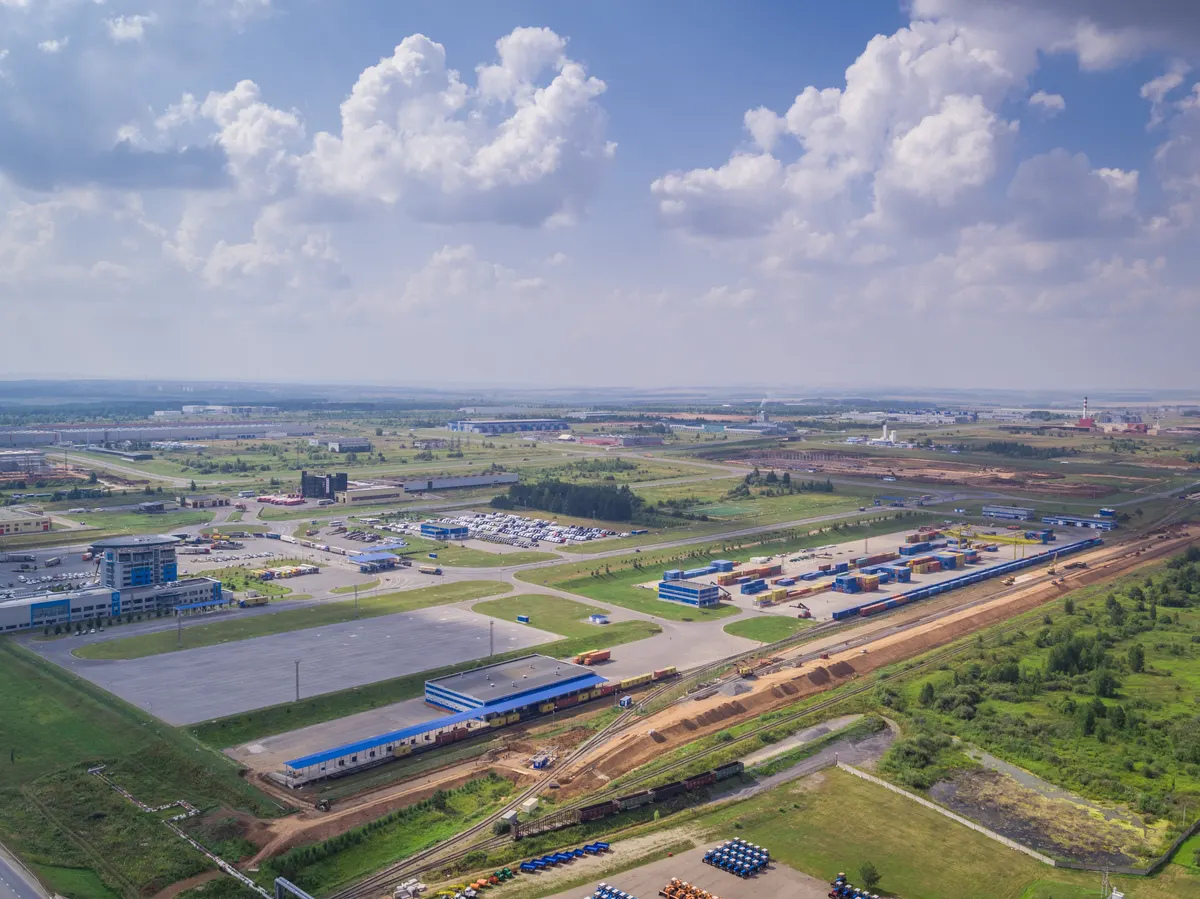
Documents leaked in 2024 place the origin of the optically guided "MC-236" concept, the designation public reporting later shortened to Shahed-236, no later than November 2022, well before any physical unit was shown publicly.4 Alabuga JSC, the Russian defense-industrial site that hosts Iran's Shahed-136/Geran-2 localization program, sent a delegation to Iran from 4 to 8 April 2023 to obtain source code, capability demonstrations, and technology-transfer terms for the Shahed-236 variants, according to the same document cache.4
On 4 February 2024, the hacktivist group PRANA Network published the contents of a breach of Sahara Thunder, an Iranian front company tied to the IRGC, exposing the pricing and localization documents that remain the single richest source on the Shahed-236's early history.4,5 Those documents describe a roughly 1.75 billion USD Iran-Russia drone-localization program, of which the Shahed-236 arrangement forms one part, reportedly settled partly with more than 2,000 kg of physical gold bars alongside cash.5
Russian state television gave the first public look at a physical Shahed-236 on 19 September 2024, when RIA Novosti aired footage from a visit by President Vladimir Putin to the Special Technology Centre in St. Petersburg; the visit is independently corroborated in Western reporting dated the same day.1,8 Close to a year separated that reveal from the earliest leaked-document description of the concept, a gap that illustrates how little of the type's development the public record actually captures.
The only documented combat-use instance of a Shahed-236 specifically, set against the far more extensively recorded base Shahed-136, is a single downed unit recovered in Ukraine around late June 2025, bearing the serial marking "MS001."6 Ukrainian open-source analysts identified the wreckage as a Shahed-236 from its optical/thermal seeker package and the onboard AI-targeting hardware described above. Reporting on the find traces to Telegram channels (eRadar, war_home, and one identified only as "Colonel GS"), relayed by Militarnyi and Ukrainska Pravda, rather than an official Ukrainian or Russian government statement.6
The recovered unit's upgrades, an added thermal camera and the AI-assisted targeting computer noted above, are consistent with battlefield testing beyond the demonstration stage, though no strike count, target type, or casualty figure specific to the Shahed-236 has surfaced in the sources reviewed for this article.6
The Shahed-236 sits alongside two related systems from the same Iranian drone-production program without forming a single numbered progression with either. Shahed-131, fielded by Russia as "Geran-1," is a smaller, shorter-range system built on the same production line, unrelated to the Shahed-236's seeker upgrade specifically.1 The base HESA Shahed-136 supplies the airframe itself: an identical delta wing, fuselage, and rail-launch method, to which the Shahed-236 adds only the nose-mounted optical seeker and the operator-in-the-loop control link.1
Shahed-238, known in Russian service as Geran-3, represents a second, separate upgrade path from the same base airframe. The Shahed-236 keeps the standard piston engine and adds a guidance package; the Shahed-238 fits a Toloue-10/13 turbojet reportedly built around a Czech PBS TJ150 core, a reinforced airframe of roughly 380 kg maximum takeoff weight, and a cruise speed several times the Shahed-236's roughly 185 km/h.3,2 The two systems fork from the Shahed-136 on different axes, guidance for the Shahed-236, propulsion for the Shahed-238, rather than one succeeding the other in sequence.2,3


Iran is the Shahed-236's confirmed originator. HESA, operating under IRGC Aerospace Force oversight, developed the type as an optical-seeker upgrade to its own Shahed-136 production line, and the database's existing operator record reflects that origin.1
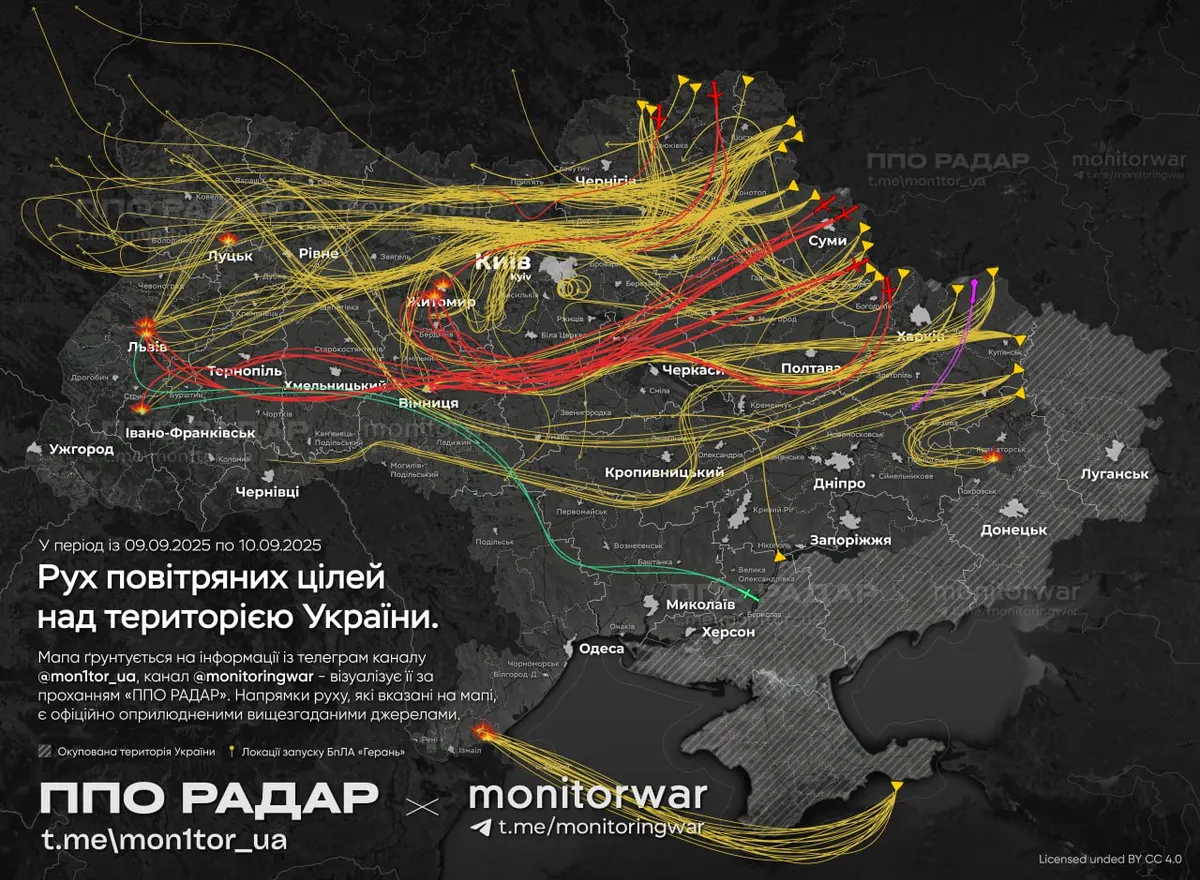
Russia meets a comparable evidentiary bar for a second operator entry, even though the database's operator table currently lists Iran alone. Independent, multi-source reporting documents both localized production, the Alabuga-hosted technology-transfer arrangement described under History, and combat fielding, the September 2024 public unveiling by Russian state media plus the June 2025 downed unit in Ukraine.1,4,6 The production-side reporting (Militarnyi, Army Recognition, Haaretz) and the field-use reporting (Militarnyi, Ukrainska Pravda) trace to separate reporting threads, which is the basis for treating Russia as a real operator here rather than only a customer under negotiation.1,4,6
Set against its own base airframe, the HESA Shahed-136, the Shahed-236 gives up nothing in stated range or payload: both variants share a roughly 2,000-2,500 km airframe range and a 50 kg warhead class, and the Shahed-236 adds a guidance package the base drone does not carry.1 The tradeoff is operational. The Shahed-236's usable controlled range, about 220 km once the relay-drone/control-station link is counted, falls far short of the base airframe's raw fuel range, because retargeting depends on a link the plain Shahed-136 has no need to maintain.1
| System | Country | Guidance | Range | Payload | Notes |
|---|---|---|---|---|---|
| Shahed-236 | Iran/Russia | EO/IR seeker, operator-in-loop | ~2,000 km (airframe) / ~220 km (controlled) | up to 50 kg | 1 confirmed combat instance |
| HESA Shahed-136 | Iran/Russia | GPS/inertial, no seeker | ~2,000-2,500 km | up to 50 kg | Base airframe, extensively used |
| ZALA Lancet | Russia | EO/TV terminal | 40 km | 3 kg | Combat-proven precision strike |
| AeroVironment Switchblade 600 | USA | EO/IR, man-in-loop | 40-100+ km | Javelin-derived warhead | Man-portable, tube-launched |
Against Russia's own ZALA Lancet, a far shorter-range but purpose-built precision loitering munition, the Shahed-236 covers roughly fifty times the distance while delivering a fraction of the terminal precision the Lancet's dedicated EO/TV tracking system is built to achieve against a moving point target.7 The comparison underlines the Shahed-236's position as an optical seeker retrofitted onto a long-range, mass-production airframe, distinct from a purpose-built precision system designed around the sensor from the outset.1,7


What is the difference between Shahed-236 and Shahed-238?
They are separate upgrades of the same Shahed-136 base airframe rather than sequential generations. The Shahed-236 keeps the standard piston engine and adds an electro-optical seeker with operator-in-the-loop control. The Shahed-238 (Geran-3) replaces the engine with a turbojet, reportedly built around a Czech PBS TJ150 core, giving it several times the Shahed-236's cruise speed and a heavier, reinforced airframe.2,3
How much does a Shahed-236 cost?
No confirmed government or manufacturer price exists. Leaked internal Sahara Thunder pricing documents put the piston/optical-seeker configuration at roughly $900,000 per unit and the turbojet configuration at roughly $1.4 million, figures from a hacked pricing sheet rather than a published contract.4
Has the Shahed-236 been used in combat?
Confirmed use is limited to one instance: a downed unit bearing the serial "MS001," recovered in Ukraine around late June 2025 and identified by Ukrainian open-source analysts from its optical/thermal seeker and onboard targeting hardware.6
Does Russia operate the Shahed-236?
Yes, on the evidence available. Russian state media publicly showed a physical Shahed-236 in September 2024, a Shahed-236 was recovered after a strike in Ukraine in June 2025, and leaked documents describe a Russian technology-transfer and localization arrangement for the type.1,4,6
Is there a confirmed export deal for the Shahed-236?
No publicly confirmed, government-announced contract exists. The only documentation is a leaked internal pricing and localization arrangement between Iran and Russia's Alabuga JSC, reported through a 2024 hack rather than an official disclosure.4,5
- "Shahed-236 Demonstrated for the First Time in Russia", Militarnyi — militarnyi.com ↩
- "Leaked Documents Reveal Iranian New Shahed-238 Power Jet Drone Can Intercept US MQ-9 Reaper", Army Recognition — armyrecognition.com ↩
- "Czech Engine and Western Electronics Components of the Shahed-238 Drone Revealed", Militarnyi — militarnyi.com ↩
- "Russia Is Localizing Shahed-236 Production", Militarnyi — militarnyi.com ↩
- "Gold for Drones: Massive Leak Reveals the Iranian Shahed Project in Russia", Haaretz — haaretz.com ↩
- "Russia Uses New Shahed With Thermal Imaging in Ukraine", Militarnyi — militarnyi.com ↩
- "Shahed-236: First Presentation of New Attack Drone in Russia Ahead of Potential Use in Ukraine", Army Recognition — armyrecognition.com ↩
- "Putin Tours St. Petersburg Drone Manufacturing Plant", The Moscow Times — themoscowtimes.com ↩