


The Fire Point FP-1 is a long-range, one-way attack drone — a loitering munition in the broad sense used across this archive, though technically closer to a disposable cruise-missile-like strike UAV — designed, built, and fielded by the Ukrainian company Fire Point of Kyiv, Ukraine. It is the firm's original deep-strike platform, unveiled in late 2024 and credited by Ukrainian officials with a large share of the drone strikes conducted against targets deep inside Russian territory since then.1,2 The FP-1 is built around a simple, cheap airframe — plywood structural elements, a small piston engine, a straight fixed wing — optimized for mass production rather than performance, and it is launched from a rail with a solid rocket booster rather than under its own power from a runway.1 Its stated purpose is to reach targets that Ukraine's shorter-range systems cannot: oil refineries, ammunition depots, chemical plants, and command infrastructure hundreds or thousands of kilometers from the front line.1,6
- Very low unit cost (about $55,000) relative to its stated 1,600 km range
- Simple, low-tech construction (plywood, single small piston engine) enables fast, distributed manufacturing
- Reported 90%+ domestically sourced components reduce exposure to sanctions/export controls
- Modular warhead lets planners trade range for payload mission to mission
- Demonstrated ability to reach targets over 2,000 km inside Russia
- Subsonic, unpowered-glide-free straight-line flight profile is comparatively easy for modern air defenses to intercept once detected
- Small warhead (as low as 50–60 kg at maximum range) limits damage against hardened targets compared to the FP-5 or ballistic systems
- Company secrecy means independent verification of performance claims is limited
- Reported dimensions and weight are inconsistent across open sources
Fire Point itself is a relatively young company, founded in mid-2022 by a team the trade press repeatedly describes as unusual for the defense sector — engineers alongside architects and game designers, assembled in response to the full-scale invasion rather than drawn from an existing state design bureau.2 The FP-1 was its first major product, followed by the shorter-range FP-2, the far larger FP-5 "Flamingo" cruise missile, and reported ballistic-missile programs (FP-7, FP-9).2 Public information on the FP-1 itself remains comparatively thin: Fire Point runs its production in concealed facilities and rarely publishes detailed specifications, so most of what is known comes from Ukrainian military statements, satellite-imagery analysis of strikes, and a handful of trade-press interviews rather than an official data sheet.1,2
Fire Point FP-1 specifications: what is actually confirmed
Reported figures for the FP-1 are more consistent for performance than for physical dimensions. At its original, most widely cited configuration the FP-1 carries a 50–60 kg warhead out to roughly 1,600 km, or a heavier warhead of up to 120 kg at reduced range.1,12 Cruise speed is reported at around 150 km/h, which — at the low end of publicly discussed figures — implies a flight of roughly ten to eleven hours to reach the far end of its stated range envelope.12 The airframe uses fixed straight wings, a two-cylinder piston engine turning a propeller, and a solid rocket booster for the initial launch off a rail, a layout broadly similar in concept to Iran's Shahed-136 (and its Russian Geran-2 derivative) but built with far cheaper materials.1 Fire Point has stated the airframe is finished with radar-absorbent coatings, though independent radar-cross-section testing has not been published.1
Dimensions are where the public record is weakest. Ukrainian defense outlets have cited a wingspan near 2.5 m with a fuselage length around 3.5 m,3 while other secondary sources put the wingspan closer to 5–6 m — a spread wide enough that it is best read as evidence of how little Fire Point discloses rather than as two competing precise measurements.1 Weight figures suffer the same problem: some catalogs conflate the drone's warhead weight with its total launch weight, so this archive does not assert a specific empty or maximum takeoff weight for the FP-1.
Guidance and construction
Navigation reportedly combines inertial navigation with satellite positioning and electronic counter-countermeasures (ECCM) hardening against jamming and spoofing.1 For at least some high-value strikes, Fire Point has fitted the FP-1 with a Starlink terminal, letting a human operator watch a video feed and steer the final attack run onto the target rather than relying purely on pre-programmed coordinates — a capability credited with improving strike precision against hardened or moving targets.10 The load-bearing structure is built from CNC-cut plywood panels with a lightweight external skin, a deliberate choice that keeps tooling and material costs low and allows Fire Point to disperse production across many small, easily concealed workshops instead of one large factory.1,4 Ukrainian officials say the FP-1 (and the related FP-2) are now more than 90% sourced from domestically produced components — including cameras and CRPA anti-jamming antennas — with only items like flight controllers still commonly bought commercially, even though Fire Point says it has developed its own board as a fallback.4
Fire Point was established in mid-2022, in the months after Russia's full-scale invasion, by a founding team the trade press describes as drawn as much from architecture and game design as from traditional aerospace engineering — a detail the company itself has leaned into when explaining its unconventional, rapid-iteration approach to weapons design.2
Development of the FP-1 ran through 2022–2024, with prototypes flying in early 2024 and full-scale production beginning around October 2024 at concealed facilities near Kyiv.1 The type was publicly unveiled in late 2024, reportedly catching Russian air defenses by surprise on its early combat missions.1 Production scaled quickly: Fire Point says it went from roughly 30 FP-1 units a day to over 100 a day by mid-2025, with cumulative production passing 5,000 units by that point — and the company's combined output across the FP-1 and FP-2 lines has since been described as reaching up to 200 drones a day, supplying an estimated 60% of the Armed Forces of Ukraine's long-range and mid-range drone strikes.1,5 Fire Point has also disclosed government contracts reportedly worth over $1 billion a year, though it has not broken out how much of that is specific to the FP-1 program versus its other products.6
The company's rapid growth and central role in Ukraine's strike-drone campaign have also drawn scrutiny. In August 2025, Ukraine's anti-corruption bureau (NABU) opened an investigation examining possible links between Fire Point and Timur Mindich, a businessman connected to President Zelenskyy's inner circle — a case that was still generating headlines well into 2026 without, as of this writing, having produced public findings specific to the FP-1 program itself.2 In June 2026, at the Eurosatory exhibition in Paris, Fire Point publicly showed upgraded FP-1 and FP-2 airframes fitted with a new wing carrying an integrated fuel tank, extending the FP-1's stated deep-strike range from roughly 1,600 km to as much as 2,700 km.7 Fire Point has also begun adding undisclosed AI-assisted systems to its drones, without saying what role the AI plays in navigation or targeting, citing operational security.7
The FP-1 has been used against Russian targets since late 2024/early 2025, with Ukrainian and Russian sources alike attributing a large share of deep-strike damage to it, though independent confirmation for any single strike usually depends on open-source satellite-imagery analysts rather than an official Ukrainian statement naming the exact drone type.8
Two of the more precisely documented FP-1 strikes hit targets around Moscow's outer defensive ring in July 2025: on July 4, 2025, an FP-1 reportedly struck the Scientific Research Institute of Applied Chemistry in Sergiev Posad, and on July 7, 2025, another hit the Krasnozavodsky Chemical Plant, roughly 70 km from central Moscow.8 Nearly a year later, on June 20, 2026, open-source analysts (notably the Dnipro OSINT channel) identified an FP-1 as the drone responsible for destroying a diesel deep-refining unit at the Tyumen oil refinery in Western Siberia — one of the region's largest, with 7.5–9 million tonnes of annual capacity — after the drone flew more than 2,000 km from Ukrainian territory.9 That distance, at the far edge of even the FP-1's newly extended range envelope, made the Tyumen strike one of the longest-range attributed strikes of the war at the time.
Fire Point's own messaging leans into this record: co-founder Denys Shtilerman has publicly described the FP-1 as responsible for "what you see burning on your TV screens" inside Russia, and the company cites internal data suggesting the type's strike success rate has been improving over time as targeting and guidance software matures.6 Independent verification of any single-strike success rate is not available, since Fire Point does not publish mission-level data.
Fire Point has disclosed at least two significant configuration changes to the baseline FP-1 rather than formally named sub-variants, alongside one distinct role adaptation:
- Extended-range (2026) configuration: a redesigned monoplane wing with an integrated fuel tank, shown publicly at Eurosatory 2026, pushing the FP-1's advertised deep-strike range from about 1,600 km to as much as 2,700 km.7
- Heavy-warhead configuration: trading range for payload, carrying up to 120 kg of explosive at correspondingly shorter distances than the baseline 50–60 kg/1,600 km profile.1
- Interceptor/anti-air adaptation: in March 2026, Fire Point's CEO said engineers had adapted the FP-1 airframe to carry FPV interceptor drones and mount machine guns or other anti-aircraft weapons, aimed at helping Ukraine counter Russian Shahed/Geran-2 raids rather than striking ground targets — with the company suggesting future versions could also carry man-portable air-defense missiles.3
| Configuration | Stated range | Stated warhead | Primary role |
|---|---|---|---|
| Baseline (2024) | ~1,600 km | 50–60 kg | Deep-strike, standard targets |
| Heavy-warhead | shorter (unspecified) | up to 120 kg | Deep-strike, hardened/high-value targets |
| Extended-range (2026) | up to ~2,700 km | not disclosed | Maximum-depth strikes |
| Interceptor adaptation | short (air-to-air) | none (guns/FPV carrier) | Counter-drone/anti-air |

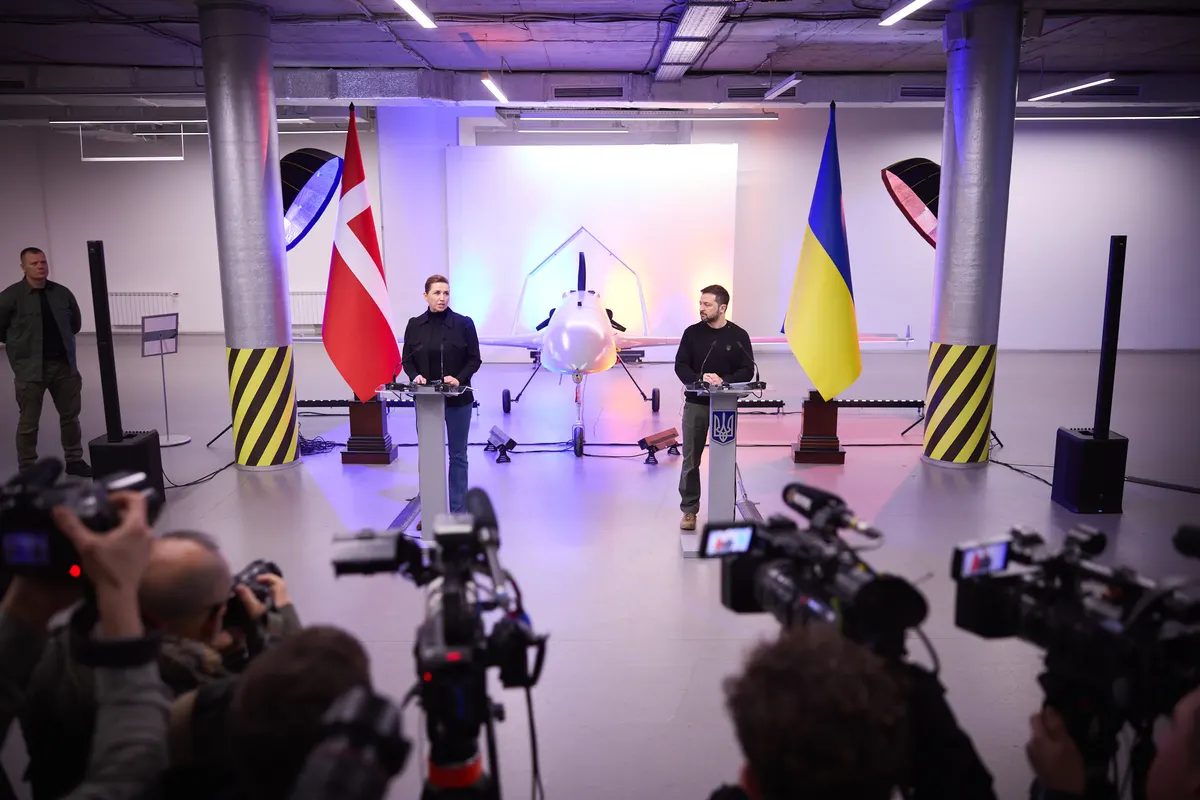
The FP-1's only confirmed operator is the Armed Forces of Ukraine, which has used the type operationally since late 2024/early 2025 against targets inside Russia and Russian-occupied territory.1 Fire Point has not disclosed any export customers, and given the drone's role as a strategic asset in an active war, none would be expected while the conflict continues.
Some reporting also links Fire Point platforms to Ukraine's Security Service (SBU) rather than the military alone, though the SBU's own long-range drone programs (such as "Morok") appear to be separate, in-house designs rather than FP-1 derivatives.10
FP-1 vs FP-2: same airframe concept, opposite trade-off
The FP-2 is Fire Point's answer to demand from frontline units for a drone that could hit closer, harder targets without needing the FP-1's extreme range. Both share the same general design language — plywood-heavy construction, fixed wings, a small piston engine, rail launch — but the FP-2 was tuned in the opposite direction from the FP-1: shorter range for a heavier warhead.2 Where the baseline FP-1 trades a light 50–60 kg warhead for roughly 1,600 km of reach, the FP-2 originally carried a 105 kg warhead only about 200 km, and Fire Point has since shown configurations carrying up to 200 kg over 370 km, or 105 kg over as far as 700 km with the 2026 wing upgrade.7 In short, FP-1 vs FP-2 comes down to mission profile: the FP-1 is built for deep strikes on strategic targets (refineries, depots, command posts far behind the line), while the FP-2 is built for operational-depth strikes closer to the front, where a bigger warhead matters more than another thousand kilometers of range. See the full Fire Point FP-2 article for details specific to that airframe.
| FP-1 (baseline) | FP-2 (baseline) | |
|---|---|---|
| Range | ~1,600 km | ~200 km |
| Warhead | 50–60 kg (up to 120 kg) | 105 kg (up to 200 kg in later configs) |
| Role | Deep strategic strike | Operational/frontline strike |
| Airframe concept | Shared: plywood, fixed-wing, piston engine, rail launch | Shared: plywood, fixed-wing, piston engine, rail launch |
FP-1 vs Antonov Liutyi (AN-196): cheap mass production vs a heavier, longer-flying design
The closest rival to the FP-1 in Ukraine's own arsenal is the Antonov AN-196 Liutyi, designed by the state bureau Antonov rather than a private startup. The Liutyi is a noticeably larger aircraft — about 4.4 m long with a 6.7 m wingspan and a launch weight in the 250–300 kg class — versus the FP-1's much smaller, lighter, and more disputed dimensions.11 Liutyi's warhead has grown from 50 kg to a reported 75 kg, similar to the FP-1's low-end figure but well short of the FP-1's 120 kg maximum, while its range is generally cited in the 1,000–2,000 km band, comparable to the FP-1's baseline 1,600 km but short of the FP-1's newly claimed 2,700 km extended-range configuration.11 Cost is the sharpest contrast: Liutyi is reported at roughly $200,000 per unit against the FP-1's roughly $55,000, a gap that reflects Antonov's more conventional aerospace-grade construction against Fire Point's plywood-and-piston-engine approach to mass production.1,11 Both drones have struck confirmed targets well over 1,000 km inside Russia, including Liutyi's February 2026 strike on a Lukoil refinery in Ukhta (~1,700 km) and the FP-1's June 2026 strike on the Tyumen refinery (~2,000+ km), and both are frequently launched in the same coordinated raids, making single-strike attribution a recurring problem for outside analysts.9,11


What is the Fire Point FP-1?
The FP-1 is a Ukrainian long-range, one-way attack drone made by the Kyiv-based company Fire Point, first fielded in late 2024 to strike targets deep inside Russian-held or Russian territory.1
What are the Fire Point FP-1 specifications?
Publicly reported figures center on a roughly 1,600 km range with a 50–60 kg warhead (up to 120 kg at shorter range), a cruise speed near 150 km/h, a two-cylinder piston engine, and a plywood-based airframe launched by a solid rocket booster.1,12 Fire Point has not published an official spec sheet, and reported physical dimensions vary significantly between sources, so treat exact length/wingspan figures with caution.
FP-1 vs FP-2: what's the difference?
The FP-1 is the long-range, light-warhead sibling (about 1,600 km / 50–60 kg baseline); the FP-2 is the shorter-range, heavier-warhead sibling (about 200 km / 105 kg baseline, with later configurations trading some of that range for even more payload or reach).2,7 They share the same basic construction approach but are aimed at different target sets.
How much does the Fire Point FP-1 cost?
Fire Point has cited a unit cost of about $55,000, versus roughly $200,000 for the comparable Antonov Liutyi.1,11 Neither figure is an audited program cost — both are company/press estimates.
What is the FP-1's range?
The originally disclosed range is about 1,600 km. In June 2026, Fire Point showed an upgraded wing/fuel-tank configuration said to extend that to as much as 2,700 km, and a strike on the Tyumen refinery that same month traveled over 2,000 km, suggesting the extended-range version was already in limited combat use.7,9
Who makes Fire Point drones, and are they state-owned?
Fire Point is a privately held Ukrainian company founded in mid-2022 and headquartered in Kyiv; it is not a state design bureau, though it works closely with Ukraine's Ministry of Defence and has reported over $1 billion a year in government contracts.2,6 It has also been the subject of a 2025 anti-corruption investigation into its ownership ties, separate from questions about the FP-1's technical performance.2
Is the FP-1 a loitering munition or a cruise missile?
It sits between the two categories as commonly used. It lacks the extended on-station "loiter and search" behavior of true loitering munitions like the Switchblade or Lancet, but it also lacks a cruise missile's typical jet or turbofan propulsion and terrain-hugging flight profile — it is best described as a low-cost, one-way attack/deep-strike drone, and this archive groups it with loitering munitions because that is the closest established category for propeller-driven, disposable strike UAVs of this kind.
- "Fire Point FP-1", Wikipedia — en.wikipedia.org/wiki/Fire_Point_FP-1 ↩
- "Fire Point (Ukrainian firm)", Wikipedia — en.wikipedia.org/wiki/Fire_Point_(Ukrainian_firm)) ↩
- "Fire Point Develops FP-1 Drone for Intercepting Aerial Targets", Militarnyi — militarnyi.com/en/news/fire-point-develops-fp-1-drone-for-intercepting-aerial-targets ↩
- "CRPA Antennas and Cameras: FP-1 and FP-2 UAVs 90% Ukrainian-Made", Militarnyi — militarnyi.com/en/news/crpa-antennas-and-cameras-fp-1-and-fp-2-uavs-90-ukrainian-made ↩
- "Ukraine's Fire Point Produces 200 Strike Drones Daily and Supplies 60% of Defense Forces", Army Recognition — armyrecognition.com ↩
- "Ukraine's top strike-drone maker moves into ballistic missile defense", Defense News — defensenews.com ↩
- "Ukrainian defence company Fire Point presents upgraded FP-1/2 drones with extended range in Paris", Ukrainska Pravda — pravda.com.ua ↩
- "Drone warfare in Ukraine: FP-1 long-range drones and unmanned ground vehicles", Ukraine's Arms Monitor (Substack) — ukrainesarmsmonitor.substack.com ↩
- "FP-1 Drone Destroyed Key Facility at Tyumen Oil Refinery", Militarnyi — militarnyi.com/en/news/fp-1-drone-destroy-facility-tyumen-refinery ↩
- "Moscow Refinery Attack Is A Landmark In Complex Drone Strikes", Forbes — forbes.com ↩
- "Liutyi", Wikipedia — en.wikipedia.org/wiki/Liutyi ↩
- "Fire Point FP-1: Military Drones Specs & Operators (2026)", GlobalMilitary.net — globalmilitary.net/aircraft/fp-1 ↩