


The Shahed 131 is a small, low-cost, delta-wing one-way-attack drone, a type of loitering munition, designed by Iran's Shahed Aviation Industries, part of the Iran Aircraft Manufacturing Industrial Company (HESA), and built in Iran.1 It is the smaller sibling within the Shahed-131/136 family, sharing a general delta-wing shape and guidance approach with the larger HESA Shahed 136 while carrying a smaller warhead over a shorter range.1,2
- Low unit weight (135 kg) simplifies transport and launch logistics
- Standoff range of roughly 900 km against fixed targets
- Composite, low-observable airframe with no dedicated radar-absorbent coating required
- Satellite uplink allows in-flight retasking
- Simple design, license-producible with modest industrial capacity
- Smaller warhead (10-20 kg) than the Shahed-136, limiting effect against hardened targets
- No onboard EO/IR seeker, SAR/GMTI radar, or laser designator
- Reported cruise speed (180-250 km/h) leaves no evasive capability against modern air defenses
- Reverse-engineered civilian engine limits reliability compared to a purpose-built military powerplant
The type's recorded role is long-range, saturation and precision one-way strikes against fixed infrastructure and air-defense targets, a category distinct from short-range, hand-launched tactical loitering munitions such as the AeroVironment Switchblade 300 or Spike Firefly, which engage individual targets at ranges measured in tens of kilometers rather than hundreds.2
Reported design origins for the Shahed 131 are contested. One account holds that a South African firm, Kentron, sold plans for its ARD-10 loitering drone to Iran's Aviation Industries Organization around 2004-2005, and that the Shahed-131/136 family was subsequently developed from that transfer.1 The Royal United Services Institute, studying recovered airframes directly, states that the origins of the Shahed 131 are obscure, and no independent confirmation of the reported Kentron transfer has been published.3
No single primary source fixes an exact public unveiling date for the type. Secondary accounts place an early exhibition appearance around 2014-2015, a date this article treats as unverified.1 Wikipedia records only that the Shahed 131 came to wide public attention in October 2022, when Russia began using it against Ukraine.1
The database groups the Shahed 131's recorded specifications into general classification, airframe, powerplant, performance, payload and sensors, armament, control and autonomy, production, and service history.1 It is classified within the loitering-munitions category, with a recorded primary role of one-way attack, and remains in service.1
Structurally the type is a small delta-wing airframe, 2.6 m long with a 2.2 m wingspan, figures confirmed consistently by Wikipedia and CSIS's Missile Threat project.1,2 Maximum takeoff weight is 135 kg, of which the stated warhead accounts for 10 to 20 kg, with roughly 15 kg the commonly cited mid-range figure.1,2 Construction uses a carbon-fiber and fiberglass composite skin over a honeycomb core, giving the type its recorded low-observable classification without any dedicated radar-absorbent coating or faceted shaping.2,3
Power comes from a single Serat-1 engine, a 38 hp air-cooled Wankel (rotary) unit reverse-engineered from the British AR731, itself designed for the ultralight-aircraft and model-aircraft hobby market rather than for weapons.3 It is not an electric design; the database's engine-power figure of 28 kW converts to approximately the same 38 hp cited by CSIS and RUSI, so no correction is needed there.1,2,3
Range is recorded at 900 km, within the wider 700-1,000 km band cited across open sources, and maximum payload is listed at 15 kg.1,2,3 Reported cruise speed is inconsistent across sources: CSIS gives roughly 180 km/h, while RUSI cites a 2014-era specification of about 250 km/h, a gap this article does not resolve.2,3
The airframe carries no EO/IR seeker, no SAR/GMTI radar, no SIGINT payload, and no laser designator. The database separately records a comms-relay capability, consistent with the satellite uplink described above.1
The recorded warhead is a single high-explosive charge with a stated weapons payload of 15 kg. The database classifies the type as armed without conventional air-to-ground missile hardpoints, reflecting a function closer to a single-use guided munition than a missile-carrying aircraft.1
Guidance combines GNSS and inertial navigation with a satellite (BLOS) uplink. The database records swarming and automatic-takeoff capability, though the "swarm" effect described in Russian and Houthi strikes reflects many drones launched together on independent routes rather than onboard coordination between airframes.1,5
The database records four operators and one named variant for the type, alongside a production-start year of 2014 and an operational status of in service.1 Both the operator list and the variant question carry nuance covered in the sections below.
Shahed Aviation Industries, a subsidiary of the Iran Aircraft Manufacturing Industrial Company, developed the Shahed 131 as a smaller complement to the Shahed 136 within Iran's wider family of delta-wing loitering munitions.1 The development path before the type's public emergence is not well documented in open sources. The database's own production-start figure of 2014 aligns with a recorded first-flight year of 2014, though no single primary account confirms an exact reveal date, and secondary reporting places an early exhibition appearance around 2014-2015 without firm sourcing.1
A claim in some secondary reporting holds that a Shahed 131 was identified in the September 14, 2019 attack on Saudi Arabia's Abqaiq and Khurais oil-processing facilities, based on a British report submitted to the United Nations Security Council. The underlying UN investigation does not support that claim as stated.
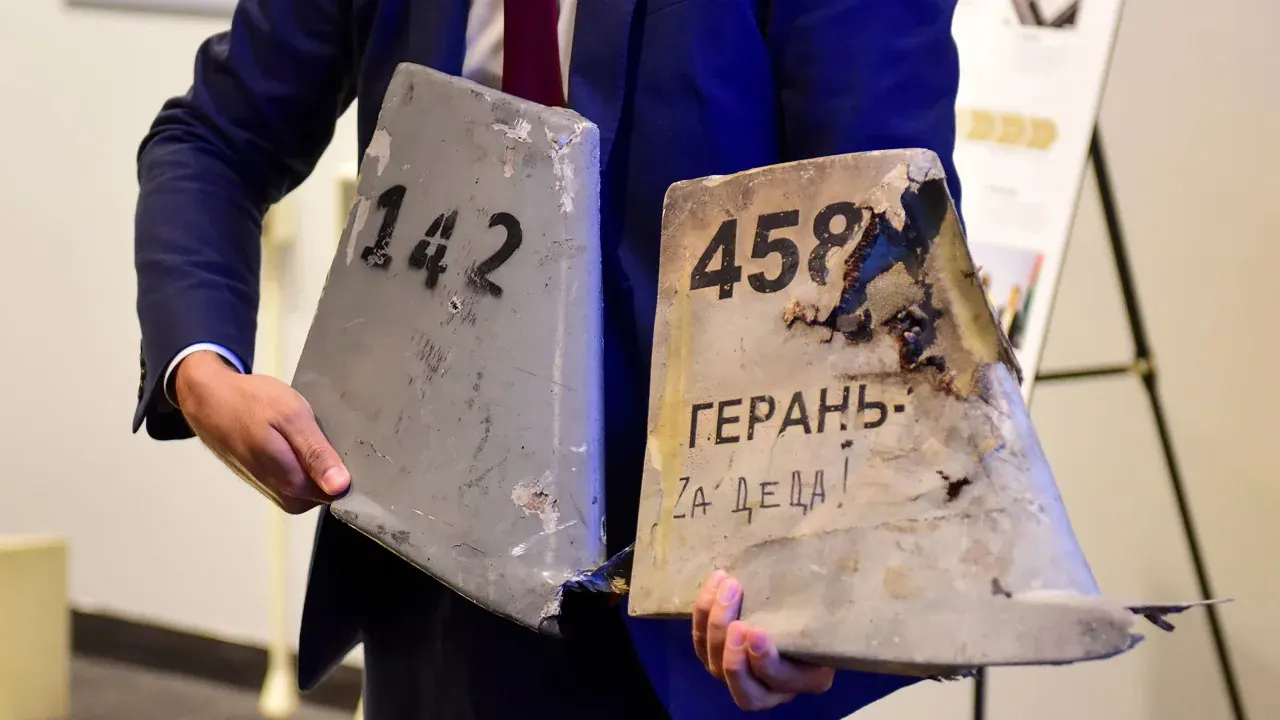
The first well-documented combat use dates to October 2022, when Russia began fielding the type against Ukraine under the domestic designation Geran-1, alongside the larger Shahed-136/Geran-2.1

Production of the Geran-1 shifted over time from Iranian-supplied kits toward Alabuga's own domestic supply chain. Western intelligence assessments cited by CNN put the share of domestically sourced components at roughly 90 percent by 2025.7,8
Iran's role in the Russian program extended beyond supplying hardware or a production license: Iran directly trained hundreds of Russian pilots, communications specialists, technicians, and handlers on the Shahed-131 system.1
Public reporting on the Alabuga production arrangement, including a roughly 1.7 to 1.75 billion USD contract for 6,000 drones with reported gold-bar payments, centers on the larger Shahed-136/Geran-2 by name. No separately disclosed price, quantity, or schedule specific to the Shahed-131/Geran-1 line has surfaced in that reporting.9,10
Russia's use of the Shahed-131 forms part of the wider Russo-Ukrainian War, which escalated into full-scale conflict in February 2022; Russia began combat use of the type as the Geran-1 in October 2022.1,7 Figures on the scale of nightly strikes typically cover Shahed-type drones broadly, encompassing both the Shahed-131/Geran-1 and the larger Shahed-136/Geran-2, rather than the Shahed-131 in isolation.11
By late 2024 and through 2025 the campaign grew substantially in volume. Russia launched 2,300 one-way-attack drones in November 2024, 2,696 in January 2025, and averaged about 140 per day in February 2025; across all of 2025 Russia launched more than 54,000 Shahed-type drones, including 5,298 in October 2025 alone, an average of roughly 171 per day that month.11
Ukrainian interception rates against these raids shifted considerably over 2025. Reported interception of strike-configured Shahed-type drones climbed from 2 to 3 percent in January-February 2025 to about 9 percent in March, then to 11.5 to 18.7 percent overall (19.5 to 32.3 percent for strike-configured airframes specifically) from April 2025 onward.11 Measured against all Russian drone types together, the success rate fell from above 90 percent in early 2025 to about 85 percent in August and September, then to just under 80 percent in October 2025, when 4,242 of 5,312 launched drones were intercepted, the lowest monthly rate of the year despite continued improvement in interceptor-drone technology.13
Individual strikes attributed to Shahed-type raids include a March 23, 2025 attack on a Kyiv apartment building that killed at least three civilians, and a September 7, 2025 assault described as the largest single-day drone attack of the war, which struck a government building in Kyiv's guarded district for the first time since 2022, alongside damage reported in Zaporizhzhia, Kryvyi Rih, and Odesa.5
Iran also used the Shahed-131 alongside the Shahed-136 in large-scale strikes against United States bases and against Israel during the 2026 conflict sometimes called the Twelve-Day War. Most of these were intercepted by Israeli and allied air defenses, with a smaller number reportedly penetrating and causing casualties or damage. Independent, source-by-source confirmation of this campaign remains thinner than for the Russo-Ukrainian theater, and this article does not assert tactical detail beyond that general association.
Iran-aligned armed groups have also employed the type outside these state-on-state conflicts. Following the 2026 Iran war, an Iraqi militia network launched Shahed-131/136-family drones, under the local designation Murad-6, against United States bases and targets in Iraq's Kurdistan Region on February 28, 2026.14,15 The Houthi movement in Yemen has separately fielded the Shahed-131 under its own designation, Waid-1, in a program that United States Defense Intelligence Agency analysis found to be materially the same Iranian-supplied hardware used by Russia.16 Both groups' distinct status from their respective national governments is set out in Operators below.
The database records a single named variant, a figure that captures only part of the naming picture. Several designations attached to the Shahed-131 mark a change of operator or production location rather than a distinct engineering type. Geran-1 is Russia's own service and production designation for the Shahed-131 built domestically at Alabuga, not a technical modification of the airframe.7 Waid-1 is the Houthi movement's service designation for the same Iranian-supplied system.16 Murad-6 is the designation used for the type by the Iraqi militia group Saraya Ababil.14
One reported change goes beyond naming: a variant referred to as Geran-3 is said to replace the Serat-1 Wankel engine with a DLE-60 twin-cylinder gasoline engine. Sourcing for this modification is limited, and this article treats it as unconfirmed pending stronger documentation.1
Set against its own sibling, the differences are concrete and measurable across nearly every recorded dimension.
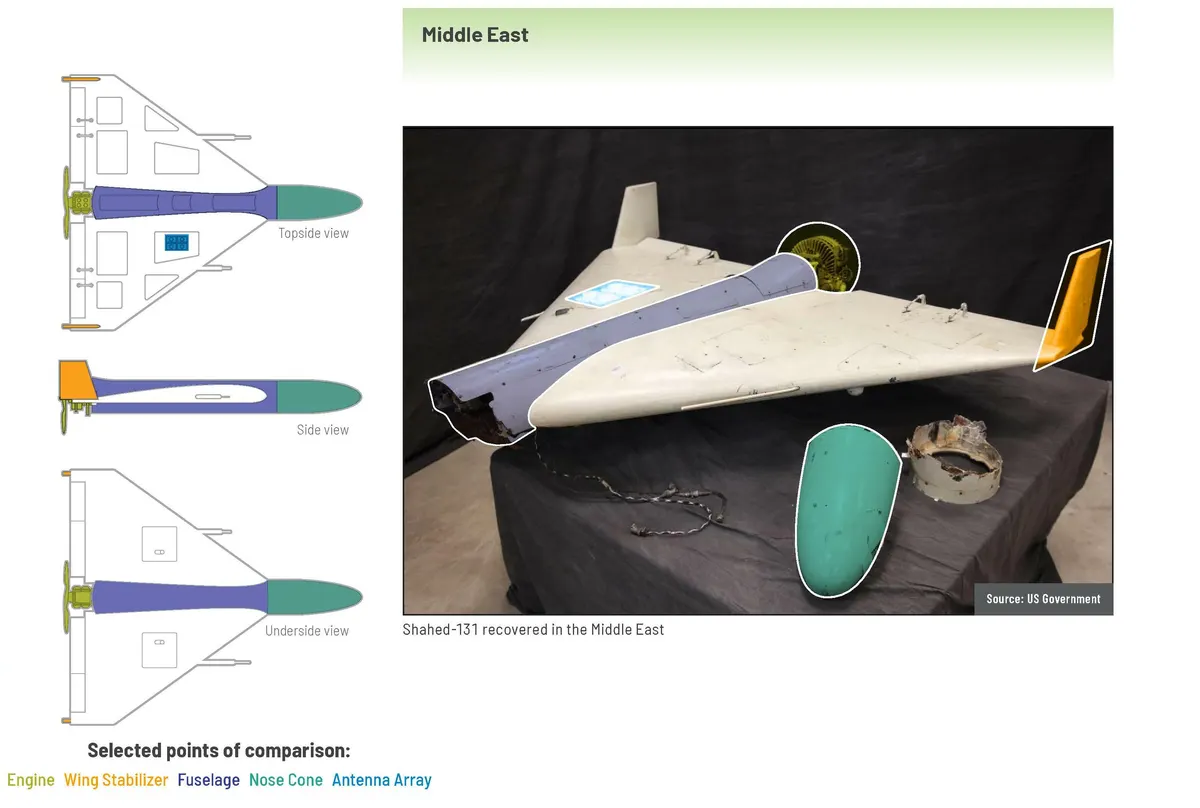
The Shahed-131 is 2.6 m long with a 2.2 m wingspan, against the Shahed-136's roughly 3.5 m length and 2.5 m wingspan; its warhead is stated at 10 to 20 kg against up to 50 kg (reportedly up to 90 kg in later Russian-modified variants) for the larger type; and its range of roughly 900 km sits well below the Shahed-136's stated range of up to 2,500 km.1,2 The two types are also visually distinguishable in wreckage and imagery: the Shahed-131's vertical stabilizer extends only upward from the wing, while the Shahed-136's extends both above and below it.4,2


Russia is the most extensively documented operator of the Shahed-131, fielding it domestically as the Geran-1 since acquiring the design and production know-how from Iran in 2022.1,7 Alabuga's production of the type has shifted toward substantially domestic sourcing, reported at around 90 percent of components by 2025.8
Iran is the type's designer and manufacturer through Shahed Aviation Industries and the Iran Aircraft Manufacturing Industrial Company. The database records the Shahed-131 as entering service in 2022, consistent with the type's rise to public prominence that year.1
The Islamic Resistance in Iraq umbrella has used Shahed-131/136-family drones, under the Murad-6 designation, against targets including United States military installations and Iraq's Kurdistan Region, with strikes recorded on February 28, 2026 following the broader 2026 Iran war.14,15
United States Defense Intelligence Agency analysis has found that Houthi forces in Yemen and Russian forces in Ukraine operate materially the same Iranian-supplied drone types, with the Houthi movement's Waid-1 corresponding to the Shahed-131 and its Waid-2 to the Shahed-136.16 This Houthi program is distinct from the Houthis' earlier, independently derived Qasef drone, based on the Iranian Ababil-T design, and the two should not be conflated.16
The most directly sourced comparison for the Shahed-131 is its own sibling, the HESA Shahed 136. The Shahed-131 is smaller across every major recorded dimension: 2.6 m long against 3.5 m, a 2.2 m wingspan against 2.5 m, a warhead of 10 to 20 kg against up to 50 kg, and a stated range of roughly 900 km against up to 2,500 km.1,2 Its engine, a 38 hp Serat-1 Wankel unit, sits below the Shahed-136's roughly 50 hp two-stroke MD-550 engine, a difference that corresponds with the shorter range and lower payload.1,3
Against short-range, hand-launched tactical loitering munitions, the Shahed-131 sits in a different weight and range class entirely. The ZALA Lancet has a maximum takeoff weight of up to about 12 kg and a range of around 40 km, extended to at least 70 km in at least one confirmed 2023 strike; the AeroVironment Switchblade 600 has an all-up weight of about 54.5 kg and a combined flyout-and-loiter range of roughly 40 to 90 km depending on configuration.17,18 Both are built to engage individual mobile or hardened targets at short range, a different mission from the standoff strikes against fixed infrastructure that the Shahed-131 is built for.17,18
The closest comparison in intended reach is the Ukrainian Fire Point FP-2, a deep-strike drone reported to carry a 105 to 200 kg warhead over 200 to 370 km depending on configuration, a heavier, longer-ranged design aimed at the same category of standoff strike against fixed targets.19
Is the Shahed-131 the same as the Shahed-136?
No. The Shahed-131 is the smaller of the two types: 2.6 m long against 3.5 m, with a 10-20 kg warhead against up to 50 kg and a stated range around 900 km against up to 2,500 km for the Shahed-136.1,2
What does "Geran-1" mean?
Geran-1 is Russia's domestic production and service designation for the Shahed-131, built at the Alabuga Special Economic Zone in Tatarstan.7
Was a Shahed-131 used in the 2019 Abqaiq-Khurais attack on Saudi Arabia?
This remains unresolved. The United Nations' own December 2019 investigation described only unidentified "delta wing-style" wreckage "of Iranian manufacture," could not confirm Iranian origin, and found that Houthi forces did not carry out the attack despite their public claim of responsibility.6
How does the Shahed-131 differ from short-range loitering munitions like the Lancet?
The Shahed-131 is a heavier, longer-range standoff weapon aimed at fixed infrastructure, at 135 kg and roughly 900 km of range, while the ZALA Lancet is built to engage individual mobile or hardened targets at up to about 12 kg and roughly 40 km of range.1,17
What is "Waid-1"?
Waid-1 is the Houthi movement's own designation for the Shahed-131 in its Yemeni operations, distinct from the Shahed-136, which the Houthis designate Waid-2.16
- "Shahed 131", Wikipedia — en.wikipedia.org ↩
- "Shahed-131 and -136", CSIS Missile Threat — missilethreat.csis.org ↩
- "Russia's Iranian-Made UAVs: A Technical Profile", RUSI — rusi.org ↩
- "Shahed-131/136 UAVs: A Visual Guide", OSMP — osmp.ngo ↩
- "How to Counter Iranian Shahed-136 and Shahed-131 Kamikaze Drones Used by Russia to Strike Ukrainian Cities", Defense Express — en.defence-ua.com ↩
- "Abqaiq–Khurais attack", Wikipedia — en.wikipedia.org ↩
- "Yelabuga drone factory", Wikipedia — en.wikipedia.org ↩
- "Iran drone factory in Russia offers clues to war effort", CNN — cnn.com ↩
- "Russia-Iran Drone Deal Documents", Washington Post — washingtonpost.com ↩
- "Alabuga Drone Plant: A Case Study of the Key Relationships Enabling Iranian Support to Russia's Military", Iran Watch — iranwatch.org ↩
- "A Comprehensive Analytical Review of Russian Shahed-Type UAVs Deployment Against Ukraine in 2025", Institute for Science and International Security — isis-online.org ↩
- "Ukrainian Interceptor Drones Tear Through Russian Shahed Swarms With 95% Kill Rate", UNITED24 Media — united24media.com ↩
- "Ukraine's Interception Rates of Russia's Drones and Missiles Are Slipping, Data Shows", ABC News — abcnews.go.com ↩
- "Iraqi Shiite Militias Join the War Between Israel, the United States, and Iran With Drone Attacks", FDD — fdd.org ↩
- "Islamic Resistance in Iraq", Wikipedia — en.wikipedia.org ↩
- "Houthis, Russians Wield Same Iranian-Supplied Drones, DIA Studies Show", C4ISRNET — c4isrnet.com ↩
- "ZALA Lancet", Wikipedia — en.wikipedia.org ↩
- "Switchblade 600", AeroVironment — avinc.com ↩
- "Fire Point to Increase FP-2 Warhead to 158 kg", Militarnyi — militarnyi.com ↩