


The IEMZ Kupol Geran-2 is Russia's domestically produced version of the Iranian HESA Shahed-136, a long-range, propeller-driven loitering munition that Russia has used for mass one-way strikes against cities and infrastructure in Ukraine since 2022.1 The airframe follows the same delta-wing configuration as the Iranian original: about 3.5 m long, a 2.5 m wingspan, and an empty weight near 200 kg, rising to roughly 240 kg in a hardened, heavier-warhead configuration reported for later Russian production.1 It carries a single explosive warhead of 50 kg in its standard configuration, or up to 90 kg in a thermobaric or combined fragmentation-incendiary loadout traded against reduced fuel and range.1 Production location and internal hardware are what separate this record from its Iranian counterpart, not the outward airframe shape.
- Low reported domestic production cost, about $70,000-80,000 per unit by 2024-25, against far costlier interceptors
- Long standoff range, up to roughly 2,500 km in its base configuration
- Two-site production at Alabuga and Kupol gives Russia redundancy against strikes on either factory
- Progressive electronic-warfare hardening — GLONASS/Kometa-M navigation, satellite-relay retargeting — has raised resistance to jamming over time
- Russia's claimed "90 percent domestic localization" is directly disputed by independent tracing of Chinese-sourced engines and components
- A cruise speed of only 185 km/h leaves it exposed to inexpensive interceptor drones and gun-based air defense
- No onboard terminal seeker in the standard warhead configuration limits precision against moving or hardened targets
- The two-stroke engine's distinctive noise still aids acoustic detection and tracking
Two Russian sites build the type. The original and larger production line runs at JSC Alabuga, inside the Alabuga Special Economic Zone at Yelabuga, Tatarstan, which began Shahed-136/Geran-2 assembly in July 2023 under a December 2022 agreement between Iran and Russia.2,3 A second line operates at IEMZ Kupol, the Izhevsk Electromechanical Plant, a subsidiary of Almaz-Antey; Reuters first reported drone production there in September 2024, and satellite imagery confirmed a substantial buildup at the site by December of the same year.4,5 This weapon record's slug names that second line specifically. Airframes built at Kupol carry a distinguishing Cyrillic "КБ" marking absent from Alabuga-built units, a detail that later mattered when a Kupol-marked, 2024-production airframe turned up far from either country's own territory (covered under History below).6
Combat use has scaled from roughly a hundred airframes a month in early 2023 to several thousand a month by 2025, making the Geran-2 the highest-volume strike weapon of the Russo-Ukrainian war by unit count.7 The December 2022 agreement that established Russian production, an estimated $1.75 billion paid largely in gold bullion for 6,000 kits, a manufacturing license, and technical training, is recorded in this database against the Shahed-136 entry rather than duplicated here, since the same contract created both the Iranian export line and the Russian domestic one.8,9
This database groups the Geran-2's recorded configuration under general classification, airframe, powerplant, performance, payload, armament, control, and production fields, several of which carry an important sourcing caveat: Russian official claims and independent open-source tracing disagree on how much of the airframe is actually built inside Russia.
Propulsion is a single MD-550-type air-cooled piston engine, a reverse-engineered 550 cc two-stroke design based on the German Limbach L550E and producing roughly 50 hp, turning a rear-mounted pusher propeller.3 Russian state media has presented the engine as a domestically cloned component; independent tracing by Frontelligence Insight, published in August 2025, instead found the engines supplied to Alabuga trace to Limbach Aircraft Engine Co., a company owned by China's Fujian Delong Aviation, delivered through resellers including Beijing Micropilot and the Chinese firm Juhang Aviation Technology, which alone supplied an estimated $58.4 million worth of engines between 2022 and 2024.10
Cruise and attack speed is reported at up to 185 km/h, and the airframe typically flies at low altitude, in a roughly 60-4,000 m operating band, to reduce radar exposure.2 Range is genuinely loadout-dependent rather than a single fixed figure: the most-cited maximum is around 2,000-2,500 km with the standard 50 kg warhead, falling to roughly 650 km when the heavier 90 kg warhead option is fitted and fuel capacity is cut to 71 liters to compensate for the added weight.1,2 At its longest-range, lowest-speed flight profile, the type is credited with an endurance of up to about 12 hours.2
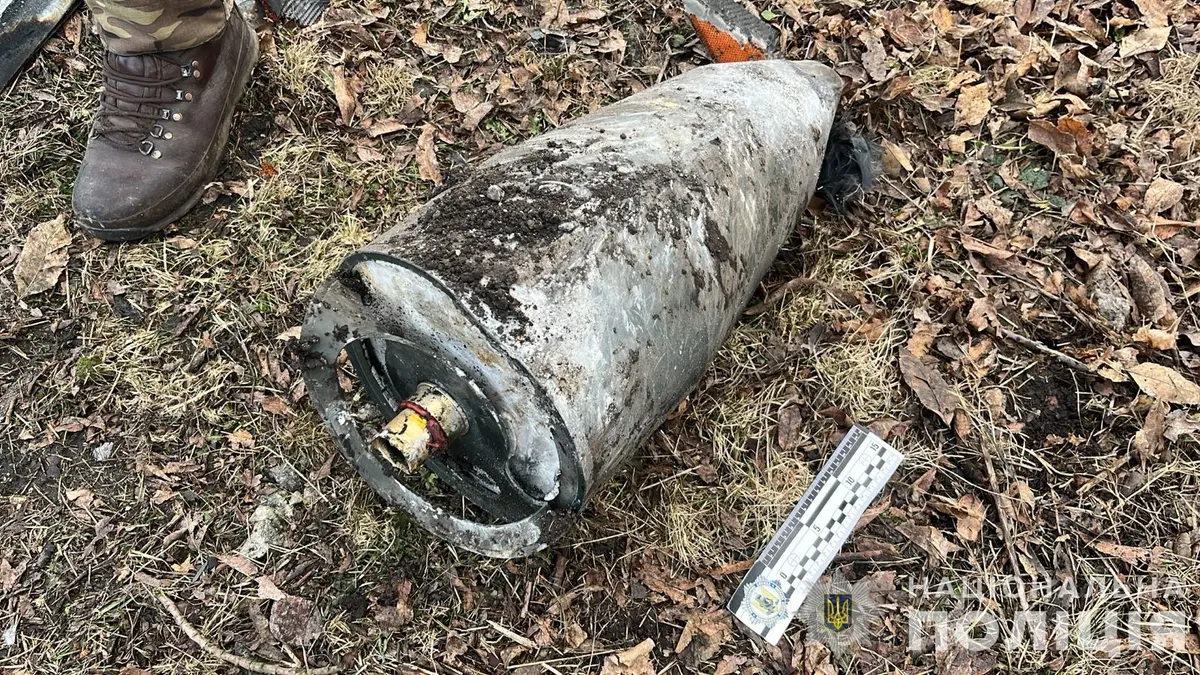
Guidance has changed substantially since the type's Iranian-supplied origin. The first Russian-marked airframes in 2022 retained the Iranian civilian-GPS-based navigation module; Russia replaced this from around October 2022 with a domestic flight-control unit using GLONASS rather than GPS, and later fitted a GLONASS-compatible, electronic-warfare-resistant navigation module known as "Kometa-M."2 A December 2023 teardown found civilian 4G SIM cards and modems added for real-time tracking of airframes in flight.1 By September 2024, recovered examples carried Starlink-branded hardware, reportedly enabling an operator to retarget a drone remotely at distances beyond 2,000 km from the launch site.1 By June 2025, some airframes carried a small onboard computer, a Raspberry Pi 5 paired with a Windows 11 mini-PC, apparently intended for onboard image processing and target recognition rather than pure pre-programmed routing.1 Most recently, a March 2026 report described a passive radar-homing seeker fitted to a Geran-2 variant, giving it a limited anti-radiation capability against emitting air-defense radars.11
Launch is by a rocket-assisted solid booster from a ramp or rail, jettisoned once the drone reaches cruise flight; truck-mounted mobile launchers are also fielded, letting a battery relocate between salvos.3 A July 2023 teardown of a recovered airframe found the Iranian lightweight honeycomb composite structure replaced with a fiberglass-over-woven-carbon-fiber layup in Russian-built examples, a change that appears aimed at easier mass manufacture rather than at any gain in speed, range, or radar performance.2 The database's own classification of the type as non-stealth reflects this: the Geran-2 carries no faceted low-observable shaping or radar-absorbent coating comparable to a dedicated stealth aircraft, and its low detectability against some radar systems owes more to its small size and low flight altitude than to any signature-reduction design.2
Unit cost has fallen as Russian production matured. Leaked program documents put Russia's 2022 cost per unit at roughly $370,000 before domestic supply chains existed at scale, against a stated 2023 target near $48,000; by April 2024 the figure was reported at about $80,000 as hardening and upgrades were added, and by 2025 open-source estimates place domestic unit cost closer to $70,000.12,9 These figures sit well above the roughly $20,000-50,000 sometimes cited in press coverage, a lower range that appears to describe estimated raw-component cost rather than what Russia has actually spent per fielded unit.12
Russian production traces to a December 2022 agreement between Iran and Russia, arranged through the Alabuga Special Economic Zone: an estimated $1.75 billion, paid largely in gold bullion, for roughly 6,000 Shahed-136 kits together with a manufacturing license and training, the same deal recorded in this database against the Shahed-136 entry.8,9 The Alabuga plant opened for assembly in July 2023, initially building from Iranian-supplied kits before shifting toward more domestically sourced components; Russia reportedly reached the original 6,000-unit target about a year ahead of the contract's own schedule, a floor rather than a ceiling on the program's eventual output.2,8
Output climbed steadily from there. Monthly production stood at roughly 100 units in January 2023, reached an estimated cumulative 4,500 units by April 2024 at a reported cost of about $80,000 per unit, and rose to roughly 200 units a week by September 2024.13,12 By March 2025, weekly output exceeded 1,000 units; by May 2025, trackers cited roughly 170 units a day, around 2,700 a month, and a cumulative total near 26,000.7 Ukrainian military intelligence projected 4,000 combined Geran-2/Garpiya-1 units a month by autumn 2025 and 5,000 a month by December, against a reported Russian production plan of 79,000 combined units for the year.7 The most rigorous available tally, compiled by the Institute for Science and International Security, counted 54,538 total Shahed-type UAV launches across 2025, of which roughly 32,200 were strike-configured airframes rather than Gerbera-type decoys, rising from about 10,731 in the first quarter to 15,876 in the fourth; by the fourth quarter, the steady-state rate was roughly 176 launches a day.7 Into 2026, more than 4,600 Shahed-type drones were launched in the first six weeks of the year alone.7 Alabuga's own physical capacity has been estimated at 5,000-5,500 units a month, and the complex expanded from about 80,000 m² to 160,000 m², with four additional buildings under construction, over the same period.5
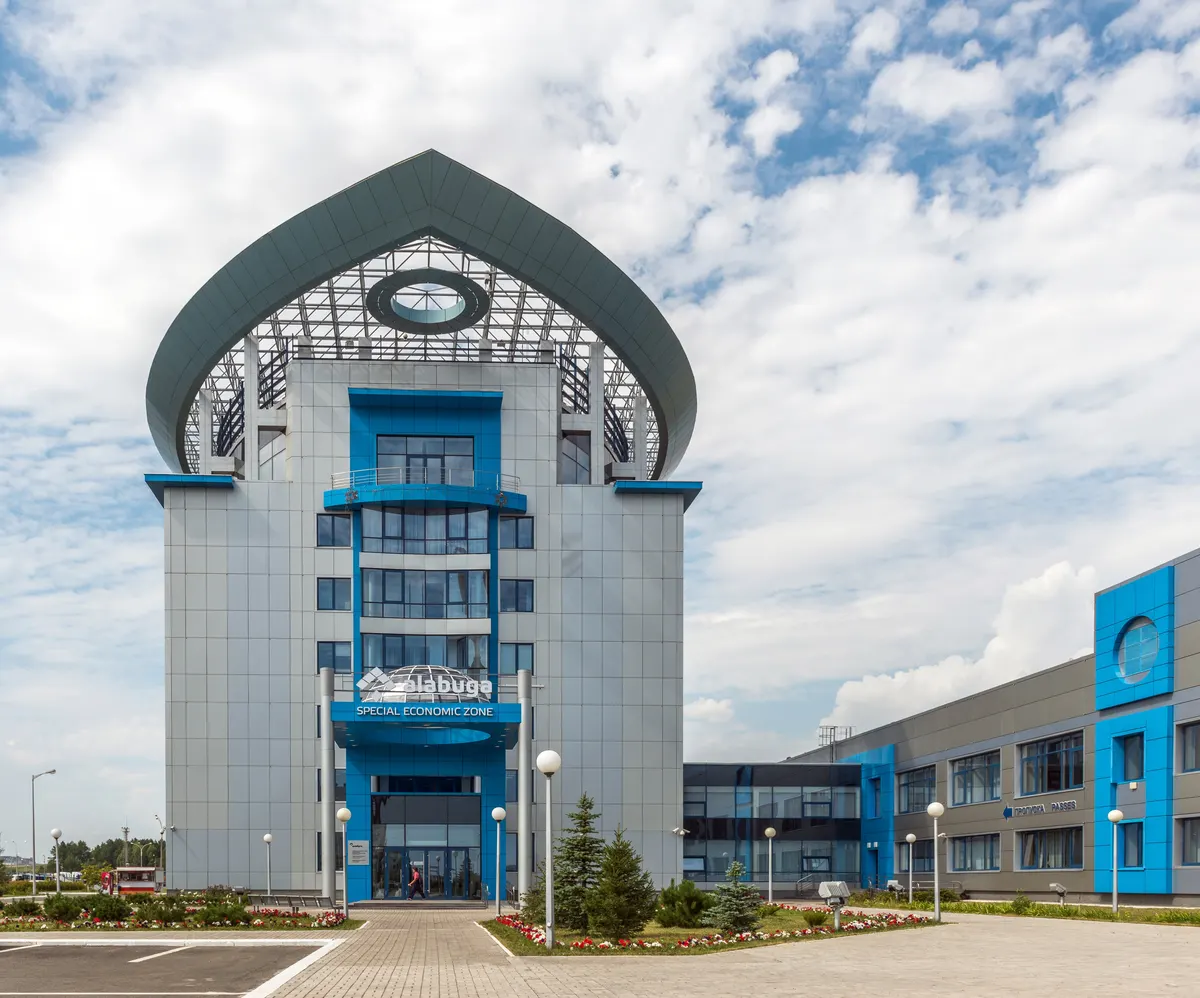
A second production line at IEMZ Kupol in Izhevsk was first reported by Reuters in September 2024 and confirmed by satellite imagery, showing an expanded security perimeter and increased vehicle traffic, by late December of that year.4,5 Russian planners appear to have treated the second site as deliberate dispersal against Ukrainian strikes rather than a replacement for Alabuga; Kupol-built airframes are distinguished by the Cyrillic "КБ" marking noted above, separate from Alabuga-built units.6 Alabuga itself has been struck at least twice: on April 2, 2024, when Russian officials reported only minor damage against Ukrainian claims of significant destruction, and on June 15, 2025, in a strike that killed one person and injured thirteen; Russia subsequently installed Pantsir air-defense systems around the facility in August 2025.5
Alabuga's workforce has drawn separate scrutiny unrelated to the drone's technical specifications: reporting has documented chronic understaffing against a planned three-shift, 810-person operation, the employment of Alabuga Polytech students as young as 15, and the recruitment of more than 1,000 foreign workers, predominantly African women, who have reported passport confiscation and shifts of up to 15 hours; North Korean workers were reportedly sent to the site beginning around June 2025.5
The type entered Ukrainian combat under Russian markings in September 2022, part of an early campaign that, by mid-October that year, was launching dozens of airframes at a time against electrical infrastructure, cutting power to hundreds of towns and villages across three regions in a single week of strikes.2
Reporting from May 2024 recorded 2,628 Shahed-type drones launched over the preceding six months; by full-year 2025, the most rigorous available count, from the Institute for Science and International Security, put total Shahed-type launches at 54,538, of which about 32,200 were strike-configured rather than decoy airframes.7 Single-day totals in 2025 reached as high as 823 air-attack vehicles on September 7 (810 of them Shahed-type), 728 on July 9, and 653 each on October 30 and December 6.7 Russia struck Ukrainian cities on 357 of 365 nights in 2025, missing only eight.7 Early 2026 continued the trend, with more than 4,600 Shahed-type drones launched in the first six weeks of the year, and a single attack on May 23, 2026 combining roughly 600 drones with 36 ballistic missiles alongside Kinzhal, Zircon, and Oreshnik missile strikes.7
Ukrainian Air Force interception rates against this drone traffic have fluctuated rather than improved in a straight line. Early 2025 figures generally exceeded 90 percent, including a claimed 94.6 percent on a roughly 1,000-drone night on March 24; the rate fell to about 82 percent in May 2025, recovered to 86-89 percent through July, declined again to around 85 percent by September, and reached a 2025 low of 79.9 percent in October as both attack volumes and Russian tactics improved.7 By April 2026, interception climbed back toward roughly 90 percent, a recovery credited chiefly to Ukraine's own interceptor-drone crews, which by some counts account for around nine of every ten intercepted Shahed-type drones, with a claimed kill rate near 95 percent against Shahed-type swarms specifically, above what surface-to-air missile systems alone have achieved against this traffic.7
The type has also reached NATO airspace directly. On September 10, 2025, 19 Russian drones penetrated Polish airspace, an incident NATO Secretary General Mark Rutte described as the largest concentration of NATO airspace violations the alliance had recorded, and which Poland characterized as a deliberate test; at least one of the recovered drones was identified as a Geran-2, and the incursion prompted NATO's "Eastern Sentry" reinforced air-policing posture.1 Three to four days later, on September 13-14, 2025, a Geran drone breached Romanian airspace, orbiting for roughly 50 minutes between the towns of Chilia Veche and Izmail before exiting back toward Ukraine near Pardina.1 The most serious such incident to date came on May 28-29, 2026, when a Geran-2 crashed into a ten-story residential building in Galați, Romania, and detonated its full warhead on impact, injuring two people — the first injuries on NATO soil directly attributed to this program — prompting Bucharest to weigh invoking Article 4 consultations.1
Geran-1 is the Russian designation applied to the smaller Shahed-131-based airframe, roughly 2.6 m long with a 2.2 m wingspan and a reported range near 900 km on a lighter warhead than the Geran-2 carries.1

Geran-3 replaces the Geran-2's piston engine with a Chinese-sourced turbojet producing roughly 785 N of thrust, reaching 300-370 km/h and about 1,000 km of range while keeping the same wing and stabilizer layout as the Geran-2 — unlike some Iranian jet-powered variants, which modify the control surfaces and intakes as well.1 It retains the same 50 kg warhead option but loses the Geran-2's heavier 90 kg configuration. Ukrainian intelligence first disclosed the type's existence in September 2025, and a recovered winter-configuration specimen later gave Ukrainian analysts data on its 12-element CRPA anti-jam GNSS antenna.1 The faster line generally described in press coverage as "jet-powered Geran," reaching up to roughly 500 km/h, is tracked in this database as a separate weapon record, the Geran-4, filed under the combat-strike-drones category rather than loitering munitions — a categorization that itself reflects how differently the two propulsion types perform in practice, despite the shared external appearance.1
A further variant, Geran-5, was reported in testing in late 2025 and confirmed operationally deployed by Ukrainian sources in January 2026; it reportedly carries a newer 16-element CRPA anti-jam antenna array along with an onboard camera and radio modem enabling in-flight retargeting.1
Gerbera is a related, separately tracked airframe in this database, a cheaper decoy sharing the Alabuga production line and built to mimic the Geran-2's radar and visual signature rather than to carry an equivalent warhead.7 At under 20 kg and built largely from foam and plywood, its engine reportedly costs only $350-500 and the complete airframe a few thousand dollars, a small fraction of a real Geran-2's unit cost; it flies a reported 600 km range, and Russian personnel have informally called it the Geran's "younger sister," a nickname rather than a technical designation.7 Russia has publicly credited its own Gastello Design Bureau with the design; Ukrainian intelligence instead attributes the engineering to the Chinese firm Skywalker Technology, with kits reportedly finished at Alabuga.10 By November 2024, decoys accounted for roughly half of all launched Russian drones and about 75 percent of new Alabuga output at that point, though by mid-2025 some Gerbera variants had been fitted with warheads or reconnaissance payloads, blurring the type's original decoy-only role.7

Against the Iranian Shahed-136 it is built from, the Geran-2 shares core dimensions, and the two systems' scored differences in this database, once entered, are expected to sit in guidance and electronic-warfare resistance rather than airframe size: the Geran-2's GLONASS/Kometa-M navigation and satellite-relay retargeting represent a genuine capability step past the Iranian original's civilian-GPS baseline, even as the underlying claim of near-total domestic manufacture remains independently disputed.2,10 Warhead options differ too: the Geran-2's 90 kg heavy-warhead configuration, traded against range, has no confirmed equivalent on baseline Iranian-built Shahed-136 airframes.1
Set against shorter-range, sensor-guided loitering munitions, the Geran-2 occupies a different tactical niche entirely. The ZALA Lancet, Russia's own tactical anti-armor loitering munition, carries an EO/optical seeker and an operator terminal for precision terminal guidance, but at a nominal range of only about 40 km, up to roughly 70 km demonstrated, and a warhead of no more than about 5 kg.1 The American AeroVironment Switchblade 600 and Israeli Elbit Systems SkyStriker sit in a similar tactical-range bracket, built around a man-portable or small-team launch footprint and terminal precision against point targets rather than standoff mass strikes.1
| System | Range | Speed | Warhead | MTOW | Unit cost |
|---|---|---|---|---|---|
| Geran-2 | ~650-2,500 km (loadout-dependent) | 185 km/h | 50 kg (up to 90 kg) | ~200 kg (up to 240 kg) | ~$70,000-80,000 |
| HESA Shahed-136 | up to 2,500 km | 185 km/h | up to 50 kg | ~200 kg | ~$193,000 (2022 export price) |
| ZALA Lancet | ~40 km (≥70 km demonstrated) | 110 km/h cruise / 300 km/h dive | up to 5 kg | 12 kg | tactical-range, far cheaper |
| AeroVironment Switchblade 600 | ~40 km outbound (≤80 km with relay) | 185 km/h dash | Javelin-derived anti-armor charge | 54.5 kg | — |
| Elbit Systems SkyStriker | 100-200+ km | ~185 km/h | 5 or 10 kg | ~40 kg | — |
The comparison underlines a single point: the Geran-2 is a strategic, mass-produced standoff weapon, comparable in scale mainly to its own Iranian parent, while the Lancet, Switchblade 600, and SkyStriker are tactical, sensor-guided munitions built to hit one target precisely at short range rather than to saturate a target set with numbers.1

How is the Geran-2 different from the Iranian Shahed-136 it is built from?
Externally the two are the same delta-wing airframe, about 3.5 m long with a 200 kg empty weight and a 50 kg standard warhead. The Geran-2 differs in where it is assembled, at Alabuga and IEMZ Kupol in Russia rather than in Iran, in its navigation hardware, GLONASS and the Kometa-M electronic-warfare-resistant module rather than the Iranian civilian-GPS baseline, and in offering a heavier 90 kg warhead option traded against range.1,2
Is Russia's claim of roughly 90 percent domestic production accurate?
This is disputed. Russian officials and state media have claimed about 90 percent domestic localization by 2025, including the engine. An August 2025 investigation by Frontelligence Insight instead traced the engines to a Chinese-owned manufacturer and catalogued at least 41 Chinese-origin components in the program, concluding that China's role has grown substantially as Iran's direct involvement has receded.10
What is the difference between the Geran-2 and the Geran-3/Geran-4?
The Geran-2 uses a piston engine and propeller, reaching about 185 km/h. Geran-3 and Geran-4 use a Chinese-sourced turbojet, reaching 300-500+ km/h depending on the specific report, and are tracked in this database as a separate weapon record, the Geran-4, under a different weapons category. Some of the deadliest 2025-2026 strikes on Kyiv combined both types with missiles in the same raid, and casualty figures from those strikes belong to the combined attack rather than to the Geran-2 specifically.1
How many Geran-2 drones has Russia produced or launched?
Precise cumulative production is not publicly confirmed and is best treated as a moving, disputed figure. The most rigorous available count, from the Institute for Science and International Security, tallied 54,538 total Shahed-type UAV launches in 2025 alone, about 32,200 of them strike-configured rather than decoy airframes, with more than 4,600 further launches in the first six weeks of 2026.7
Has a Geran-2 ever struck NATO territory?
Yes. Geran-type drones entered Polish airspace on September 10, 2025 (19 drones) and Romanian airspace on September 13-14, 2025. On May 28-29, 2026, a Geran-2 crashed into a residential building in Galați, Romania, injuring two people in the first NATO-soil injuries directly attributed to the program.1
- "Shahed 136", Wikipedia — en.wikipedia.org ↩
- "Exclusive: Focus – Geran-2 Kamikaze Drone, the Russian Version of the Iranian Shahed-136, Deployed in Ukraine", Army Recognition — armyrecognition.com ↩
- "Russian 'Geran' / Shahed Drones", Covert Shores — hisutton.com ↩
- "Russia Ramps Up Drone Infrastructure: In Addition to Alabuga, Shahed Drones Now Produced at IEMZ Kupol", Defense Express — en.defence-ua.com ↩
- "Yelabuga drone factory", Wikipedia — en.wikipedia.org ↩
- "Iran Launches Russian Geran Drones — Copies of Its Own Shaheds — as Moscow and Tehran Spread Them to Allies", United24 Media — united24media.com ↩
- "A Comprehensive Analytical Review of Russian Shahed-Type UAVs Deployment Against Ukraine in 2025", Institute for Science and International Security — isis-online.org ↩
- "Shaheds For What? Russia Drone Deal May Have Given Iran Seller's Remorse", Forbes — forbes.com ↩
- "Gold for Drones: Massive Leak Reveals the Iranian Shahed Project in Russia", Haaretz — haaretz.com ↩
- "Why Russia's Shahed Drone Program Cannot Survive Without China", Frontelligence Insight via United24 Media — united24media.com ↩
- "Geran-2: The Anti-Radar Evolution of Russian Drones", Meta-Defense — meta-defense.fr ↩
- "How Much Russia Pays For Shahed Now, Down From $300,000 Per Drone In 2022", Defence UA — en.defence-ua.com ↩
- "Visible Progress at Russia's Shahed Drone Production Site", Institute for Science and International Security — isis-online.org ↩