


Phoenix Ghost is a family of one-way attack drones, a type of loitering munition, developed by AEVEX Aerospace, a private defense-technology firm headquartered in Solana Beach, California.1,2 The United States Department of Defense began sending Phoenix Ghost systems to Ukraine in April 2022, two months into Russia's full-scale invasion, as part of a broader push to rush loitering munitions to Ukrainian forces alongside AeroVironment's Switchblade line.1,3 For more than two years the program's actual specifications were kept almost entirely out of public view; AEVEX and the Pentagon confirmed only that the weapon existed and that it worked, without publishing dimensions, weight, warhead size, or even photographs.2,3
- Rapidly fielded and scaled: from a handful of prototypes to a reported 5,000+ units delivered in under three years[^6]
- Reported unit prices ($49,000–$69,000 for base configurations) well below many Western precision munitions[^7]
- Visual-based, GPS-independent navigation resists Russian electronic jamming[^2]
- Spans two weight classes (Group 2 and Group 3), giving Ukraine both a light, portable option and a longer-range strike option under one program
- Extended-range "EFI" variants reportedly push range past 800 miles (1,300 km), well beyond most tube-launched rivals[^2]
- Core specifications remain unconfirmed or inconsistent across official disclosures years after fielding[^2][^3]
- No independently verified combat footage existed for over two years, making battlefield-performance claims hard to check[^8]
- Reported figures for the Dominator variant differ substantially between 2024 sources, even after AEVEX's own disclosure[^2][^3]
- Warhead size and armor-penetration data have not been published for any variant
That secrecy broke in October 2024, when AEVEX representatives disclosed at the Association of the US Army (AUSA) symposium in Washington that "Phoenix Ghost" was never a single airframe. It is a program name covering at least four distinct designs — Atlas, Dagger, Disruptor, and Dominator — spanning two Department of Defense unmanned-aircraft weight classes (Group 2 and Group 3) and two propulsion types.2,4 The program traces to the U.S. Air Force's Big Safari special-projects office, and AEVEX has said some of the airframes began as aerial targets the company built for testing counter-drone defenses before being adapted into strike munitions.3
By the Pentagon's own account, Ukrainian units used the early production run heavily and effectively against targets it was never meant to be seen doing.5 A senior defense official said in mid-2022 that "the Ukrainians have been making excellent use of the Phoenix Ghost system," a judgment that helped justify expanding the contract well beyond the first announced batch.5 By December 2024, AEVEX said it had delivered more than 5,000 Phoenix Ghost airframes to Ukraine, funded through roughly $582 million in Pentagon contracts, making the company the largest single supplier of drones to Ukraine under U.S. government contracts.6
What Is Actually Confirmed About Phoenix Ghost Specifications
Public Phoenix Ghost specifications only exist because AEVEX chose to release them at the October 2024 AUSA symposium; nothing before that date came with dimensions attached to an on-the-record company source.2 Two of the disclosed designs, Atlas and Dagger, fall into the Pentagon's Group 2 unmanned-aircraft category (roughly 9–25 kg maximum takeoff weight) and are electrically propelled. Atlas is reported at about 0.9 m long with a 1.7 m wingspan, a maximum takeoff weight near 9.5 kg, an 3.7 kg payload, and one to two hours of endurance over a range of roughly 120 km.3 Dagger is somewhat larger, at about 1.8 m long with a 2.7 m wingspan, a 15.9 kg maximum weight, an 80-minute endurance, and a range near 193 km; AEVEX has priced the base Dagger configuration at roughly $49,000 per unit.3,7
Disruptor and Dominator sit in the heavier Group 3 class (up to about 600 kg) and use internal-combustion engines turning a pusher propeller rather than electric motors.2 Disruptor is reported at 3.08 m long with a 4.8 m wingspan, a maximum takeoff weight of about 84 kg on a pneumatic tube launch or 93 kg using rocket-assisted takeoff (RATO), and a roughly 23 kg payload. AEVEX gives its standard-engine endurance as 4.5 hours over a 599 km range, extending to 11.6 hours and 1,323 km with an upgraded fuel-injected ("EFI") engine option.2 AEVEX prices a basic Disruptor at roughly $69,000.7
Across all four variants, AEVEX describes a common navigation approach built around visual-based navigation, in which the aircraft autonomously identifies and tracks landmarks and terrain features to hold a course without relying on GPS, backed by mesh-networked radio links and combined electro-optical/infrared sensor data for target identification.2 That design choice matters directly in the Ukraine theater, where Russian electronic-warfare units routinely jam GPS signals across large stretches of the front. Launch methods vary by variant: Atlas and Dagger are hand- or catapult-launched given their light weight, while Disruptor can be launched pneumatically from a tube, by rocket booster, or from a moving vehicle.2 None of the four disclosed designs incorporates radar-absorbent coating or faceted shaping; AEVEX has not claimed low-observable performance for any Phoenix Ghost variant.
Origins in the Air Force's Big Safari Program
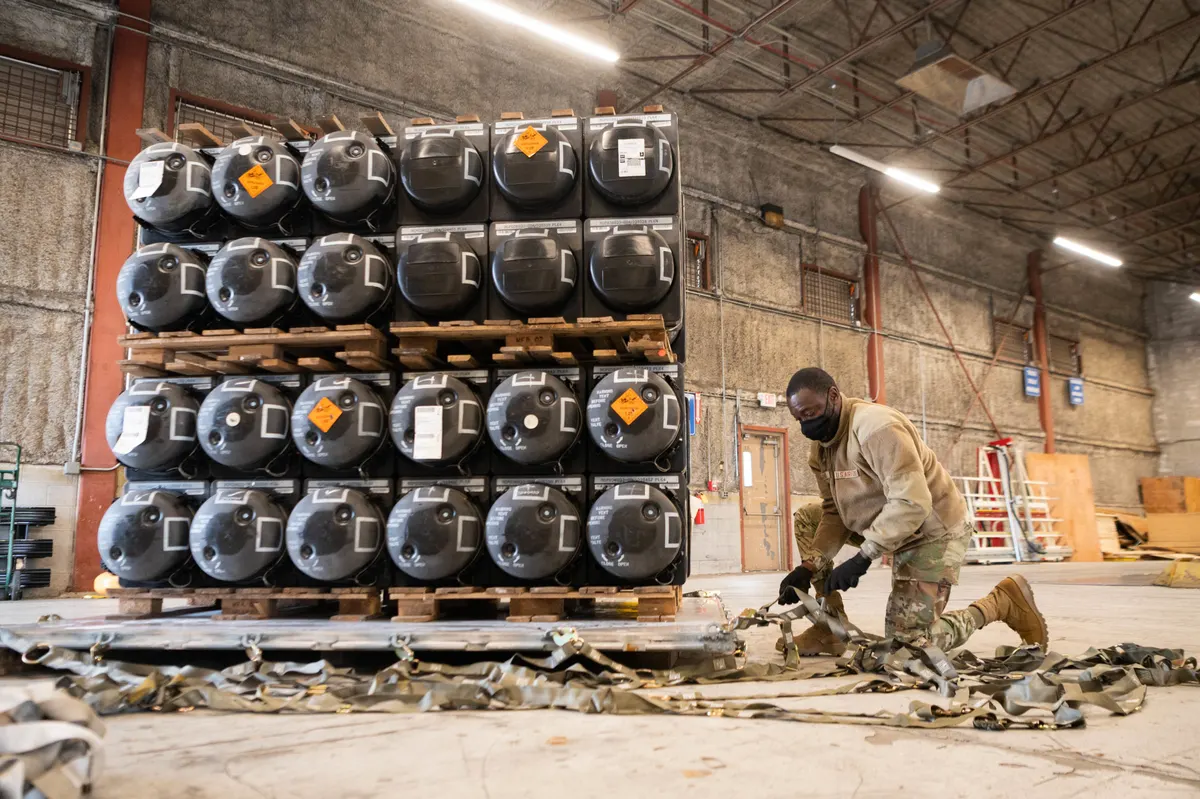
Phoenix Ghost did not begin as a wartime emergency program. AEVEX has said the effort traces to the U.S. Air Force's Big Safari special-projects office, the same organization responsible for a range of rapid, low-profile aircraft modification programs, and that some of the airframes started life as aerial targets built to help test American counter-drone systems before Russia's invasion of Ukraine.3 That predates the war itself, which sits awkwardly next to Pentagon statements at the time describing the system as built quickly and specifically to answer a Ukrainian battlefield requirement — a tension the department's own secrecy around the program made difficult for outside observers to resolve.1,5
Rollout to Ukraine, 2022–2024
The Pentagon first disclosed Phoenix Ghost publicly in an aid package announced in April 2022, which included at least 121 of the systems; the first shipments reached Ukrainian forces before the end of that month.1,5 Asked how the new weapon compared to the already-fielded AeroVironment Switchblade, Pentagon spokesman John Kirby said Phoenix Ghost offered "similar" capability but not an exact match, citing "differences in the scope of capability" between the two systems without elaborating.2 That comparison, made before either system's specifications were public, fueled years of press speculation that Phoenix Ghost was simply a rebadged or lightly modified Switchblade; AEVEX's later disclosures showed it to be a separate, in-house design.
In July 2022, the Pentagon authorized a further 580 Phoenix Ghost units under a roughly $175 million drawdown package, enabling steady shipments from August onward; by September 2022 close to 700 units had reached Ukraine.6,10 A November 2022 package added a further 1,100 units, bringing the total pledged since April to at least 1,800 systems.11
Deliveries continued to scale through 2023 and 2024: AEVEX's chief executive said in mid-2024 the company was shipping more than 300 drones a month, against a stated maximum capacity near 1,000 a month if the company moved to three production shifts.3
The October 2024 Disclosure
AEVEX used the AUSA symposium to reveal, for the first time, that the airframe had changed considerably since 2022 — a company representative said the nose cone and paint scheme had both been altered for improved camouflage from the version originally fielded — and to name the four variants publicly for the first time.2 By December 2024, the company put its cumulative Ukraine deliveries at more than 5,000 units across roughly $582 million in Pentagon contracts, a figure that made Phoenix Ghost, by unit count, the largest American drone program supporting Ukraine.6
Documented Phoenix Ghost combat use is limited to the Russo-Ukrainian War following Russia's February 2022 full-scale invasion; no other confirmed operational deployment has been reported.1 Ukrainian officials described the system as effective against medium-armored ground vehicles, artillery positions, and troop concentrations, aided by an onboard infrared sensor that allows night operation and by loiter times the Pentagon put at up to six hours for some configurations.5,9
Battlefield-effectiveness claims for the system are harder to verify than the delivery numbers behind them. Ukrainian presidential adviser Oleksiy Arestovych said in mid-2022 that the 580-unit tranche then being delivered should account for roughly 350 destroyed targets, implying a claimed hit rate near 60 percent, and separate reporting suggested the initial 121-unit batch may have accounted for 70 or more destroyed targets.9 None of these figures has been independently confirmed by U.S. officials or corroborated with verified strike footage; a Pentagon official's on-the-record comment was limited to the general statement that Ukrainian forces were making "excellent use" of the system.5,9
AEVEX's October 2024 disclosure named four variants across two Department of Defense weight classes. Figures below follow The War Zone's account of AEVEX's AUSA presentation; Dominator figures in particular have been reported differently elsewhere, as noted above.2
| Variant | DoD Group | Max. Weight | Endurance | Range | Base Price |
|---|---|---|---|---|---|
| Atlas | Group 2 (electric) | ~9.5 kg | 1–2 hr | ~120 km | not disclosed |
| Dagger | Group 2 (electric) | ~15.9 kg | ~80 min | ~193 km | ~$49,0007 |
| Disruptor | Group 3 (piston engine) | ~84–93 kg | 4.5 hr (11.6 hr, EFI) | ~599 km (~1,323 km, EFI) | ~$69,0007 |
| Dominator | Group 3 (piston engine) | ~93–102 kg | 4.6 hr (11.7 hr, EFI) | ~471–1,196 km2 | not disclosed |
Disruptor's twin-boom-less, straight-wing airframe and Dominator's twin-boom, inverted-V-tail configuration are the two most visually distinct designs among the four, according to AEVEX's own description; both can accept either a standard piston engine or a longer-range, fuel-injected ("EFI") engine option that roughly doubles endurance and range at the cost of a heavier, more complex powerplant.2

| Year | Buyer | Quantity | Amount | Present Value (2025) |
|---|---|---|---|---|
| 2024 |  Ukraine | 5,000 | $582.0 M | $597.3 M |
| 2022 | Ukraine | 121 | — | — |
| 2022 | Ukraine | 580 | $175.0 M | $192.5 M |
| 2022 | Ukraine | 1,100 | — | — |

The United States developed Phoenix Ghost through the Air Force's Big Safari office and has funded every unit sent to the field, but it is not the system's combat operator; U.S. forces have not been reported using Phoenix Ghost themselves.3 Ukraine is the program's sole confirmed operator, having received the type continuously since April 2022 across a series of presidential drawdown and Ukraine Security Assistance Initiative packages: at least 121 units in April 2022, 580 more from July 2022, and a further 1,100 in November 2022, for a total of at least 1,800 pledged by the end of that year, rising to a cumulative delivered total AEVEX put at more than 5,000 by December 2024.1,6,10,11
Phoenix Ghost's most consistent point of comparison in press coverage is AeroVironment's Switchblade family, the other major loitering munition the United States has supplied to Ukraine in quantity, and the specific system the Pentagon's spokesman referenced by name when Phoenix Ghost was first announced.2 The two programs differ in nearly every particular now that both are documented: Switchblade 300 is a single, tube-launched airframe weighing between 2.7 kg and 3.6 kg depending on production block, with a roughly 10 km range and 10-to-20-minute endurance, carrying a small warhead equivalent to a 40 mm grenade for use against personnel and light vehicles.12 Switchblade 600 scales that concept up for anti-armor work: a roughly 22.7 kg system with a stated range beyond 40 km, about 40 minutes of endurance, and an anti-armor warhead built for hardened, standoff targets, reportedly priced around $200,000 per unit.13,12
Phoenix Ghost, by contrast, is a program spanning four separate airframes rather than one, and its Group 3 variants outrange either Switchblade by a wide margin: Disruptor's standard-configuration 599 km range, or 1,323 km with the EFI engine option, is many times Switchblade 600's 40+ km figure, though the two systems are not really built for the same tactical problem.2,13 Switchblade's tube-launched, backpack-portable form factor suits a squad or platoon holding a fixed position and needing a fast, short-range precision strike; Phoenix Ghost's larger Group 3 variants trade that portability for far longer standoff range and loiter time, positioning them closer to a small strike aircraft than a soldier-carried munition. On price, AEVEX's disclosed base figures ($49,000 for Dagger, $69,000 for Disruptor) undercut Switchblade 600's reported unit cost considerably, though neither company has published a fully like-for-like cost breakdown covering training, ground control equipment, and logistics.7,13
Set against Ukraine's other Western-supplied loitering munitions, such as Elbit's SkyStriker, Phoenix Ghost's public specification set remains the least mature: SkyStriker's warhead options (5 kg and 10 kg), endurance figures, and launch method have been publicly documented by Elbit since 2017, while equivalent Phoenix Ghost figures only became public in October 2024, and even then with the internal inconsistencies noted above.2,4


What are the Phoenix Ghost's specifications?
Confirmed Phoenix Ghost specifications only exist for the four variants AEVEX named in October 2024: Atlas and Dagger (Group 2, electric, under 16 kg, 1–2 hour endurance) and Disruptor and Dominator (Group 3, piston-engined, roughly 84–102 kg, 4.5-to-11.7-hour endurance depending on engine option).2 Even those figures are reported inconsistently for the Dominator variant across different 2024 sources, so some specification details remain genuinely unsettled in open reporting rather than simply unpublished.2,3,4
How much does the Phoenix Ghost cost?
AEVEX has disclosed base prices of about $49,000 for the Dagger variant and $69,000 for the Disruptor variant. Averaged across the roughly $582 million the Pentagon had paid for more than 5,000 units by December 2024, the blended program cost works out to around $116,000 per unit, though that figure mixes all four variants together with contract overhead rather than reflecting a single airframe's price.6,7
What is the Phoenix Ghost's range?
Range varies sharply by variant. Atlas is credited with roughly 120 km, Dagger with about 193 km, and Disruptor with 599 km on its standard engine, extending to 1,323 km with the optional fuel-injected engine. Dominator's range has been reported inconsistently, from roughly 470 km to nearly 1,200 km depending on the source and engine option.2,3
How many Phoenix Ghost drones has the US sent to Ukraine?
The Pentagon pledged at least 1,800 Phoenix Ghost units across three packages in 2022 alone: 121 in April, 580 in July, and 1,100 in November. By December 2024, AEVEX said cumulative deliveries under U.S. government contracts had passed 5,000 units.1,6,10,11
Phoenix Ghost vs Switchblade: what is the difference?
Switchblade is a single-airframe, tube-launched family (the 300 for light targets, the 600 for armor) built around short range and rapid, backpack-portable deployment. Phoenix Ghost is a four-variant program spanning two weight classes, with its larger Group 3 designs reaching far greater range and endurance than either Switchblade model, at the cost of a bulkier launch footprint and a specification record that only became public in late 2024.2,13
Who makes the Phoenix Ghost?
AEVEX Aerospace, a privately held U.S. defense-technology company based in Solana Beach, California, builds Phoenix Ghost under a U.S. Air Force program that traces to the Air Force's Big Safari special-projects office.1,3
- "Aevex Phoenix Ghost", Wikipedia — en.wikipedia.org ↩
- "Secretive Phoenix Ghost Kamikaze Drones Rushed To Ukraine Finally Come Out Of The Shadows", The War Zone — twz.com ↩
- "Tracking Down The Mysterious Phoenix Ghost Kamikaze Drone", Forbes — forbes.com ↩
- "Secretive Phoenix Ghost Loitering Munitions Sent to Ukraine Since 2022 Revealed at AUSA Symposium", The Aviationist — theaviationist.com ↩
- "The Pentagon Commented On Phoenix Ghost Performance In Ukraine And Reported an Increase In Their Number", Defense Express — en.defence-ua.com ↩
- "Revealed: The Mysterious Phoenix Ghost Drones Of The Ukraine War", Forbes — forbes.com ↩
- "Price For Phoenix Ghost Drones Revealed: The Mysterious Drones Developed At Warp Speed in the U.S.", Defense Express — en.defence-ua.com ↩
- "Has Elusive 'Phoenix Ghost' Loitering Munition Broken Cover At Last?", Forbes — forbes.com ↩
- "Has Elusive 'Phoenix Ghost' Loitering Munition Broken Cover At Last?", Forbes — forbes.com ↩
- "DOD to send Ukraine 580 'Phoenix Ghost' drones", InsideDefense — insidedefense.com ↩
- "Refurbished Soviet tanks, HAWK missiles and more Phoenix Ghost drones coming soon to Ukraine", Breaking Defense — breakingdefense.com ↩
- "AeroVironment Switchblade", Wikipedia — en.wikipedia.org ↩
- "Switchblade 600", AeroVironment — avinc.com ↩