

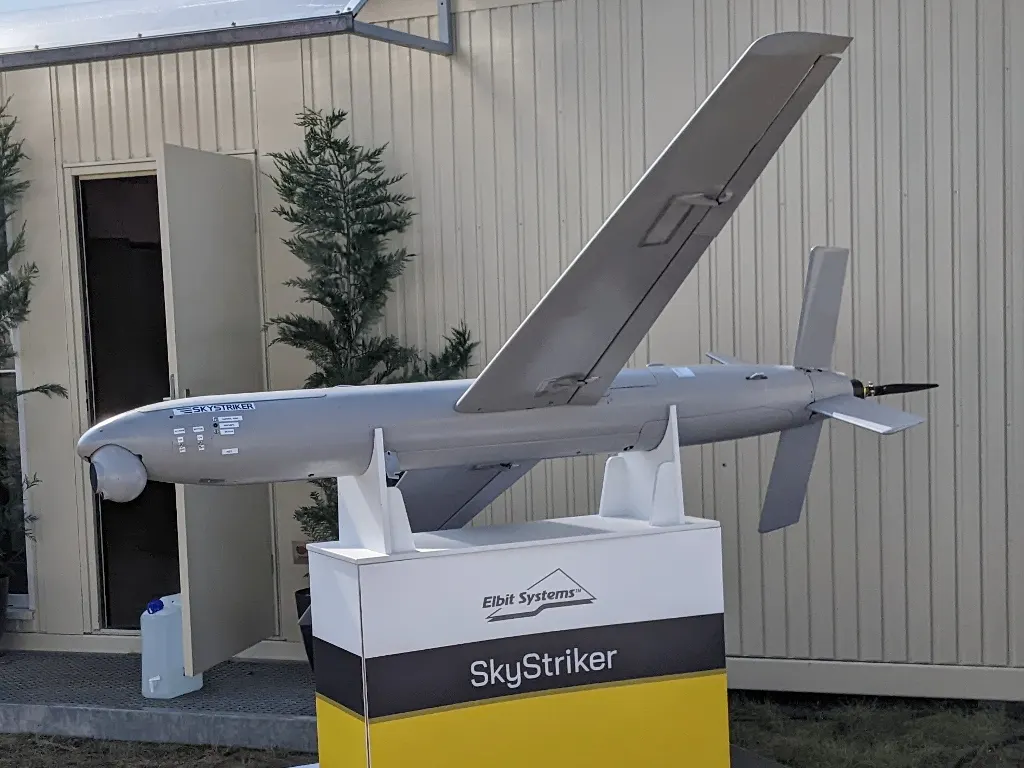

The SkyStriker is an autonomous, electrically propelled loitering munition built by Elbit Systems Ltd. of Israel. Elbit unveiled the system publicly at the Paris Air Show in June 2017, describing it at the time as already in serial production with unspecified orders in place.1,2,3 The weapon belongs to the family of loitering munitions, aircraft that combine a reconnaissance loiter phase with a one-way terminal strike, and it is marketed at the tactical, corps-level end of that category rather than as a strategic long-range weapon.
- Electric propulsion gives a low acoustic and thermal signature in the terminal phase[^6][^7]
- Dual CCD/IR seeker allows precision terminal guidance without reliance on GPS[^4]
- Operator can abort a strike up to two seconds before impact and re-engage or recover the airframe[^4]
- Shares a launch canister with Elbit's PULS rocket artillery, letting one vehicle fire rockets and loitering munitions[^5]
- Two warhead options (5 kg / 10 kg) trade endurance against lethality for different mission profiles[^8]
- Publicly reported range figures are inconsistent across years, complicating direct comparison with rivals[^5][^9]
- Full dimensions (length, wingspan) are not published in open sources
- Endurance drops from roughly two hours to about one hour when the heavier 10 kg warhead is fitted[^8]
- Confirmed export list remains short relative to competing systems from Turkey, Poland, and Russia
Canister- or catapult-launched from ground vehicles or naval platforms, the SkyStriker carries a field-interchangeable 5 kg or 10 kg warhead and is reported at a maximum all-up weight of roughly 35 kg.4,5 A gimbaled dual CCD/infrared seeker with a synchronized tracker lets the operator identify, follow, and strike a target with an electro-optically guided terminal dive, and Elbit states the airframe can complete a mission profile without GPS and under electronic countermeasures.4 The single electric pusher motor keeps the acoustic and thermal signature low enough that, according to trade-press accounts, the aircraft is largely inaudible until near the point of impact.6,7
Elbit designed the SkyStriker as a single airframe with two payload configurations rather than as separate named variants. The 5 kg warhead configuration is rated for roughly two hours of loiter endurance, while fitting the 10 kg warhead cuts that to approximately one hour, a straightforward lethality-for-endurance trade that the operator selects before a mission.4,8
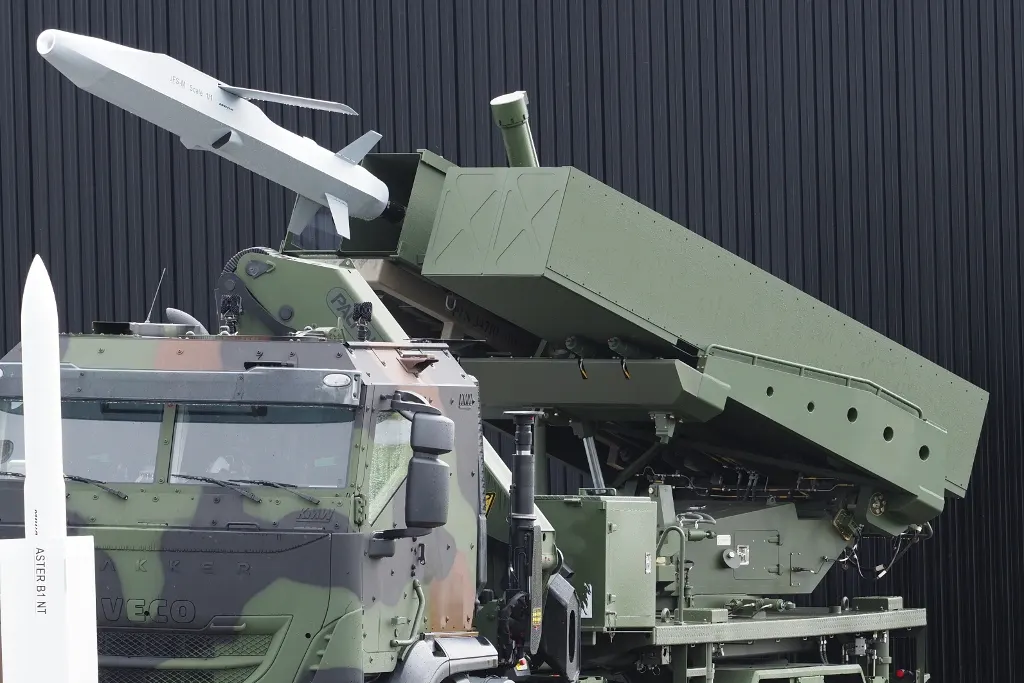
Launch itself is ground- or naval-based, using a sealed canister that can be fired from a dedicated stand-alone rack or integrated directly onto Elbit's PULS multiple rocket launcher, so a single artillery vehicle can fire guided rockets and loitering munitions from the same rail.5,8 Cruise speed is cited at roughly 185 km/h, with a terminal dive reported at up to 300 knots (about 555 km/h), and the system is rated to operate in winds up to 40 knots with only slight accuracy degradation.7,8,4 Once committed to a strike, the operator retains an abort window of up to two seconds before impact and can re-engage the target or recall the aircraft for recovery.4
Sensor and armament fit is comparatively narrow next to reconnaissance-focused unmanned aircraft: the SkyStriker carries an electro-optical/infrared payload for target lock but no SAR/GMTI radar, SIGINT payload, laser designator, or communications-relay package, since its guidance system is built specifically around a strike task rather than persistent surveillance.4 It flies under remote control with autonomous flight-control functions, including automatic takeoff, but has no reported swarming capability.
Several published specification sets diverge from figures elsewhere in this entry's database record, most notably on maximum weight, cruise speed, and range; the values in the prose above follow the sourced trade-press figures rather than the lower database entries.
Below are the recorded specification groups for the SkyStriker.
The following performance, payload, and control fields round out the airframe's operating envelope as tracked in the database.
Set against a similarly weight-classed rival, the Polish WB Electronics Warmate 2 carries a comparable 5 kg high-explosive fragmentation warhead and a similar roughly two-hour endurance, making it the closest analog to the SkyStriker in overall mission profile among the systems catalogued here.
Lighter "micro" loitering munitions occupy a distinct weight class from the SkyStriker. The AeroVironment Switchblade 300 weighs under 4 kg in its current Block 20 form and carries a far smaller charge, while the Rafael Spike Firefly is a backpack-portable, sub-3 kg system built for engagements measured in hundreds of meters rather than tens of kilometers. Both trade the SkyStriker's endurance and warhead size for portability at squad level.
Elbit Systems introduced the SkyStriker at the Paris Air Show in June 2017, stating that the system was already in serial production and that unspecified customer orders existed at the time of the unveiling.1,2,3 Trade coverage from the show framed the aircraft as Elbit's entry into an emerging market for loitering munitions rather than as a wholly new product category for the company.2
Azerbaijan placed the first confirmed foreign order for the SkyStriker in 2019, becoming the system's first publicly reported export customer.11 The following two years brought two further disclosed contracts. In September 2021, the Indian Army signed for approximately 100 units through Elbit and its India-based partner, the Adani Group's Alpha Design Technologies, in a deal reported at roughly $12.3 million (about ₹1 billion), with provision for licensed "Make in India" production at a facility in Bengaluru.10,8
That same month, Turkmenistan revealed its own SkyStriker fleet during a September 2021 independence-day military parade, a disclosure that analysts at Oryx linked to Ashgabat's observation of Azerbaijan's use of the type against Armenia the previous year.11 No purchase announcement had preceded the parade; the aircraft's existence in Turkmenistan's inventory became public only through the broadcast footage itself.
A further export contract followed in September 2023: an unnamed European government signed for "several hundred" canister-configuration SkyStrikers in a deal valued at $95 million, with deliveries scheduled over a two-year window. Neither Elbit nor the buyer government disclosed the customer's identity, and speculation that the buyer operates the PULS launcher system has not been confirmed.5,12
Elbit's most recent publicized step came in June 2026, when the company and Germany's Diehl Defence announced a strategic partnership at the ILA Berlin air show to jointly offer the SkyStriker to the Bundeswehr, with local German manufacturing contemplated if a contract is awarded. The announcement describes an industrial teaming arrangement and a marketing offer, not a signed sale.9
Azerbaijan's use of the SkyStriker during the 2020 Nagorno-Karabakh war against Armenian forces is cited as the type's combat debut, part of a wider Azerbaijani loitering-munition campaign during that conflict.11
Israeli use of the SkyStriker is best documented for a cluster of strikes in Gaza in April 2025, reported by Drop Site News. That reporting attributes five strikes to the system within a five-day span: April 17 in Mawasi Khan Younis, where a tent sheltering the Abu al-Rous family was hit, killing ten or more people including three women and five children; a second strike the same day in Beit Lahia that killed six members of a family sheltering in a tent; a third strike that day in Jabaliya refugee camp, striking the Asaliyah family at approximately 1:20 a.m. and killing seven; a strike on April 19 near a British field hospital tent in Mawasi Khan Younis that killed five members of the Abu al-Nida family; and a strike on April 21 near a café in the same area that killed two people. Drop Site News tallies at least 30 people killed across the five reported strikes, including 14 children, with all five described as hitting tents or other shelters housing displaced civilians.14
The 2025 India–Pakistan conflict, following the April 22, 2025 attack at Pahalgam, brought the type's combat debut for its Indian operator. On May 7, 2025, Indian forces reportedly used SkyStrikers drawn from the 2021 procurement batch in coordinated strikes, alongside Rafale-launched SCALP and AASM Hammer munitions, against a set of seven targets described by Indian officials as camps and infrastructure in Pakistan-administered territory during the operation later named Operation Sindoor.10
Elbit has not published distinct named variants of the SkyStriker. The airframe instead offers a configuration choice between a 5 kg warhead, rated for approximately two hours of endurance, and a 10 kg warhead, rated for approximately one hour, letting the customer trade loiter time for lethality on a per-mission basis.4,8 Launch hardware likewise comes in two forms: a stand-alone canister for ground or naval mounting, and a version integrated directly onto the PULS rocket artillery launcher.5 India's contracted units are being assembled under license through the Elbit–Alpha Design Technologies joint venture in Bengaluru, a production arrangement rather than a distinct model.10

| Year | Buyer | Quantity | Amount | Present Value (2025) |
|---|---|---|---|---|
| 2023 | — | 350 | $95.0 M | $100.4 M |
| 2021 |  India | 100 | $12.3 M | $14.6 M |
| 2021 |  Turkmenistan | — | — | — |
| 2019 |  Azerbaijan | — | — | — |
Confirmed SkyStriker operators are limited to a small set of states with named, sourced acquisition or combat-use reporting.
| Operator | Status | Acquired | Notes |
|---|---|---|---|
| Israel | Active, combat-used | Domestic developer | Documented strikes in Gaza, April 202514 |
| Azerbaijan | Active, combat-used | Ordered 2019 | Combat debut, 2020 Nagorno-Karabakh war11 |
| India | Active, combat-used | Signed September 2021 | ~100 units, ~$12.3 million, licensed local production; combat-used May 202510 |
| Turkmenistan | Active | Revealed September 2021 | Disclosed via independence-day parade footage11 |
| Undisclosed European state | In delivery | Signed September 2023 | $95 million, "several hundred" units, two-year delivery window; identity not confirmed5,12 |
Germany is not a confirmed operator. In June 2026, Elbit and Diehl Defence announced an industrial-teaming arrangement to jointly pitch the SkyStriker to the Bundeswehr, with a German production line contemplated if the offer succeeds; as of that announcement, no purchase contract had been signed.9
The SkyStriker's closest analog by weight, warhead, and endurance class is the Polish WB Electronics Warmate 2, which carries a similar 5 kg high-explosive fragmentation warhead (an anti-armor variant is rated to penetrate roughly 400 mm of rolled homogeneous armor) and a roughly two-hour endurance against the SkyStriker's own two-hour figure on its lighter warhead setting.8 Where the two diverge is stated range: Warmate 2 is cited at up to 240 km depending on radio link, against the SkyStriker's commonly cited 100 km (or "over 200 km" per Elbit's 2026 figure).5,9,8
Russia's ZALA Lancet, by contrast, is a shorter-range, lighter system built around a roughly 40 km operational radius (with strikes reported out to about 70 km) and a base warhead near 3 kg, upgraded variants exceeding 5 kg. Its all-up weight of up to 12 kg is a fraction of the SkyStriker's roughly 35 kg, reflecting a design built for shorter-range, higher-volume use rather than the SkyStriker's longer-loiter tactical role.8
| System | Range | Endurance | Warhead | Weight |
|---|---|---|---|---|
| SkyStriker | ~100 km (2017–2023); "200+ km" claimed 2026 | 2 hr (5 kg) / 1 hr (10 kg) | 5 kg or 10 kg | ~35 kg |
| WB Electronics Warmate 2 | Up to 240 km (180 km radio) | ~2 hr | 5 kg HE-FRAG / 400 mm RHA (HEAT) | 30 kg MTOW |
| ZALA Lancet | ~40 km (strikes to ~70 km) | 40 min (up to 1 hr enhanced) | 3 kg base / 5+ kg upgraded | Up to 12 kg |
What warhead does the SkyStriker carry? The airframe accepts either a 5 kg or a 10 kg warhead, selected before launch; the heavier option shortens rated endurance from about two hours to about one hour.4,8
What is the SkyStriker's operational range? Sources published between 2017 and 2023 cite an operational radius of approximately 100 km. A June 2026 Elbit–Diehl Defence announcement describes a later figure of "over 200 km," most plausibly reflecting a newer production standard rather than a correction of the earlier number.5,9
Which countries operate the SkyStriker? Confirmed operators are Israel, Azerbaijan, India, and Turkmenistan, plus an undisclosed European state that signed a $95 million contract in September 2023. Germany has entered an industrial-teaming arrangement with Elbit and Diehl Defence as of June 2026 but has not signed a purchase contract.11,10,5,9
Has the SkyStriker been used in combat? Yes. Confirmed combat use includes Azerbaijan's deployment during the 2020 Nagorno-Karabakh war, Israeli strikes in Gaza documented for April 2025, and Indian strikes on May 7, 2025 during Operation Sindoor.11,14,10
Can the SkyStriker fire from the same launcher as artillery rockets? Yes. A dedicated canister configuration mounts onto Elbit's PULS multiple rocket launcher, allowing a single vehicle to fire both guided rockets and SkyStriker loitering munitions.5
- "Elbit Systems Introduces SkyStriker", Elbit Systems — elbitsystems.com ↩
- "Elbit Systems Pitches SkyStriker Drone in Emerging Market of Loitering Munitions", Defense News — defensenews.com ↩
- "Elbit Systems Debuts SkyStriker Loitering Munition", AIN Online — ainonline.com ↩
- "SkyStriker Loitering Munition System", Elbit Systems — elbitsystems.com ↩
- "Unnamed European Country Orders SkyStriker Loitering Munitions", Militarnyi — militarnyi.com ↩
- "SkyStriker", Military Factory — militaryfactory.com ↩
- "Elbit SkyStriker", War Wings Daily — warwingsdaily.com ↩
- "SkyStriker", BattlePolicy — battlepolicy.com ↩
- "Elbit Systems and Diehl Defence Form Strategic Partnership to Offer SkyStriker Loitering Munition", Elbit Systems — elbitsystems.com ↩
- "Elbit Systems, Adani's Alpha Design Sign Deal for Loitering Munitions", Israel Defense — israeldefense.co.il ↩
- "Replicating Success: Turkmenistan's...", Oryx — oryxspioenkop.com ↩
- "Elbit Sells SkyStriker Loitering Munition to Mystery European Customer", Defense News — defensenews.com ↩
- "Israel, Gaza, and the SkyStriker Suicide Drone", Drop Site News — dropsitenews.com ↩
- "Mistral Inc. and UVision Inc. Secure a $982 Million Multi-Year IDIQ Contract with the U.S. Army for HERO-120 Loitering Munition System", UVision — uvisionuav.com ↩
- "Brazil Is Advancing in Negotiations to Acquire Hero-30 and Hero-120 Loitering Munition Systems", Zona Militar — zona-militar.com ↩