

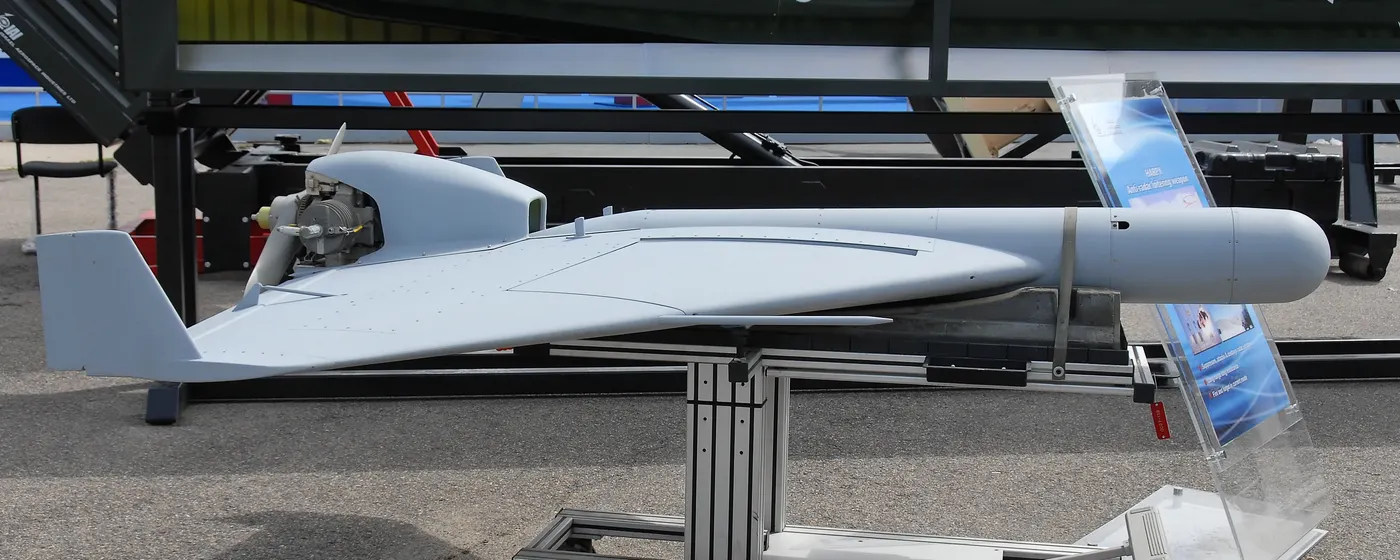

The IAI Harpy is an Israeli anti-radar loitering munition developed by Israel Aerospace Industries (IAI), first tested in 1989 and generally regarded as one of the first operational fire-and-forget loitering munitions built specifically for the suppression of enemy air defences (SEAD) mission.1 Rather than being launched at a pre-designated target like a conventional anti-radiation missile, the Harpy is fired from a canister-mounted ground launcher into a general patrol area, where it loiters for up to two hours searching for hostile radar emissions with a passive homing seeker before diving onto any radar it detects and destroying itself and the target in the impact.1
- Fire-and-forget: no GPS link, datalink or ground controller needed after launch
- Passive radar seeker, immune to radar-off decoy tactics that defeat conventional anti-radiation missiles
- Roughly two hours of loiter time lets it wait out radar shutdowns
- Canister/mobile-launcher basing keeps ground footprint and crew exposure low
- One of the first operational systems in its class, with a multi-decade service record
- Purely autonomous strike, no man-in-the-loop abort once a radar lock is made
- Passive anti-radar seeker only; cannot engage a target that is not emitting
- Lower top speed (185 km/h) than its own successor, the Harop
- Precision and sensor scores trail newer electro-optically guided loitering munitions
Design lineage is less settled than the aircraft's operational record. According to Wikipedia and a defense-analyst account of IAI's loitering-munition line, the Harpy's airframe and mission concept reportedly trace back to the ARD-10 "Lark," a loitering drone developed by South Africa's Kentron (later renamed Denel Dynamics) for the South African Defence Force in the 1980s but never fielded by Pretoria; Kentron is said to have sold the design to IAI in the late 1980s, where it was developed into the Harpy and flight-tested from 1989.1,7 This lineage claim rests on secondary sourcing rather than a primary Israeli or South African program record, and should be read as reported rather than confirmed.
The Harpy is classed as an anti-radar loitering munition rather than a reconnaissance UAV: its entire airframe is expendable, built around a single mission profile of loiter, detect, and dive.1 It carries no recovery gear, and IAI markets it as a one-way SEAD weapon rather than a reusable drone.
At 2.7 m long with a 2.1 m wingspan and a 135 kg maximum takeoff weight, the Harpy is small enough to be carried, stored and fired from a road-mobile canister launcher, typically arranged in multi-round batteries so several units can be launched in quick succession against a suspected air-defence radar site.1
Propulsion is a single UEL AR731 piston engine rated at approximately 28 kW, turning a pusher propeller — a modest, low-cost powerplant consistent with the type's design goal of an expendable, mass-producible munition rather than a reusable aircraft.1
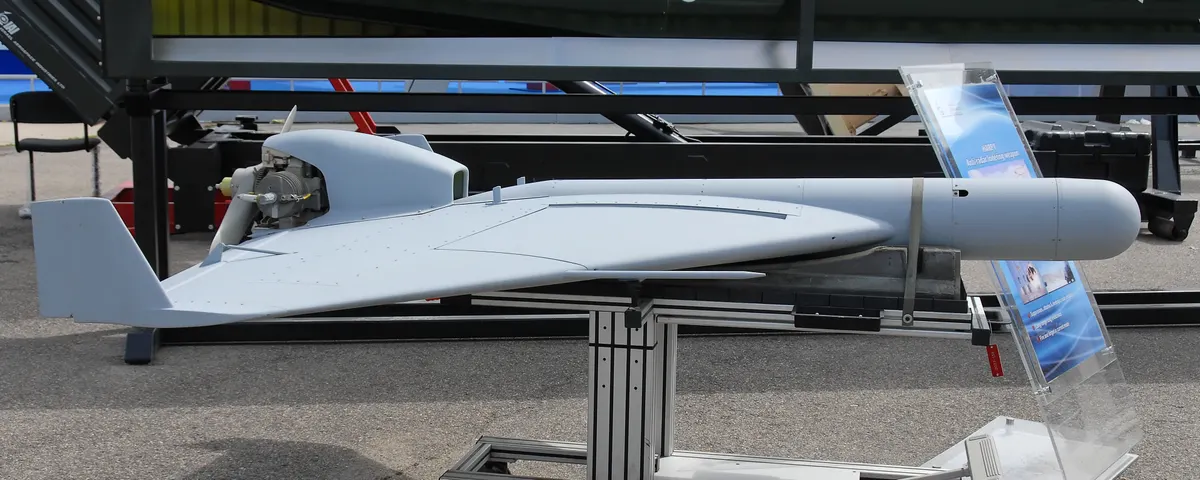
Top speed is 185 km/h, with a stated range of around 500 km and an endurance of roughly two hours on station, figures that describe an aircraft optimized to linger over a suspected radar belt rather than to dash to a fixed target.1 Maximum payload is listed at 32 kg, matching the weapons payload figure below; this is the mass of the onboard warhead that detonates when the Harpy dives on a detected emitter.
The Harpy carries a fragmentation warhead in the 15-30 kg class, triggered on impact once its passive radio-frequency seeker has locked onto a hostile emitter's signal; because the seeker is passive, the weapon cannot see or strike a target that is not actively radiating, a limitation that shaped the design of its later stablemate, the Harop.1,7
Guidance is fully autonomous once launched: the Harpy searches a pre-programmed patrol area for radar emissions matching known threat signatures and commits to an attack dive without further human input, a fire-and-forget model that removed the need for a datalink back to a ground operator but also removed any ability to abort a strike in progress — a limitation IAI would specifically address in the follow-on Harop.1,7
IAI catalogues at least two Harpy variants and the type is recorded as having entered service with roughly half a dozen operators, though — as discussed under Operators below — several countries commonly listed as Harpy users are more reliably documented as operators of the related Harop instead.8
The Harpy remains in service more than three decades after its first test flight, still fielded in its original passive-anti-radar role even as IAI's product line has moved toward the man-in-the-loop Harop for newer sales.1,7
Development work that became the Harpy began in the late 1980s at IAI, building — by most published accounts — on the ARD-10 "Lark" loitering-drone concept reportedly acquired from South Africa's Kentron.1,7 The type was first flight-tested in 1989, and IAI marketed it through the 1990s as a solution to the classic SEAD problem: destroying or suppressing surface-to-air missile radars without risking a manned aircraft or relying on a radar to stay switched on long enough for a conventional anti-radiation missile, such as the AGM-88 HARM, to home in on it. A loitering weapon that could patrol for up to two hours solved that timing problem by simply waiting.
The Harpy's most consequential episode in its service history was not a combat use but a diplomatic one: the China deal of the mid-1990s and the crisis it caused a decade later. China purchased a batch of Harpy drones from Israel in 1994, in a deal reportedly worth around $55 million; the exact number of units transferred is not reliably documented despite a commonly repeated figure of roughly 50.3,6 In 2003, China contracted with Israel to have its existing Harpy fleet upgraded, and the units in question were shipped back to Israel in 2004 for that work.3,4
Washington objected strongly once it learned of the shipment, arguing that upgrading systems already in Chinese hands risked strengthening capabilities that could be used against Taiwan in a future cross-strait conflict.3,5 Under sustained US pressure, Israel returned the Chinese drones in 2005 without performing the requested upgrade.3,4 The affair had lasting consequences for the US-Israel defense relationship: in April 2005 the United States suspended Israel's status as a Security Cooperation Participant in the Joint Strike Fighter (F-35) program, a status tied to Israeli industry's ability to bid on program work, and did not reinstate it until 6 November 2005.4,6 The episode remains one of the clearest examples of a single loitering-munition export deal producing a multi-year rupture in an arms-supplier relationship.


| Year | Buyer | Quantity | Amount | Present Value (2025) |
|---|---|---|---|---|
| 2004 |  India | — | $50.0 M | $85.2 M |
| 1995 |  South Korea | 100 | $50.0 M | $105.6 M |
| 1994 |  People's Republic of China | — | $55.0 M | $119.5 M |
Israel operates the Harpy with its own armed forces, the type's original and longest-standing user, dating to development and testing in the late 1980s and continuing today.1 China purchased the type in 1994 and, notwithstanding the 2004-2005 upgrade dispute described above, retained its originally delivered, non-upgraded Harpy inventory.3,4 South Korea has fielded the type since deliveries began in 1997, operating it through a dedicated ROKAF electronic-combat unit.9 India has operated a Harpy mobile-launcher battery since its roughly 2004-era purchase, separate from its later Harop holdings.10
Several other countries — including Turkey, Azerbaijan, and Morocco — appear in aggregator listings as Harpy operators, but the best-documented primary reporting on their loitering-munition purchases and combat use points specifically to the Harop rather than the Harpy, as discussed above; this article treats those attributions as unconfirmed for the Harpy specifically pending better sourcing.2,7,8
Within the modern loitering-munition category, the Harpy sits at the historical origin point of a class now populated by far more numerous designs, including ZALA Lancet, the AeroVironment Switchblade 600, and the HESA Shahed 136.1 Its core design choice — a passive radar-only seeker instead of an electro-optical one — is now the exception rather than the rule among newer entrants, most of which favor exactly the man-in-the-loop, EO/IR-guided approach that IAI itself moved to with the Harop.
| SPEC | IAI Harpy | ZALA Lancet | AeroVironment Switchblade 600 | HESA Shahed 136 |
|---|---|---|---|---|
| Top Speed | 185 km/h | 300 km/h | 185 km/h | 185 km/h |
| Range | 500 km | 40 km | 40 km | 2500 km |
| Endurance | 2 h | 0.67 h | 0.667 h | — |
On raw range and payload the Harpy is competitive with, or ahead of, several of its modern peers, a reflection of its comparatively large, purpose-built airframe rather than any recent technology edge; endurance and payload were the two figures IAI optimized for in a weapon meant to patrol over a suspected air-defence belt rather than dash a short distance to a fixed coordinate.
Where the Harpy trails newer designs is precision and sensor sophistication: its passive radar-only seeker cannot engage a target that stops emitting, and it lacks the man-in-the-loop correction that lets EO/IR-guided systems retarget or abort in flight.


Three documented Harpy sales illustrate the type's export history, alongside the China deal already described above.
South Korea signed a contract for the Harpy in 1995, with deliveries running from 1997 to 2001.9 The original order was for 50 units at a reported cost of around ₩25 billion; South Korean sourcing indicates the order was later doubled to roughly 100 units at a cost near ₩50 billion (on the order of $50 million), though this figure comes from a single non-English secondary source and should be treated as approximate rather than confirmed.9 By 2001 the type was fielded by the Republic of Korea Air Force's 8th Fighter Wing, under its 288th Electronic Combat Battalion, giving South Korea a dedicated Harpy-equipped SEAD unit years before most Western air forces adopted comparable loitering munitions.9
India signed an earlier and smaller Harpy deal around 2004, reported at roughly $50 million, for a mobile-launcher configuration carrying 16 drones per launcher.10 This transaction predates, and is distinct from, India's later and more widely publicized Harop acquisitions — including the Harops reportedly used in 2025's Operation Sindoor strikes — which should not be conflated with this earlier Harpy purchase.10
What is the IAI Harpy? An Israeli anti-radar loitering munition built by Israel Aerospace Industries, first tested in 1989, designed to loiter over a suspected air-defence radar site and dive onto any radar it detects with a passive homing seeker.1
How is the Harpy different from the Harop? The Harpy carries a passive, radar-only seeker and attacks fully autonomously with no way to abort once it commits; the Harop is a related, faster IAI design that swaps in an electro-optical/infrared seeker and man-in-the-loop control, letting an operator confirm, retarget or recall the weapon, and letting it strike non-radiating targets that a Harpy cannot see.2,7
Why did the US suspend Israel from the F-35 program over a Harpy deal? Israel had agreed, under a 2003 contract, to upgrade Harpy drones China had bought in 1994, shipping the Chinese units to Israel in 2004 for the work. Washington objected on the grounds the upgrade could strengthen Chinese capability in a future Taiwan conflict; Israel returned the drones unupgraded in 2005, but the US had already suspended Israel's Security Cooperation Participant status in the Joint Strike Fighter program in April 2005, restoring it that November.3,4,6
Which countries operate the Harpy? Israel, China, South Korea, and India are the best-documented operators. Turkey, Azerbaijan and Morocco are commonly listed as Harpy users in secondary sources, but their loitering-munition purchases and combat use are more reliably tied to the related Harop.2,3,4,9,10
What is the Harpy's range and endurance? Approximately 500 km of range and up to two hours of loiter endurance at a top speed of 185 km/h, carrying a warhead of up to 32 kg.1
- "IAI Harpy", Wikipedia — en.wikipedia.org ↩
- "IAI Harop", Wikipedia — en.wikipedia.org ↩
- "USA and Israel in crisis over China Harpy deal", FlightGlobal — flightglobal.com ↩
- "U.S. Curbs Israeli Role in F-35 Development", Haaretz — haaretz.com ↩
- "U.S., Israel Seek to Cut Deal on China Arms Sales", Arms Control Association — armscontrol.org ↩
- Congressional Research Service report RL33222, US Congress — congress.gov ↩
- "IAI's Loitering Munitions", The Aviationist — theaviationist.com ↩
- "IAI Harop vs IAI Harpy", GlobalMilitary.net — globalmilitary.net ↩
- "IAI 하피 (IAI Harpy)", Namuwiki — en.namu.wiki ↩
- "India tempted by Israeli Harpy", FlightGlobal — flightglobal.com ↩