


The Hero-120 is a mid-range loitering munition built by UVision Air, an Israeli defense company headquartered at the Emek Hefer Industrial Park, and it sits in the middle of the manufacturer's Hero family, above the man-portable Hero-30 and below the vehicle-launched Hero-400EC.1 Electrically powered and canister-launched, it carries a shaped-charge, dual-purpose warhead intended for tanks, light armor, fortified positions, and personnel, and it is designed to loiter over a target area for up to an hour before an operator commits it to a terminal attack.2,3 Anyone searching for Hero-120 specifications will find a moving target: the manufacturer and outside reporting have described the airframe's core weight, warhead size, and range differently across successive product updates since the type's launch, a point this article returns to below rather than picking one figure and hiding the rest.
- Electric propulsion gives a quiet, low-signature flight profile compared with piston- or jet-powered rivals
- Gimbaled EO/IR seeker with man-in-the-loop control allows abort and re-attack in the final seconds
- 60-minute stated endurance supports genuine loitering over a target area, not just a one-way transit
- Launch flexibility: single portable canister, multi-cell vehicle racks, naval mounts, and helicopter integration
- Rapidly growing, multinational customer list including the US, Argentina, and Hungary
- Published weight, warhead, and range figures have shifted across sources and product years, complicating like-for-like comparison
- Line-of-sight datalink dependency limits effective range compared with satellite-linked long-range strike drones
- Independently confirmed combat use of the Hero-120 specifically is scarce next to battle-tested rivals like the ZALA Lancet or Shahed-136
- Flyaway unit cost estimated near 150,000 USD sits well above small first-person-view attack drones costing a few thousand dollars each
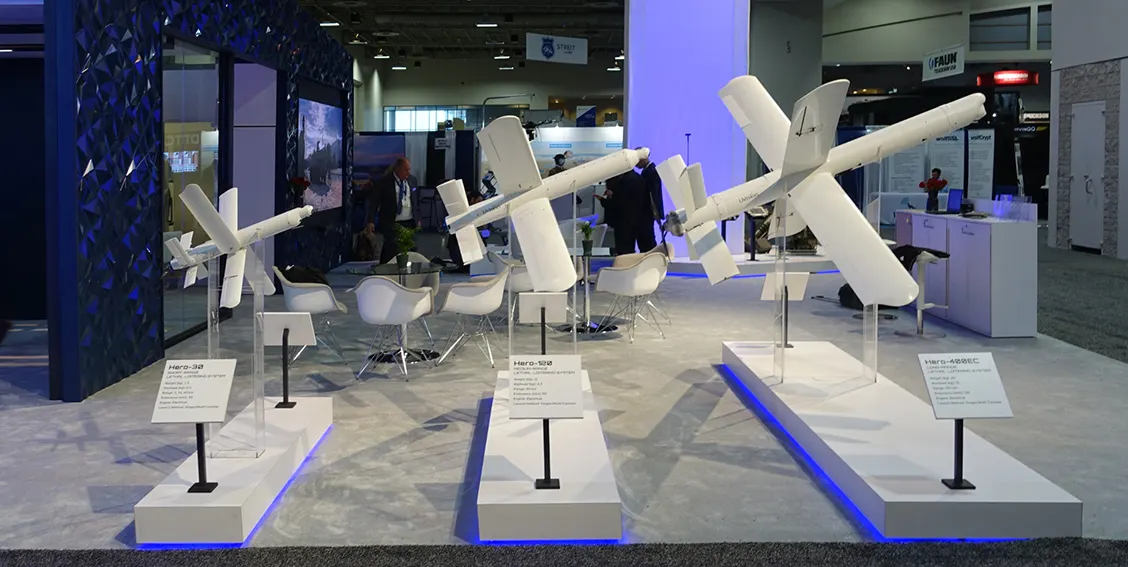
Structurally the airframe is a tubular fuselage with cruciform wing and tail surfaces that fold flat for storage inside its launch canister and open automatically after launch.2 A single electric motor turns a rear-mounted, two-bladed pusher propeller, giving the type a quiet, low-thermal-signature flight profile compared with piston- or jet-powered rivals such as the HESA Shahed-136.2,3 Guidance runs through a gimbaled electro-optic/infrared seeker with automatic target tracking, an encrypted datalink, and a man-in-the-loop control scheme: the operator watches the live feed, commits to an attack, and can abort or re-attack a different target in the final seconds if conditions change.4,5 That combination — cheap-enough electric propulsion, an hour of loiter time, and a human still making the final call — is the case UVision makes for the Hero-120 against both fire-and-forget guided missiles and the more numerous, less precise one-way drones fielded elsewhere in the loitering-munitions category.
The Hero-120's clearest recent claim to attention is procurement scale rather than combat record: in October 2025 the US Army awarded a five-year, up-to-$982 million indefinite-delivery/indefinite-quantity contract to UVision USA and integrator Mistral Inc. for the type, described by trade press as the largest publicly disclosed US procurement of loitering munitions to date.11,12 Whether the Hero-120 is in service today therefore has two different answers depending on which force is asked: it is a fielded, funded program for the US Marine Corps, US Special Operations Command, and the US Army, and a recently delivered or still-arriving system for Argentina, Hungary, and at least one undisclosed NATO buyer, while independently confirmed combat employment of the Hero-120 specifically, as opposed to its smaller sibling the Hero-30, remains thin in open sources.7,16
Published dimensions for the Hero-120 are reasonably consistent: one 2024 US trade-press account gives a length of about 1.34 m and a folded width of about 1.4 m, figures that fit a canister-launched airframe of this size.5 Weight and warhead figures are where sources diverge. Army-Technology and several manufacturer-linked summaries list a roughly 12 kg airframe carrying a 4.5 kg warhead; the specialist reference site Designation Systems separately puts all-up weight, including the launch canister, at about 18 kg; and older or lower-end citations, including some current retail-aggregator listings, still describe a 3.5 kg warhead rather than 4.5 kg.2,3,17 The most defensible reading is that the 4.5 kg, dual-purpose shaped-charge-and-fragmentation warhead reflects the type's current production standard, while the 3.5 kg figure traces to earlier marketing material or a lighter configuration.2
Endurance is the one performance figure that holds steady across nearly every source reviewed: about 60 minutes of loiter time.2,3,5 Speed figures are less consistent, with Designation Systems citing a loiter speed as low as roughly 90 km/h and a terminal-dive speed up to 260 km/h, while a 2024 US trade account gives a flat maximum speed of 185 km/h; operating altitude is typically cited at 360-900 m, with one source noting a demonstrated capability up to 5,500 m.2,5
Launch flexibility is one of the type's more consistently documented traits. The Hero-120 fires from a single man-carried canister with a bipod mount, from 4-, 6-, or 8-cell vehicle-mounted multi-canister racks, and from naval platforms; the US Marine Corps has integrated it onto the LAV-M light armored vehicle, the JLTV, and the Long Range Unmanned Surface Vessel under its Organic Precision Fires-Mounted (OPF-M) program.3,6 In May 2023, UVision USA demonstrated an airborne launch from a Bell 412EP helicopter at Yuma Proving Ground, releasing the munition at altitude, handing tactical control between operators, and striking a ground target after covering roughly 50 km, with the round retaining a 30 km control range from the launching aircraft.6 That test fed into a dedicated modular aerial launcher for helicopters that UVision unveiled in June 2025, developed with US integrators Fulcrum Concepts and Mistral Inc. and pitched as installable on Western and NATO-standard rotorcraft without deep avionics integration.14 The US has separately explored launching the type from fixed-wing C-130 transport aircraft, a concept that drew commentary in Indian defense media about potential lessons for India's own indigenous loitering-munition programs, though no Indian purchase or induction of the Hero-120 itself has been reported.
A flyaway unit cost of about 150,000 USD, with a gross unit cost (including support and integration) of roughly 202,500 USD, appears in Shephard Defence Insight estimates; neither UVision nor its government customers have published an official per-unit price, so this figure should be read as an independent analyst estimate rather than a confirmed contract price.5,6
UVision Air was established in 2011 and is controlled by businessman Aaron Frenkel through the Magnus holding company; former IDF deputy chief of staff Yair Naveh became chairman in 2015, and the company is led today by CEO Ran Gozali with roughly 300 employees.1 The Hero product line grew outward from that founding point across the following decade into a family spanning the man-portable Hero-30 up through the vehicle- and rail-launched Hero-900 and Hero-1250, with the Hero-120 occupying the anti-armor middle tier aimed at infantry and mechanized units rather than special-operations teams alone.1,3 The Israel Defense Forces became an early customer: UVision disclosed in July 2020 that the IDF had taken delivery of the smaller Hero-30 and used it successfully in combat, a milestone that predates most of the export activity described below.16
Export activity accelerated from 2021. UVision signed a strategic cooperation agreement with Germany's Rheinmetall in October 2021 under which Rheinmetall, through its Italian subsidiary RWM Italia, manufactures and markets Hero systems across Europe.7,10 That partnership's first disclosed European sale, revealed through EU procurement documents in December 2022, was a roughly 3.88 million euro contract for Italian special forces to receive the smaller Hero-30 under an "urgent mission requirement," not the Hero-120 covered in this article.7
Latin America's first Hero customer followed within days: on 27 December 2022, Argentina's Ministry of Defence signed a contract, through Israel's Directorate of International Defense Cooperation, for both Hero-120 and Hero-30 systems, described by Israeli officials as the first such sale to a Latin American country.8,9 Argentine sources characterized the initial buy as a small training batch for the army and marine corps rather than a large operational order.8 Hungary followed in July 2023 with a contract in the "low three-digit-million euro" range through the Rheinmetall-UVision partnership; Rheinmetall's own announcement did not disclose which Hero variants or how many units were included, though several trade outlets separately reported it as a Hero-120 order, with deliveries running from 2024 into 2025.10
In the United States, the Marine Corps selected the Hero-120 for its OPF-M requirement in June 2021, targeting integration onto the LAV-M, JLTV, and Long Range Unmanned Surface Vessel.6 US Special Operations Command followed in June 2024 with a 73.5 million USD contract, running through 2029, for a special-operations-optimized Hero-120SF variant offering, according to UVision, improved payload capacity and greater deployment flexibility across launch platforms; production for US orders runs through UVision USA's Virginia facility and a South Carolina plant opened with SAIC in March 2024 to satisfy Buy American Act requirements.5 Brazil was reported in January 2024 to be advancing negotiations of its own for Hero-30 and Hero-120 systems, though as of this writing no signed Brazilian contract has been confirmed, so it is treated here as a reported prospect rather than a completed sale.
UVision continued expanding the program's reach through 2025: a modular aerial launcher for helicopters in June, a multi-layered AI "Common Operating System" in September intended to coordinate Hero-120, Hero-400, and Hero-1250 rounds alongside SpearUAV's rotary-wing Viper munition as a single networked force, and the acquisition of SpearUAV itself in November 2025.14,15,1 The largest single milestone came on 7 October 2025, when the US Army awarded UVision USA and Mistral Inc. an indefinite-delivery/indefinite-quantity contract worth up to 982 million USD for Hero-120 systems, building on the Army's earlier Lethal Miniature Aerial Missile Systems program, with deliveries expected to begin in early 2026.11,12 An undisclosed NATO member in Europe placed a further order, reported in the low three-digit-million-euro range, for several hundred Hero-30, Hero-120, and Hero-400 systems produced through RWM Italia, with deliveries planned from early to late 2026.13
Open-source reporting on the Hero-120's own combat record lags well behind its procurement record. The type that UVision has publicly confirmed in actual combat is the smaller Hero-30, which the company said in July 2020 had already been used successfully by IDF units after completing testing and evaluation; company and trade materials describe the wider Hero range, including the Hero-120, as "operationally proven" and field-tested by "leading fighting forces," but without naming a specific engagement in which a Hero-120 was fired at a real target.16,3
No source reviewed for this article documents Hero-120 use in Ukraine by either side, in the 2020 or 2023-2024 Nagorno-Karabakh fighting involving Azerbaijan, or in operations attributed to Serbia or Colombia; the loitering munition most closely associated with Azerbaijan's 2020 campaign is Israel's own IAI Harop, a separate anti-radiation design from a different Israeli manufacturer, and it should not be confused with the Hero-120.1 Given Israel's general reluctance to export weapons usable against Russia, and Russia's own use of Iranian- and domestically-produced loitering munitions against Ukraine, no Hero-120 presence in that war has been reported in the sources checked here. Readers researching "Hero-120 combat use" should treat the type, for now, as a heavily procured but only lightly combat-documented system, a status shared with a number of other recent-generation Western loitering munitions still early in their fielding.
The Hero-120 sits in the middle of a six-tier family that scales from man-portable anti-personnel use up to long-range strategic strike, with the smaller members sharing the same cruciform-wing configuration and, per Rheinmetall's own marketing, a common ground control terminal across variants.3,4
| Variant | Approx. weight | Warhead | Range | Endurance | Propulsion |
|---|---|---|---|---|---|
| Hero-30 | ~3-7.8 kg (system) | ~0.5 kg | 5-40 km (comms-dependent) | ~30 min | Electric3,16 |
| Hero-90 | ~7-8 kg | ~1.2 kg | 40+ km | ~45 min | Electric3 |
| Hero-120 | ~12-18 kg | 3.5-4.5 kg | 40-60+ km | ~60 min | Electric2,3,5 |
| Hero-400EC | ~40 kg | ~8-10 kg | 60-150 km | ~2 hrs | Electric3 |
| Hero-900 | ~90 kg | ~25 kg | ~150 km | ~6 hrs | Gasoline3 |
| Hero-1250 | ~125-155 kg | ~50 kg | ~200 km | 6-10 hrs | Gasoline3,4 |
The Hero-120SF is a dedicated special-operations variant developed for US Special Operations Command under the June 2024 contract, which UVision describes as offering improved payload capacity and broader launch-platform flexibility relative to the baseline Hero-120, without a public breakdown of exactly which internal components changed.5 Because Rheinmetall and UVision have repeatedly declined to specify which Hero variant a given foreign contract covers, some deals referenced in this article, including Hungary's, are described by trade press as Hero-120 orders without official confirmation of the exact model mix.


| Year | Buyer | Quantity | Amount | Present Value (2025) |
|---|---|---|---|---|
| 2025 |  United States | — | $982.0 M | $982.0 M |
| 2024 | United States | — | $73.5 M | $75.4 M |
| 2023 |  Hungary | — | — | — |
| 2022 |  Argentina | — | — | — |
The United States is the Hero-120's largest disclosed customer, spanning three separate programs: the Marine Corps' OPF-M requirement (selected June 2021, integrating the type onto the LAV-M, JLTV, and Long Range Unmanned Surface Vessel), US Special Operations Command's Hero-120SF buy (73.5 million USD, June 2024, through 2029), and the US Army's indefinite-delivery/indefinite-quantity contract worth up to 982 million USD (awarded October 2025, deliveries from early 2026).6,5,11
Argentina became the first Latin American Hero customer under a 27 December 2022 contract covering both Hero-120 and Hero-30 systems, initially described as a small batch intended to train army and marine corps personnel; by mid-2024, the Argentine Army's Special Operations Forces Group (AFOE) had publicly shown Hero-family systems as part of its own inventory.8,9
Hungary signed a contract in the low three-digit-million-euro range in July 2023 through the Rheinmetall-UVision partnership, with deliveries running 2024-2025; several trade outlets identify the order as covering the Hero-120 specifically, though Rheinmetall's own announcement withheld variant and quantity details.10 An unnamed NATO member state placed a further order for several hundred Hero-30, Hero-120, and Hero-400 systems in the low three-digit-million-euro range, with deliveries planned through 2026.13
Israel, as the type's country of origin, is treated here as a likely operator on the strength of the IDF's confirmed use of the smaller Hero-30 and UVision's domestic ties, though a specific documented Hero-120 engagement by Israeli forces was not found in the sources reviewed.16 Brazil was reported in January 2024 to be negotiating for Hero-30 and Hero-120 systems, but this remains an unconfirmed prospect rather than a signed deal as of this writing.
Set against the AeroVironment Switchblade 600, the Hero-120 occupies a similar anti-armor niche but with meaningfully different reach: the Switchblade 600 is generally cited at a 40-plus km range and a 40-minute endurance, while the Hero-120's current-generation figures of 60-plus km and 60 minutes give it both greater standoff distance and roughly 50 percent more time over a target area before it must strike or return.5,12 Both systems share a broadly similar tactical concept, a gimbaled EO/IR seeker feeding a human operator who commits to the final attack, but the Hero-120's wider adoption across US Marine Corps, Army, and Special Operations programs simultaneously gives American forces two independently sourced systems in roughly the same weight and mission class rather than a single vendor for organic precision-strike loitering munitions.
Against Israel's own IAI Harop, the comparison runs in the other direction: the Harop is a considerably larger, faster, longer-endurance anti-radiation weapon built to hunt hostile radar emitters over hours rather than an hour, whereas the Hero-120 is a smaller, canister-launched round built for a soldier or vehicle crew to engage a directly observed target such as a tank or fighting position.1 The two systems come from different Israeli manufacturers and serve adjacent but distinct roles within the same loitering-munitions category: the Harop trades portability for stand-off suppression-of-air-defense range, while the Hero-120 trades range for the ability to be carried, launched, and retargeted by a small ground unit within minutes.


What are the Hero-120's specifications?
Sources converge on an airframe of roughly 12-18 kg depending on whether the launch canister is included, a 3.5-4.5 kg dual-purpose warhead (with 4.5 kg reflecting the more current figure), about 60 minutes of loiter endurance, and a stated range that has grown from around 40 km in earlier material to more than 60 km in current manufacturer and US Army contract descriptions.2,3,5,12
How much does the Hero-120 cost?
No government buyer has published an official unit price. Shephard Defence Insight estimates a flyaway unit cost of about 150,000 USD and a gross unit cost, including integration and support, of roughly 202,500 USD.5,6
What is the Hero-120's range?
Current manufacturer material and 2025 US Army contract coverage describe a range in excess of 60 km, up from approximately 40 km in Rheinmetall's product materials and a 50 km figure in a 2024 US trade account, most likely reflecting genuine product improvement over the type's production life rather than inconsistent reporting of a single fixed spec.2,3,5,12
Is the Hero-120 in service today?
Yes, with several forces, though at different maturity stages: the US Marine Corps selected it for OPF-M in 2021, US Special Operations Command holds a dedicated Hero-120SF contract running through 2029, the US Army's roughly $1 billion IDIQ deliveries were expected to begin in early 2026, Argentina and Hungary have both signed contracts with deliveries into 2025-2026, and an undisclosed NATO member is due deliveries through 2026.6,5,11,8,10,13
How does the Hero-120 compare to the Switchblade 600 and other rivals?
The Hero-120 offers greater range and endurance than the AeroVironment Switchblade 600 in its current-generation figures, while both share a similar gimbaled-sensor, man-in-the-loop attack concept aimed at armored and high-value targets; against Israel's own IAI Harop, the Hero-120 is the smaller, shorter-endurance, more portable system built for direct ground-unit use rather than the Harop's longer-range anti-radiation mission.5,12,1
Who makes the Hero-120, and how many have been exported?
UVision Air of Israel designs and originally manufactures the Hero-120; in Europe, Germany's Rheinmetall produces and markets it through Italian subsidiary RWM Italia under a 2021 cooperation agreement, and in the United States, UVision USA and integrator Mistral Inc. handle production and support. No total production or export figure has been publicly disclosed; confirmed buyers include the United States, Argentina, and Hungary, alongside at least one undisclosed NATO member, with Brazil reported as a prospective additional customer.1,7,11,8,10,13
- "UVision Air", Wikipedia — en.wikipedia.org ↩
- "UVision Hero-120", Designation Systems — designation-systems.net ↩
- "Hero Family of Loitering Munition Systems", Army Technology — army-technology.com ↩
- "Loitering munitions – HERO", Rheinmetall — rheinmetall.com ↩
- "US Special Operations to get Hero-120SF loitering munitions", Shephard Media — shephardmedia.com ↩
- "Hero loitering munition air-launched from helicopter in US Army demo", Shephard Media — shephardmedia.com ↩
- "Documents reveal secret customer of Hero-30 kamikaze drones", Defense News — defensenews.com ↩
- "Argentinian Ministry of Defense Buys UVision Hero-30 and Hero-120 Loitering Munitions", MilitaryLeak — militaryleak.com ↩
- "Argentina buys Uvision loitering munitions from Israel", Janes — janes.com ↩
- "Hungary orders Hero loitering munitions from Rheinmetall/UVision", European Security & Defence — euro-sd.com ↩
- "US Army Orders $1B Worth of HERO-120 Loitering Munitions from UVision and Mistral", Milivox — milivox.media ↩
- "Mistral and Uvision awarded IDIQ US Army contract for Hero-120 loitering munitions", European Security & Defence — euro-sd.com ↩
- "NATO customer awards German Rheinmetall hundred million euros for Hero loitering munitions", Army Recognition — armyrecognition.com ↩
- "UVision develops modular aerial launcher for its Hero-120 loitering munitions", European Security & Defence — euro-sd.com ↩
- "UVision unveils AI system for smarter drone warfare", The Jerusalem Post — jpost.com ↩
- "IDF using UVision mini loitering munition", Janes — janes.com ↩
- "UVision Hero-120 Expendable Short-Range Lethal Loitering System UAV", Military Factory — militaryfactory.com ↩