

The AeroVironment Switchblade 600 is a man-portable, tube-launched loitering munition built by AeroVironment of the United States as the anti-armor complement to the smaller, man-hunting Switchblade 300.1 Where the 300 was designed to defeat individual soldiers and light vehicles, the 600 carries a shaped-charge warhead derived from the FGM-148 Javelin anti-tank missile, giving it the ability to defeat main battle tanks and other armored targets at stand-off range.1,2 The system launches from a tripod-mounted tube, climbs out under its own quadcopter-style rotors, then transitions to fixed-wing flight for cruise and loiter, streaming live electro-optical/infrared video back to a ground operator who selects, tracks, and finally commits the munition onto its target.2
- Javelin-derived shaped-charge warhead effective against armored vehicles
- Man-in-the-loop "wave-off and recommit" lets the operator abort or re-target in flight
- Tube-launched from a portable tripod, no dedicated launch infrastructure required
- Long flight endurance and stand-off range compared with direct-fire anti-armor weapons
- Reported combat effectiveness against Russian air-defense and armor systems in Ukraine
- Fielding badly lagged public announcements; still an unfielded prototype as late as mid-2022
- No confirmed independent unit-cost figure specific to the 600 variant
- Cumulative Switchblade program contracts bundle the 300 and 600 together, obscuring 600-specific figures
- Limited number of confirmed international customers to date

A defining engineering feature is the system's patented "wave-off and recommit" capability: unlike a conventional missile, an operator watching the terminal video feed can abort an attack in flight and re-attack a different target, a man-in-the-loop safeguard intended to reduce the risk of misidentified or moved targets.7,8 That control model places the Switchblade 600 closer to a persistent, recoverable-decision weapon than to a fire-and-forget missile, at the cost of requiring a trained operator to stay engaged through the entire engagement.
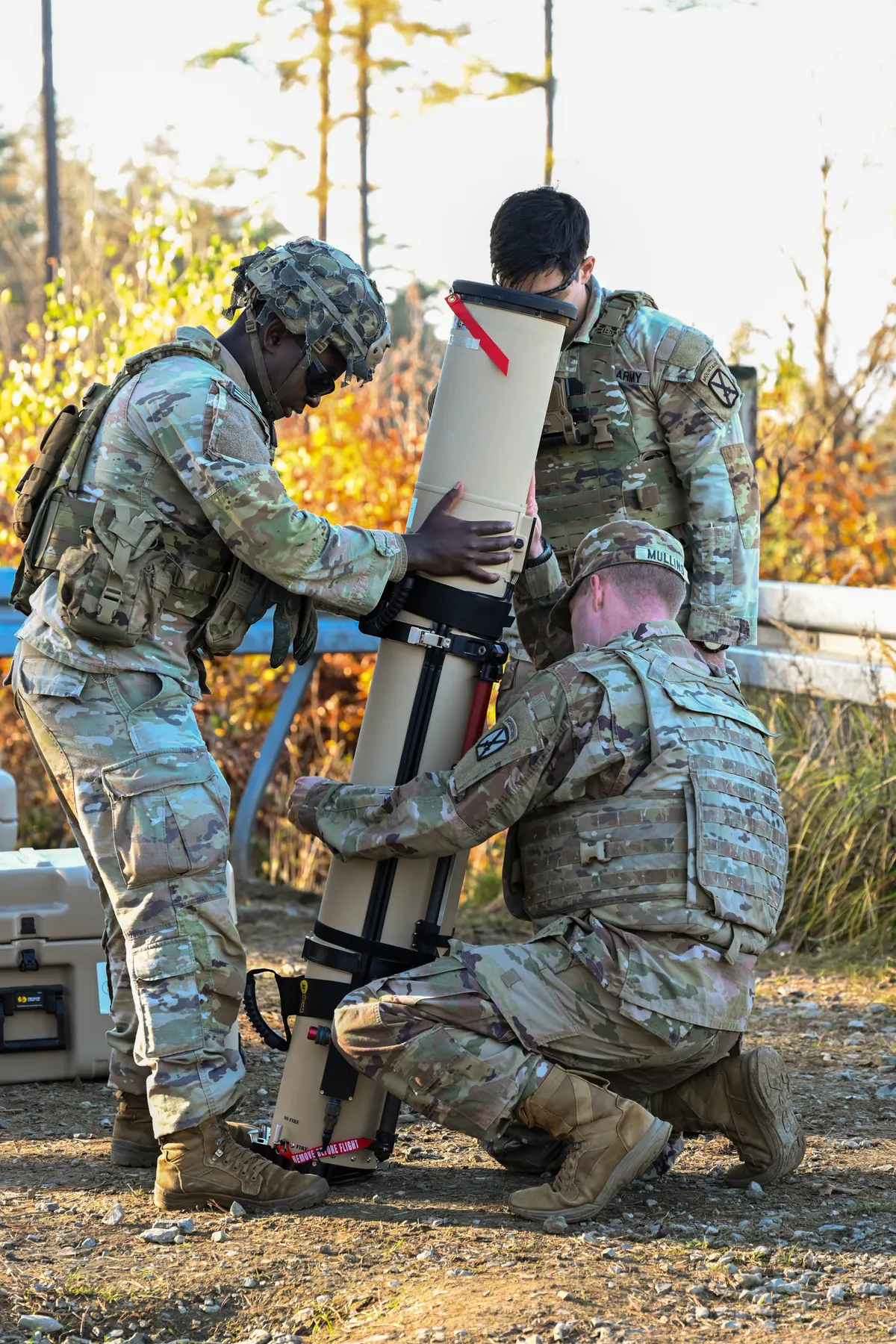
The Switchblade 600 airframe is compact enough for two operators to carry and launch from a tripod-mounted tube in the field, reflecting AeroVironment's man-portable design lineage shared with the smaller Switchblade 300.2 The system uses a hybrid launch-and-cruise configuration: a quadcopter rotor set lifts the munition clear of the tube and any surrounding cover, after which it transitions to efficient fixed-wing flight for the loiter and approach phases.2
The warhead is explicitly derived from the FGM-148 Javelin, a shaped-charge anti-armor design intended to defeat main battle tanks, giving the Switchblade 600 lethality against armored targets that the smaller anti-personnel Switchblade 300 was never built to provide.1,2 AeroVironment and independent sources describe this warhead lineage as the central distinguishing feature between the two Switchblade variants, rather than merely a scaled-up version of the same munition.1
Terminal guidance is man-in-the-loop: the operator watches a live EO/IR video feed relayed from the munition's nose-mounted sensor and manually confirms or redirects the strike, rather than the weapon selecting or engaging targets autonomously.7,8 This is paired with the wave-off and recommit function, allowing the operator to break off an attack run in flight and either re-engage the same target or search for another one, a capability AeroVironment has patented as part of the Switchblade family's control architecture.7
AeroVironment developed the Switchblade 600 as the larger, harder-hitting sibling of its earlier Switchblade 300, extending the tube-launched loitering-munition concept from an anti-personnel weapon into one capable of defeating armored vehicles by pairing the airframe with a Javelin-derived warhead.1,2 Public interest in the system accelerated sharply after Russia's full-scale invasion of Ukraine in February 2022, when the Switchblade 600 was discussed as a candidate anti-tank capability for Kyiv from as early as March 2022.3
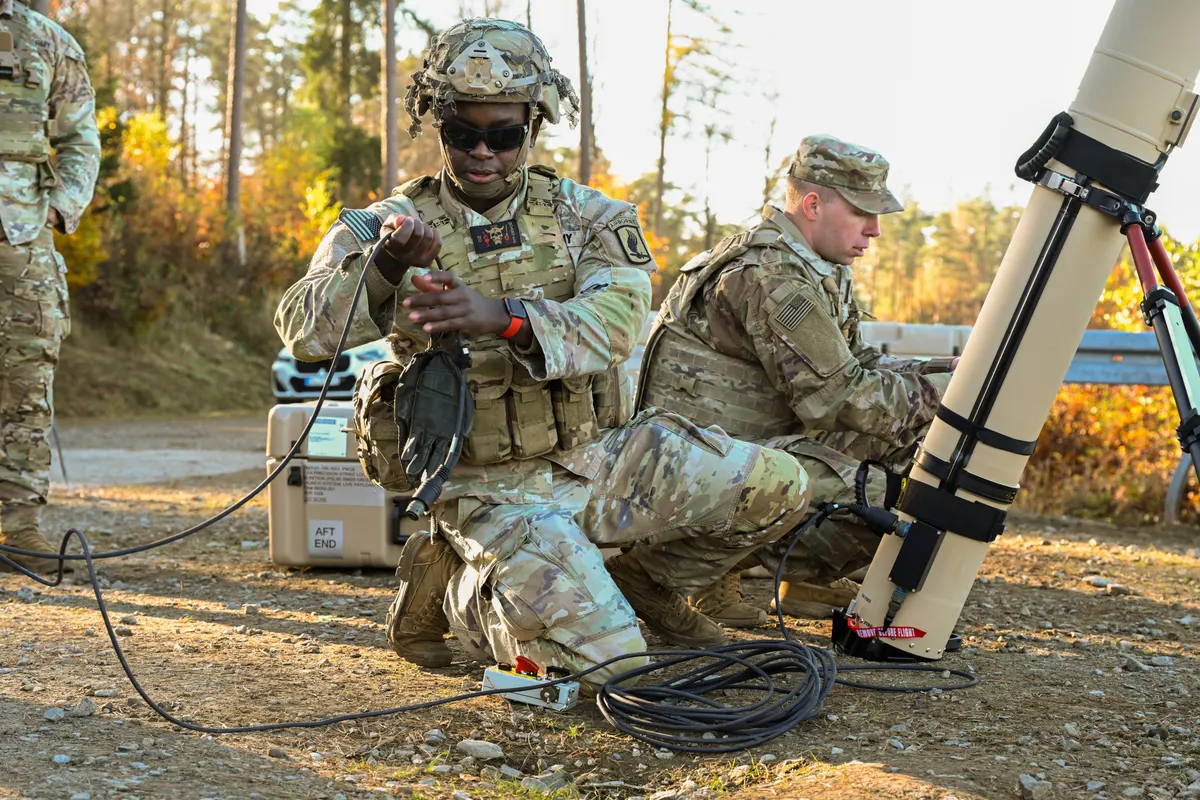
That early attention outran the program's actual maturity. By May 2022, reporting made clear the Switchblade 600 remained an unfielded prototype with no confirmed delivery date, despite having already been publicly floated as a solution for Ukraine's anti-armor needs.4 The gap persisted through the summer: as of August 2022 the system was still absent from the battlefield, and it was only that month that the U.S. government signed a contract for the first ten production units, a modest initial batch far short of the volumes implied by earlier announcements.5 The episode illustrates a recurring pattern in emerging-weapons reporting, where an early policy announcement or funding decision is conflated with an actual fielded capability months or years before delivery.
The first roughly ten Switchblade 600 units reached Ukraine in late 2022 as part of U.S. security-assistance drawdown packages rather than a commercial sale, and the system did not see its combat debut in the war until spring 2023, months after those units arrived.5,6 AeroVironment has also reportedly explored manufacturing the Switchblade 600 locally inside Ukraine, though this claim rests on a single source and has not been independently corroborated.11
Russia-Ukraine War
Ukrainian forces first employed the Switchblade 600 in combat in spring 2023, following the delayed arrival of the initial ten-unit batch delivered under U.S. drawdown authority in late 2022.5,6 Ukrainian and Ukrainian-sourced reporting has since credited the system with strikes against high-value Russian targets: on 11 June 2024, a Switchblade 600 reportedly struck a Russian Buk surface-to-air missile launcher near Sarabash in Donetsk Oblast after a flight of more than 30 km, an engagement cited as demonstrating the munition's stand-off range against a mobile, defended target.9
A further reported strike in October 2024 targeted what was described as a Russian SA-15 (Tor) short-range air-defense system; this attribution is hedged in the reporting itself, described as "believed to be" a Switchblade 600 or an improved derivative rather than positively confirmed, and should not be treated as a fully verified engagement.10 Both incidents, if accurate, point to a Ukrainian employment pattern that favors using the Switchblade 600 against high-value air-defense and armor assets rather than routine frontline targets, consistent with the weapon's anti-armor design intent.9,10


| Year | Buyer | Quantity | Amount | Present Value (2025) |
|---|---|---|---|---|
| 2024 |  United States | — | $990.0 M | $1.02 Mr |
| 2022 |  Ukraine | 10 | — | — |
| 2022 |  Lithuania | — | $48.0 M | $52.8 M |
Five countries are listed as Switchblade 600 operators: the United States, the United Kingdom, Ukraine, Lithuania, and New Zealand.12 Lithuania's acquisition is the best-documented non-U.S. case, formalized through its December 2022 contract, and it stands as the program's first confirmed international sale.12,13 Public reporting on the depth of Switchblade 600 integration in the United Kingdom and New Zealand is comparatively limited relative to the U.S. and Ukrainian cases described above.
The Switchblade 600 sits within a broader field of tube- or rail-launched loitering munitions fielded or in development since the early 2020s, most of them built around the same core trade-off between man-portability, warhead size, and range. Russia's ZALA Lancet and Iran's Shahed 136 represent the opposing side of the Russia-Ukraine war's loitering-munition contest, though the Shahed 136 is a longer-range, larger one-way attack munition rather than a man-portable anti-armor system, and the Lancet is a smaller, shorter-range system more directly comparable in launch footprint to the Switchblade family.9 Within the U.S. and allied portable anti-armor loitering-munition category, the Switchblade 600 is most directly comparable to Israel's Rafael/Spike Firefly and Elbit Systems SkyStriker, both of which similarly pair man-portable launch with a warhead intended for lightly armored or infantry targets.2
The clearest internal comparison is with its own sibling, the Switchblade 300: the two share a launch concept and control architecture, including the wave-off and recommit function, but the 600's Javelin-derived warhead gives it an anti-armor capability the 300 does not have, at the cost of a larger, heavier system that is less easily carried by a single dismounted operator.1,2


The Switchblade 600's export and procurement history is comparatively short and, in several cases, bundled together with its sibling Switchblade 300 in program-level contract figures rather than broken out separately.
Ukraine received the first approximately ten Switchblade 600 units in late 2022 through U.S. security-assistance drawdown aid rather than a direct commercial purchase, with combat use following in spring 2023.5,6
Lithuania became the first non-U.S. customer for the Switchblade 600, signing a contract worth approximately €45 million (roughly $48 million) in late December 2022 covering launch and control equipment, a simulator, and maintenance support; Lithuania also expressed intent at the time to acquire the smaller Switchblade 300.12,13,14
Romania and Sweden were named alongside Lithuania in a 26 September 2024 U.S. foreign military sales contract that raised the cumulative ceiling for the Switchblade program to $743 million; the announcement did not break out per-country or per-variant amounts, so the specific scale of Romanian and Swedish Switchblade 600 orders within that ceiling is not independently confirmed.15
United States Army domestic procurement is covered by the same roughly $990 million indefinite-delivery/indefinite-quantity contract awarded to AeroVironment in August 2024 that also supplies the Switchblade 300; this is a domestic Army contract vehicle covering both variants together, not an export sale, and it does not itemize how much of the ceiling is allocated to the 600 specifically.16,17
What is the AeroVironment Switchblade 600? A tube-launched, man-portable loitering munition built by AeroVironment, designed as the anti-armor counterpart to the smaller Switchblade 300, carrying a warhead derived from the FGM-148 Javelin missile.1,2
How does the Switchblade 600 differ from the Switchblade 300? The 600 is built around a Javelin-derived shaped-charge warhead intended to defeat armored vehicles, while the 300 is a smaller system designed primarily against personnel and light vehicles; both share the same tube-launch concept and man-in-the-loop control architecture, including wave-off and recommit.1,2
When did the Switchblade 600 first see combat? Ukrainian forces first used the system in combat in spring 2023, after an initial batch of roughly ten units arrived in late 2022 under U.S. drawdown security assistance; the weapon had been publicly discussed as early as March 2022 but was still an unfielded prototype as of May 2022.3,4,5,6
Which countries operate the Switchblade 600? Five confirmed operators are listed: the United States, the United Kingdom, Ukraine, Lithuania, and New Zealand. Lithuania was the first international customer, signing a roughly €45 million contract in December 2022.12,13
Is the Switchblade 600 expensive compared with other systems? Cost criticism of the Switchblade family, including estimates in the range of $70,000-$175,000 or more per unit, has been documented primarily for the smaller Switchblade 300 rather than confirmed specifically for the 600, so that criticism should not be presented as settled fact for this variant.18,19
- "Switchblade 600", AeroVironment — avinc.com ↩
- "AeroVironment Switchblade", Grokipedia — grokipedia.com ↩
- "Tank-Busting Switchblade 600 Drones Have Not Arrived In Ukraine", The War Zone — twz.com ↩
- "Bad News: The Switchblade 600 Drone Isn't In Ukraine Yet", 19FortyFive — 19fortyfive.com ↩
- "Switchblade 600 kamikaze drones are delayed", Mezha.ua — mezha.ua ↩
- "No place to hide for Russian tanks", RBC-Ukraine — newsukraine.rbc.ua ↩
- "US Army Switchblade 600 Live-Fire Armored Brigade", Milivox — milivox.media ↩
- "Switchblade", GlobalSecurity.org — globalsecurity.org ↩
- "No place to hide for Russian tanks", RBC-Ukraine — newsukraine.rbc.ua ↩
- "US Switchblade 600 kamikaze drone proves highly effective in Ukraine, destroying Russian Tor air defense system", Army Recognition — armyrecognition.com ↩
- "AeroVironment plans to manufacture Switchblade 600 in Ukraine", Militarnyi — militarnyi.com ↩
- "Lithuania acquires Switchblade 600", Shephard Media — shephardmedia.com ↩
- "Lithuania to buy AeroVironment Switchblade drones", The Defense Post — thedefensepost.com ↩
- "Lithuania first international customer of Switchblade 600 kamikaze drone", Defense Brief — defbrief.com ↩
- "AV Secures $743 Million Additional Contract Ceiling for Switchblade", AeroVironment Investor Relations — investor.avinc.com ↩
- "AeroVironment wins nearly $1B to supply Switchblade munitions to Army", Defense News — defensenews.com ↩
- "US Army Switchblade AeroVironment", The Defense Post — thedefensepost.com ↩
- "Switchblade: What Ever Happened to Ukraine's Kamikaze Drone?", The National Interest — nationalinterest.org ↩
- "Why Are $400 Ukrainian Drones Beating $100,000 American Switchblades?", Medium — medium.com ↩