


Israel Aerospace Industries unveiled the Mini Harpy at the Aero India exhibition in Bangalore on 19 February 2019, presenting it as a single canister-launched loitering munition that folds the radar-hunting logic of the company's original Harpy into the same airframe as the camera-guided, man-controlled seeker used on the larger Harop.1,2 Rather than choosing between an autonomous radar-killer and an operator-directed precision striker, the Mini Harpy carries both, switching between a passive anti-radiation channel and a gimbaled electro-optical/infrared channel depending on what kind of target it is hunting.1,3
- Dual anti-radiation and electro-optical/infrared seeker in one airframe
- Man-in-the-loop or fully autonomous engagement modes
- Abort and re-attack capability, unlike a one-way missile
- Canister launch from trucks or small naval craft, minimal logistics footprint
- Electric propulsion for a quiet approach
- No publicly confirmed export customer or combat use as of 2026
- Smaller 7 kg warhead than either full-size parent system
- Endurance fell from roughly 2h45m at launch to about 80 minutes in the current configuration
- Unit cost never publicly disclosed
The system is built by IAI's Systems, Missiles and Space Group, based in Israel, the same division responsible for the full-size Harpy and Harop families.2 IAI markets the Mini Harpy specifically for suppression of enemy air defenses (SEAD) against mobile radar and air-defense systems, and for armed intelligence, surveillance and reconnaissance missions against vehicles, launchers and command posts that never radiate at all.3,4
Mini Harpy specifications have shifted noticeably between the 2019 launch and the system's re-marketing at AUSA 2025, and both figures are worth knowing because sources online still repeat both. At its 2019 unveiling, IAI quoted a 45 kg air vehicle carrying an 8 kg shaped-charge warhead with roughly two hours forty-five minutes of loiter endurance.2,5 By the time IAI re-displayed the Mini Harpy at the 2025 AUSA exposition, the company's own current product page and show coverage described a heavier 50 kg vehicle with a smaller 7 kg warhead and a shorter minimum 80-minute loiter time, alongside a 100 km operating radius and a 200-knot (roughly 370 km/h) dash speed that both the 2019 and 2025 material broadly agree on.1,6
How does the Mini Harpy work in practice? It launches vertically or at a shallow angle from a sealed, single-use canister, climbs to search altitude on its electric motor, and either hunts autonomously for emitting radars or waits under operator control while the electro-optical/infrared seeker streams video back for target confirmation.1,6 The operator can abort an attack run and re-attack later, and IAI advertises a circular error probable of under one meter and post-strike battle damage assessment from the onboard camera before the warhead detonates.1,6
Is the Mini Harpy still in service, or still just a marketing product? As of mid-2026, IAI has not publicly named a confirmed government operator for the Mini Harpy specifically, even though its full-size relatives are combat-proven and widely exported. That gap between a technically mature product and an unconfirmed customer list runs through every later section below.
A Heavier Airframe With a Smaller Warhead Than Either Parent
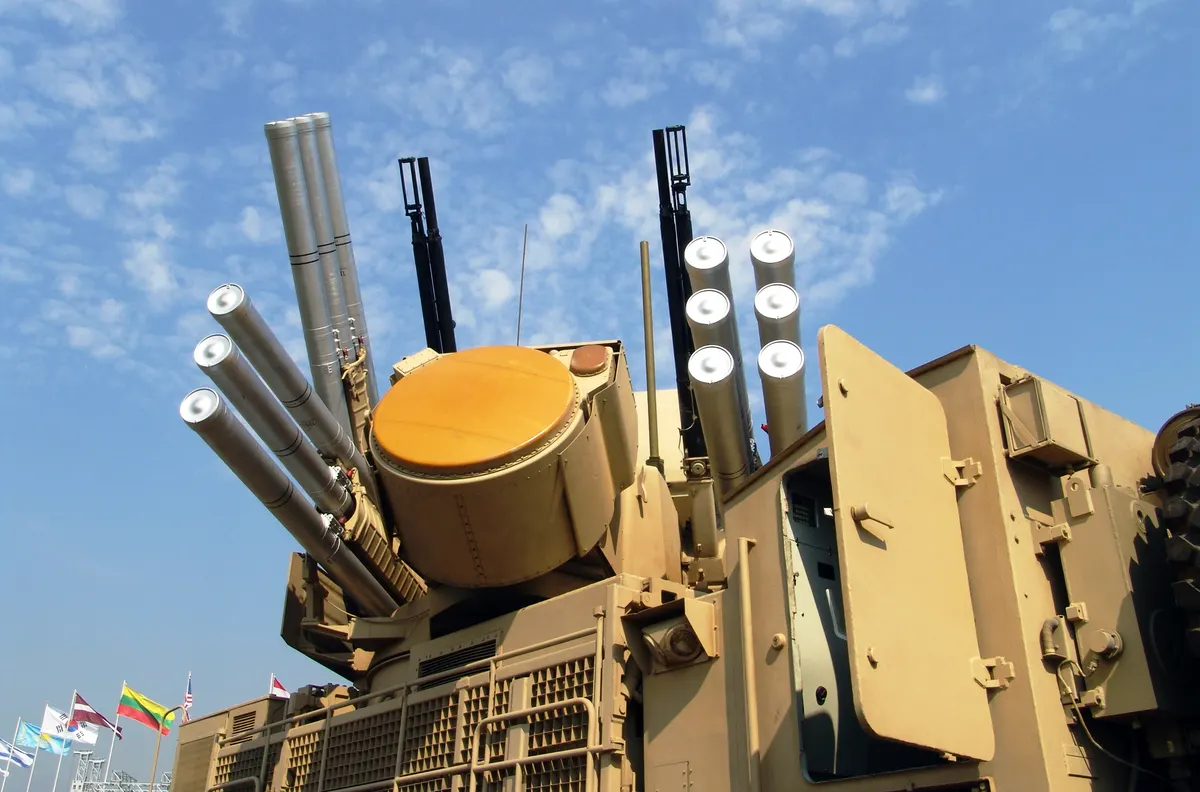
The Mini Harpy sits well below the original 135 kg Harpy and the Harop's far larger airframe in size, but it is not simply a scaled-down copy of either. According to The Aviationist, IAI built the Mini Harpy by adding an anti-radiation sensor onto the airframe of the company's smaller Green Dragon tactical munition, rather than shrinking the Harpy or Harop structure directly.7 That gives the Mini Harpy a 50 kg current weight and a 7 kg warhead, compared with the Harpy's 32 kg high-explosive warhead and the Harop's roughly 15 to 23 kg warhead depending on the source consulted.6,7,8
- UAV Classloitering munition
- Category (MALE/HALE/Tactical/Micro)dual seeker anti-radar / EO-IR loitering munition
- Primary RoleSEAD and armed ISR
- In ServiceNo
That weight and warhead reduction looks deliberate rather than accidental. IAI positions the Mini Harpy as a lighter, cheaper complement to the full-size Harpy and Harop rather than a replacement for either, aimed at tactical units that want one canister-launched system instead of two separate ones.3
- Max Takeoff Weight50 kg
The Dual Anti-Radiation and Electro-Optical/Infrared Seeker
IAI describes the Mini Harpy as the only loitering munition in the world carrying what it calls a triple-sensor seeker, an anti-radiation channel plus separate day and night electro-optical/infrared channels bundled into a single gimbaled head.1,9 Independent coverage of the AUSA 2025 relaunch simplifies this to a dual EO/IR and anti-radar seeker, which is the same hardware described in different marketing language.6 In practice, the anti-radiation mode lets the Mini Harpy search autonomously for an active radar emitter and home on it without a data link, the same fire-and-forget logic that made the original 1989 Harpy one of the first operational anti-radar loitering munitions.8 The electro-optical/infrared mode instead requires a two-way data link and an operator watching the video feed, borrowed directly from the Harop's man-in-the-loop control scheme.7,9
- Number of Engines1
- Electric PropulsionYes
IAI has marketed this dual-seeker combination consistently since the 2019 unveiling, even as the underlying weight and endurance numbers shifted around it, because it is the single feature that most clearly separates the Mini Harpy from single-seeker rivals in the same weight class.1,6
- Top Speed370 km/h
- Range100 km
- Endurance1.3
- Maximum Payload7 kg
Electric Propulsion and Canister Launch
Like the rest of the Harpy and Harop family, the Mini Harpy flies on battery-driven electric propulsion rather than the small piston or Wankel engines used on some rival loitering munitions, trading raw range for a quiet, low-signature approach that IAI markets as a genuine tactical advantage against alert air-defense crews.1,2 The airframe ships sealed inside its own launch canister, mountable in banks on a light tactical truck bed or a small naval patrol craft, and the 2019 unveiling also advertised a helicopter-launch option that current IAI material no longer emphasizes.2,5 IAI Mini Harpy unit cost has never been publicly disclosed, consistent with the rest of the family, though its smaller warhead and shorter range than the Harop suggest a lower price point aimed at tactical, brigade-level users rather than the operational-level customers that buy the longer-ranged Harop.
- EO/IR SensorYes
| SPEC | IAI Mini Harpy | IAI Harpy |
|---|---|---|
| Max Takeoff Weight | 50 kg | 135 kg |
| Maximum Payload | 7 kg | 32 kg |
| Range | 100 km | 500 km |
| Endurance | 1.3 h | 2 h |
- ArmedYes
- Weapon Typesshaped charge
- Control Typeautonomous or man-in-the-loop
- Autonomous CapableYes
- Operators0
- Operational Statusexport marketed, unconfirmed service
From a Failed South African Radar-Killer to an Israeli Export Success
The Mini Harpy's anti-radiation seeker concept originated in a program that never entered service. In the late 1980s, the Kentron firm of South Africa, a predecessor of today's Denel Dynamics, sold IAI the design for its ARD-10 loitering drone, a program South Africa had shelved after failing to build a working radar seeker of its own.10 IAI used that airframe to develop the original Harpy, first tested in 1989, becoming one of the first operational anti-radiation loitering munitions anywhere.10 The Harpy's core weakness was well understood from the start, a radar operator who simply switched off the set could vanish from the seeker's view entirely, since the weapon had no way to find a silent target.8
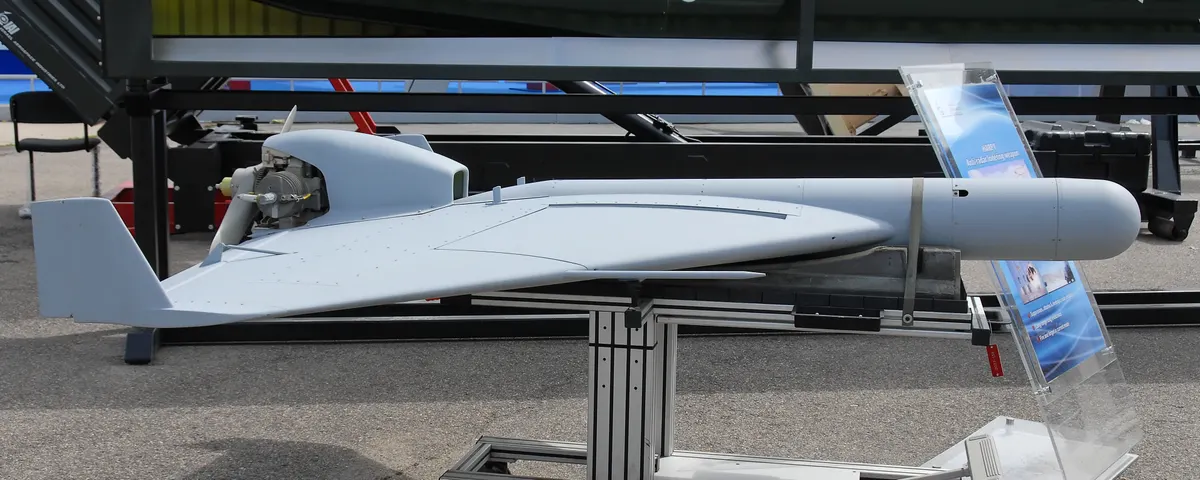
IAI's answer was the Harop, unveiled publicly at Aero India in 2009 after reportedly entering service with Turkey around 2005, replacing the Harpy's pure radar homing with an electro-optical/infrared sensor and a two-way data link for man-in-the-loop control.8,9 The Harop could now strike vehicles, launchers and command posts that never radiated at all, at the cost of needing a human operator watching a video feed rather than flying fully autonomous missions. India bought roughly eight to ten Harop systems for about $100 million and announced induction plans in 2009, becoming one of the type's first major export customers.9

The Mini Harpy folds both approaches into one 2019-era product, aimed at customers who wanted Harpy-style autonomous radar hunting and Harop-style precision video-guided strikes without buying two separate systems. IAI executive Boaz Levy, general manager of the company's Systems, Missiles and Space Group, framed the announcement around the difficulty of hitting fast-moving targets that expose themselves for only a few seconds at a time, arguing that loitering munitions close that window better than conventional strike aircraft or artillery can.2
After a quiet period with little public coverage, the Mini Harpy reappeared prominently at the AUSA 2025 exposition in Washington, D.C., where IAI displayed the updated 50 kg, 7 kg-warhead configuration and emphasized the dual EO/IR and anti-radar seeker as its main selling point against newer Western and Chinese loitering munitions competing for the same tactical SEAD niche.6 In June 2026, IAI granted the American firm Palladyne AI an exclusive license to manufacture the Harpy, Harop and Mini Harpy families inside the United States, aiming the deal squarely at the US Long-Range Precision Munition competition, an award reportedly worth $100 to $200 million and expected around October 2026.11
The Mini Harpy itself has no publicly confirmed combat deployment as of mid-2026. Its full-size relatives, by contrast, have a substantial combat record that explains why armies keep buying into the same product family. Azerbaijan first documented Harop use against Armenian forces in clashes along the Nagorno-Karabakh line of contact in April 2016, then used the type far more visibly during the Second Nagorno-Karabakh War in 2020, where Harops helped destroy Armenian air-defense radars and vehicles in freezing conditions and GPS-jammed airspace.9
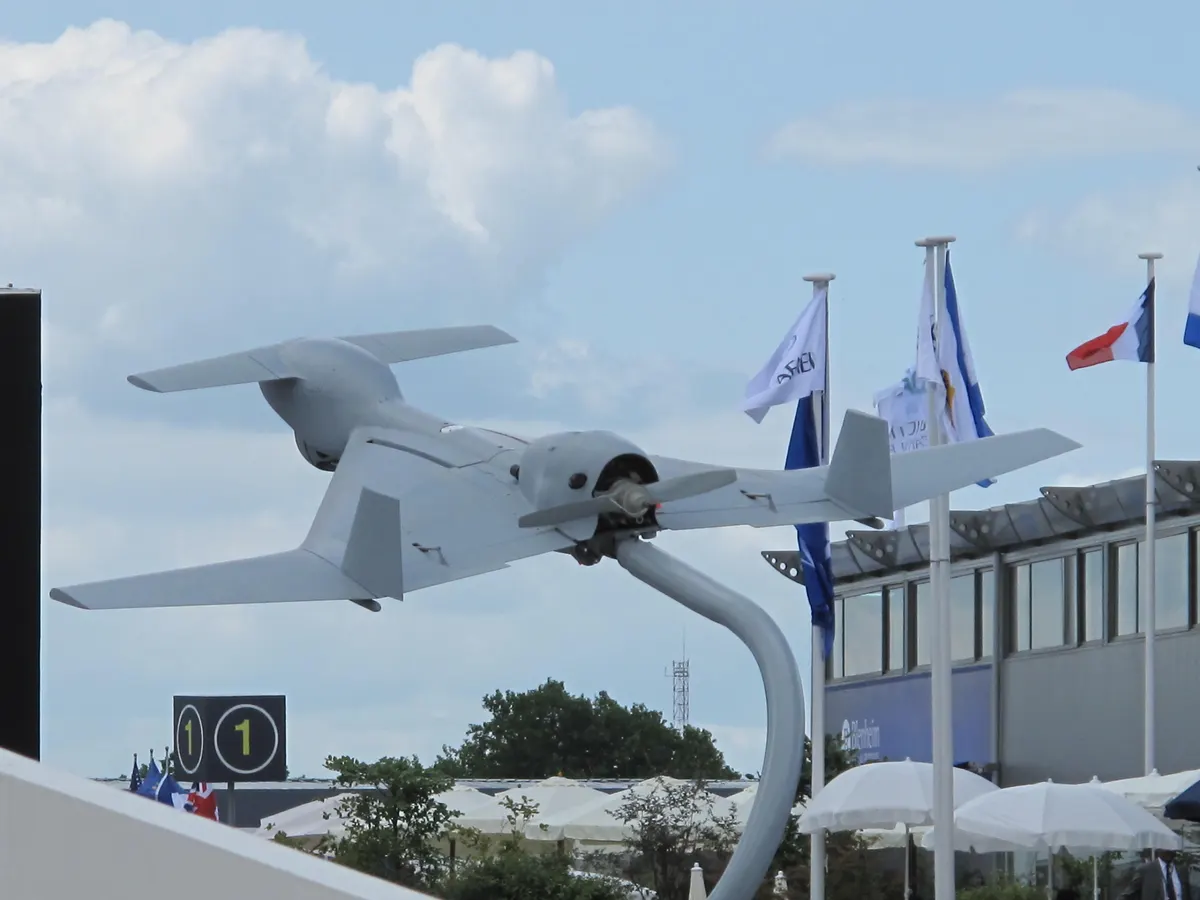
In Syria in May 2018, a Harop reportedly destroyed a Syrian SA-22 (Pantsir) air-defense system, the exact class of mobile radar target the Mini Harpy's own anti-radiation seeker is designed to hunt.9 More recently, India used Harop munitions during the 2025 India-Pakistan conflict, striking targets around Karachi, Lahore and Rawalpindi as part of what Indian officials called Operation Sindoor, while Pakistan claimed to have intercepted dozens of Indian drones during the exchange.9
None of this combat record belongs to the Mini Harpy specifically. IAI has marketed the Mini Harpy since 2019 without disclosing a confirmed government buyer, and no open-source reporting found documents a Mini Harpy strike, loss or intercept anywhere. That is a genuine gap in the public record, not a claim that the system has been rejected or shelved, since IAI continued to actively re-market it as recently as AUSA 2025 and the June 2026 Palladyne AI licensing deal.6,11
A quiet combat record for a system this size would not be unusual on its own. Small, tactical loitering munitions often see far less public disclosure once fielded than a larger, harder-to-hide system like the Harop, since operators can classify unit-level strike details that a larger program's export paperwork or media coverage cannot avoid revealing.
IAI does not appear to sell the Mini Harpy itself in named sub-variants, unlike the Harpy, which spun off the longer-ranged Harpy NG. Instead, the Mini Harpy's own specifications changed between its 2019 launch configuration and the version IAI displayed at AUSA 2025, effectively functioning as an informal variant split, a heavier 50 kg airframe with a lighter 7 kg warhead and shorter endurance replaced the original 45 kg, 8 kg, near-three-hour-endurance configuration shown in 2019.2,6

The broader Harpy and Harop product family includes several genuinely distinct siblings worth distinguishing from the Mini Harpy specifically. The Harpy NG is a next-generation, longer-endurance evolution of the original autonomous radar-killer. A dedicated Maritime Harop variant adapts the Harop's electro-optical seeker and man-in-the-loop control for shipboard naval launch. Green Dragon, the tactical munition IAI reportedly built the Mini Harpy's own airframe from, is itself sold as a separate, lighter electro-optical-only system for smaller units.7,9 None of these should be confused with the Mini Harpy's own dual-seeker configuration, since the naming across IAI's loitering munition catalog is dense enough that specialist coverage regularly has to spell out which product each name actually refers to.
That naming density matters for anyone reading a defense-export report or a photo caption from a trade show. A photo simply labeled an IAI loitering munition on a truck-mounted canister could plausibly show a Harpy, a Harop, a Mini Harpy, or Green Dragon, and only the seeker head or accompanying caption reliably distinguishes them.
No government has been publicly confirmed as a Mini Harpy operator specifically, in service, on order, or in testing, as of mid-2026. That absence stands out against the rest of the IAI loitering munition catalog, since the Harpy counts Azerbaijan, the People's Republic of China, India, Israel, Morocco and South Korea among its confirmed users, and the Harop counts Azerbaijan, India, Israel, Morocco and, more recently, the Netherlands.6,8,9
Estonia is the closest thing to a lead here without being a confirmed answer. IAI announced multiple loitering-munition agreements with Estonia's defense procurement agency from 2023 onward, and photographs released alongside those announcements have shown both Harop and Mini Harpy hardware, but neither IAI nor the Estonian government has publicly itemized which specific variants and quantities were included.6 The clearest near-term path to a genuine Mini Harpy operator runs through the United States rather than a fresh export deal, following the June 2026 Palladyne AI licensing agreement targeting the US Long-Range Precision Munition competition, though that remains a manufacturing and bidding arrangement rather than a confirmed sale.11
Until IAI or a buyer government names a customer directly, the honest operator picture for the Mini Harpy is a product that is manufactured, marketed and re-marketed across two show cycles without a disclosed end user, a genuinely different situation from most fielded loitering munitions with years of confirmed service.
The Mini Harpy exists because the Harpy and Harop solve different halves of the same problem, and IAI's own sales pitch for the Mini Harpy leans directly on that gap. The Harpy searches for an active radar and destroys it without any human in the loop, fast and simple, but blind to any target that goes quiet or never radiates. The Harop swaps that autonomy for a camera and a data link, letting an operator strike a target that a Harpy would simply lose, at the cost of a far larger 15 to 23 kg-class warhead and airframe that make it a genuinely different weight class from the Mini Harpy rather than a direct rival.7,8,9
Against the full-size Harpy specifically, the Mini Harpy trades roughly two-thirds of the warhead weight (32 kg versus 7 kg) and a meaningful amount of range and endurance for the added flexibility of the electro-optical/infrared channel and man-in-the-loop control that the Harpy simply does not have.6,8 Against the Harop, the comparison runs the other way, the Harop's roughly 6-to-9-hour endurance and far longer data-link range dwarf the Mini Harpy's 80-minute, 100 km envelope, but the Harop also lacks the Mini Harpy's autonomous anti-radiation search mode entirely.6,9 The Mini Harpy vs Harpy vs Harop question, in other words, comes down to matching a customer's mission profile. A brigade or naval unit that needs one compact, dual-mode munition for both radar-hunting and video-guided precision strikes fits the Mini Harpy, while an air force or navy running longer, deliberate strike missions against relocatable or non-emitting targets is closer to the Harop's actual market.
| Spec | Mini Harpy | Harpy | Harop |
|---|---|---|---|
| Weight | 50 kg | 135 kg | Not separately confirmed |
| Warhead | 7 kg | 32 kg | 15 to 23 kg |
| Range | 100 km | Up to 500 km (product literature) | Roughly 200 km data-link, longer stated endurance-limited range |
| Endurance | ~80 min | 2+ hours | 6 to 9 hours |
Every figure in that table carries the same caveat raised throughout, IAI's own published numbers for this product family have shifted across different marketing cycles, and the Mini Harpy row reflects the AUSA 2025 configuration rather than the heavier-warhead, longer-endurance 2019 launch specification.2,6


What is the IAI Mini Harpy? The Mini Harpy is an Israeli canister-launched loitering munition unveiled by Israel Aerospace Industries in February 2019, combining the autonomous anti-radiation seeker of the company's Harpy with the electro-optical/infrared, man-in-the-loop guidance of the Harop in a single smaller airframe.1,2
How is the Mini Harpy different from the Harpy and the Harop? The Harpy hunts radar emitters entirely autonomously and cannot strike a target that stops radiating. The Harop swaps that for a camera and a two-way data link so an operator can strike non-emitting targets directly. The Mini Harpy carries both a radar-homing seeker and an electro-optical/infrared seeker in one smaller, lighter airframe with a smaller warhead than either parent.7,8,9
Is the Mini Harpy still in service? No government has publicly confirmed operating the Mini Harpy as of mid-2026, even though IAI continues to actively market it, most recently at the AUSA 2025 exposition and through a June 2026 US manufacturing licensing deal with Palladyne AI.6,11
What is the Mini Harpy's range and endurance? IAI's current product literature lists a 100 km operating range and a minimum 80-minute loiter endurance, down from the roughly two hours forty-five minutes IAI advertised at the system's 2019 launch.1,2,6
How much does the Mini Harpy cost? IAI has never publicly disclosed a Mini Harpy unit cost, consistent with the rest of the company's loitering munition catalog.
What caliber or warhead does the Mini Harpy carry? The Mini Harpy is not a gun-caliber weapon, it carries a roughly 7 kg shaped-charge warhead in its current configuration, down from about 8 kg at the system's 2019 unveiling.2,6
- "Mini Harpy - Autonomous Tactical loitering munition", Israel Aerospace Industries — iai.co.il ↩
- "IAI Unveils New Loitering Munition - Mini Harpy", Israel Aerospace Industries — iai.co.il ↩
- "IAI launches Mini Harpy loitering munition", Shephard Media — shephardmedia.com ↩
- "IAI Unveils Mini Harpy Loitering Munition", Israel Defense — israeldefense.co.il ↩
- "IAI Mini Harpy loitering munition", MilitaryLeak — militaryleak.com ↩
- "AUSA 2025: IAI's Mini Harpy loitering munition reappears with dual EO/IR and anti-radar seeker", Army Recognition — armyrecognition.com ↩
- "Let's Talk About The Israel Air Industries Loitering Munitions And What They're Capable Of", The Aviationist — theaviationist.com ↩
- "Harop: Israel's pioneering loitering munition for SEAD and precision strike", BattlePolicy — battlepolicy.com ↩
- "IAI Harop", Wikipedia — en.wikipedia.org ↩
- "IAI Harpy", Wikipedia — en.wikipedia.org ↩
- "Palladyne AI partners with IAI to bring Israeli Harpy, Harop drones to US", Breaking Defense — breakingdefense.com ↩