


MBDA Italia introduced the Harpax family of loitering munitions to the public for the first time on 30 September 2025, at the Seafuture naval exhibition in La Spezia, Italy.1 The reveal covered two flying models, a small quadcopter called Harpax Mini and a tube-launched fixed-wing round called Harpax Small, alongside a longer-range Harpax Medium that was announced but not yet shown.2 Harpax was built to answer the Italian Army's own combat requirements rather than to chase a broad export catalog first, and every airframe in the family is sourced entirely inside Italy so that design authority, intellectual property and production capacity stay under national control.3
- fully Italy-sourced airframes and IP
- shared software stack with MBDA's Akeron family cuts development cost
- modular payload bay on Harpax Small (warhead, ISTAR, or jamming module)
- light enough for dismounted infantry to carry and launch
- unproven in actual combat as of mid-2026
- Harpax Medium undefined beyond a range figure and a 2026 concept freeze
- no signed Italian Army production contract yet, only field trials
- warhead mass modest next to larger rivals such as Switchblade 600
Both drones sit inside the wider category of loitering munitions, expendable, sensor-guided aircraft that circle above a target area before diving in to detonate an onboard warhead. Harpax Mini and Harpax Small share that basic one-way-attack concept but differ sharply in size, launch method and target set, which is the point of building a family rather than a single airframe. Harpax Mini is a VTOL quadcopter meant for close-in urban fighting, small enough for one soldier to hand-launch through a doorway or window. Harpax Small is a tube-launched, fixed-wing round meant for longer-range strikes on vehicles and dug-in positions, closer in size and role to established Western systems like AeroVironment's Switchblade 300 and Switchblade 600.
MBDA Italia is the Italian national division of MBDA, the tri-national missile maker jointly owned by Airbus, BAE Systems and Leonardo.9 That Leonardo stake, and MBDA Italy's roughly 1,800-strong workforce, is part of why the Harpax program leans so heavily on domestic sourcing rather than on components shared across MBDA's French or British arms.9 MBDA Italia's sales manager, Cristiano Proietti, has described the approach as working with small and medium-sized Italian firms to move quickly from prototype to production, rather than developing a single large program on a slower timeline.3
Questions that come up often around the MBDA Harpax loitering munition include what it costs, whether it is already in service, and how its range compares with the Switchblade family it is frequently measured against. As of mid-2026 MBDA has not published a unit price for either Harpax Mini or Harpax Small, and the Italian Army has not signed a production contract, only run field trials.2,4 The Harpax Small's declared range sits at up to 20 kilometers, roughly double the Switchblade 300's advertised figure and about half of Switchblade 600's.5
A Two-Airframe Family Built on One Shared Software Stack
Harpax is not one drone but a common architecture applied to two very different airframes, with a third planned. MBDA Italia designed Harpax Mini and Harpax Small to share the same software-defined guidance, navigation, datalink waveforms and encryption, and reportedly reused elements of the tactical datalink and control software already built for MBDA France's Akeron loitering munition family, cutting development cost and time.3 The two programs remain organizationally and industrially separate, Akeron RCX 50 and Akeron RCH 170 are French Army systems born from a 2022 French defence-innovation-agency requirement, while Harpax answers an Italian Army requirement and uses Italian-built airframes.8 The commercial logic is the same across both national branches, MBDA wants a low-cost, quickly fielded munition that does not require the bespoke industrial base of its larger anti-ship and air-defence missiles.
- UAV Classman-portable tube-launched loitering munition (Harpax Small variant)
- Category (MALE/HALE/Tactical/Micro)kamikaze / ISTAR-capable loitering munition
- Primary Roleinfantry-portable precision strike and reconnaissance loitering munition
- In ServiceNo
Because both Harpax variants are software-defined, MBDA has said the family can in principle share a single ground control station and operator interface across Mini and Small, easing training for infantry units that might field both.3 Development has deliberately avoided exotic or bleeding-edge components. Trade press covering the program has described MBDA Italia's approach as prioritizing cost control over cutting-edge technology, with the explicit goal of staying under the price benchmark set by rival Western loitering munitions so Harpax can also attract export customers once the Italian Army requirement is satisfied.6
- Length1 m
- Wingspan1 m
- Max Takeoff Weight8 kg
The Harpax Small's Fixed-Wing, Tube-Launched Airframe
Harpax Small is the fixed-wing member of the family, launched from a tube with a pneumatic charge and a bipod mount, and unfolding its wings in flight.3 Folded for transport and launch it measures roughly 100 by 13 by 13 centimeters, expanding to a one-meter wingspan once airborne.2 Maximum takeoff weight is about 8 kilograms, including a warhead of roughly 1.5 kilograms, and MBDA quotes a cruise speed of up to 200 km/h, an operational range of 15 to 20 kilometers, and an endurance of 25 to 40 minutes depending on the payload and distance flown.2,6 That places Harpax Small, in the words of one defense-industry comparison, as an intermediate design sitting between the American Switchblade 300 and Switchblade 600 in size, range and endurance.5
- Engine Typeelectric pusher propeller
- Number of Engines1
- Electric PropulsionYes
- Propeller / Configurationpusher propeller
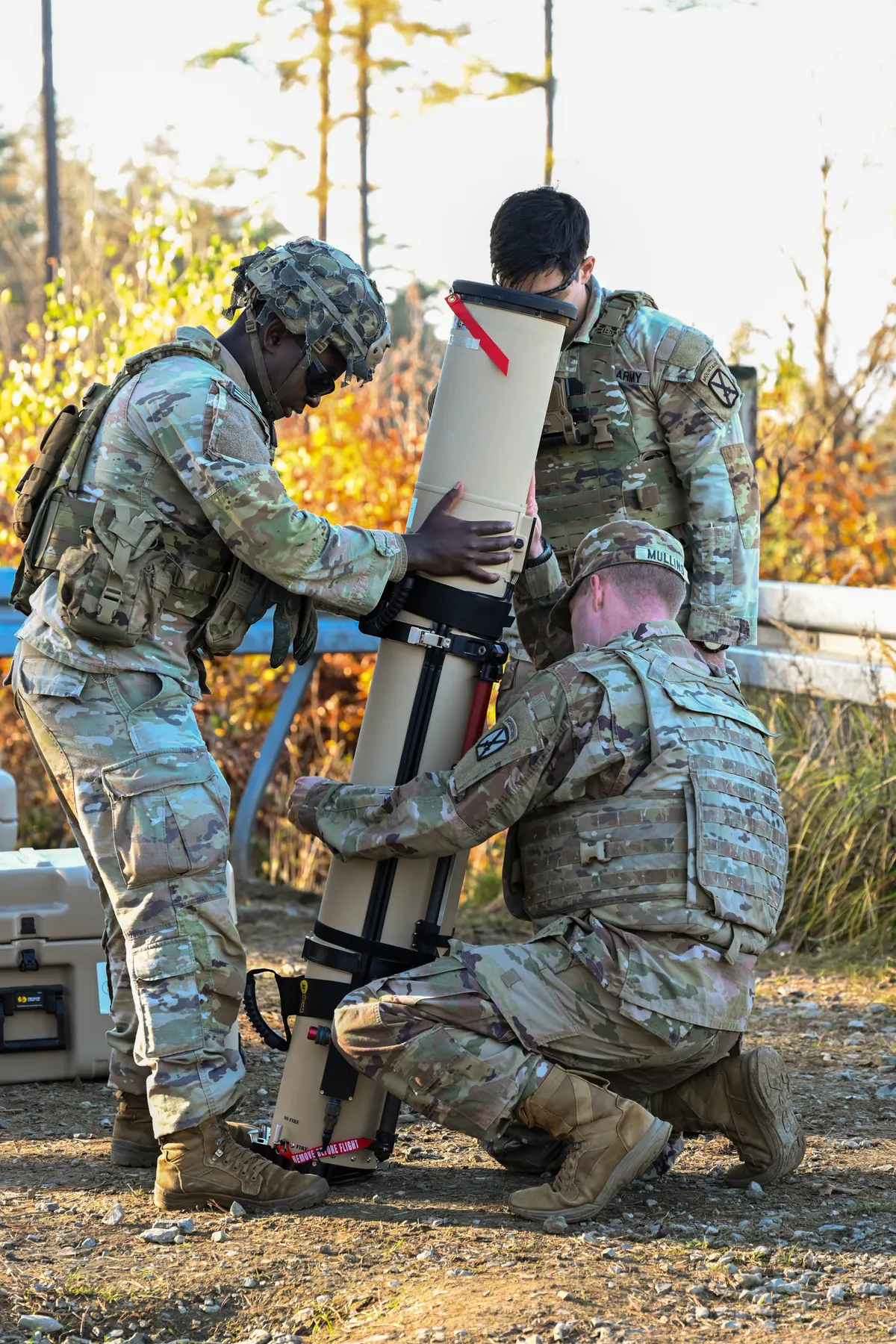
The nose section of Harpax Small is modular. Beyond the standard high-explosive fragmentation warhead, MBDA has said the same airframe can carry an interchangeable payload module for reconnaissance sensors, an electronic-warfare jamming package, or other cargo, turning the same tube-launched round into a reusable ISTAR or electronic-attack platform rather than a strictly one-way weapon.3 That modularity is one reason MBDA Italia frames Harpax as a platform family rather than a single munition, echoing the logic behind larger loitering munition programs elsewhere that separate the flight vehicle from its mission payload.
- Cruise Speed200 km/h
- Range20 km
- Endurance40
- Maximum Payload1.5 kg
The Harpax Mini Quadcopter for Room-to-Room Fighting
Harpax Mini is the smaller, rotary-wing member of the family, a four-rotor quadcopter with folding arms, hand- or ground-launched rather than tube-fired.1 Its maximum takeoff weight is about 2.5 kilograms, including a smaller 500-gram warhead, and it measures roughly 86 by 86 by 30 centimeters.1,2 MBDA quotes a cruise speed under 50 km/h, an operational range of 5 kilometers, and an endurance of around 20 minutes, though at least one account puts endurance closer to 30 to 40 minutes depending on flight profile.7
- EO/IR SensorYes
Harpax Mini's VTOL launch and small footprint are built specifically around urban combat, small enough to fly through a window or doorway and engage a soldier, a machine-gun position, or a light vehicle at very short range with minimal collateral damage to the surrounding structure.3 Its warhead is mounted low on the airframe rather than in the nose, a configuration MBDA has said suits engagements against targets inside buildings better than a forward-firing charge does.3
- ArmedYes
- Weapons Payload1.5 kg
- Weapon TypesHE-fragmentation warhead
Warhead and Payload Options from KNDS Ammo Italy
Both Harpax warheads are supplied by the Italian arm of KNDS, the Franco-German land-systems and ammunition group, which has developed a family of high-explosive fragmentation charges specifically for the two airframes.3 The warheads use a cylindrical structure with pre-formed spherical fragments, and MBDA has described the explosive fill as configurable, letting the same basic charge be tuned for more or less collateral damage depending on the target and the surrounding environment.3 Both drones carry electro-optical cameras for target identification and can fly either autonomously against a designated coordinate or under direct FPV (first-person-view) control from an operator, with a manual abort function built into the guidance software.1,3
- Control Typeautonomous waypoint or FPV piloted
- Autonomous CapableYes
- Variants3
- Operational Statusfield trials with Italian Army only, no production contract confirmed
The Harpax family grew out of the same set of battlefield lessons that reshaped Western thinking on cheap, disposable attack drones after 2022, when large numbers of improvised and purpose-built loitering munitions proved able to destroy vehicles and fortified positions at a fraction of the cost of a guided missile. MBDA Italia set out to build an Italian-sourced answer rather than import or license an existing design, partnering with small Italian manufacturers instead of building an entirely new production line in-house.3 Airframe work went to two specialist firms, a Terni-based company for the Harpax Mini's rotary-wing platform and a Foligno-based firm for the Harpax Small's fixed-wing airframe, while KNDS Ammo Italy supplied the warheads.3


The first real operational test came before the public reveal. In March 2025, soldiers of the Italian Army's 3rd Alpini Regiment used the Harpax Mini during the Volpe Bianca (White Fox, in English) exercise in the Puster Valley of the South Tyrol, supported by the 9th Rombo Cybersecurity Regiment.3 In the scenario, a separate reconnaissance drone spotted a target and passed the information into Italy's digital command network, nicknamed the tactical bubble, letting a ground commander task the Harpax Mini to strike it directly, a demonstration of the sensor-to-shooter link the Italian Army calls Army 4.0.3
MBDA did not publicly name or unveil the Harpax family until six months later, at the Seafuture exhibition in La Spezia from 29 September to 2 October 2025, where the company showed a half-scale Harpax Mini model and a one-fifth-scale Harpax Small model, and confirmed a third, longer-range Harpax Medium was already in development.2,7 The same event saw MBDA sign a separate production contract for the Italian Navy's Teseo Mk/E anti-ship missile, a reminder that Harpax sits alongside, not in place of, MBDA Italia's larger missile lines.4
Further trials followed the Seafuture unveiling. MBDA and the Italian Army planned a second round of field exercises for November 2025 involving mobile targets and jamming systems, intended to test the family's resistance to electronic countermeasures rather than just its strike accuracy.3 For the Harpax Medium, MBDA has set a concept freeze for September 2026, after which the third family member's actual specifications should firm up, it is currently described only in terms of an intended 80-kilometer range and a role flanking conventional artillery with indirect fire support at distances beyond what Harpax Small can reach.2 Industry reporting as of late 2025 projected the Italian Army could move toward a formal adoption decision within about a year of the Seafuture unveiling, though no contract has been confirmed.6
Harpax Mini is the quadcopter variant, hand- or ground-launched, built for close urban engagements with a roughly 2.5-kilogram takeoff weight, a 500-gram warhead, a 5-kilometer range and about 20 minutes of endurance.1,2
Harpax Small is the fixed-wing, tube-launched variant, built for longer-range strikes on vehicles and fortified positions, with an 8-kilogram takeoff weight, a roughly 1.5-kilogram warhead, a 15-to-20-kilometer range and 25 to 40 minutes of endurance depending on payload and distance.2,5
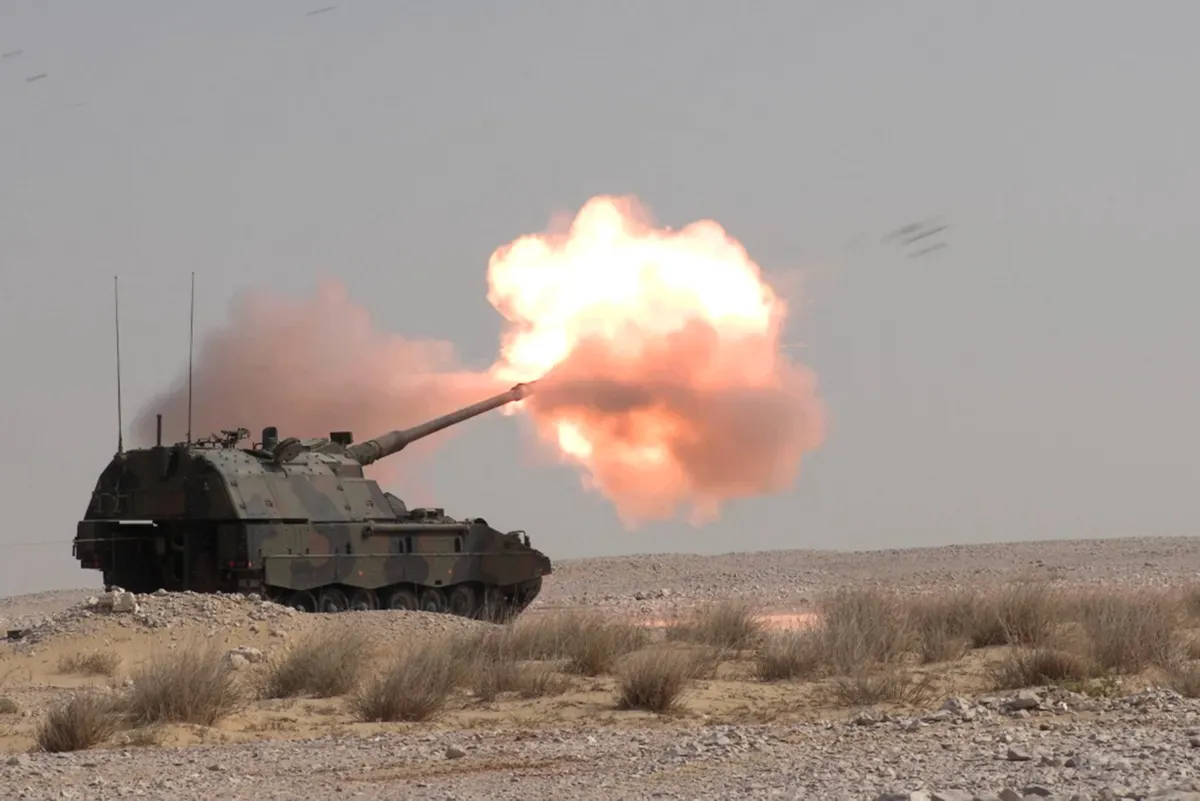
Harpax Medium is the announced but undeveloped third member of the family, intended to reach roughly 80 kilometers and carry a substantially larger payload than Harpax Small, positioned to provide indirect fire support alongside artillery rather than the close-in strikes the two smaller Harpax variants are built for.2 MBDA has set a concept freeze date of September 2026 for this variant, meaning firm specifications were not yet public as of this writing.2
Beyond the warhead-carrying kamikaze role, MBDA has also floated non-lethal Harpax Small payload modules, including an ISTAR sensor package and an electronic-warfare jamming module, both using the same tube-launched airframe and control software as the strike variant.3 None of those payload variants had a separate public name or confirmed test date as of mid-2026.

The only confirmed user of any Harpax variant so far is the Italian Army, which has field-tested the Harpax Mini in at least one live exercise (Volpe Bianca, March 2025) and had a second round of trials involving mobile targets and jamming scheduled for November 2025.3 No formal Italian Army acquisition contract for either Harpax Mini or Harpax Small had been announced as of mid-2026, so the program remains in the evaluation and trials phase rather than in operational service. MBDA has said it has also detected early interest from the Italian Navy and Italian Air Force, though neither service has run a public trial of the system.2
MBDA Italia has said its cost-control approach is meant to make Harpax attractive to international customers as well, once the Italian Army requirement is satisfied, though as of mid-2026 no export customer had been named and no export deal had been signed.6
Trade press has measured Harpax Small directly against the American Switchblade family, and the pairing is a useful way to read what MBDA Italia was actually trying to build. A defense-industry technical comparison placed Harpax Small in between Switchblade 300 and Switchblade 600 on nearly every axis, heavier and longer-ranged than the smaller Switchblade 300, lighter and shorter-ranged than the larger Switchblade 600.5
| Metric | Harpax Small | Switchblade 300 | Switchblade 600 |
|---|---|---|---|
| Takeoff weight | ~8 kg | ~2.5 kg | ~15 kg |
| Range | 15-20 km | ~10 km | ~40 km |
| Endurance | 25-40 min | ~15 min | ~40 min |
| Cruise speed | up to 200 km/h | n/a | n/a |
That middle position is deliberate rather than accidental. Switchblade 300 is built to kill dismounted soldiers and light vehicles at short range with an anti-personnel warhead, while Switchblade 600 carries an anti-armor shaped charge and a far longer reach for hitting armored vehicles well behind the front line.5 Harpax Small's roughly 1.5-kilogram HE-FRAG warhead sits closer to Switchblade 300's anti-personnel role than to Switchblade 600's anti-armor one, even though its range and endurance numbers are closer to the larger American round, which suggests MBDA Italia prioritized reach and loiter time over raw warhead mass for its first fixed-wing Harpax variant.
Harpax's more interesting internal comparison, though, is with MBDA's own French Akeron family. Akeron RCX 50 and Akeron RCH 170 were developed for the French Army under a 2022 defence-innovation-agency requirement and share the underlying software and datalink architecture MBDA Italia reused for Harpax, but the two national programs otherwise diverged, separate airframes, separate industrial partners, and separate customer requirements.8 Where the French requirement split into a short-range anti-personnel round and a longer-range anti-armor round from the outset, the Italian Harpax family instead grew a small urban quadcopter and a mid-range fixed-wing round first, with the long-range Harpax Medium arriving later as a third addition rather than a parallel launch. Both national approaches point at the same underlying MBDA strategy, reuse expensive software development across borders while keeping physical production, and the jobs and industrial sovereignty that come with it, inside each customer nation.


What is the MBDA Harpax? Harpax is a family of Italian loitering munitions developed by MBDA Italia for the Italian Army, unveiled publicly in September 2025 and made up of the small Harpax Mini quadcopter, the longer-range fixed-wing Harpax Small, and a planned longer-range Harpax Medium still in development.1,2
Is the MBDA Harpax in service? Not yet as of mid-2026. Harpax has completed at least one field exercise with the Italian Army's 3rd Alpini Regiment and had further trials scheduled, but no production contract had been publicly confirmed.3
How much does the MBDA Harpax cost? MBDA has not published a unit price for Harpax Mini or Harpax Small. The company has said cost control was a central design goal, aiming to price the family below the benchmark set by comparable Western loitering munitions.6
What is the range of the MBDA Harpax? Harpax Mini's operational range is about 5 kilometers, Harpax Small's is 15 to 20 kilometers, and the still-undeveloped Harpax Medium is intended to reach roughly 80 kilometers.1,2
How does the MBDA Harpax compare to the Switchblade? Harpax Small sits between the American Switchblade 300 and Switchblade 600 in weight, range and endurance, while carrying a smaller warhead than either at a comparable size class.5
Who makes the MBDA Harpax? MBDA Italia, the Italian division of the tri-national missile maker MBDA, developed Harpax with Italian small and medium-sized manufacturing partners building the airframes and KNDS Ammo Italy supplying the warheads.3,9
- "MBDA Italy unveils Harpax family of loitering munitions", Janes — janes.com ↩
- "Seafuture 2025 – MBDA launches the Harpax family of loitering munitions", EDR Magazine — edrmagazine.eu ↩
- "MBDA Italia unveils two new Loitering Munitions", EDR Magazine — edrmagazine.eu ↩
- "MBDA signs Italian Navy Teseo Mk/E missile production contract, unveils HARPAX loitering munitions", Shephard Media — shephardmedia.com ↩
- "MBDA Unveils Its Own Switchblade Analog", Defense Express — en.defence-ua.com ↩
- "Барражирующие боеприпасы MBDA Harpax", Military Watch Magazine (topwar.ru English edition) — en.topwar.ru ↩
- "SEAFUTURE 2025 logbook, Day 2", MBDA official account on X — x.com ↩
- "SOFINS 2025: MBDA details Akeron family of loitering munitions", Janes — janes.com ↩
- "MBDA", Wikipedia — en.wikipedia.org ↩