


The ZALA Lancet is a Russian loitering munition — a class of weapon covered in this archive's glossary of loitering munitions that combines the loiter time of a small reconnaissance drone with a warhead intended to destroy the target it finds. It is built by ZALA Aero, a subsidiary of the Kalashnikov Concern, and was first shown publicly in June 2019 at the Army-2019 forum in Moscow.1 The type is often described in casual reporting as a version of the earlier ZALA KYB-BLA ("Kub-BLA"), and the two do share a launch catapult and general X-wing configuration, but they are distinct designs: the Lancet is a separate, more advanced successor rather than a rebadge of the Kub-BLA airframe.1
- Low unit cost (reported around $35,000–$37,000) relative to the armored vehicles it targets
- Compact, catapult-launched airframe with a short logistics footprint
- EO/IR terminal guidance suited to hitting a specific point on a vehicle rather than an area
- Paired reconnaissance-strike loop with the Orlan-10 shortens the time between detection and attack
- Reported production increases have made it one of the most frequently used precision-strike drones of the war
- Short standalone link range, which is why it depends on a spotter drone for over-the-horizon targeting
- Viral strike footage often shows an impact but not confirmed destruction of the target vehicle
- Hit-rate and effectiveness claims from Russian and Ukrainian-aligned sources are contradictory and unverified
- No confirmed export sale despite a marketed export variant
- Supply chain for components reportedly depends on sanctions-evasion routes through third countries
Lancet's public reputation was built less by official Russian disclosures than by battlefield video. Since 2022 it has become one of the most visually documented weapons of the full-scale war between Russia and Ukraine, credited — sometimes over-credited, as this article discusses below — with strikes on some of the most modern armored vehicles supplied to Ukraine.2,3 It normally does not operate alone: a companion reconnaissance drone finds and marks the target before a Lancet is launched, a division-of-labor described in more detail under History and Conflicts.4
Airframe and Propulsion
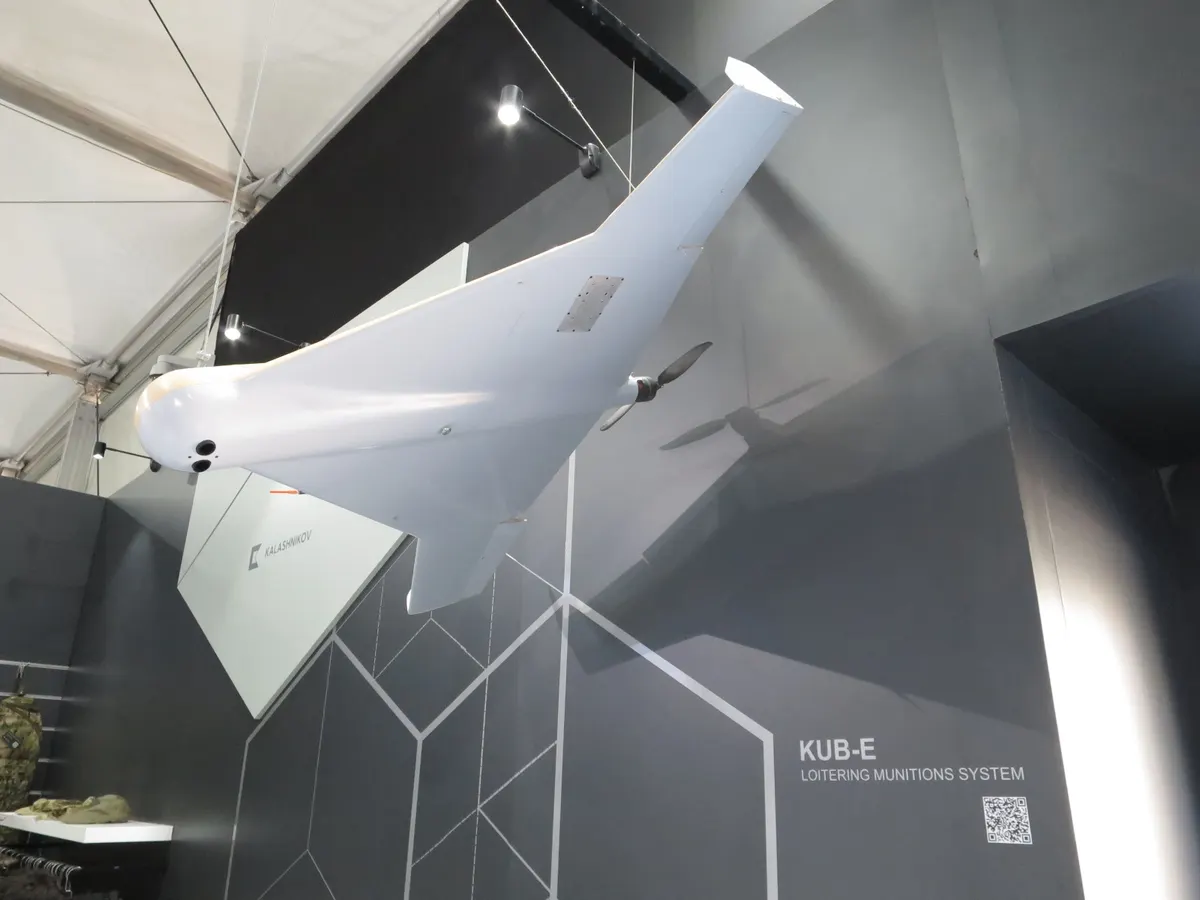
The production Lancet-3 variant covered by this profile has a maximum takeoff weight of about 12 kg and carries a payload of up to 3 kg, launched from a pneumatic catapult and driven by a single electric motor.1 Reported speeds run from roughly 110 km/h cruise up to about 300 km/h in a terminal dive, with an operating radius in the region of 40 km and an airborne endurance of around 30–40 minutes — figures broadly consistent with the compact X-wing airframe design ZALA unveiled in 2019.1,5
Guidance, Payload and Autonomy
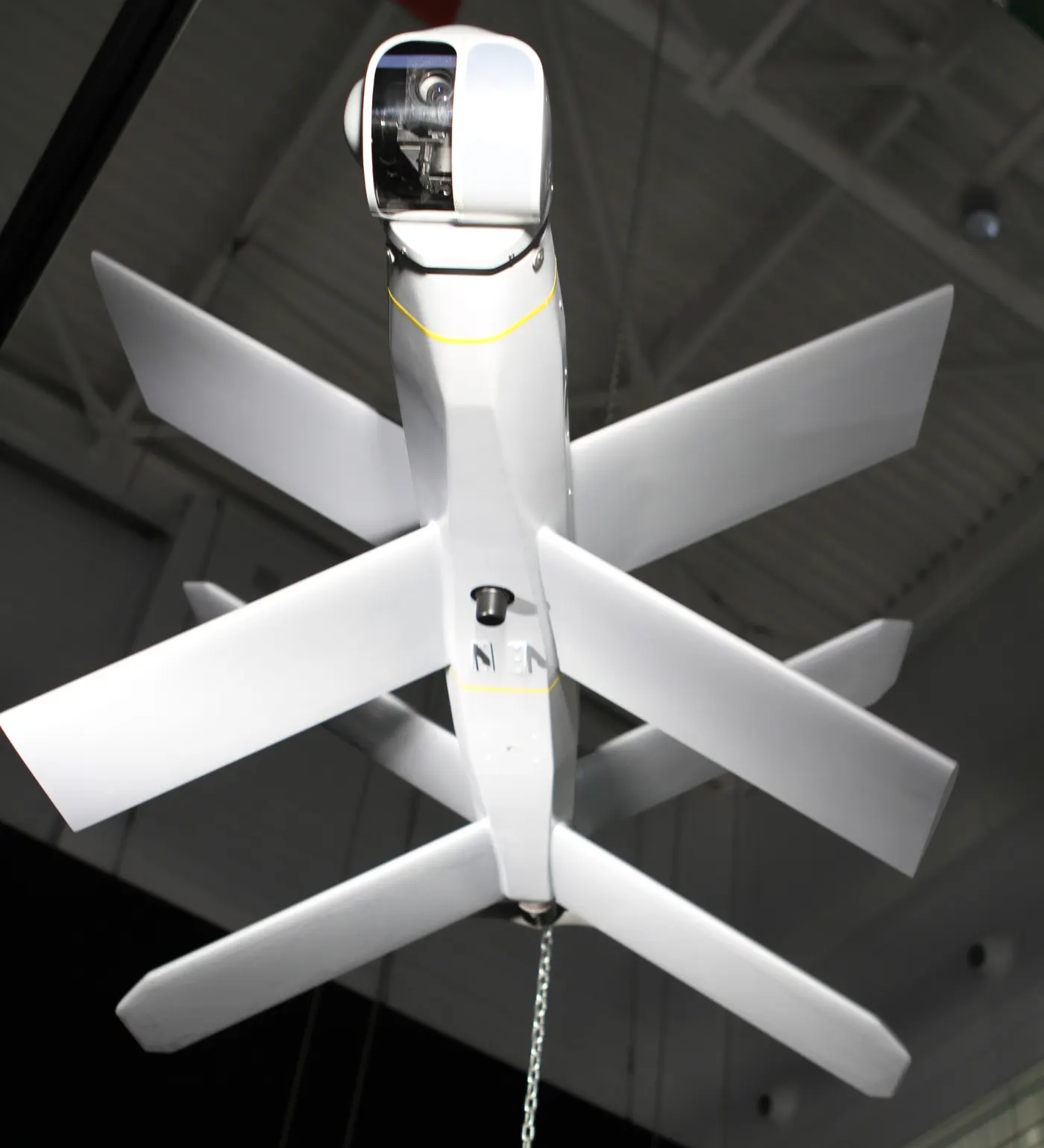
Lancet carries an electro-optical/infrared sensor for terminal targeting and a warhead described across variants as high-explosive, HE-fragmentation, shaped-charge/HEAT, or thermobaric, allowing the same airframe family to be tasked against armor, personnel, or soft-skinned equipment.5 It is radio-controlled with a reserve frequency, rather than satellite-linked, and is described as capable of autonomous terminal guidance and coordinated ("swarming") employment with other munitions, though the specific extent of onboard autonomy in combat use is not independently verifiable from open reporting.1
ZALA Aero, part of the Kalashnikov Concern, unveiled the Lancet at the Army-2019 defense forum in Moscow in June 2019 as a follow-on to its earlier KYB-BLA loitering munition, sharing the same catapult launch method but built to different specifications.1 Before its large-scale use against Ukraine, the type was reportedly field-tested in Syria between 2020 and 2021, including against anti-government forces in Idlib province, giving Russian forces initial combat experience with the weapon ahead of the 2022 escalation in Ukraine.1
Russia's use of Lancet expanded sharply after its 2022 invasion of Ukraine, and Russian industry sources have described production increases ranging from roughly threefold to as much as fiftyfold since the war began, though no single audited production figure is publicly available.6,7 Independent open-source tracking gives a sense of the scale reached by mid-decade: the OSINT project LostArmour recorded between 285 and 303 Lancet strikes over a 29-day period in May 2024, the highest single-month count it had logged.7
Syrian Civil War
Lancet's combat debut reportedly came during the Syrian Civil War, where it was field-tested by Russian forces against anti-government forces in Idlib in 2020–2021, ahead of its far larger-scale use in Ukraine from 2022 onward.1
Russo-Ukrainian War
Lancet's reputation as an anti-armor weapon was cemented by viral strike footage from 2023 onward. On 3 August 2023, Telegram video widely reshared by channels including "Military Informant" showed what was reported as the first documented Lancet-3 strike on a Ukrainian Leopard 2A6 main battle tank.2 Later that same month, similar footage circulated showing a Lancet strike on a US-supplied M2A2 Bradley infantry fighting vehicle.3 These clips became the signature images establishing Lancet's reputation as a tank-killer in Western and Russian media alike — but the footage typically ends at the moment of impact, without follow-up damage assessment, so viral framing that treats every hit as a confirmed kill goes beyond what the videos themselves show; several such vehicles were reported only damaged, not destroyed.2,3
Much of Lancet's battlefield effect comes from how it is used rather than the munition alone. Russian forces typically pair it with an Orlan-10 reconnaissance drone (or related ZALA-421-16E2-type platforms), which performs the initial reconnaissance, locates and designates the target, and relays communications, since the Lancet's own datalink range is limited on its own.4 This reconnaissance-strike loop is central enough to Russian employment that Ukrainian counter-drone tactics specifically target the Orlan-10 spotter aircraft, aiming to break the chain between detection and the artillery or Lancet strike that follows before the strike munition is even launched.4
Claims about Lancet's effectiveness against Ukrainian targets are contested and should be read with that context in mind. One Russian-aligned account cites a 77.7 percent hit rate in a reported campaign of more than 2,800 Lancet launches against Ukrainian artillery.8 Separately, the Ukrainian-aligned OSINT tracker LostArmour has stated that roughly 70 percent of Lancet strikes miss their targets.9 These two figures are close to mutual opposites, and neither has been independently verified by a neutral source; this article presents both as attributed, disputed claims rather than settled facts.8,9
ZALA has fielded the Lancet as a small family of airframes built around the same X-wing configuration rather than as substantially different designs. The Izdeliye-51 is the larger of the two core production variants, carrying a warhead reported at 5 kg or more and offering an endurance of roughly one hour.5 The Izdeliye-52, the smaller and evidently more widely used variant (and the one whose specifications most closely match the performance figures given above), carries a roughly 3 kg warhead, uses an updated electro-optical guidance package, and has a reported link range around 30 km.5 A newer "Product-53" variant was reported in August 2023, though public technical detail on it remains limited.5

Listed operators include Russia (active since around 2020) and Iran. Russia's status as the sole confirmed operational user is well documented through its use in Syria and, at scale, in Ukraine.1,2 Independent open-source reporting reviewed for this article, however, does not confirm a Lancet transfer to or operational use by Iran. Iran's own loitering-munition inventory is built around separate domestically produced designs such as the HESA Shahed 136, and no cited source documents a Lancet delivery to Iranian forces. Given the broader documented absence of any confirmed Lancet export as of 2024, an Iranian operator listing should be treated with caution pending clearer sourcing.
Lancet is most often compared to Western loitering munitions built for the same anti-armor niche, particularly the AeroVironment Switchblade 600, and to Russia's other prolific strike drone of the war, the Iranian-designed HESA Shahed 136 (used by Russia under the name Geran-2). The comparison is more about role than raw specification: Shahed 136/Geran-2 is a long-range, one-way attack drone flown against fixed infrastructure and area targets from hundreds of kilometers away, while Lancet is a short-range, reconnaissance-cued munition flown against point targets — typically vehicles and artillery — that its Orlan-10 spotter has already located.1,4
| SPEC | ZALA Lancet | AeroVironment Switchblade 600 | HESA Shahed 136 |
|---|---|---|---|
| Max Takeoff Weight | 12 kg | 15 kg | — |
| Range | 40 km | 40 km | 2500 km |
| Endurance | 0.67 h | 0.667 h | — |
| Top Speed | 300 km/h | 185 km/h | 185 km/h |
Within this archive's own composite scoring, Lancet's overall rating of 73 places it just above the Switchblade 600's 72 and well above the Shahed 136's 57, reflecting its higher scores for precision and cost-effectiveness against a lower loiter-endurance and range score than either comparator — consistent with its role as a short-range, reconnaissance-cued strike weapon rather than a long-endurance loiterer or a long-range one-way attack drone.


As of the most recent open-source reporting, no confirmed export sale of the Lancet to a foreign customer has been documented. Multiple outlets report that through 2023–2024 Russia prioritized domestic Ministry of Defense demand over exports, and that Lancet lacked the export licensing and documentation that would be needed for a foreign sale.6 At the Army-2024 forum in Moscow in August 2024, the state arms exporter Rosoboronexport unveiled a dedicated export package under the name "Lancet-E," pairing a Z-16-E reconnaissance drone with 51-E and 52-E munition variants, and stated an estimated export potential of more than 1,000 systems.10,11 That announcement is a marketing and sales pitch rather than evidence of an actual transaction: no buyer, contract, or delivery has been named in connection with Lancet-E, and this article treats the distinction between advertised export readiness and a confirmed sale as significant rather than a technicality.10,11
Sustaining even domestic-only production has reportedly required workarounds to Western sanctions on Russia's defense-industrial base. Investigative reporting has named China-based intermediary firms — including one identified as "OMP," founded by a ZALA employee, and another, "SpetsTechnotrade," linked to an employee's father — along with exporters based in Turkey, as supply-chain partners that have helped keep ZALA's production running despite sanctions.12,13 In January 2025, the US State Department sanctioned entities accused of supplying ZALA with microelectronics, machine tools, and motors or engines used in Lancet production.14
Is the ZALA Lancet the same weapon as the KYB-BLA (Kub-BLA)? No. The two loitering munitions share a launch catapult and a broadly similar airframe concept, but ZALA presents the Lancet as a distinct, more advanced successor design rather than a renamed Kub-BLA.1
Did a Lancet destroy a Ukrainian Leopard 2 tank? Video from 3 August 2023 documented a Lancet-3 strike on a Ukrainian Leopard 2A6, and similar footage that month showed a strike on an M2A2 Bradley. The footage confirms an impact; it generally does not show a subsequent damage assessment, so whether the vehicles were destroyed outright or only damaged is not established by the videos alone.2,3
How does Lancet find its targets? It is normally cued by a separate reconnaissance drone, most often an Orlan-10, which locates and designates the target and relays communications, since Lancet's own datalink range is limited on its own — a targeting loop Ukrainian forces have targeted by attacking the Orlan-10 spotter itself.4
Has Russia exported the Lancet? No confirmed export sale has been reported as of the most recent open-source coverage. Rosoboronexport marketed an export configuration, "Lancet-E," at the Army-2024 forum with an estimated market potential above 1,000 systems, but no buyer or contract has been publicly named.10,11
How effective is the Lancet against Ukrainian targets? Claims conflict sharply: one Russian-aligned source cites a 77.7 percent hit rate against Ukrainian artillery, while the OSINT tracker LostArmour states roughly 70 percent of Lancet strikes miss. Neither figure has been independently verified, and this archive presents both as disputed claims rather than fact.8,9
- "ZALA Lancet", Wikipedia — en.wikipedia.org ↩
- "First Ukrainian Leopard 2A6 Tank Hit by Russian Lancet Drone", Army Recognition — armyrecognition.com ↩
- "Video Shows Lancet Drone Strike on Bradley in Ukraine", Newsweek — newsweek.com ↩
- "Целеуказание за минуты: Орлан-10 закрыл петлю между обнаружением цели и артиллерийским ударом", ru1.ru — ru1.ru ↩
- "Russia unveils new Lancet-3 kamikaze drone variant", Sputnik Africa — en.sputniknews.africa ↩
- "Dreaded Lancet Suicide Drones Due To Surging Use During...", Eurasian Times — eurasiantimes.com ↩
- "Russia Ramps Up Production of Lancet Kamikaze Drones", Defence Industry Europe — defence-industry.eu ↩
- "Exclusive Report: Russia Launches Over 2,800 Lancet Drones Targeting Ukrainian Artillery With 77.7% Hit Rate", Army Recognition — armyrecognition.com ↩
- "Що приховує статистика по 'Ланцетам'" (context on contested Lancet effectiveness claims), Pravda.com.ua — pravda.com.ua ↩
- "For the First Time, the Export Variant Lancet-E Makes Its Debut at Army Forum 2024", Defence Security Asia — defencesecurityasia.com ↩
- "Rosoboronexport Unveils Lancet-E System at Army 2024", Rostec — rostec.ru ↩
- "China Helps Lancet Drone Manufacturer Circumvent Sanctions", Militarnyi — militarnyi.com ↩
- "Investigation: Who Helped Russians Increase Production of Domestic Attack Drones Despite Sanctions", Kyiv Independent — kyivindependent.com ↩
- "Sanctions To Disrupt Russia's Military-Industrial Base and Sanctions Evasion", US Department of State — state.gov ↩