


The ZALA KUB-BLA is a small, catapult-launched loitering munition built by ZALA Aero Group, a subsidiary of Kalashnikov Concern. It belongs to the class of weapons covered in this archive's loitering munitions entry: an unmanned aircraft that carries its own warhead, flies toward a designated point or search area, and detonates on impact rather than returning to base. The Russian designation is Куб-БЛА ("Cube"), rendered in export marketing as Kub-E, Kub-UAV, or KYB.1 ZALA first displayed the airframe publicly at the IDEX-2019 arms exhibition in Abu Dhabi in February 2019, three years before Russia's full-scale invasion of Ukraine, and press coverage has tied its origin to combat experience Russian forces gathered in Syria between 2015 and 2018.2
- Compact, catapult-launched airframe with a light logistics footprint
- Electric propulsion gives a quiet terminal approach compared with combustion-engine strike drones
- Two selectable targeting modes: pre-set GPS coordinates or an uploaded reference image
- Export-cleared and combat-tested years before its main production run began
- Upgraded HMX-based warhead reportedly raises blast yield over the original charge
- Baseline variant carries no live video feed for terminal correction, unlike sibling Lancet
- Total airframe weight has never appeared in open manufacturer or press sources
- Vendor "AIVI" autonomous-targeting claims remain independently unverified
- Payload capacity of 3 kg is small next to several rival anti-armor loitering munitions
- Documented combat use is far smaller in volume than that of the Lancet
KUB-BLA predates its better-known sibling, the ZALA Lancet, by several months on the exhibition floor and by roughly a year in the sustained combat use that followed.2,3 Both systems come from the same manufacturer and both launch from a pneumatic catapult, but their airframes differ: KUB-BLA is built as a conventional flying wing, while Lancet uses a cruciform "double-X" wing arrangement that ZALA describes as a first for a weapon of this class, adopted to sharpen the terminal dive and reduce the aircraft's radar and visual signature.3,4 The larger practical gap is in guidance. The baseline KUB-BLA carries no video link to its operator, so once the aircraft begins its terminal approach nobody on the ground can see or adjust its path, while Lancet keeps a live video feed running through impact, letting its operator retarget the strike or call it off.5 Open-source analysts have pointed to that missing terminal feed as a genuine operational limitation of KUB-BLA relative to Lancet, and it is one plausible reason Lancet went on to see far heavier combat use once the full-scale war began.6
The airframe spans 1,210 mm wingtip to wingtip, measures 950 mm in length, and stands 165 mm high, figures that are consistent across manufacturer and independent press descriptions.1,2 It is driven by a single electric motor turning a pusher propeller at the rear of the fuselage, powered by a lithium-ion battery, and it leaves the ground from a pneumatic catapult rather than under its own power.2,7 ZALA also markets a shipboard version of the launcher for use from small high-speed craft, though no combat deployment of that naval variant has been documented.2
No source reviewed for this profile gives a total airframe or launch weight for the KUB-BLA. Only the payload capacity is documented with any consistency: up to 3 kg of combined guidance electronics and explosive charge, a figure repeated across both manufacturer material and independent reporting.1,2 That 3 kg figure describes the payload, not the aircraft as a whole, and any total-mass number attached to this weapon elsewhere should be treated as unsupported until a primary source is found.
Reported speed ranges from 80 km/h up to a maximum of 130 km/h, with an airborne endurance of 30 minutes and an operating range of roughly 40 km.1,2 The range figure sits below the theoretical distance the airframe could cover at maximum speed for its full endurance — about 65 km — which suggests the quoted 40 km reflects a control-link limit rather than a battery limit, though no source makes that distinction explicit.
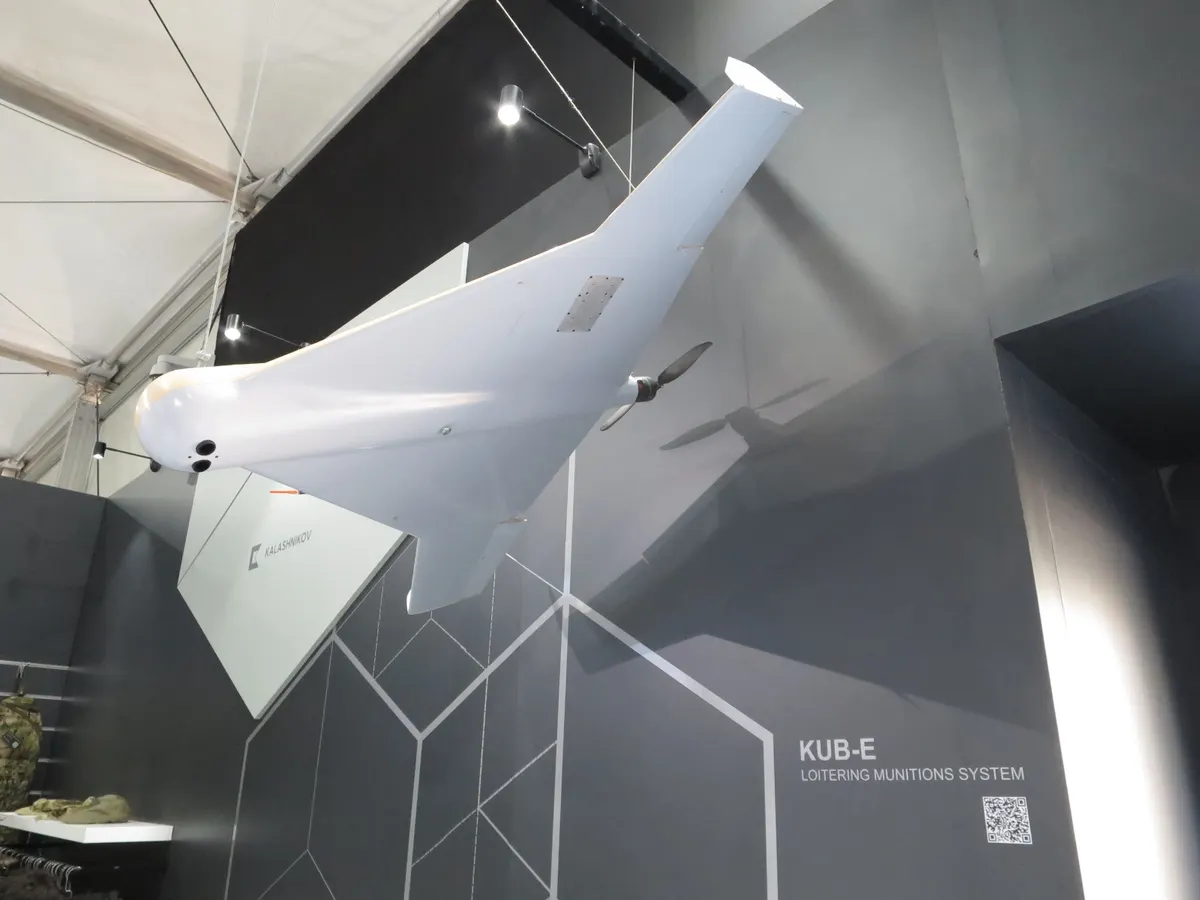
Guidance is set before launch, either as fixed GPS coordinates or as an uploaded photograph the aircraft's optics attempt to match against the terrain below.1,2 ZALA additionally markets an onboard system it calls "AIVI" (Artificial Intelligence Visual Identification), advertised as capable of real-time recognition and classification of targets and, separately, of a "swarm mode" allowing coordinated multi-aircraft strikes; the manufacturer has also claimed the system multiplies the area a single operator can search by a factor of 60.1,2 None of these three claims — AI-based recognition, the 60-times search-area figure, or swarm coordination — has been independently confirmed in documented combat use.
The original warhead is described as a roughly 3 kg high-explosive fragmentation charge with an effective blast radius of about 3 m.7 Beginning around December 2023, Russian forces began fielding an upgraded warhead, designated OFBCh-2.5, using an HMX-based explosive fill that the manufacturer states raises blast yield to roughly 1.7 times that of a comparable TNT charge — a multiplier that comes from the manufacturer rather than independent testing.8,9
Set against its sibling, KUB-BLA compares as follows on the figures available:
| Parameter | KUB-BLA (baseline) | ZALA Lancet |
|---|---|---|
| Airframe | Flying wing | Cruciform "double-X" wing3,4 |
| Total weight | Not documented (payload only: 3 kg)1,2 | Reported around 5 kg (Izdeliye-51) to 12 kg (Izdeliye-52) MTOW3 |
| Warhead | ~3 kg HE-frag baseline; OFBCh-2.5 HMX-based upgrade (~Dec 2023)7,8 | Reported 3–5 kg depending on variant3 |
| Range | ~40 km2 | Reported up to ~40 km, varying by source3 |
| Endurance | 30 min1,2 | Reported 30–60 min, varying by variant3 |
| Terminal guidance | Coordinates or image match; no video feed on the baseline5 | Live video feed retained through impact5 |
| First shown publicly | February 2019, IDEX2 | June 2019, Army-2019 forum3 |
Reading these figures together, KUB-BLA and Lancet occupy a similar weight and range bracket, and the meaningful separation between them is guidance rather than airframe size: Lancet's retained video channel gives its operator a chance to correct or abort a strike in the final seconds, a capability the baseline KUB-BLA does not have.5,6 An assessment of precision grounded in that gap alone would place KUB-BLA's baseline variant toward the lower end of its weight class, since a munition that cannot be corrected after its final course is set is, by construction, less forgiving of an initial targeting error than one that can.
Development is reported to trace to Russian Aerospace Forces' experience in Syria between 2015 and 2018, before the airframe reached public view.2 ZALA unveiled it at the IDEX-2019 exhibition in Abu Dhabi in February 2019, and by 2020 it was reportedly undergoing further testing in Syria alongside the newer Lancet.2,6
An export configuration, KUB-E, passed Russian state testing in November 2021, and Russian authorities cleared it for export in January 2022, weeks before the invasion of Ukraine began.2,12 Ukraine's Defence Intelligence chief, Maj. Gen. Kyrylo Budanov, later stated that Russian forces used the Kub "at the very beginning of the conflict on February 24 and so forth," placing its combat debut against Ukraine on the first day of the full-scale invasion.16
Roughly two years into the war, in late December 2023, the upgraded OFBCh-2.5 warhead began reaching Russian units.8,9 A further revision, marketed under the Kub-2 designation family (including Kub-2-1E and Kub-2-2E variants), added an electro-optical targeting package described by the manufacturer as AI-assisted; its first documented field use came roughly a year after the upgrade was announced, in the Pokrovsk sector of the front.9 Kalashnikov presented an export version, Kub-2-E, at a defense show in the United Arab Emirates in January 2025.14
The most recent claims come from the manufacturer alone and remain unconfirmed by independent reporting. In December 2025, Kalashnikov stated it had received export licenses covering the Kub-2 and Kub-10 families and had concluded unspecified large supply contracts, without naming a buyer.15 In February 2026, the company presented a further variant, Kub-10ME, describing it as Russia's first tactical guided munition with a range beyond 100 km; in March 2026 the manufacturer said export contracts for an unnamed "international customer" had been executed.1 None of these three statements names a buyer, a quantity, or a value, and none has been corroborated outside Kalashnikov's own announcements.
Budanov's account places KUB-BLA in Russian use inside Ukraine from the opening days of the full-scale invasion, in February 2022.16 The event most often cited as the first documented combat use came several weeks later: on March 12, 2022, photographs of a crumpled metallic airframe, reportedly recovered in Kyiv's Podil district, circulated on Telegram; open-source analysts matched the wreckage to the KUB-BLA type, and Ukrainian forces stated they had shot the aircraft down before or during detonation.10,17
That incident is widely cited as the first confirmed combat use of a Russian-made loitering munition, and it was reported at the time as among the earliest possible battlefield uses of an AI-linked weapon. The wreckage itself only establishes that the airframe type was present and brought down; it does not establish how the aircraft was being guided in its final approach.10
Two months later, on May 18, 2022, the Russian Ministry of Defence released footage of a strike on a Ukrainian M777 155 mm howitzer position. Independent assessments of the video — reported by Newsweek and by Forbes' David Axe — concluded the strike caused only minor damage at best, attributing the limited effect to the standoff distance of the attack and the weapon's comparatively small warhead; the crew reportedly displaced, but the howitzer itself was not destroyed.18,19
Use in Syria is also documented, against targets in Idlib Governorate during the Syrian civil war, overlapping in time with the weapon's early Ukraine deployment.1 Across the broader war in Ukraine, the Ukrainian open-source tracking project Lostarmour had logged at least 44 recorded Kub-family uses as of December 2023 — a modest total next to Lancet's own tally over the same period, and a figure consistent with KUB-BLA remaining a comparatively minor part of Russia's loitering-munition inventory once Lancet was in wide service.1
A single regional outlet has reported that in 2024, Wagner Group personnel operated KUB-BLA in Mali for both reconnaissance and strike roles; the same report states that two units were found abandoned near Inazarraf in July 2024 following clashes with Tuareg rebel forces.11 This account has not been corroborated elsewhere and should be read with that caveat.
| Variant | Notes |
|---|---|
| KUB-BLA (baseline) | Original production version; no video downlink; 3 kg-class HE-fragmentation warhead1,7 |
| Kub-E | Export-cleared configuration, cleared by Russian authorities in January 202212 |
| KUB-BLA, upgraded warhead | Fields the OFBCh-2.5 HMX-based warhead from roughly December 20238,9 |
| Kub-2 / Kub-2-1E / Kub-2-2E | Adds an electro-optical, manufacturer-described AI-assisted targeting package; first documented in combat in the Pokrovsk sector roughly a year after the upgrade's announcement9 |
| Kub-10E | Extended-range export designation1 |
| Kub-10ME | Presented February 2026; manufacturer claims a range beyond 100 km — unverified independently1 |
| Naval launch variant | Dedicated launcher for high-speed boats and small ships; no documented combat use2 |
The gap between the baseline KUB-BLA and the Kub-2 family is largely about what the aircraft can see in its final seconds of flight: the original relies entirely on pre-flight targeting data, while the Kub-2 variants add a camera package intended to let the munition recognize its target during the approach itself.9 The Kub-10 line instead trades sensor sophistication for reach, and the newest member of that line, Kub-10ME, is the subject of the least independently tested claim in the whole product family — a stated range past 100 km that, as of this writing, rests entirely on the manufacturer's own presentation.1

Set against loitering munitions produced outside Russia, KUB-BLA sits at the light end of the weight and warhead spectrum rather than in the heavier anti-armor tier occupied by systems such as the AeroVironment Switchblade 600. Reported figures place the Switchblade 600 at roughly 22.7 kg for the airframe alone and about 54.5 kg all-up with its launch tube, carrying a Javelin-derived anti-armor warhead over a datalink-extendable range past 40 km — a considerably larger and more specialized weapon than KUB-BLA's sub-3-kg-payload airframe.2 Elbit's SkyStriker, by comparison, has a reported maximum takeoff weight around 40 kg with a selectable 5 kg or 10 kg warhead and a manufacturer-stated range of 100 km, again well beyond KUB-BLA's declared 40 km and payload class.2 Poland's WB Electronics Warmate 2 is reported at roughly 30 kg maximum takeoff weight with a warhead up to 4.8 kg — again heavier across the board than KUB-BLA, though sources disagree on its exact range, with figures spanning from roughly 20 km to well over 200 km.2
Against lighter, man-portable systems the comparison runs the other way. Rafael's original Spike Firefly carries a roughly 350 g warhead on a 3 kg airframe with an engagement range measured in the hundreds of meters to about 1.5 km, and the later L-Spike 1x variant, at 2.2 kg with a 420 g warhead, still operates at a fraction of KUB-BLA's declared 40 km reach.2 Ukraine's Fire Point FP-2 sits at the opposite extreme from both: a deep-strike design carrying a 105 kg (and reportedly growing to 158 kg) warhead out to roughly 200 km, a different weapon class entirely from the small tactical strike role KUB-BLA was built for.2
Within this archive's own composite scoring, KUB-BLA's sibling Lancet carries an overall rating of 73, just ahead of the Switchblade 600 at 72; the Firefly and FP-2 both sit at 68, SkyStriker at 65, and the Warmate 2 at 59. KUB-BLA itself has not yet been scored in this archive, but the technical picture assembled above — a small warhead, a 40 km declared range, and, in its baseline form, no terminal video correction — points toward figures nearer the lower end of that group than toward Lancet's own rating, largely on account of the guidance gap between the two ZALA designs described above.5,6
The single most consequential difference within ZALA's own product line remains the one described in Specs and Design: Lancet kept its operator watching the target through impact, while the original KUB-BLA released it and hoped for the best. That gap in the human's ability to intervene late in the attack, more than any difference in airframe size or warhead weight, is the detail independent analysts have singled out to explain why the two siblings ended up on such different combat trajectories.5,6
Is the KUB-BLA the same weapon as the ZALA Lancet? No. They share a manufacturer and a catapult launch method, but KUB-BLA uses a flying-wing airframe with no terminal video feed, while Lancet uses a cruciform "double-X" wing and keeps a live video link to its operator through impact.3,4,5
Did Russia use an autonomous "killer robot" drone against Ukraine in 2022? Wreckage matched to a KUB-BLA was recovered in Kyiv in March 2022, and the incident was widely reported as a possible first combat use of an autonomous weapon. The Bulletin of the Atomic Scientists concluded the photographic evidence did not establish whether the drone had operated autonomously, and noted the system still requires a human to approve any strike.10
What warhead does the KUB-BLA carry? The original variant carries a roughly 3 kg high-explosive fragmentation charge with an effective blast radius near 3 m. From around December 2023, an upgraded OFBCh-2.5 warhead using an HMX-based fill entered service, which the manufacturer states raises blast yield to about 1.7 times that of an equivalent TNT charge.7,8
How far can the KUB-BLA fly, and how heavy is it? Reported range is about 40 km with an endurance of 30 minutes at speeds between 80 and 130 km/h. Total airframe weight has not been published in any source reviewed for this article — only the payload capacity, up to 3 kg, is documented.1,2
Has the KUB-BLA been exported? An export-cleared version, KUB-E, was approved for sale by Russian authorities in January 2022. A single regional report claims Eritrea received 8 KUB-E units in May 2022, and Kalashnikov has since 2025 announced further export licenses and contracts for a Kub-2/Kub-10 "international customer," but no buyer, quantity, or value for that later claim has been independently confirmed.12,13,15
- "ZALA Kub-BLA", Wikipedia — en.wikipedia.org ↩
- "ZALA KYB (Kub) Strike Drone", Army Technology — army-technology.com ↩
- "Lancet Loitering Munition System", Army Technology — army-technology.com ↩
- "Удaрный беспилотник ZALA Lancet — копьё XXI века", ZALA Aero — zala-aero.com ↩
- "Russian Drone Swarm Technology Promises 'Aerial Minefield' Capabilities", The National Interest — nationalinterest.org ↩
- "The Russian Kub-BLA Drone With 3-kg Warhead Allegedly Received Artificial Intelligence", Defense Express — en.defence-ua.com ↩
- "KUB / KYB-UAV", GlobalSecurity.org — globalsecurity.org ↩
- "Russian Kamikaze Drone Gets a More Powerful Warhead", The Defense Post — thedefensepost.com ↩
- "Rare: Russia's Kub-BLA Drone Received a Modernized Warhead", Defense Express — en.defence-ua.com ↩
- "Russia May Have Used a 'Killer Robot' in Ukraine. Now What?", Bulletin of the Atomic Scientists — thebulletin.org ↩
- "Wagner Operating Kub Loitering Munition in Mali", Military Africa — military.africa ↩
- "Russia Clears Kamikaze Drone for Export", The Defense Post — thedefensepost.com ↩
- "Eritrea Receives 8 Russian ZALA KYB Drones in Return for Russian Military Base", Harnnet — harnnet.org ↩
- "Kalashnikov Unveils Latest Loitering Munition Kub-2-E in UAE", Bulgarian Military — bulgarianmilitary.com ↩
- "Поставки Калашниковым Куба-2", www1.ru — www1.ru ↩
- "Weapons Systems With Autonomous Functions Used in Ukraine", Automated Decision Research — automatedresearch.org ↩
- "Russia Using Kalashnikov/ZALA Aero Kub Suicide Drones in Ukraine", Army Recognition — armyrecognition.com ↩
- "Video Shows Russian Drone Attack on Ukraine's US-Made Howitzers", Newsweek — newsweek.com ↩
- "The Russians Are Targeting Ukraine's American-Made Howitzers", Forbes — forbes.com ↩
- "1,500 Russian Lancet Suicide Drones Already Used in Ukraine", Bulgarian Military — bulgarianmilitary.com ↩