

The AeroVironment Red Dragon is a fixed-wing, catapult-launched loitering munition built for one-way attack missions in electronic-warfare-heavy, GPS-denied battlefields.1 AeroVironment, the United States manufacturer behind the combat-proven Switchblade family, unveiled Red Dragon at the SOF Week 2025 conference in Tampa, Florida, on May 6, 2025, days after completing its corporate merger with BlueHalo and rebranding the combined company simply as AV.2,3 Unlike the earlier, man-portable Switchblade 300 and Switchblade 600, Red Dragon is built for range rather than portability, with a stated reach of more than 400 kilometers and a design goal of surviving heavy jamming without relying on satellite navigation at any point in the mission.1,4
- 400 km stated range, far beyond the tube-launched Switchblade family
- GNSS-independent navigation designed to keep working under heavy jamming
- Modular 10 kg payload bay (kinetic warhead, EW, or sensor package)
- Catapult launch rate of up to five vehicles per minute for saturation strikes
- Built on fewer than 150 unique components with no China-sourced parts
- No independently confirmed combat record under the Red Dragon name specifically
- Claimed battlefield-testing theatre and adversary have not been named by AV
- Pentagon guidance on autonomous lethal engagement for the system remains undefined
- Unit cost, full production rate, and total contracted quantity are undisclosed
Red Dragon is officially described by AV as a fully autonomous-capable UAV rather than a fully autonomous one, meaning it supports an optional man-in-the-loop control mode in which a ground operator can review target imagery and issue a final engagement decision before the munition strikes.4,5 That framing matters for how the system is marketed to the US and allied militaries, since AV positions Red Dragon as a scalable, mass-producible platform rather than a boutique special-operations tool, aiming eventually to deliver airframes and push new capabilities out at software-update speed rather than on traditional hardware-refresh cycles.1
The AeroVironment Red Dragon specifications released so far describe a 45-pound (roughly 20 kg) all-up round with an 11.8-foot wingspan and a 6.6-foot fuselage, cruising at around 90 km/h and capable of a terminal dash speed near 160 km/h during the final attack run.1,5,6 Answering the frequently searched question of how Red Dragon is different from Switchblade, the short version is scale. Switchblade 300 and Switchblade 600 are tube-launched, tripod-portable systems built for squad- and platoon-level anti-personnel and anti-armor strikes at ranges under 40 kilometers, while Red Dragon is a catapult-launched, battalion-level strike asset meant to reach ten times farther.1,7
The airframe is a small, electrically powered fixed-wing design optimized for mass production rather than for the runway-independent vertical launch used by many quadrotor-hybrid loitering munitions.1 AV built Red Dragon on its AVACORE shared software architecture, the same underlying software stack the company is using across its newer autonomous product line, which it says shortens development time and lets new sensor or seeker hardware be integrated without redesigning the airframe from scratch.5,8
Endurance for the full 400 kilometer autonomous profile runs to roughly five or six hours depending on battery configuration and flight profile, a figure AV has confirmed is battery-dependent rather than fixed.6,8 The munition launches from ground-based rail launchers that AV says can cycle up to five airframes per minute, a rate intended to support coordinated, swarm-style salvo launches rather than single one-off strikes.6,7
The standard payload is a roughly 5-pound explosively formed penetrator warhead sized for anti-armor and hardened-point-target work, fitted inside a 22-pound (10 kg) modular bay that AV says can alternatively carry an electronic-warfare payload or a dedicated reconnaissance sensor package instead of a kinetic warhead.1 That modularity is central to how Red Dragon is marketed, letting the same airframe serve as a strike weapon on one sortie and a jamming or intelligence-gathering platform on the next without a hardware change.
Navigation is the system's most distinctive feature. Red Dragon combines a hardened GPS receiver with digital scene-matching, airspeed sensors, and laser range-finding so it can continue toward a target area even if GPS signal is denied or spoofed entirely.1 Target detection and classification run through AV's SPOTR-Edge perception software, a passive optical seeker system that is inherently resistant to RF jamming because it does not depend on an active radar return or radio uplink to identify a target.1,5 Within an operator-defined search box, Red Dragon can identify, classify, and track a candidate target largely on its own, presenting the imagery back to a human controller for a final go or no-go decision within roughly a one-minute window before it will act autonomously.1
AeroVironment's loitering-munition line traces back through the tube-launched Switchblade 300 and the larger, Javelin-warhead-derived Switchblade 600, both of which saw extensive, well-documented combat use in Ukraine after the 2022 Russian invasion.10,11 Red Dragon was developed inside AV's MacCready Works advanced-programs division, named for AeroVironment founder Paul MacCready, specifically to extend that Switchblade-era experience of jamming-heavy, GPS-denied combat into a system with far greater range and higher production volume.1,5
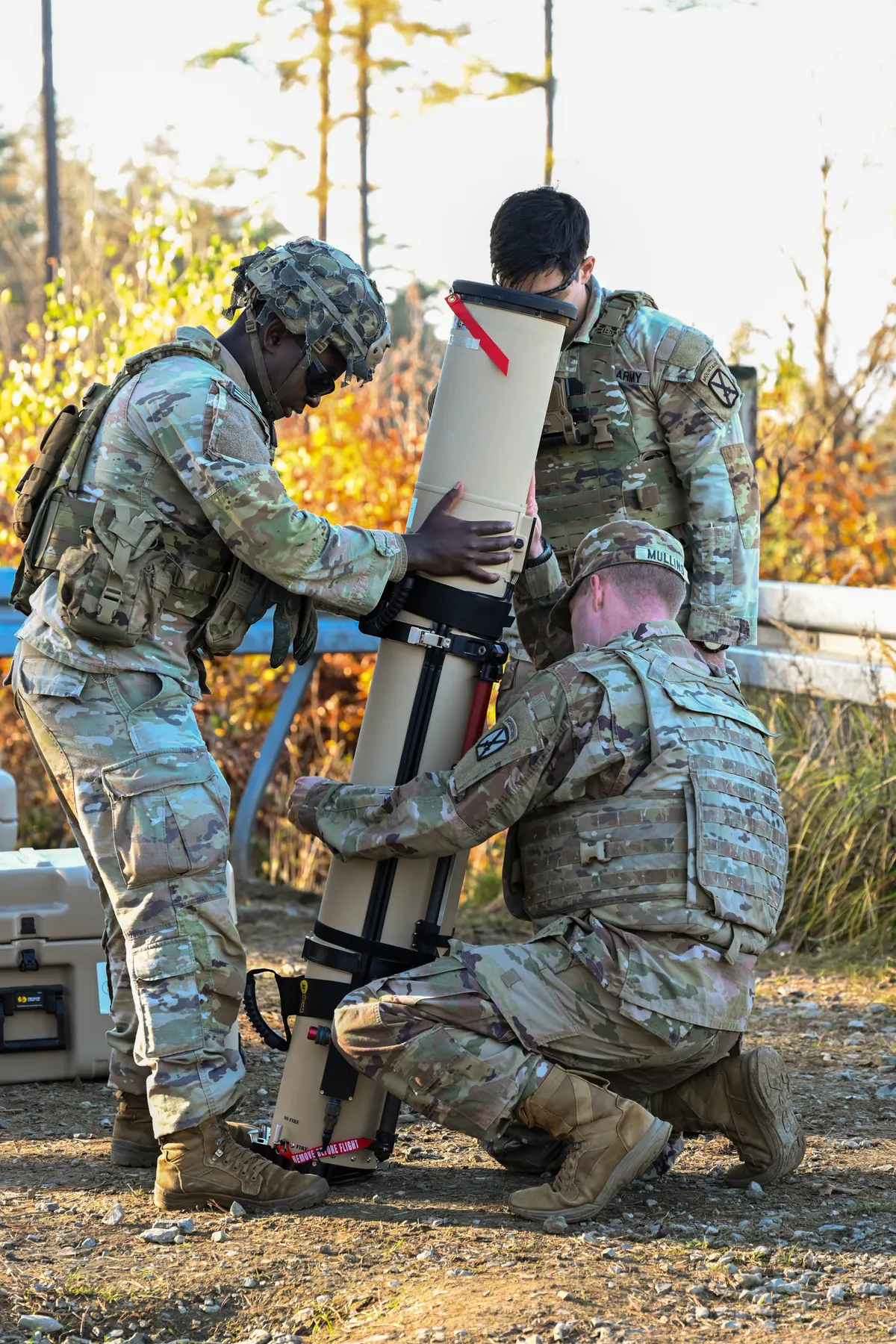
The company unveiled Red Dragon publicly on May 6, 2025, at the SOF Week special-operations trade show in Tampa, days after AeroVironment completed a corporate merger with BlueHalo and adopted the shortened brand name AV.2,3 At the unveiling, AV chief executive Wahid Nawabi described the system as already battle-tested, citing close to a thousand flights conducted against what he called the heaviest jamming environment achievable in a real-world setting, while declining to identify either the theatre of operation or the customer involved.12 MacCready Works executive vice president Jeff Rodrian framed the program around mass producibility, calling GNSS-independent navigation and mass production the pillars of a mission-ready system for contested battlespace.5
Given that undisclosed provenance, Ukrainian defense-industry outlet Defense Express has speculated that Red Dragon's claimed battlefield testing could have taken place covertly inside Ukraine, on the reasoning that it remains the only active battlefield offering realistic jamming conditions for this class of weapon, though no named unit, engagement, or independent confirmation supports that specific claim.7 That gap between marketing language and verifiable combat record is worth stating plainly. Nothing in open-source reporting as of mid-2026 confirms Red Dragon has struck a target in the Russo-Ukrainian War or any other named conflict under its own name, distinct from the well-documented record of its Switchblade siblings.

Formal US government interest followed roughly ten months later. On March 12, 2026, the US Army awarded AeroVironment a contract worth more than $17.5 million covering Red Dragon air vehicles, launchers, ground control stations, battery chargers, spare-parts kits, training materials, and field-service support, with an initial performance window running to April 8, 2026.9,13 The Army did not disclose the exact number of airframes covered. The same announcement window also included a separate, larger $117.3 million Army contract for AV's P550 reconnaissance drone, a pairing that lets a battalion combine long-endurance sensing with Red Dragon's long-range strike capability.9 Coverage of the purchase tied it to Defense Secretary Pete Hegseth's Drone Dominance initiative and the Pentagon's wider Artemis program pushing affordable, long-range, autonomy-capable strike systems down to platoon and battalion level.9
AV has not disclosed a formal variant-naming scheme for Red Dragon as of mid-2026, but the system is explicitly modular by payload rather than by airframe. The baseline configuration carries a roughly 5-pound explosively formed penetrator warhead for anti-armor and point-target strikes, while the same 10 kg bay can instead carry an electronic-warfare payload or a dedicated reconnaissance sensor package for missions where destroying the target is not the objective.1 AV has also indicated it intends to offer a non-ITAR-restricted export configuration aimed at international customers who cannot receive the version sold to the US military, though that exportable model had not been formally launched as of the March 2026 Army contract.1

| Yıl | Alıcı | Adet | Tutar | Bugünkü Değer (2025) |
|---|---|---|---|---|
| 2026 |  Amerika Birleşik Devletleri | — | $17.6 M | $17.6 M |
The only confirmed Red Dragon operator to date is the United States Army, which placed its first disclosed procurement contract in March 2026.9,13 AV executives have stated the system has already flown combat-representative missions for at least one other, unnamed customer, but no foreign government has been publicly identified as a confirmed Red Dragon buyer or operator, and the company has said it is still pursuing an exportable, non-ITAR variant for international sales rather than actively delivering the baseline system abroad.1,12
Red Dragon and the Switchblade 600 share a manufacturer and a design lineage, but they occupy different rungs of the loitering-munition category and were built to answer different battlefield problems. The Switchblade 600 is a squad-portable, tube-launched system with a stated range around 40 kilometers and a man-in-the-loop wave-off-and-recommit control scheme built for tank-killing precision at short stand-off distances.11 Red Dragon trades that portability for reach, launching from a ground rail rather than a shoulder-carried tube and pushing range out to a claimed 400 kilometers, ten times farther, while shifting toward an optional man-in-the-loop model where the drone can identify and act on targets with less continuous operator attention.1,6
| Spec | Switchblade 600 | Red Dragon |
|---|---|---|
| Launch method | Tripod-mounted tube | Ground rail catapult |
| Stated range | ~40 km11 | ~400 km1 |
| Control | Man-in-the-loop, wave-off/recommit11 | Optional man-in-the-loop, autonomous option4 |
| Warhead | Javelin-derived shaped charge11 | ~5 lb explosively formed penetrator1 |
The two systems are best understood as complementary rather than competing. A unit fighting at short range against armor still wants the Switchblade 600's precise, recallable terminal control, while a headquarters trying to strike a target 300 kilometers behind the front line in a heavily jammed electromagnetic environment is the scenario AV specifically built Red Dragon to answer. Whether Red Dragon proves as combat-effective as the Switchblade family did in Ukraine remains genuinely unresolved, since its own combat record, unlike the Switchblade 600's, is not independently documented as of mid-2026.

What is the AeroVironment Red Dragon? It is a fixed-wing, catapult-launched loitering munition (one-way attack drone) built by AeroVironment, now branded AV, designed to strike targets over roughly 400 kilometers without relying on GPS.1
How is Red Dragon different from the AeroVironment Switchblade? Switchblade 300 and Switchblade 600 are shorter-range (under 40 km), tube-launched, tripod-portable systems built for squad and platoon use. Red Dragon is a longer-range, ground-rail-launched system aimed at battalion-level strike missions roughly ten times farther out.1,11
Is the Red Dragon drone in Ukraine? AV has confirmed test flights and unnamed-customer battlefield testing but has not named Ukraine specifically, and Ukrainian defense-industry commentary describing a possible Ukraine connection remains speculation rather than confirmed fact.7,12
How much does the AeroVironment Red Dragon cost? AV has not disclosed a per-unit price. The US Army's first confirmed contract, covering airframes, launchers, ground stations, and support, was valued at more than $17.5 million without a disclosed unit breakdown.9
Is Red Dragon in service with the US military? The US Army placed its first confirmed procurement contract for Red Dragon in March 2026, though the system remains in an early fielding and evaluation phase rather than widespread service.9,13
- "Red Dragon Highly-Autonomous One-Way Attack Drone Unveiled", The War Zone — twz.com ↩
- "Newly branded as 'AV,' AeroVironment unveils new loitering munition, predicts play for CCA", Breaking Defense — breakingdefense.com ↩
- "AV Launches Red Dragon UAS and Titan 4 C-UAS", Inside Unmanned Systems — insideunmannedsystems.com ↩
- "AV Unleashes Red Dragon, A New Breed of Fully Autonomous Capable, GPS-Denied One-Way Attack Unmanned Aircraft Systems", AV (AeroVironment) — avinc.com ↩
- "Red Dragon", AV (AeroVironment) — avinc.com ↩
- "U.S. Army to Field Red Dragon Autonomous Drone Capable of 400 km Strikes Without GPS", Army Recognition — armyrecognition.com ↩
- "Advanced 400-km Strike Drone from Switchblade Creators May Already Be in Ukraine", Defense Express — en.defence-ua.com ↩
- "New 'Red Dragon' Drone Can Strike 400 km Without GPS, May Already Be in Ukraine", United24 Media — united24media.com ↩
- "Army Buys Red Dragon Strike Drone as Lethal Autonomy Rules Remain Undefined", SOFX — sofx.com ↩
- "Switchblade kamikaze drone production to ramp up following Ukraine use", Defense News — defensenews.com ↩
- "AeroVironment Switchblade", Wikipedia — en.wikipedia.org ↩
- "One-way attack drone swarm has been used on the battlefield, AeroVironment CEO says", Military Embedded Systems — militaryembedded.com ↩
- "Army buys Red Dragon long-range attack drones", DefenseScoop — defensescoop.com ↩