

The Baykar Kemankeş 1 (commonly written Kemankes-1 in English-language reporting) is a jet-powered loitering munition developed by Baykar, the Turkish manufacturer of the Bayraktar TB2 and Akıncı unmanned combat aircraft.1 Baykar itself describes the system as a "mini intelligent cruise missile," a label that captures its position between a traditional slow, propeller-driven kamikaze drone and a small guided missile: it is powered by a turbojet rather than an electric motor or piston engine, is not recoverable, and is built to be carried and launched from Baykar's own unmanned aircraft rather than flown independently from the ground.2 It is the company's first production loitering munition, unveiled publicly at TEKNOFEST 2023 in Istanbul and moving through a multi-year flight-test campaign since.3
- Turbojet propulsion gives it a far higher dash/dive speed than electric-rotor loitering munitions in the same weight class
- Pre-integrated with three already widely exported Baykar UCAVs (TB2, TB3, Akıncı), simplifying adoption for existing Bayraktar customers
- Dual-use EO/IR sensor supports reconnaissance as well as terminal strike guidance
- Demonstrated air-to-air intercept capability against aerial targets, unusual for a loitering munition of its size
- Light enough that a single TB2 can reportedly carry up to four rounds per sortie
- Core specifications (weight, range, endurance) vary substantially across Baykar's own statements and independent reporting, suggesting a design still being finalized
- Warhead reported as small (roughly 5-10 kg depending on source), limiting effect against hardened targets
- No confirmed independent combat use as of this writing, unlike longer-fielded rivals such as the [ZALA Lancet](/en/weapons/zala-lancet) or [HESA Shahed 136](/en/weapons/hesa-shahed-136)
- Endurance of roughly 20-30 minutes is short next to vehicle-launched rivals built for longer loiter times
Kemankeş-1 is certified to launch from three Baykar platforms: the Bayraktar TB2, the Bayraktar TB3, and the larger Bayraktar Akıncı, each of which can carry multiple rounds on underwing pylons.4 Its light weight relative to the payload limits of those aircraft is deliberate — reporting on the system states a TB2 alone can carry up to four Kemankeş-1 rounds within its roughly 150 kg total payload allowance, letting a single armed drone sortie against several separate targets rather than expending its entire weapons load on one strike.4 Because it is essentially a missile launched from a UCAV rather than a UCAV weapon station in the ordinary sense, Baykar and Turkish outlets frequently market it as extending a carrier drone's effective reach without exposing the (much more expensive) aircraft itself to short-range air defenses.2
Reported figures for Kemankeş-1's core specifications vary noticeably between Baykar's own statements, Turkish trade press, and international aggregators such as Wikipedia — a pattern common to systems still early in testing and export, and one this article flags rather than silently resolving. Wikipedia's infobox lists a 45 kg launch weight, a 10 kg payload, an 100 km operational range, a maximum speed of 330 km/h (180 knots), and a 20-minute endurance.1 Shephard Media and EDR Magazine, drawing on Baykar's 2025 test announcements, instead report a 40 kg launch weight, a 150 km range, and roughly 30 minutes of endurance.5,6 Baykar's own promotional material claims a maximum range "over 200 km" and up to an hour of flight time, while a Turkish defense outlet's technical rundown puts launch weight at just 30 kg with a 6 kg warhead.2,7 None of these sources fully reconcile with one another, which is unsurprising for a weapon whose payload and fuel load likely change between test configurations and eventual production standard; this article treats the Wikipedia and Shephard/EDR figures as the most consistently cross-referenced and notes the others as Baykar's own higher claims.
Guidance combines GNSS/INS navigation for the transit phase with an AI-assisted electro-optical/infrared seeker for the terminal phase, and Baykar describes the munition as operating under human-in-the-loop control at typical ranges, with autonomous target recognition intended to extend engagement beyond the operator's direct line of sight.2,4 The same sensor package doubles as a reconnaissance and battle-damage-assessment tool, letting the carrier aircraft use an unlaunched round's camera for surveillance before committing to a strike.1
Propulsion and airframe
Kemankeş-1 is powered by a small turbojet identified in Turkish trade coverage as the IL170, a roughly 38 lbf-thrust engine built by İdeaLab, a private Turkish propulsion company, rather than by a larger state defense-industry supplier.4 That detail is worth noting on its own: most loitering munitions in this weight class, including most of Kemankeş-1's rivals, use small piston or electric motors, and a domestically produced turbojet at this scale is still relatively rare outside a handful of countries. The airframe itself is compact — Wikipedia lists it at 1.73 m long with a 1.14 m wingspan and 0.40 m height — with small fixed wings sized for a munition meant to be carried folded under a UCAV wing and deployed only after release.1
Guidance, sensors, and countermeasures
The sensor package is built around a two-axis-stabilized daylight camera offering 36x optical zoom, a 60°-to-2° variable field of view, and full-HD (1920×1080) resolution, paired with an AI-assisted autopilot and, according to Baykar's later 2025 test statements, electronic-warfare countermeasures intended to resist jamming of its navigation and data links.1,8 Terminal guidance can use either the electro-optical feed or GNSS coordinates, giving the operator a choice between a manually tracked strike and a fire-and-forget profile against a fixed target.2
Payload and platform integration
Reported payload capacity ranges from about 5 to 10 kg depending on the source and test configuration, described as sufficient against soft and lightly armored targets such as personnel, unarmored or light-armored vehicles, and air-defense radar or launcher vehicles, but modest next to the 20 kg payload envisioned for the larger, ground-launched Kemankeş-2 or the 40-50 kg warheads carried by long-range one-way attack drones like the Shahed-136.2,9
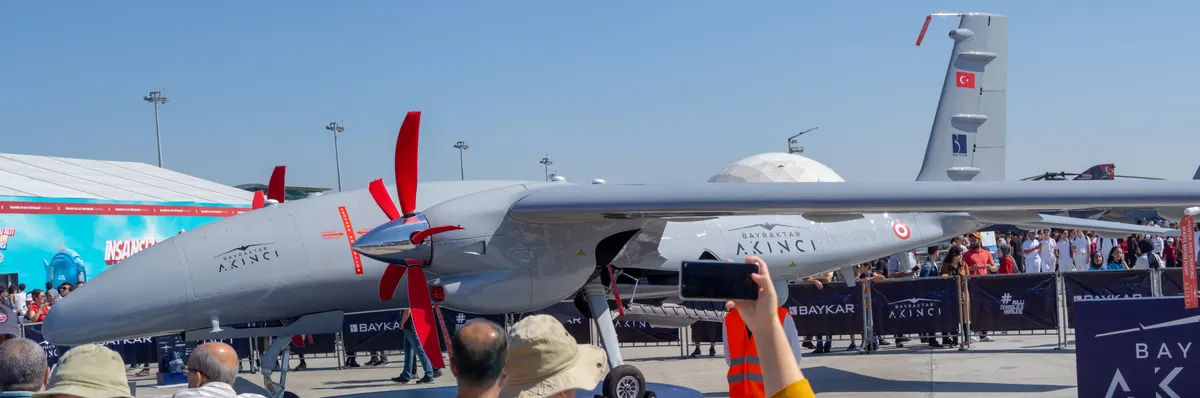
Integration with the TB2, TB3, and Akıncı gives Kemankeş-1 access to carrier aircraft with very different endurance profiles — the Akıncı alone is credited with over 24 hours of flight time and more than 1,350 kg of total payload capacity — meaning the munition's own 20-30 minute endurance is generally the limiting factor on how far from the carrier's flight path a target can actually be engaged.8
Naming and unveiling
The name Kemankeş, literally "bow-puller" or archer in Ottoman Turkish, is drawn from historical Ottoman military figures known for archery skill, most famously the 17th-century grand vizier Kemankeş Kara Mustafa Pasha; Baykar's naming convention for the system follows the company's broader pattern of giving its products Turkish/Ottoman-derived names rather than acronyms.10 Baykar's chief technology officer, Selçuk Bayraktar, first announced the system's coming reveal in comments made aboard the Turkish amphibious ship TCG Anadolu in early 2023, describing it at the time as "a cruise missile with hundreds of kilometers of range" — a considerably larger range claim than any range figure the company or independent testers have since reported for the production Kemankeş-1.3 The system was then shown publicly for the first time as a static exhibit at TEKNOFEST 2023, held at Istanbul's Atatürk Airport from 27 April to 1 May 2023.1
The first powered, motor-operated firing test followed shortly after, with footage of a launch from a TB2 released on 15 June 2023.3
2025 test campaign
Baykar ran a visible sequence of test milestones through 2025, each announced separately and each adding a distinct capability claim. On 24 March 2025, two Kemankeş-1 rounds launched from a TB2 completed what Baykar called a maximum-flight-and-dive test, flying more than 100 km before diving onto their designated targets and, notably, landing intact by parachute for recovery and post-test inspection rather than being destroyed on impact.5 On 4 July 2025, a round launched from an Akıncı struck a designated ground target with what Baykar described as pinpoint accuracy, in a joint exercise run out of the company's Çorlu and Keşan flight-test centers.9 Separately, reporting in late June and July 2025 described Baykar demonstrating an air-to-air engagement, with a Kemankeş-1 launched from an Akıncı intercepting an aerial target in flight — an unusual role for a system of this size and one more commonly associated with dedicated air-defense interceptors than with ground-attack loitering munitions.11,12 A further Army Recognition report dated 31 October 2025 described what it called the type's "first live-fire" engagement of an airborne target from an Akıncı; whether this represents a distinct, later test or a re-reported account of the same June/July intercept was not resolved by the sources reviewed for this article, and readers should treat the exact sequence of 2025 air-to-air tests as not fully settled in open reporting.13
First export: Azerbaijan
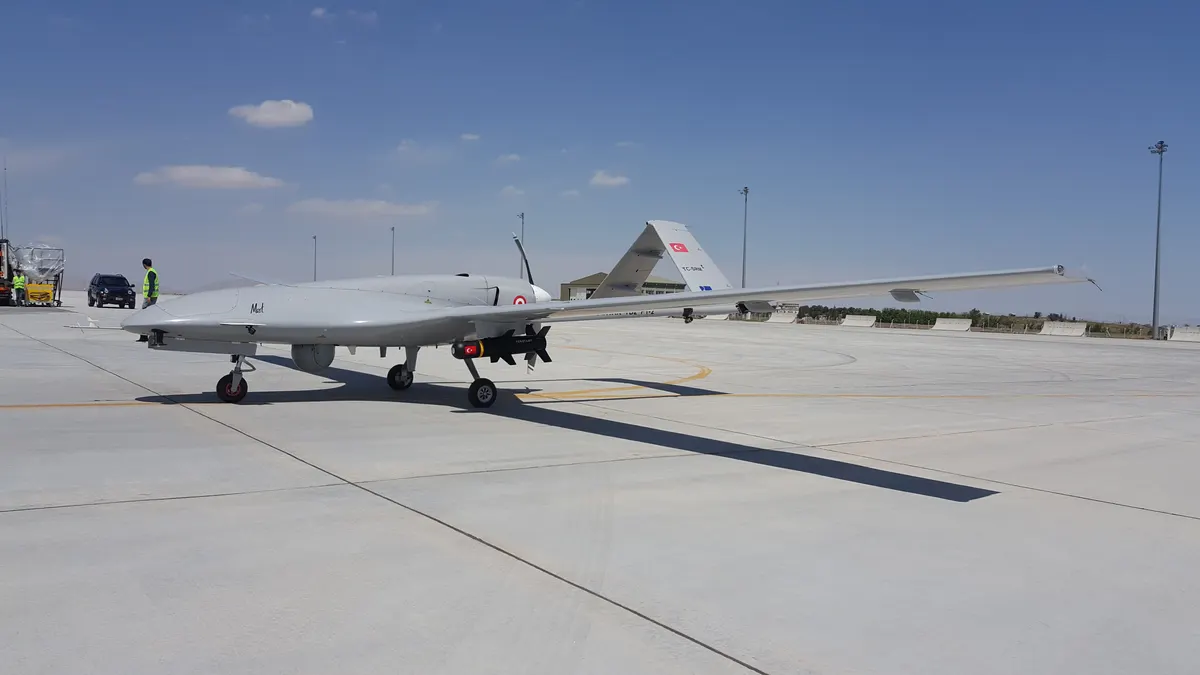
Azerbaijan became Kemankeş-1's first disclosed export customer, introducing the munition into service alongside Baykar's TOLUN glide bomb at the ADEX 2024 defense exhibition, where the Azerbaijani Ministry of Defence displayed both weapons integrated onto its existing TB2 fleet.14
Azerbaijan had operated Bayraktar TB2s since before its 2020 war with Armenia over Nagorno-Karabakh, so the Kemankeş-1 acquisition reads as an incremental munitions upgrade to an already-fielded drone fleet rather than a new platform sale.14
Kemankeş-1 is the smaller, air-launched member of what Baykar now markets as a two-part Kemankeş family; the second member, Kemankeş 2, is a separate, larger weapon rather than an upgraded version of the same round, and is covered in its own article rather than in depth here. Where Kemankeş-1 is released from a carrier UAV in flight, Kemankeş-2 is a ground-launched design: it is fired from a vehicle-mounted ramp after the launch vehicle accelerates into the wind, with a rocket-assisted takeoff option also described for launches without a vehicle run-up.6 Baykar first showed Kemankeş-2 publicly in 2024 and unveiled a further-developed version at the SAHA 2026 exhibition in Istanbul in May 2026.15
| Spec | Kemankeş-1 (air-launched) | Kemankeş-2 (ground-launched) |
|---|---|---|
| Launch weight | ~40-45 kg1,5 | ~70-75 kg6,15 |
| Payload | ~5-10 kg1,2 | ~20 kg6,15 |
| Length | 1.73 m1 | 2.47 m6 |
| Wingspan | 1.14 m1 | 1.35 m6 |
| Range | ~100-200 km1,2 | ~150-180+ km6,15 |
| Endurance | ~20-30 min1,5 | ~30-40 min6,15 |
| Launch method | Released from TB2/TB3/Akıncı in flight4 | Vehicle ramp or rocket-assisted takeoff6 |
Because Kemankeş-2 dispenses with the weight and drag limits imposed by being carried under a UAV wing, it trades away some of Kemankeş-1's speed for a heavier warhead and, on paper, a longer range, and is aimed more at independent, ground-based strike detachments than at extending a UCAV's own reach.6
The two systems are neither interchangeable nor sequential replacements for one another; Baykar has continued developing both in parallel rather than retiring one in favor of the other.

| Yıl | Alıcı | Adet | Tutar | Bugünkü Değer (2025) |
|---|---|---|---|---|
| 2024 |  Azerbaycan | — | — | — |
Turkey, the developing nation, has run the great majority of documented Kemankeş-1 test flights through its own Baykar-operated flight-test centers at Çorlu and Keşan.5,9 None of the sources reviewed for this article contain an explicit Turkish Ministry of National Defence statement confirming formal induction of Kemankeş-1 into Turkish Armed Forces frontline service, as distinct from company-run development and acceptance testing; readers should treat Kemankeş-1's status with Turkey itself as "in active testing, developer nation" rather than confirmed as formally fielded, pending a clearer government announcement.
Azerbaijan is Kemankeş-1's only confirmed foreign operator, having introduced it into service at ADEX 2024 for use from its existing Bayraktar TB2 fleet.14
No other export customers for Kemankeş-1 specifically had been publicly disclosed as of this writing, though Baykar's TB2 and Akıncı platforms — the aircraft Kemankeş-1 is designed to fly from — are already in service with dozens of countries, giving the munition a large pool of potential future buyers among existing Bayraktar operators.
Kemankeş-1's closest conceptual rival among the systems tracked on this site is the AeroVironment Switchblade 600, a US tube-launched loitering munition aimed at similar soft- and light-armor targets. The two differ chiefly in propulsion and deployment method rather than in overall size: Switchblade 600's all-up round weighs about 22.7 kg and carries a Javelin-derived anti-armor warhead, reaches a dash speed of roughly 185 km/h, and covers a reported 40+ km at up to 40 minutes endurance from a man-portable tube launcher, all at an unpublished but analyst-estimated unit cost in a similar band to Kemankeş-1's own estimated $65,000-100,000.16,5 Kemankeş-1 trades Switchblade 600's soldier-portability for turbojet speed and integration with a much larger carrier aircraft: it is roughly twice as fast at its reported maximum speed, but it cannot be launched without a TB2, TB3, or Akıncı overhead, whereas the Switchblade 600 needs nothing but a three-person crew and a tube.16 That difference in deployment model, rather than raw performance, is likely to matter most commercially: an air force or army already operating Bayraktar UCAVs gains a stand-off munition at comparatively low integration cost, while a force with no Baykar drones would need to buy the carrier aircraft before the munition offers any value at all.
Against the Iranian HESA Shahed 136 family's smaller sibling, the piston- or electric-powered Shahed-101, the contrast runs the other way on speed and range. Shahed-101 is reported at 35-45 kg launch weight with a 5-8 kg warhead, comparable to Kemankeş-1 on payload, but it trades speed for distance: reported maximum speeds of 150-200 km/h are well below Kemankeş-1's turbojet-driven figures, while its range, credited at 900-1,500 km depending on configuration, is an order of magnitude beyond anything reported for Kemankeş-1.17 The two systems reflect different doctrines rather than a simple better/worse comparison: Shahed-101 is built cheaply and in mass for long-range, saturation-style strikes on fixed infrastructure, while Kemankeş-1 is a shorter-range, higher-speed munition meant to extend the reach and survivability of an already-airborne strike drone rather than to fly hundreds of kilometers on its own.

What are the Kemankeş-1 specifications?
Reported figures vary by source: Wikipedia lists a 45 kg launch weight, 10 kg payload, 100 km range, 330 km/h (180 knot) maximum speed, and 20-minute endurance, while Baykar's own 2025 test statements and Turkish/international trade press cite figures closer to 40 kg, 150-200+ km range, and 30 minutes or more of endurance.1,5,2 No fully reconciled, independently audited datasheet has been published, so this article treats the range of reported values as the honest answer rather than picking one number.
How fast is Kemankeş-1, and what is its range?
Sources disagree on exact figures, but converge on Kemankeş-1 being substantially faster than electric-rotor loitering munitions of similar size, with maximum/dive speeds reported between roughly 330 and 740 km/h (400 knots) depending on the source, and range estimates spanning a demonstrated 100+ km flight test up to Baykar's own claim of "over 200 km."1,5,4
Is Kemankeş-1 in service, and who operates it?
Azerbaijan is the only confirmed operator, having introduced Kemankeş-1 into service at the ADEX 2024 exhibition for use from its existing Bayraktar TB2 fleet.14 Turkey has run extensive company-level flight testing through Baykar's own test centers, but no source reviewed here documents a formal Turkish Armed Forces induction announcement distinct from ongoing development testing.5,9
What is the difference between Kemankeş-1 and Kemankeş-2?
Kemankeş-1 is released in flight from a Bayraktar TB2, TB3, or Akıncı; Kemankeş-2 is a separate, larger weapon launched from a ground vehicle ramp or with a rocket-assisted takeoff, carrying roughly twice the payload over a somewhat longer range at the cost of top speed.6,15 They are parallel products rather than one being an upgrade of the other.
Who makes Kemankeş-1?
Kemankeş-1 is developed and manufactured by Baykar, the Turkish company best known for the Bayraktar TB2 and Akıncı unmanned combat aircraft, with its turbojet engine supplied by the Turkish propulsion firm İdeaLab.4
Has Kemankeş-1 been used in actual combat?
No confirmed combat use has been reported as of this writing. Coverage of Kemankeş-1 to date documents company flight tests, a live-fire ground-target strike, and an air-to-air interception demonstration, plus Azerbaijan's 2024 introduction of the system into service, but no source reviewed for this article documents an operational strike against a real target in an active conflict.5,9,11,14
- "Baykar Bayraktar Kemankeş 1", Wikipedia — en.wikipedia.org ↩
- "3 Questions – What kind of weapon system is the Baykar Kemankeş?", Baykar Technology — baykartech.com ↩
- "Baykar's KEMANKES long range munition to be revealed in TEKNOFEST 2023", English Defence News — en.defenceturk.net ↩
- "Meet Baykar's jet powered KEMANKES loitering munition", English Defence News — en.defenceturk.net ↩
- "Baykar's Kemankes 1 missile completes maximum flight and dive test", Shephard Media — shephardmedia.com ↩
- "SAHA Expo 2024 - Baykar Kemankeş mini-cruise missiles close to finishing the development phase", EDR Magazine — edrmagazine.eu ↩
- "Bayraktar KEMANKES 1 Mini Cruise Missile, Türkiye", Airforce Technology — airforce-technology.com ↩
- "Turkish Baykar KEMANKEŞ-1 Mini Cruise Missile Hits Airborne Targets in First Live-Fire from Akinci Drone", Army Recognition — armyrecognition.com ↩
- "Baykar tests AI-powered KEMANKEŞ 1 with precision strike success", Daily Sabah — dailysabah.com ↩
- "Kemankeş Mustafa Pasha", Wikipedia — en.wikipedia.org ↩
- "Türkiye's Baykar Kemankeş-1 Loitering Munition Adds Air-to-Air Strike Role to Drone Warfare", Army Recognition — armyrecognition.com ↩
- "Baykar Demonstrates Air-to-Air Capability with Kemankes-1 Loitering Munition", SMG Conferences — smgconferences.com ↩
- "Turkey's Baykar Kemankeş-1 Loitering Munition Adds Air-to-Air Strike Role", UAS Vision — uasvision.com ↩
- "Azerbaijan Introduces Kemankeş 1 and TOLUN Into Service", TURDEF — turdef.com ↩
- "Türkiye Unveils KEMANKEŞ 2 Deep-Strike Missile That Could Expand NATO Mobile Strike Capability", Army Recognition — armyrecognition.com ↩
- "Switchblade 600", AeroVironment — avinc.com ↩
- "Iran Deploys Electric Shahed-101 Kamikaze Drones for Silent Saturation Attacks Across Gulf States", Army Recognition — armyrecognition.com ↩