


The Alabuga Gerbera is a small, low-cost Russian unmanned aerial vehicle assembled at the Alabuga Special Economic Zone in Yelabuga, Tatarstan, Russia — the same industrial complex that builds the Iranian-designed HESA Shahed-136 under license as the Geran-2.1 It was first documented near Kyiv on July 24, 2024, when a wrecked example was recovered and photographed, and its intended role has been reclassified in open-source reporting more than once since.3 Visually the type copies the Geran-2's delta-wing silhouette closely enough to be mistaken for it on radar and by eye in the seconds a Ukrainian air-defense crew has to react, but internally it is a different weapon: a foam-and-plywood airframe that, in most examples recovered through 2024, carried no explosive warhead at all — built to be shot down in place of a real strike drone rather than to strike anything itself.1,2,5
- Roughly a tenth of the Geran-2's unit cost, letting Russia field decoys in large numbers
- Visual and radar signature close enough to a real Geran-2 to force air-defense crews to react to it
- Simple foam/plywood construction allows rapid, low-skill mass production
- Adaptable single airframe — reconnaissance, small-warhead strike, and FPV-carrier roles have all been fielded from the same base design
- Reported production rate of up to 50 units a day at Alabuga
- No warhead in most fielded examples, so a large share of launches carry no lethal payload
- Reported 2.5-5 kg warhead on armed variants is far below the Geran-2's 50-90 kg, limiting it to soft or small targets
- Slower and shorter-ranged in most configurations than the Geran-2 it imitates
- Cheap Ukrainian FPV interceptors have eroded the cost advantage the type was built around
Is Gerbera a decoy, then, or an armed loitering munition? Both, depending on which airframe and when it was built. Whether the type qualifies as a loitering munition in the strict sense is an open question this record does not resolve silently: a classic loitering munition loiters over a target area and delivers a warhead, while an unarmed decoy variant does neither and functions closer to an expendable radar target. This leaf groups Gerbera with other loitering munitions because Russia has, since around February 2025, fielded configurations that do carry small warheads and behave as strike weapons, and because every version shares a production line, launch method, and flight profile with weapons that unambiguously qualify.6,7
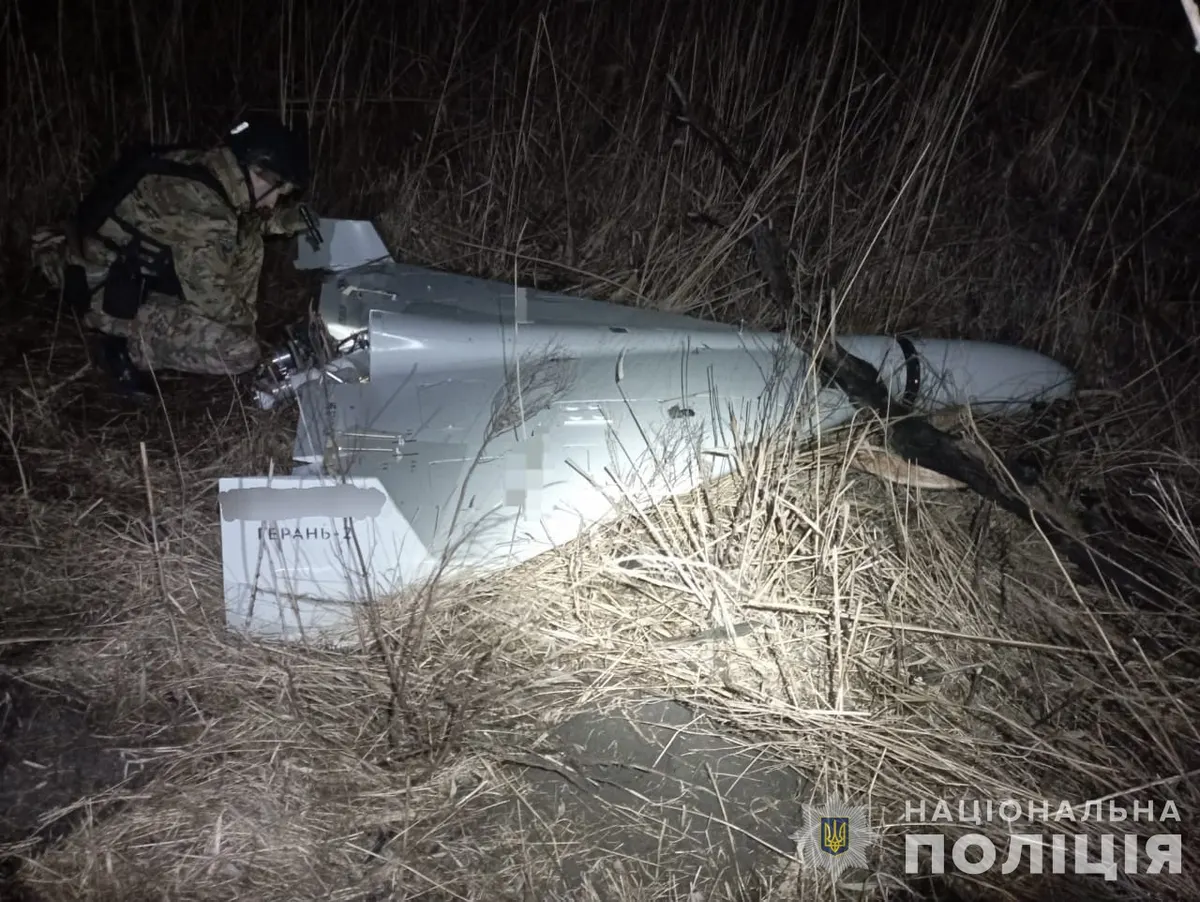
Russian channels that introduced the type publicly credited a domestic "Gastello Design Bureau" and described three roles from the outset — kamikaze, reconnaissance, and decoy. Ukraine's Defence Intelligence (GUR) instead attributes the underlying airframe to the Chinese firm Skywalker Technology, with kits shipped to Alabuga for finishing, and a GUR teardown found no Russian-made component among the type's electronics.1,2 Roughly $10,000 per unit is the most widely cited production cost, though Ukrainian intelligence figures for the bare airframe alone have run as low as $500-2,000 — a spread that likely reflects raw-component cost versus a finished, instrumented airframe rather than a genuine factual dispute.9,10
Reported dimensions vary slightly by source, but most Ukrainian teardown reporting and the U.S. Army's open-source threat guide converge on a length near 2 m and a wingspan around 2.5 m — visibly smaller than the Geran-2's roughly 3.5 m length on a similar wing.1,14 Empty weight is reported at under 20 kg, against roughly 200 kg for a Geran-2, a difference driven almost entirely by construction: the Gerbera airframe is an internal plywood frame skinned in painted polystyrene foam, cut to shape with hot-wire tools rather than molded or machined.1,3 That light weight and simple tooling are what make a reported production rate of up to 50 units a day at Alabuga plausible for a factory also running Geran-2 final assembly.9
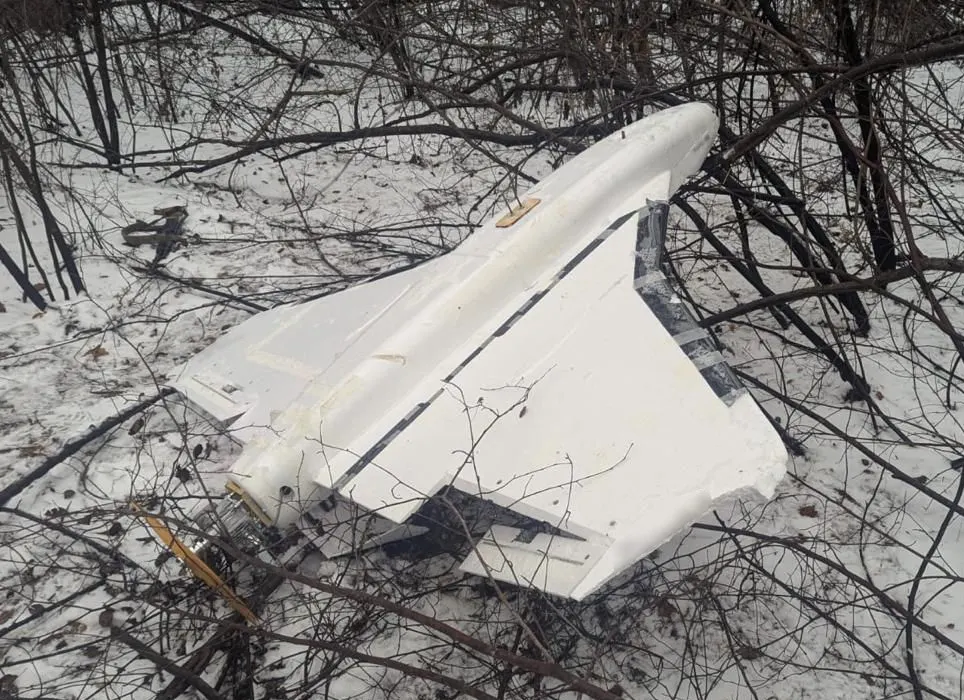
Propulsion is a small two-stroke piston engine turning a rear-mounted pusher propeller, most commonly a DLE60 60 cc unit from the Chinese manufacturer Mile Hao Xiang Technology, which the United States sanctioned in mid-2024; some recovered examples instead carry a Chinese RCGF Stinger 70cc twin-cylinder engine.1,2,4 Reported top speed is around 160 km/h, cruising up to roughly 3,000 m altitude to limit radar exposure. Range is reported anywhere from 300 km to 600 km depending on fuel load and payload, a wide bracket reflecting genuine configuration differences: an armed unit trades fuel volume for warhead weight, shortening its own reach.1,9
Guidance electronics mirror the broader Geran-2 program's reliance on imported parts. GUR's teardown identified a CRPA anti-jam antenna built around Analog Devices, Texas Instruments, and NXP Semiconductors chips, and a flight controller adding STMicroelectronics, Atmel, and the Chinese firm XLSEMI — with, in GUR's assessment, no Russian-origin part identified anywhere in the electronics.2 Reconnaissance-configured airframes carry a Chinese Topotek KHY10S90 gimbal camera transmitting video to a ground operator, reportedly used to spot and geolocate Ukrainian air-defense positions, including Patriot and NASAMS batteries, for targeting by other weapons.3,4 Later production has added a Xingkai Tech mesh-network modem, letting multiple airborne Gerberas relay data to one another under Ukrainian electronic-warfare jamming — a modular reuse of Alabuga's existing Geran-2 supply chain rather than a distinct new engineering effort.2,9
Ukrainian volunteers and open-source analysts first documented a Gerbera wreck near Kyiv on July 24, 2024; the Russian drone unit "Stalin's Falcons" acknowledged the type on Telegram within days, an early confirmation that it was an operational program rather than a one-off prototype.3 The name follows a long-standing Russian convention of naming munitions after flowers — gerbera being a genus known in English as the African daisy — the same convention that produced Geran ("geranium") for the Shahed-136 derivative, though the two airframes are unrelated internally beyond sharing the Alabuga production line.1,15
A GUR report published November 18, 2024 catalogued the airframe's electronics in detail — chips from Texas Instruments, Analog Devices, and NXP Semiconductors, a Chinese gimbal camera, and a Chinese DLE60 engine sanctioned by the United States that same summer — and used the near-total absence of Russian-origin components to argue for a foreign rather than domestic design origin, contradicting the "Gastello Design Bureau" attribution circulating on Russian channels.1,2 Production scaled quickly through the second half of 2024: by that November, Ukraine's Defence Intelligence assessed that decoy-type drones, chiefly Gerbera, made up roughly half of all Russian drone launches on a given night and about 75 percent of new output from Alabuga specifically, with 2025 production plans reportedly targeting on the order of 24,000 Gerbera units alongside a much larger Geran-2/Geran-3 run.1,4 That ratio is the clearest evidence of the type's original purpose: for a period, Alabuga was building more airframes meant to be shot down than airframes meant to hit anything.
Gerbera has been used almost exclusively as part of mixed Russian drone-and-missile packages against Ukraine rather than in attacks attributable to it alone, and most nightly reporting lumps Gerbera launches together with Geran-2 and Geran-3 under a single "Shahed-type" count.7 Ukrainian FPV interceptor crews began downing Gerberas in numbers from around October 2024. By May 2025, the Ukrainian "Darknode" interceptor unit reported a single night's tally of 100 intercepted drones, of which 76 were Geran-2/Shahed-type strike drones and 24 were Gerberas — one of the few dated, unit-level breakdowns to distinguish the two types in public reporting.1
The first confirmed use of an armed Gerbera in a direct tactical strike is dated to April 2025, several months after the February 2025 reporting on OFBCh-2.5 warhead installations; by August 2025, Ukraine's Border Guard was describing armed variants as an increasingly common part of the mix rather than an isolated finding.1,6 Gerbera's reach has also extended beyond Ukraine's own airspace. Recovered examples were identified in Lithuania in July 2025 — one breaching airspace near the Šumskas checkpoint on July 10, and a second recovered on August 1 at the Gaižiūnai training area carrying roughly 2 kg of explosives — incidents Lithuanian analysts have not conclusively attributed to error or intent.1 On September 9-10, 2025, Gerberas were reportedly among roughly 19 drones that crossed into Polish airspace, an incursion NATO's Secretary General called the largest concentration of NATO airspace violations the alliance had recorded and which triggered the alliance's reinforced "Eastern Sentry" air-policing posture.1,15
Attack volume involving Gerbera alongside Geran-type drones continued rising into 2026. A single night in mid-November 2025 saw roughly 135 combined Shahed-type and Gerbera-type drones launched, of which about 80 were Geran-2/Geran-3 strike types, implying a substantial decoy component in the remainder.7
Russian sources introduced the type from the outset as covering three roles from one airframe rather than three separate hardware builds: decoy (unarmed, flown to be shot at), reconnaissance (camera-equipped, feeding target data to operators), and kamikaze (armed, delivering a small warhead).1,3 Open-source reporting since February 2025 has effectively added a fourth configuration to that list.
| Configuration | Warhead | First reported | Primary purpose |
|---|---|---|---|
| Decoy (unarmed) | None | July 2024 | Draw air-defense fire away from armed strike drones |
| Reconnaissance | None (camera payload) | 2024 | Locate and geolocate Ukrainian air-defense positions |
| Armed / kamikaze | OFBCh-2.5 warhead or KZ-6 charge, ~2.5-5 kg | February 2025 | Direct strikes on soft or small targets |
| FPV carrier ("mothership") | None (carries a separate munition) | February 2026 | Extend FPV drone range; relay data deep behind Ukrainian lines |
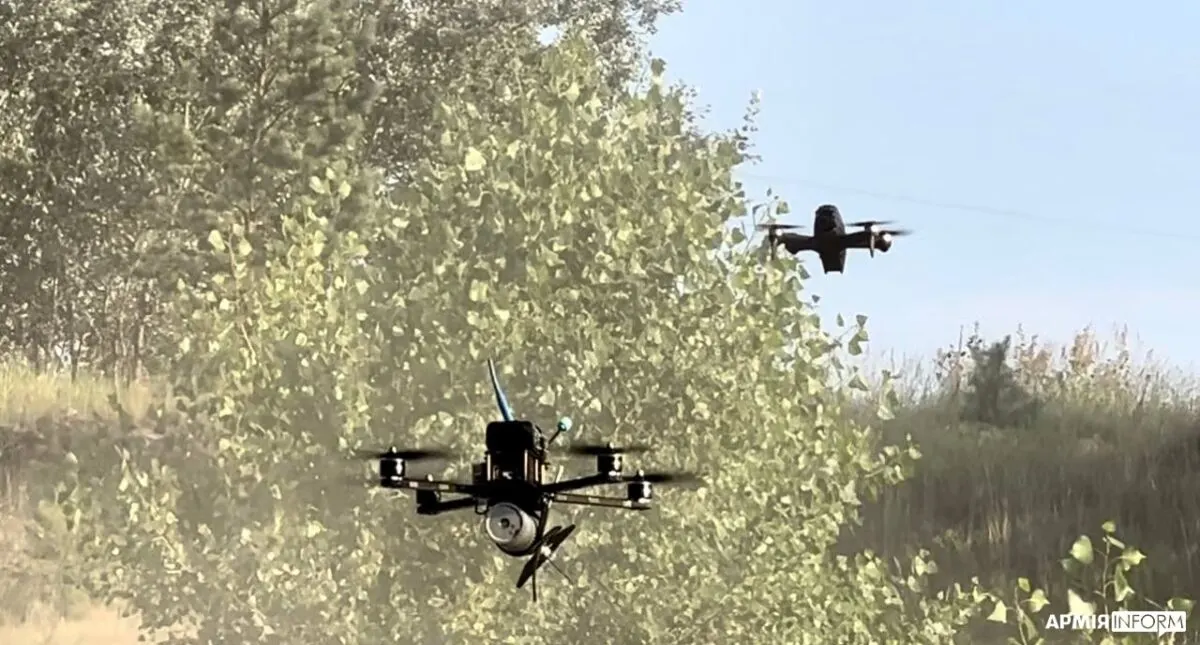
The most recent addition is structurally the most unusual. From early February 2026, Ukrainian analysts documented Gerbera airframes modified to physically carry and launch a single FPV drone in flight, with a mounting bracket and release mechanism replacing the warhead bay.11,12 The carried FPV drone can strike independently or conduct reconnaissance once released, and the Gerbera itself reportedly doubles as a radio-relay node, extending the FPV drone's effective range well beyond what its own battery and radio would otherwise allow — letting Russian forces launch precision FPV strikes deep behind the front line from a single long-range, expendable carrier.11,12 A related mesh-network relay build, distinct from the FPV carrier, uses the Xingkai Tech modem hardware noted above to extend jam-resistant connectivity for other Russian drones operating nearby.

Russia is the sole confirmed operator, fielding the Gerbera exclusively against Ukraine and, incidentally, over parts of Lithuanian, Polish, and Romanian airspace during the transit or navigational failure of individual airframes.1 No export sale or third-party operator has been reported. Component sourcing gives the program an unusual multinational footprint short of operatorship, however: Chinese suppliers provide the engine, camera, and mesh-network modem, and Western semiconductor makers' chips appear throughout the flight-control and antenna hardware GUR catalogued, despite none of those countries operating the type themselves.2
No confirmed reports place Gerbera assembly, or any part of its supply chain, outside Russian territory beyond the Chinese and Western component sourcing already described above.
Set beside the airframe it imitates, Gerbera is best understood as a purpose-built cost decoy rather than a scaled-down version of the same weapon. A Geran-2 is estimated to cost Russia somewhere between $30,000 and $80,000 to build domestically, well below the roughly $193,000 per-unit price implied by the original Iranian export contract for Shahed-136 kits, but still several times a Gerbera's roughly $10,000.13 Physically the two share a visual silhouette and a production complex but little else: the Geran-2 runs about 3.5 m long against Gerbera's 2 m, carries a 50-90 kg warhead against Gerbera's reported 2.5-5 kg when armed at all, and both reach a broadly similar top speed of around 160-185 km/h on a comparable low-altitude flight profile.1,13 The practical result is that a Ukrainian radar operator sees two very similar returns and has, in the moment available, no reliable way to tell which is which — which is the entire point of building Gerbera in the first place.4
| System | Length / wingspan | Warhead | Top speed | Range | Unit cost |
|---|---|---|---|---|---|
| Alabuga Gerbera | ~2 m / 2.5 m | None, or ~2.5-5 kg armed | ~160 km/h | 300-600 km | ~$10,000 |
| Geran-2 | ~3.5 m / 2.5 m | 50 kg (up to 90 kg) | ~185 km/h | ~650-2,500 km | ~$30,000-80,000 |
| HESA Shahed-136 | ~3.5 m / 2.5 m | up to 50 kg | ~185 km/h | up to 2,500 km | ~$193,000 (2022 export price) |
That cost gap is also the core of the type's tactical logic. Ukrainian air-defense missiles capable of reliably downing a Geran-2 or Gerbera at range cost tens of thousands of dollars each, well above a Gerbera's own unit cost, so every decoy that draws a missile shot rather than a bullet or a cheaper interceptor drone is a favorable trade for Russia regardless of whether that decoy ever carried a warhead.10,14 Ukraine's documented response has been to substitute purpose-built FPV interceptor drones, reported around $5,000 each, for expensive missiles wherever possible, a shift credited with returning a large share of intercepted Shahed-type and Gerbera traffic to interceptor-drone kills rather than missile kills by 2026.10 Against other Russian decoy programs the picture is thinner: Russia has also fielded a separate decoy type sometimes referred to as Parodiya, but public reporting on its specifications and production scale remains far less developed than on Gerbera, making a detailed comparison premature.15
What is the Gerbera drone and who makes it?
The Gerbera is a small, low-cost Russian unmanned aerial vehicle assembled at the Alabuga Special Economic Zone in Yelabuga, Tatarstan, the same complex that builds the Geran-2. Russian sources have credited a domestic "Gastello Design Bureau" with the design, while Ukraine's Defence Intelligence attributes the underlying airframe to the Chinese firm Skywalker Technology, with kits finished at Alabuga.1,2
Is Gerbera a decoy, or is it armed?
Both, depending on the specific airframe and when it was built. Most Gerberas recovered through late 2024 carried no warhead and functioned purely as decoys or reconnaissance platforms. Since roughly February 2025, some units have been found fitted with small explosive charges (reportedly 2.5-5 kg), and Ukrainian officials described armed variants as increasingly common through 2025. There is no public confirmation of what share of any given night's launches are armed versus unarmed.1,6,7
What are the Gerbera drone specifications?
Reported figures center on a 2 m length, 2.5 m wingspan, empty weight under 20 kg, a 60-70 cc piston engine turning a pusher propeller, a top speed near 160 km/h, and a range of 300-600 km depending on fuel and payload. Construction is a plywood internal frame under a painted polystyrene foam skin.1,9
How much does a Gerbera drone cost?
Most cited estimates put unit cost around $10,000, though Ukrainian intelligence figures for the bare airframe have run as low as $500-2,000; the spread likely reflects component cost versus finished-airframe cost rather than a genuine factual dispute. Either figure sits far below the roughly $30,000-80,000 Russia is estimated to pay for a Geran-2.9,10,13
Gerbera vs Shahed-136 and Geran-2: what's the actual difference?
Gerbera is smaller, cheaper, and in most configurations unarmed, sharing only a visual silhouette and the Alabuga production site with the Geran-2/Shahed-136 airframe it imitates. Where the Geran-2 is built to deliver a 50-90 kg warhead over up to 2,500 km, Gerbera is built primarily to be mistaken for one on radar and draw air-defense fire away from it.1,13
Is Gerbera a loitering munition?
Classification is genuinely disputed. Armed Gerbera configurations fit the standard definition of a loitering munition; unarmed decoy and reconnaissance configurations, which still account for a large share of production, deliver no warhead and function more like an expendable radar target. This record groups the type with other loitering munitions because it shares a production line, launch method, and flight profile with weapons that unambiguously qualify, while flagging the distinction rather than resolving it silently.
- "Gerbera (drone)", Wikipedia — en.wikipedia.org) ↩
- "The russian UAV 'Gerbera' contains Sanctioned Electronic Parts", Defence Intelligence of Ukraine (GUR) — gur.gov.ua ↩
- "What Is Gerbera? Russia's Long-Range Drone Enters Ukraine Battlefield", Newsweek — newsweek.com ↩
- "Russian Decoy Drones that Depend on Western Parts Pose a Great Challenge to Ukrainian Defenses", Institute for Science and International Security — isis-online.org ↩
- "Russia uses cheap decoy drones to overload Ukraine's air defense, Ukrainian intelligence says", Kyiv Independent — kyivindependent.com ↩
- "Russia equips decoy Gerbera drones with explosive payloads", Euromaidan Press — euromaidanpress.com ↩
- "Ukrainian Defense Intelligence: Russians Significantly Modernized Shahed and Gerbera Drones", Militarnyi — militarnyi.com ↩
- "Some Background On Russia's Gerbera Decoy Drone And Armed Specimens Thereof", SPAS Consulting — spasconsulting.com ↩
- "Gerbera: Russia's Low-Cost Shahed Decoy & Multi-Role Drone", Battlepolicy — battlepolicy.com ↩
- "Novel interceptor drones bend air-defense economics in Ukraine's favor", Defense News — defensenews.com ↩
- "Russians Modified the Gerbera UAV to Serve as a Carrier for FPV Drones", Militarnyi — militarnyi.com ↩
- "Russia Deploys Gerbera UAV as FPV Drone Mothership for the First Time", Defense Express — en.defence-ua.com ↩
- "HESA Shahed 136", Wikipedia — en.wikipedia.org ↩
- "Exclusive Analysis: Russia's Low-Cost Gerbera Kamikaze Drones Break Ukrainian Defenses Threaten NATO Frontier", Army Recognition — armyrecognition.com ↩
- "Russia's 'Gerbera' Drones Are Giving NATO a Terrible Headache", The National Interest — nationalinterest.org ↩