


The CASC CH-901 is a small, tube-launched loitering munition built by the China Academy of Aerospace Aerodynamics (CAAA), a UAV and missile research institute of China Aerospace Science and Technology Corporation (CASC), the state-owned aerospace conglomerate of China.1,2 It belongs to the "Rainbow," or Cai Hong (彩虹), series of unmanned systems that CASC exports under the CH brand, and it sits at the small, man-portable end of the loitering munitions class: weapons that combine a reconnaissance drone's camera and hover time with an integral warhead, letting an operator search for a target before committing to a strike rather than firing blind at a fixed point.1 CASC unveiled the design in 2016, and it has since been marketed under at least three overlapping names — CH-901, FH-901, and the export designation BG-201 — a naming pattern addressed in full under Variants below.3,1
- Compact, 9 kg, tube-launched airframe deployable by a single soldier in about three minutes[^1][^3]
- Warhead options include a shaped charge reported to penetrate 10 cm of armor, unusually potent for its weight class[^1]
- Multiple launch modes on offer: hand-carried tube, 48-cell vehicle rack, and, on paper, an internal drone bay[^3][^10]
- Marketed at defense exhibitions in the Middle East and Southeast Asia since 2018, giving it a wider public profile than a purely domestic program[^5][^9]
- No confirmed foreign sales contract has been publicly reported as of this writing, despite an export designation and years of exhibition appearances[^5][^9]
- No independently verified combat use has been documented; the closest public evidence is a 2022 live-fire demonstration video, not a battlefield engagement[^7]
- Published specifications (speed, endurance, range) are inconsistent across sources, with no factory data sheet to resolve the discrepancies[^1][^4]
- The most widely circulated "swarm" footage was produced by a different Chinese institute using a visually similar airframe, not confirmed CASC hardware[^10]
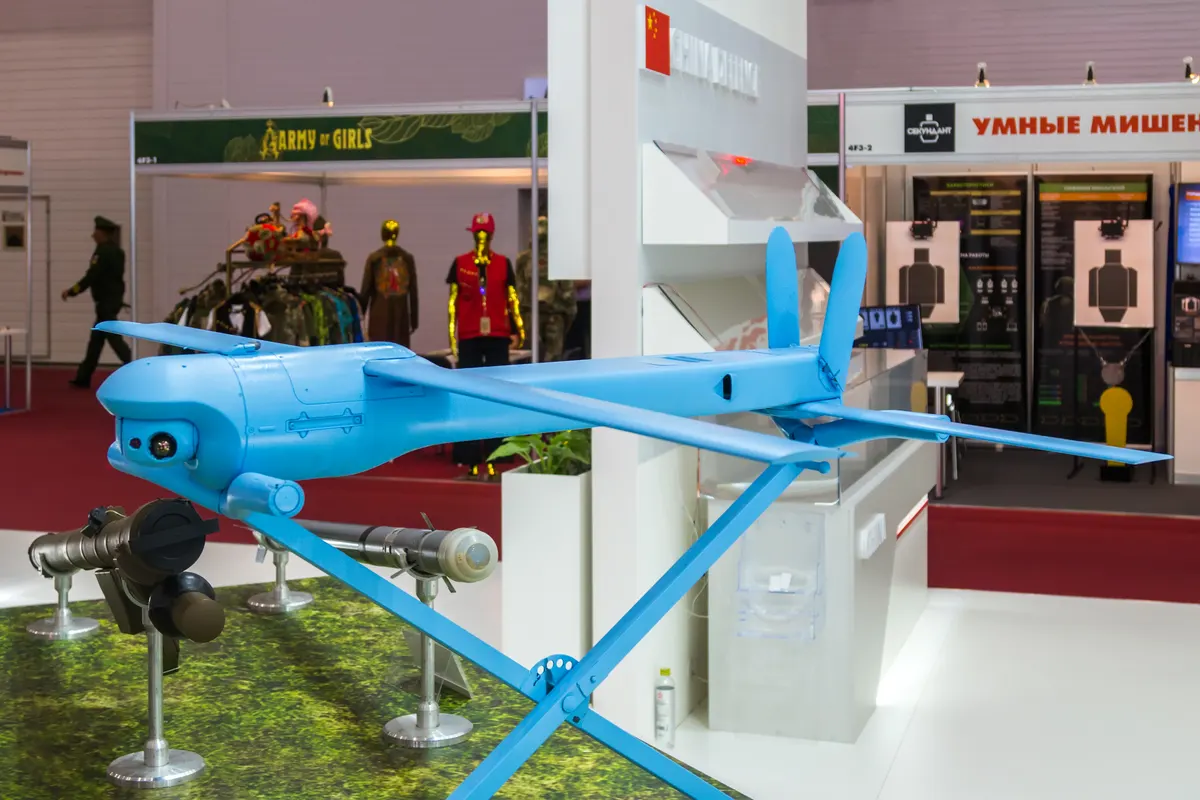
At roughly 1.2 meters long and 9 kilograms at launch, the CH-901 is heavier and carries a larger warhead than most comparable Western tube-launched munitions, but its published performance figures vary considerably between sources, a recurring problem with Chinese systems that lack an openly published factory specification sheet.1,4 The airframe is most often shown launched from a soldier-carried tube, but CASC and affiliated Chinese institutes have also displayed it fired from vehicle-mounted box launchers and, on paper, from an internal bay aboard a larger unmanned "loyal wingman" aircraft, a layered launch concept meant to let a single crew or vehicle put many munitions in the air at once.5,6
Export and combat-use claims about the CH-901 are considerably thinner than for some of CASC's larger, better-documented drones, and this article flags that distinction wherever it applies: state-media video of live-fire drills and defense-fair display units are common, while confirmed foreign sales contracts and independently verified combat engagements are not.7,9
CH-901 Specifications: Airframe, Warhead, and Sensor Package
The CH-901 is a small fixed-wing aircraft with a cylindrical fuselage, a high-mounted wing, and a two-blade pusher propeller driven by an electric motor at the rear of the airframe, a configuration chosen for quiet, low-observable flight at low altitude rather than for outright speed.1 Reported gross weight is a consistent 9 kilograms across nearly every source, and length is consistently given as 1.2 meters, but beyond those two figures the published numbers diverge.1,4,3 Wikipedia's most detailed profile describes a cruise dash to the target area at 180 km/h, a loiter phase around 100 km/h, and a terminal dive of up to 288 km/h once a target is confirmed, all flown at 100 to 150 meters of altitude, with a stated endurance of about 60 minutes.1 Several other outlets instead cite a flat "top speed" of 150 km/h, an endurance of up to 120 minutes, and an operating radius of 15 kilometers, figures that read as a simplified restatement of the same underlying material rather than an independent measurement.4,8 Given this spread, and the absence of a CASC-published data sheet, this article treats the fuller cruise/loiter/dive profile as the more detailed figure and the rounder 150 km/h and 120-minute numbers as the more commonly repeated simplification, without asserting either set as definitively correct.
The warhead bay carries a payload of about 3.5 kilograms, offered as either a fragmentation charge for use against personnel and light vehicles or a shaped high-explosive-anti-tank charge reported to penetrate roughly 10 centimeters of rolled homogeneous armor — enough for light armored vehicles rather than a main battle tank's frontal armor.1,3 A camera-only payload is also offered, converting the same airframe into a pure reconnaissance round rather than a strike weapon, the same "swap the module you need" logic used by several other man-portable loitering munitions in this weight class.4
Tube Launch, Vehicle Racks, and the 48-Cell Swarm Launcher
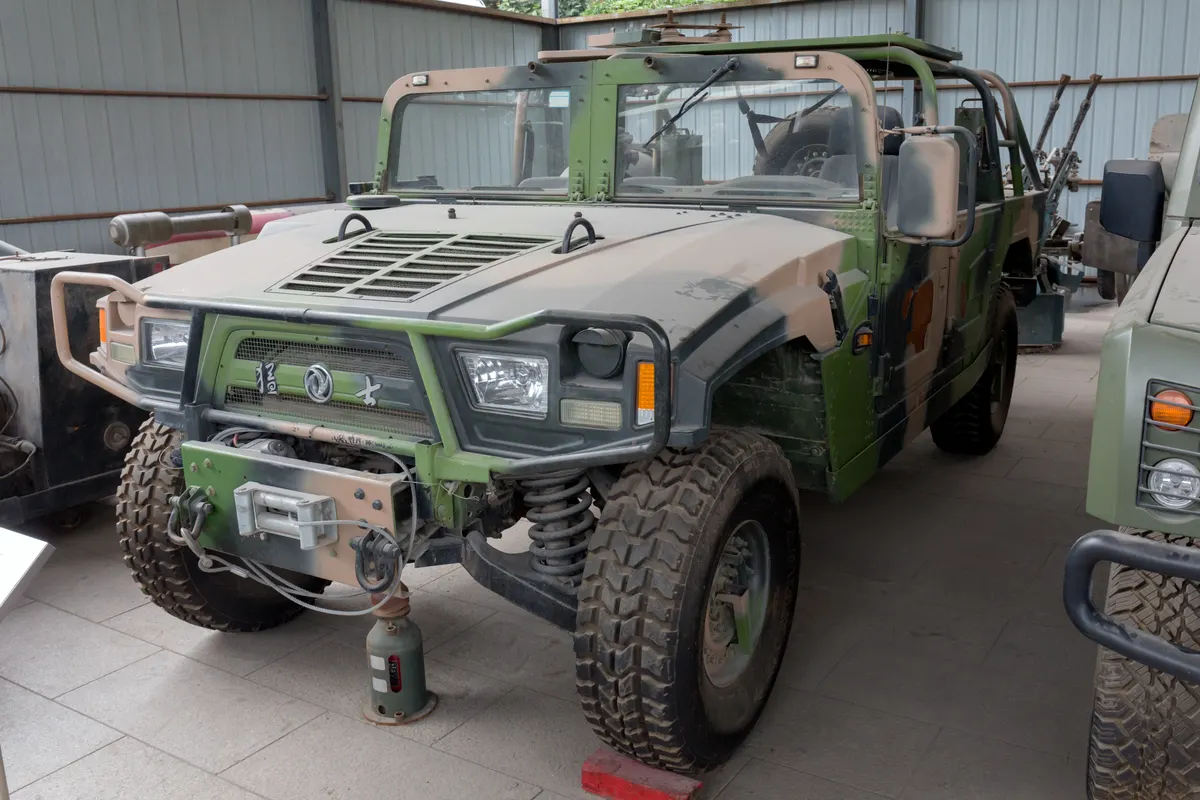
Targeting relies on an electro-optical seeker feeding a remote operator over a datalink, reported able to identify a target at roughly 2 kilometers, with the operator confirming a target before committing to the terminal dive.1,4 Deployment from a soldier-carried tube is advertised as achievable in about three minutes from unpacking to launch, the same man-portable logic that underlies smaller Western systems like the Switchblade 300, discussed further under Comparison.3,1 Beyond the hand-carried tube, CASC and affiliated marketing material have shown the CH-901 fired from a 48-tube box launcher mounted on a Dongfeng Mengshi light tactical vehicle, first displayed around 2020, and a similar box-launcher configuration was still being demonstrated as recently as 2025.8,5
On paper, the type has also been offered as an internal-bay munition for the Feihong FH-97, a stealthy "loyal wingman" unmanned aircraft CASC unveiled at the 2021 Zhuhai Airshow: one industry write-up describes the FH-97's internal weapons bay as holding up to 12 FH-901 munitions for mid-flight release, though that figure comes from secondary reporting rather than an official CASC data sheet.11,6
From Rainbow to Feihong: CASC's Unveiling and Marketing of the CH-901
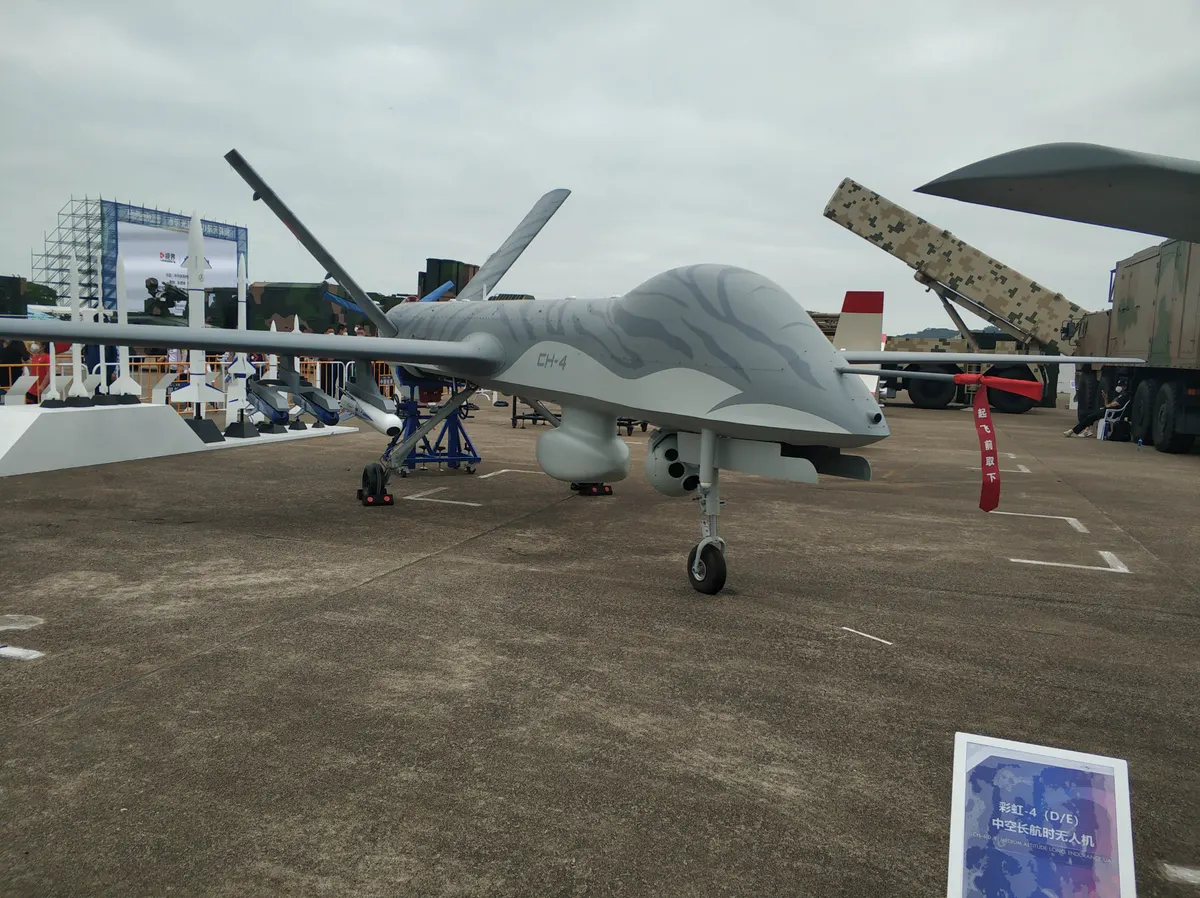
CASC unveiled the CH-901 in 2016 as part of its "Rainbow" family of export-oriented unmanned systems, sold internationally through the company's China Aerospace Long-March International Trade arm alongside larger CASC drones such as the CH-4 and CH-5 medium-altitude, long-endurance types.3,1 The munition's first significant international exhibition appearance came at SOFEX 2018 in Amman, Jordan, a biennial special-operations and defense trade show, where Chinese exhibitors marketed it as a man-portable reconnaissance-and-strike round for individual soldiers and small units.5
By 2021, CASC was showing a version marketed as FH-901 at Zhuhai Airshow alongside the Feihong-branded FH-97 loyal-wingman aircraft, which the company said could carry and release FH-901 munitions from an internal bay.11,6 CASC's larger CH-4 and CH-5 drones, which the smaller CH-901 is often displayed and marketed alongside, have themselves been sold to several buyers across the Middle East, Africa, and Asia, giving the wider "Rainbow" line name recognition the smaller munition does not yet share.3
The munition's most widely covered public appearance came on 8 September 2022, when Chinese state media released video of live-fire drills at a forum on unmanned equipment in Beijing, showing the FH-901 destroying a ground target alongside CASC's CH-4 and CH-5 drones.7 Western outlets framed the video explicitly as Beijing's answer to the Switchblade loitering munitions the United States had by then supplied to Ukraine in the hundreds, a framing state media itself appears to have encouraged.7 Later that year, the design, or a closely related one, was reportedly briefed to officials in Thailand at the Thailand Defense and Security exhibition — another exhibition appearance rather than a confirmed sale.9
No independently confirmed combat use of the CH-901 or FH-901 has been documented in the sources reviewed for this article. The closest public evidence remains the September 2022 live-fire drill footage released by Chinese state media, which shows a demonstration strike on a static target rather than a real engagement, and no operator, foreign or domestic, has published an after-action account of using the munition in a live conflict.7
A separate and frequently conflated episode is a September 2020 swarm-launch test, conducted not by CASC but by the China Academy of Electronics and Information Technology (CAEIT), which released video of a 48-tube box launcher mounted on a Dongfeng Mengshi vehicle firing a barrage of small fixed-wing drones, with additional launches shown from a Bell 206L and a Robinson-type helicopter.10 The airframes in that footage are visually similar to the CH-901 but were not confirmed by name as CASC hardware, and some reporting at the time described a combined vehicle-and-helicopter launch capacity as high as 200 drones.12,10 The video showed up to 11 drones holding formation on a ground-control display, switching patterns and simulating reconnaissance-and-strike runs, but independent analysts were skeptical of how much it actually proved.
David Shank, a US air-and-missile-defense specialist, said of the footage that "controlling large swarms has been a prevalent technology for ten years and isn't unique," and that the video "displays a computer exercise and simulation and nothing conclusive on capability," adding that only drones coordinating through genuine machine-to-machine control or artificial intelligence, rather than a single operator directing a formation from a tablet, would represent a real defensive challenge.13 Commentary at the time also noted that the released footage showed only the ground-control screen's tracking display, without corresponding onboard camera footage that would substantiate a claim of autonomous coordination.13 Whether the 2020 test involved genuine CH-901 hardware, a CAEIT-built lookalike, or some blend of the two, and whether the coordination shown was autonomous or manually choreographed, both remain open questions on the evidence available.
Reporting on the CH-901 line is complicated by three overlapping designations that appear to describe the same or nearly the same airframe. CH-901 is CASC's original 2016 "Rainbow"-brand designation.3 FH-901 is the name used for the same or a closely related munition under CASC's separate "Feihong" export brand, the designation attached to the September 2022 live-fire video and to the internal-bay loadout offered for the FH-97 drone.7,11 BG-201 appears in export-catalog contexts as a further sales designation for the same system.3 No source reviewed for this article draws a clear, sourced line between "FH-901 as a hardware upgrade of CH-901" and "FH-901 as a rebrand of the same product under a second in-house brand," so this article treats the two names as referring to the same basic munition unless a specific source distinguishes them.
Beyond naming, the clearest functional variation is in payload rather than airframe: the same munition body accepts a fragmentation warhead, a shaped-charge anti-armor warhead, or a camera-only reconnaissance payload in place of a warhead, without a separate model designation for each configuration.1,4 Launch-platform variation is broader still, spanning the man-portable single tube, the 48-cell Dongfeng Mengshi vehicle rack first shown around 2020 and demonstrated again in 2025, and the internal weapons bay reportedly offered for the FH-97 loyal-wingman aircraft — each a different way of firing what is described as the same core munition rather than a distinct sub-type.3,8,11

Confirmed operator data for the CH-901 is limited. Chinese sources and defense catalogs consistently describe China as the type's developer and presumed first user, but no independent source reviewed for this article documents a specific People's Liberation Army unit fielding the CH-901 in confirmed service, as distinct from CASC displaying and test-firing it.4,1

No foreign sales contract for the CH-901, FH-901, or BG-201 has been publicly confirmed as of this writing. The system has been shown at international exhibitions on at least two occasions: SOFEX 2018 in Jordan, where CASC's export arm marketed it to Middle Eastern and international buyers, and the Thailand Defense and Security exhibition in 2022, where a version of the munition was reportedly briefed to Thailand's officials.5,9 Neither appearance is documented in available sources as having produced a signed export deal, and this article does not list either country as a confirmed operator on that basis alone.
The CH-901 is best measured against two much smaller Western tube- or hand-launched loitering munitions that occupy a broadly similar tactical niche: AeroVironment's Switchblade 300 and Rafael's Spike Firefly. At roughly 9 kilograms and a 3.5-kilogram warhead, the CH-901 is close to three times the weight of the Switchblade 300's 2.7 to 3.6-kilogram production rounds, and about three to four times the weight of the Spike Firefly's 2.2 to 3-kilogram airframe.14,15 That extra mass buys a larger warhead: the CH-901's 3.5 kg payload, with a shaped-charge option reported to penetrate 10 cm of armor, dwarfs both the Switchblade 300's roughly 40mm-grenade-equivalent charge and the Firefly's 350 to 420-gram warhead, giving the Chinese system a plausible light-armor kill capability neither of the smaller munitions is built for.1,14,15
Range figures are harder to compare confidently given how much CH-901 sources disagree with one another, but even the lower end of the commonly cited range, around 10 to 15 kilometers, sits well above the Spike Firefly's 500-meter to 5-kilometer bracket and is broadly in line with the Switchblade 300's 10 to 30-kilometer range depending on production block.1,15,14 Endurance is similarly uncertain for the CH-901, with figures spanning 40 to 120 minutes depending on the source, against the Switchblade 300's roughly 10 to 20-plus minutes and the Firefly's 15 minutes armed.1,4,15,14 If the higher published CH-901 endurance figures hold up, the type would loiter considerably longer than either Western system, though the inconsistency in the underlying reporting means this should be read as a plausible advantage rather than a settled fact.
| System | Weight | Warhead | Range | Endurance |
|---|---|---|---|---|
| CASC CH-901 | ~9 kg | ~3.5 kg (frag. or HEAT)1 | 10-15 km (disputed)1,4 | 40-120 min (disputed)1,4 |
| AeroVironment Switchblade 300 | 2.7-3.6 kg14 | ~40mm-grenade equivalent14 | 10-30 km14 | 10-20+ min14 |
| Spike Firefly | 2.2-3 kg15 | 350-420 g15 | 0.5-5 km15 | 15 min armed15 |
Chinese state media has explicitly pitched the CH-901/FH-901 as a domestic counterpart to the Switchblade following the latter's combat use in Ukraine, a comparison this article treats as a marketing framing rather than a settled technical judgment, since the two systems have not been tested against each other or independently benchmarked side by side.7 The clearer, less disputed difference is one of combat record: the Switchblade 300 and Spike Firefly are both combat-proven, with documented use in Ukraine and in Israeli operations in the West Bank and Gaza respectively, while the CH-901's public record consists of exhibitions and a state-media demonstration video rather than a confirmed engagement.15,7

What are the CH-901 specifications?
Reported figures vary by source, but the CH-901 is consistently given as about 1.2 meters long and 9 kilograms at launch, carrying a roughly 3.5-kilogram fragmentation or shaped-charge warhead. Speed, range, and endurance figures diverge sharply between sources — 150 to 288 km/h, 10 to 15 km, and 40 to 120 minutes depending on the citation — and no CASC-published data sheet resolves the discrepancy.1,4
Who makes the CH-901?
The China Academy of Aerospace Aerodynamics, a UAV and missile research institute of China Aerospace Science and Technology Corporation, China's main state-owned space and missile conglomerate.2,1
What does the CH-901 cost?
No publicly disclosed unit price has been found for the CH-901. Chinese state-owned defense exporters do not typically publish per-unit pricing, and no defense-industry report reviewed for this article cites a figure.
What are the CH-901 export countries?
None are publicly confirmed as of this writing. The munition has been exhibited at SOFEX 2018 in Jordan and reportedly briefed to Thai officials in 2022, but no signed export contract has been documented in available reporting, unlike CASC's larger CH-4 and CH-5 drones, which do have confirmed foreign customers.5,9
CH-901 vs Switchblade: how do they compare?
The CH-901 is roughly three times heavier than the Switchblade 300 and carries a substantially larger warhead with a reported anti-armor option, while the Switchblade 300 has a combat record in Ukraine that the CH-901 does not have anywhere. Chinese state media has framed the CH-901/FH-901 as a domestic Switchblade counterpart, but the comparison rests on marketing rather than independent side-by-side testing.1,14,7
Has the CH-901 been used in combat?
No independently confirmed combat use has been documented. The most widely cited public appearance is a September 2022 live-fire demonstration video released by Chinese state media, not a report of use in an actual conflict.7
- "CASC CH-901", Wikipedia — en.wikipedia.org ↩
- "CASC Rainbow", Wikipedia — en.wikipedia.org ↩
- "CH-901 (FH-901): China's tube-launched loitering munition", BattlePolicy — battlepolicy.com ↩
- "CASC CH-901 Loitering Munition / Expendable UAV", Military Factory — militaryfactory.com ↩
- "China defense industry presents CH-901 suicide drone at SOFEX 2018", Army Recognition — armyrecognition.com ↩
- "Feihong FH-97", Wikipedia — en.wikipedia.org ↩
- "Super Success In Ukraine, China Unveils Its Own Switchblade-Like Kamikaze Drone In Live Fire Drills", Eurasian Times — eurasiantimes.com ↩
- "China's FH-901 and Russia's new EW System", SP's Land Forces — spslandforces.com ↩
- "A New Chinese Loitering Weapon Appears in Thailand", Defense Update — defense-update.com ↩
- "China Conducts Test Of Massive Suicide Drone Swarm Launched From A Box On A Truck", The War Zone — twz.com ↩
- "FH-97: China's Stealth Loyal Wingman Ushers in the Era of AI-Enabled Unmanned Combat", Bolt Flight — boltflight.com ↩
- "China Releases Video Of New Barrage Swarm Drone Launcher", Forbes — forbes.com ↩
- "100% Autonomous Or Chinese Propaganda? US Expert Decodes Viral Video Showing China's Kamikaze Swarm Drones", Eurasian Times — eurasiantimes.com ↩
- "Switchblade 300 Block 20", AeroVironment — avinc.com ↩
- "Spike FireFly", Army Technology — army-technology.com ↩