

The STM Kargu-2 is a man-portable, electrically powered quadcopter built by STM — Savunma Teknolojileri Mühendislik ve Ticaret A.Ş., an Ankara-based defense engineering firm of Turkey — and belongs to the broader class of loitering munitions, weapons that combine the hover or hold time of a small reconnaissance drone with an explosive payload meant to destroy whatever target the operator selects.1 The original Kargu was unveiled as an unarmed surveillance quadcopter at Expodefensa 2017 in Bogotá, Colombia; the armed variant that followed, generally referred to as Kargu-2, carries an explosive warhead for a kamikaze-style strike role and is the configuration STM currently markets and exports.1,2
- Deployable by a single soldier in under one minute, with no launcher or catapult required[^2]
- Compact takeoff weight of about 7 kg keeps the system within man-portable logistics limits[^4]
- EO/IR sensor with 10x optical zoom supports terminal identification of small or moving targets[^5]
- Interchangeable warhead options (fragmentation, thermobaric, and since 2024 armour-piercing) extend the target set from personnel to light armor[^6]
- Exported to at least ten countries across three continents as of 2024, indicating sustained foreign demand[^15]
- Endurance of about 30 minutes trails longer-loitering rivals such as the Switchblade 600 or SkyStriker by an hour or more[^2][^22][^19]
- Official range of 10 km sits at the low end of the loitering-munition field, well short of vehicle-launched systems reaching 100 km or more[^2][^19]
- Marketed swarm coordination of 20-30 units has never been demonstrated in an actual engagement[^1]
- CEO-claimed facial-recognition targeting has never been publicly demonstrated by STM[^1]
- Autonomy claims made by STM and language used in the 2021 UN report describe the system's decision-making very differently, leaving its real degree of independent target engagement unresolved[^3][^10]
Kargu-2's international profile rests overwhelmingly on a single event: a March 2021 report by the United Nations Panel of Experts on Libya, which described unmanned combat systems including the Kargu-2 hunting down retreating forces during the 2020 fighting around Tripoli.3 That report, and the very different ways it has been read by journalists, legal scholars, and STM itself, is the subject of most of the History and Conflicts sections below. Outside of that episode, the airframe is a small, hand-launched attack drone of a type increasingly common in the same weight class as systems like the Spike Firefly or the Switchblade 300, discussed further in Comparison.
The production airframe measures 600 mm in length and width and 430 mm in height, and takes off at roughly 7.06 kg with the standard day-camera payload or 7.8 kg when fitted with a thermal-imaging camera.4 It carries a payload capacity of about 1.3 kg, distributed among warhead options that now include a fragmentation charge for anti-personnel use (reported around 1.5 kg in the configuration confirmed in Azerbaijani service), a thermobaric warhead, and, following development work STM completed by late 2024, an armour-piercing charge intended to extend the system's effect against light armored vehicles.5,6 Four electric rotors give the airframe a reported maximum speed of 72 km/h, a normal operating altitude around 500 m, and a ceiling of 2,800 m, all figures that are broadly consistent across STM's own materials and independent trade-press coverage.4,2
Reported endurance is consistently cited at just over 30 minutes, a figure that appears both in STM's current product description and in earlier third-party reporting.2 Published range figures are less consistent: STM's current official product page states 10 km, while several older sources, including some current trade-press summaries, still list 5 km, and at least one aggregator cites figures as high as 15 km.2,7,11 This article treats the 10 km figure from STM's current official page as the primary spec and notes 5 km as an earlier or lower published figure rather than a confirmed upgrade.
Targeting relies on a stabilized electro-optical/infrared sensor pod with 10x optical zoom, paired with what STM describes as machine-learning-based image processing for real-time target identification, classification, and tracking, plus a proximity fuse with an adjustable detonation range.5 A newer variant adds a passive wideband radio-frequency seeker that allows the airframe to home in on the emissions of enemy radars or, more recently, hostile FPV drones, a capability STM began marketing as battlefields grew crowded with cheap first-person-view quadcopters.12
STM also markets a swarming capability, with public figures ranging from "up to 20 platforms" to "up to 30 units" coordinating against a single objective, and its chief executive has said the system can be tasked to identify specific individuals through facial recognition.1 Neither claim has an independently documented combat demonstration behind it: Wikipedia's summary of open-source reporting states plainly that the swarm's ability to autonomously identify, select, and coordinate attacks on a target "has, however, never been demonstrated by STM in reality," and that the facial-recognition function "has however never been demonstrated by the company" either.1 Both features should be read as manufacturer claims pending independent verification rather than as confirmed operational capabilities.
STM is a Turkish state-linked defense engineering firm and is a separate company from Baykar, maker of the Bayraktar TB2, Akıncı, and Kızılelma unmanned aircraft; the two firms are frequently confused in casual coverage of Turkish drones but produce unrelated product lines.13 Kargu was first shown publicly at Expodefensa 2017 in Bogotá as an unarmed reconnaissance quadcopter, and the armed Kargu-2 variant entered Turkish military service sometime between 2018 and 2020, with different trade outlets placing the fielding date differently.1,4
In June 2020, STM began preparing to deliver more than 500 Kargu units to Turkish security forces, a domestic order that represented the system's first large-scale fielding.4 The company later reported completing its first export sale in 2021, though the buyer and quantity were not publicly disclosed.20
Development continued well after the type's initial fielding. By ADEX 2024, STM had completed and field-tested an armour-piercing warhead variant intended to give the airframe a credible anti-armor role alongside its original anti-personnel and thermobaric options, and the company subsequently marketed a passive RF-seeker version aimed at countering enemy radars and FPV drones.6,12 The commonly repeated claim that "Kargu" derives from a Turkish word for a mountain watchtower appears in Wikipedia's and Militarnyi's summaries of the system, though general Turkish-dictionary sources do not independently corroborate that exact gloss, so the etymology is presented here as widely repeated rather than fully verified.1,5
Libya, 2020 — the UN Panel of Experts report
The event that made Kargu-2 internationally known took place during the closing weeks of the Libyan civil war's Tripoli campaign. On 27 March 2020, forces of the Turkish-backed Government of National Accord launched Operation PEACE STORM as Haftar-affiliated forces retreated from the capital's outskirts.3 The Panel of Experts' March 2021 report to the UN Security Council states that "logistics convoys and retreating HAF were subsequently hunted down and remotely engaged by the unmanned combat aerial vehicles or the lethal autonomous weapons systems such as the STM Kargu-2 and other loitering munitions," and separately describes these systems as having been "programmed to attack targets without requiring data connectivity between the operator and the munition."3 The same report credits the combination of drones and loitering munitions with defeating Haftar-aligned Pantsir S-1 air-defense systems during the retreat.3
Kargu-2 has also seen reported domestic use by the Turkish Armed Forces, including along the Syrian border in counter-terrorism operations against PKK-linked targets, according to open-source summaries; specific incident dates and independent confirmation for the Syria-border claim are limited, so it is presented here with that caveat.1
Nagorno-Karabakh, 2020-2024 — Azerbaijan
No confirmed evidence of Kargu-2 combat use in Ukraine has been found in the sources reviewed for this article. One aggregator source states that Ukraine imported an unspecified number of Turkish Kargu units before the full-scale 2022 invasion, but no article provides a delivery date, quantity, or documented battlefield engagement in Ukrainian service, so this claim is not treated as established here. Turkey's best-documented drone export to Ukraine is the Bayraktar TB2, a product of Baykar rather than STM, and the two systems and companies should not be confused.13
The Kargu line covers several distinct configurations built on the same general airframe, alongside separate STM products that are sometimes marketed together but are not variants of Kargu-2 itself.
- Kargu — the original 2017 configuration, an unarmed reconnaissance and surveillance quadcopter.1
- Kargu-2 — the armed configuration referenced in the UN Libya report and the version generally offered for export today, carrying an explosive warhead for a precision-strike role.1
- Kargu with armour-piercing warhead — a 2024-developed payload option adding an anti-armor charge to the existing fragmentation and thermobaric options on the same airframe, first exported under a contract finalized in May 2025.6
- Kargu with RF seeker — a passive wideband radio-frequency-homing variant developed to counter enemy radars and hostile FPV drones.12
- Kargu FPV — a separately branded STM kamikaze first-person-view drone product line, distinct from the quadcopter Kargu-2 platform described in this article.12
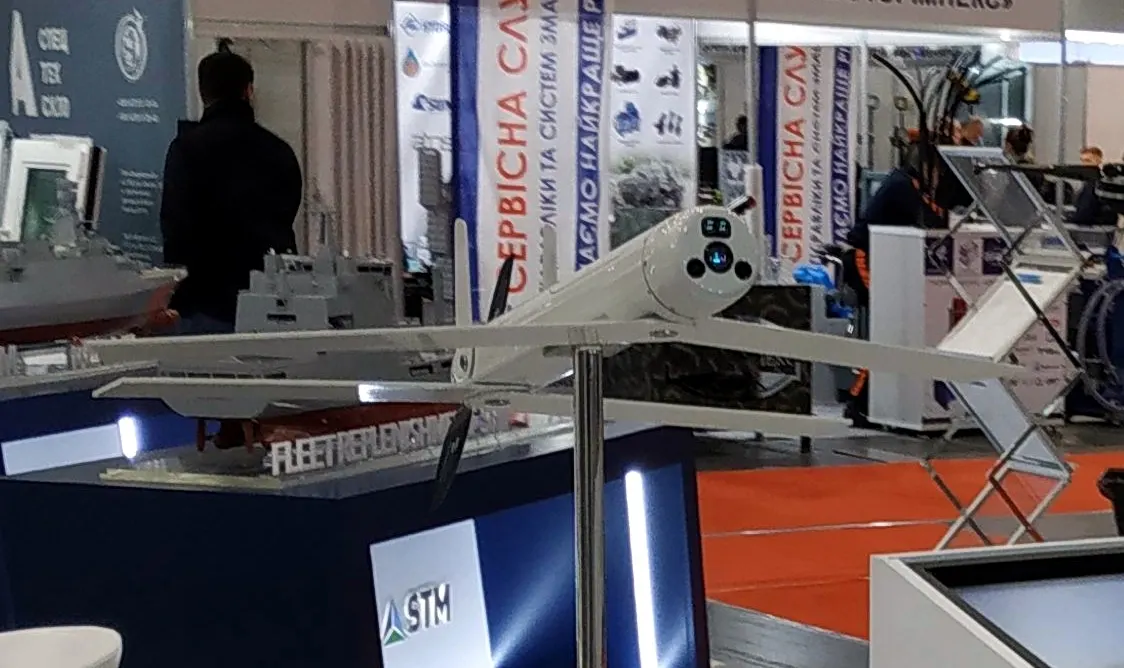
STM also produces the Alpagu, a related but separate loitering munition with a fixed-wing rather than rotary-wing airframe. Alpagu is substantially lighter, at about 1.95 kg against Kargu-2's roughly 7.06 kg takeoff weight, carries a smaller warhead of around 270 g against Kargu-2's 1.3 kg payload capacity, and has a shorter endurance of about 15 minutes and a shorter line-of-sight control range of about 8 km.14 The two systems are frequently marketed and delivered together as a rotary-and-fixed-wing pair, as in the January 2026 export deal covered under Operators below, but Alpagu is a distinct product rather than a Kargu-2 variant.14
None of these related product lines should be read as replacing the base Kargu-2 in STM's catalog; the company continues to offer the original fragmentation and thermobaric configurations alongside the newer armour-piercing and RF-seeker options, and alongside the separately branded Alpagu and Kargu FPV lines, rather than retiring any one configuration in favor of another.2,6,12,14


| Yıl | Alıcı | Adet | Tutar | Bugünkü Değer (2025) |
|---|---|---|---|---|
| 2022 |  Peru | — | — | — |
Turkey is the primary and original operator, having fielded the Kargu-2 in its armed forces from roughly 2018-2020 and begun a domestic delivery of more than 500 units from June 2020.4,1
Azerbaijan is a confirmed operator as of 10 June 2024, when its Ministry of Defence released footage from the Caucasian Eagle 2024 exercise showing the system with Azerbaijani-language control labels; earlier reports of Kargu use during the 2020 Nagorno-Karabakh war remain unconfirmed and are not treated as established fact in this article.7 Peru is a reported customer, with STM representatives confirming an export sale as of May 2022, though the quantity and delivery date have not been publicly specified; this claim rests on a single secondary aggregator source and carries moderate rather than high confidence.16
An unnamed European member of both NATO and the EU became STM's newest disclosed customer under a contract announced 16 January 2026, covering both Kargu and Alpagu systems along with vehicle-mount and battle-management-system integration — described as the first export of these systems to a NATO-EU member state.13 STM states more broadly that Kargu had reached ten or more countries across three continents by 2024, and that the combined Kargu-Alpagu customer base reached fifteen countries across four continents by the time of the 2026 European deal, though most individual buyers beyond Turkey, Azerbaijan, and Peru remain undisclosed.4,13 Turkey's foreign minister said in September 2022 that the country was willing to sell Kargu-2 to Japan, and later reporting through 2025 continued to describe Japanese interest or evaluation, but no signed contract with Japan has been reported, so Japan is not listed here as a confirmed operator.13
Kargu-2 sits at the small, short-range, man-portable end of the loitering-munition category rather than among the longer-range vehicle- or catapult-launched systems that dominate recent battlefield reporting. Its 7.06 kg takeoff weight and 10 km range place it closer in class to man-portable systems like the Rafael Spike Firefly or the AeroVironment Switchblade 300 than to larger loitering munitions built for standoff strikes.
| System | Country | Weight | Range | Endurance | Speed |
|---|---|---|---|---|---|
| STM Kargu-2 | Turkey | 7.06 kg | 10 km2 | 30 min2 | 72 km/h4 |
| Spike Firefly | Israel | 3 kg munition round17 | ~500 m urban / ~1.5 km open17 | 15 min armed17 | not disclosed |
| AeroVironment Switchblade 300 | United States | ~2.5 kg round8 | ~10 km21 | ~15 min21 | not disclosed |
| ZALA Lancet | Russia | up to 12 kg18 | 40 km official18 | 30-40 min18 | up to 110 km/h cruise18 |
| AeroVironment Switchblade 600 | United States | ~22.7 kg airframe22 | 40+ km22 | 40 min22 | not disclosed |
| Elbit Systems SkyStriker | Israel | ~35 kg19 | ~100 km19 | up to 2 hrs (5 kg warhead)19 | not disclosed |
Against the Lancet, the Switchblade 600, and the SkyStriker, Kargu-2's 10 km range and 30-minute endurance are both a fraction of what those larger systems report — the Lancet's official range alone is four times greater, and the SkyStriker's endurance runs to roughly four times longer.18,19 Kargu-2's comparative advantages are logistical rather than performance-based: at roughly 7 kg it is deployable by one soldier in under a minute without a catapult or launch tube, a profile closer to the Spike Firefly and Switchblade 300 weight class than to the vehicle- or tube-launched systems above it in the table.2,17,8


Did an autonomous drone really kill someone in Libya without human control? The March 2021 UN Panel of Experts report on Libya describes retreating forces being "hunted down and remotely engaged" by systems including the Kargu-2, in what it calls "a true 'fire, forget and find' capability," but the report stops short of stating outright that a human death resulted from a munition operating without human supervision.3,9 Widely repeated media claims that this was the first autonomous drone killing of a human are an extrapolation from that ambiguous language rather than a direct finding of the report itself.15
Is Kargu-2 fully autonomous? STM describes the system as operating under a "man-in-the-loop principle," requiring an operator to confirm a target before any strike, and says its autonomous functions are used mainly for navigation and for distinguishing people, animals, and vehicles.10 The UN report's "fire, forget and find" language describes something closer to full autonomy, and the two characterizations have not been reconciled by any independent audit.3
Has Kargu-2 been confirmed in Ukraine? No. Some aggregator reporting mentions Turkish Kargu imports by Ukraine before 2022, but no source reviewed here documents a delivery date, quantity, or battlefield use in Ukrainian service, so it is not treated as a confirmed operator in this article.
Is STM the same company as Baykar, maker of the Bayraktar TB2? No. STM and Baykar are separate Turkish defense firms with unrelated product lines; STM builds the Kargu and Alpagu loitering munitions, while Baykar builds the Bayraktar TB2, Akıncı, and Kızılelma unmanned aircraft.13
Can Kargu-2 really coordinate a 20-30 unit drone swarm? STM markets swarm coordination figures in that range, but no independent combat demonstration of autonomous swarm target identification, selection, and coordinated attack by the Kargu-2 has been documented.1
- "STM Kargu", Wikipedia — en.wikipedia.org ↩
- "Kargu — Autonomous Tactical Multi-Rotor Attack UAV", STM — stm.com.tr ↩
- "A U.N. Report Suggests Libya Saw The First Battlefield Killing By An Autonomous Drone", NPR — npr.org ↩
- "Kargu Rotary-Wing Attack Drone", Air Force Technology — airforce-technology.com ↩
- "Kargu loitering munition", Militarnyi — mil.in.ua ↩
- "ADEX 2024: STM completes development of anti-tank warhead for Kargu loitering munition", Janes — janes.com ↩
- "Kargu loitering munition used in Azerbaijan exercise", Janes — janes.com ↩
- "Switchblade 300 Block 20", AeroVironment — avinc.com ↩
- "The Kargu-2 Autonomous Attack Drone: Legal & Ethical Dimensions", Lieber Institute, West Point — lieber.westpoint.edu ↩
- "Kargu-2 debate raises awareness of autonomous weapons", Ploughshares — ploughshares.ca ↩
- "STM Kargu specifications", automatedresearch.org — cited for the higher outlier range figure, treated as secondary ↩
- "STM deploys RF seeker on Kargu against FPV drone threats", STM — stm.com.tr ↩
- "Türkiye's STM delivers Kargu and Alpagu loitering munitions to European NATO country", Army Recognition — armyrecognition.com ↩
- "Alpagu — Fixed-Wing Loitering Munition System", STM — stm.com.tr ↩
- "Turkish defense giant STM exports Kargu drone to more than 10 countries in 2024", Türkiye Today — turkiyetoday.com ↩
- "20 countries want Kargu, the UAV 'hunting a man without an order'", Bulgarian Military — bulgarianmilitary.com ↩
- "Spike FireFly", Army Technology — army-technology.com ↩
- "ZALA Lancet", Wikipedia — en.wikipedia.org ↩
- "SkyStriker Loitering Munition System", Elbit Systems — elbitsystems.com ↩
- "First Export Success for Kargu Rotary-Wing Attack UAV", Asian Military Review — asianmilitaryreview.com ↩
- "Switchblade", Designation Systems — designation-systems.net ↩
- "Switchblade 600", AeroVironment — avinc.com ↩