


The HESA Shahed 136 is a one-way attack drone, a type of loitering munition, designed in Iran and built by the Iran Aircraft Manufacturing Industrial Company (HESA).1 Structurally it is a small delta-wing aircraft, about 3.5 m long with a 2.5 m wingspan and an empty weight of roughly 200 kg, carrying an explosive warhead of up to 50 kg in the nose and flying a pre-programmed route to its target before detonating on impact.1 It has no recovery mechanism; the airframe itself is expended as the munition. The unit price recorded in the leaked 2022 Iran-Russia production contract, 193,000 USD, covers that entire vehicle and its warhead, not a token quantity of raw parts.14
- Low unit cost relative to the interceptors typically used against it
- Long stated range (2,500 km) for standoff strikes
- Simple design, license-producible with modest industrial capacity
- Satellite uplink allows in-flight retasking
- Slow, about 185 km/h, with no evasive capability
- No onboard sensor or terminal seeker, limiting precision against moving or hardened targets
- Distinctive two-stroke engine noise aids acoustic detection
- No stealth shaping; tracked visually and by radar once acquired
The delta-wing shape is widely theorized to descend from a 1980s West German prototype known as the "DAR" (Die Drohne Antiradar, "the anti-radar drone"), developed by Dornier; some analysts have linked the same design lineage to the IAI Harpy, an Israeli anti-radiation loitering munition of the same era.2,3 That genealogy is analyst speculation about a shared ancestry rather than a documented transfer of blueprints, and no primary-source paper trail connecting the German program directly to HESA has been published.2 What is documented is the engine: the Shahed-136's MD-550 two-cylinder piston engine is a reverse-engineered copy of the German Limbach L550E, a small aero-engine originally built for ultralight aircraft.2
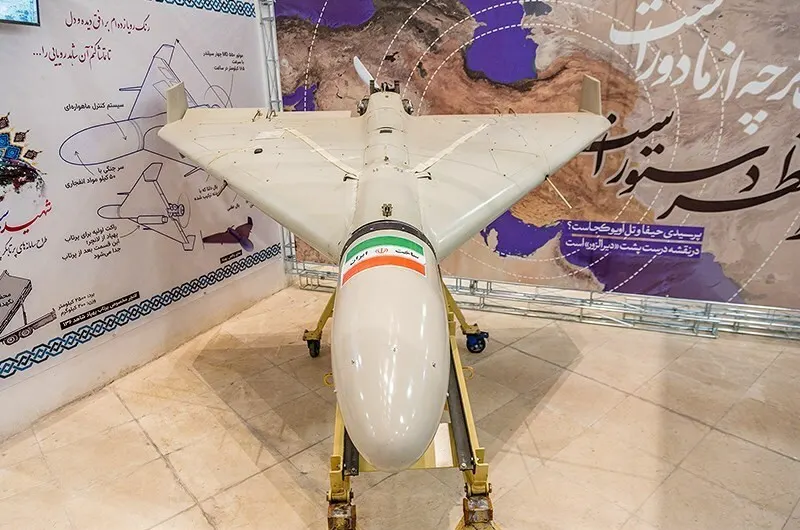
The Shahed-136 in flight. Its slim delta-wing airframe, roughly 3.5 m long, has no vertical tail and no dedicated stealth shaping.1
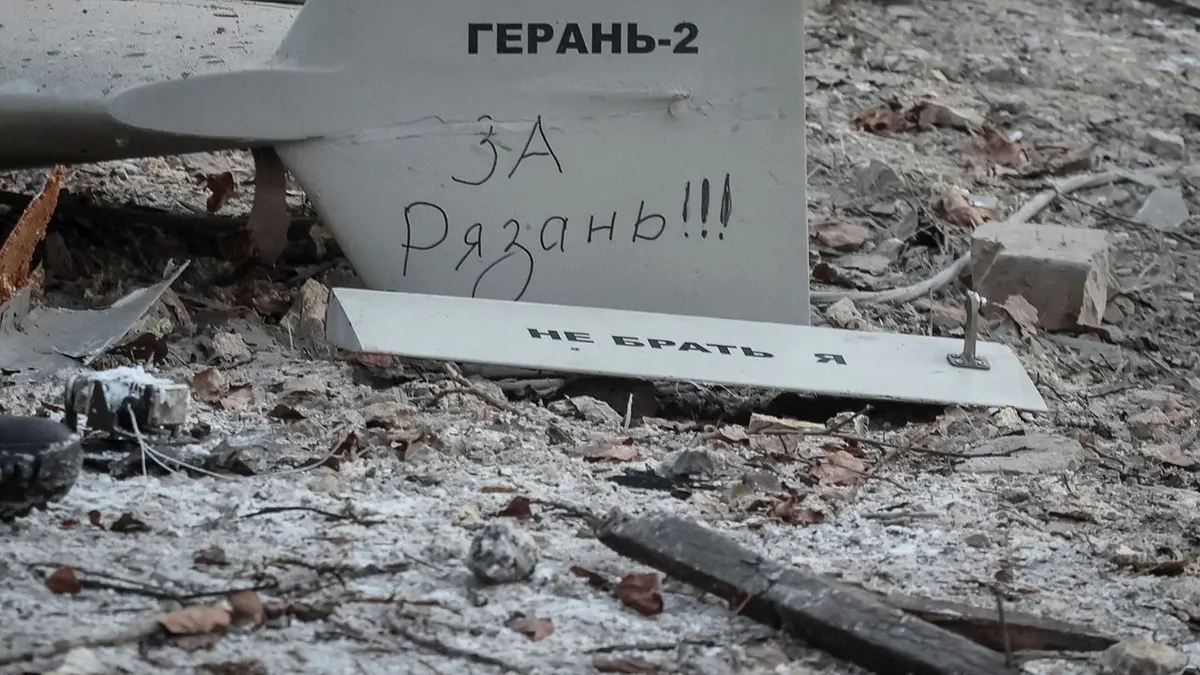
Iran began supplying the type to Russia in 2022 for use against Ukraine, where domestically built copies are designated "Geran-2."4,11 The Shahed-136 is not precision-guided in the way an EO/IR-homing loitering munition is: it carries no seeker, no SAR/GMTI radar, and no laser designator, and instead navigates by GPS/inertial route plus, in current-production examples, a satellite (BLOS) uplink that lets an operator alter its course in flight.7 Its stated combat role is mass, low-cost, one-way strikes against fixed infrastructure and area targets, rather than the individually engaged mobile targets a shorter-range, sensor-guided loitering munition such as the ZALA Lancet is built to hit.7
The database groups the Shahed-136's specifications into general classification, airframe, powerplant, performance, payload/sensors, armament, control/autonomy, production, and service status. It is classified as a one-way attack drone within the loitering-munitions category, its primary role recorded plainly as suicide/kamikaze attack, and it remains in service.1
Structurally the type is a simple flying delta-wing airframe: 3.5 m long, a 2.5 m wingspan, and an empty weight of about 200 kg.1 It carries no radar-absorbent coating or faceted low-observable shaping, and the database records it, correctly, as not stealth; its small size and low flight altitude, rather than any signature-reduction design, are the main reasons it is difficult for some radar systems optimized against faster, larger targets to detect and engage.7
Power comes from a single MD-550 air-cooled piston engine, a reverse-engineered derivative of the German Limbach L550E producing roughly 50 hp and turning a rear-mounted pusher propeller.2 It is not an electric design. The engine's audible, buzzing note gave the type its most widely used nickname in Ukraine, the "flying moped."6
At 185 km/h the Shahed-136 is slow, well below the speed of the cruise and ballistic missiles it is often launched alongside, but it is credited with a stated range of up to 2,500 km and a maximum payload of about 50 kg, figures that place its design priority on standoff distance and cost rather than speed or precision.1
The airframe carries none of the sensor payloads found on more expensive loitering munitions: no EO/IR seeker, no SAR/GMTI radar, no SIGINT package, no laser designator, and no comms-relay function.1 That absence is a direct trade-off against unit cost, and it also underlies the type's comparatively low precision and counter-measure-resistance scores next to sensor-equipped rivals such as the AeroVironment Switchblade 600 or the Spike Firefly.
The warhead is a single explosive charge of up to 50 kg; the database flags the type under the same air-to-ground armament category used for guided missiles, reflecting its function against ground targets rather than a literal missile airframe.1
Guidance is autonomous: the drone flies a pre-set GPS/inertial route to its target area without a human pilot in the loop.1 A satellite (BLOS, beyond-line-of-sight) link lets Russian operators alter the flight plan after launch, a capability later-production Shaheds/Gerans have reportedly used to shift from a purely pre-programmed profile toward real-time manual retasking during a raid.7
Individual airframes are not built to operate as a coordinated swarm exchanging data with one another; the "swarm" effect described in Russian strike packages is produced by launching dozens of drones together on independent routes, not by onboard swarming logic.7,8
Unit cost is recorded in the database at 193,000 USD. That figure corresponds to the 2022 contract price Russia paid for Shahed-136/Geran-2 kits under the Alabuga production program, not to the far lower figure of roughly 20,000 USD often repeated in press coverage; the lower number reflects only the estimated raw-component cost of the airframe, not what Russia actually paid per unit under the government contract.14,15
The Shahed-136's delta-wing configuration is widely theorized in open-source analysis to trace back to "DAR" (Die Drohne Antiradar), an anti-radar drone prototype built in West Germany in the 1980s by Dornier; the same broad design lineage has also been proposed, by some analysts, as a common ancestor of Israel's IAI Harpy.2,3 This remains a contested, circumstantial genealogy rather than a documented licensing or espionage trail, and neither Iranian nor Russian officials have ever acknowledged it.2 The one clearly documented technology transfer is mechanical rather than aerodynamic: the Shahed-136's MD-550 engine is a reverse-engineered copy of the Limbach L550E, a German-designed light-aircraft piston engine.2

Iran built up a family of delta-wing loitering munitions through the 2010s, of which the Shahed-136 became the largest and longest-ranged production type, and began supplying it to Russia for use against Ukraine.4 Russia started combat testing the drone in Ukrainian airspace in August 2022.4
The first confirmed Shahed-136 shoot-down over Ukraine came on 13 September 2022, and the earliest confirmed strike attributed to the type destroyed a Ukrainian, U.S.-supplied M777 towed howitzer near the northeastern front during Ukraine's autumn 2022 counteroffensive, one of the first documented instances of an Iranian-supplied weapon system directly affecting the battlefield in Europe.4,5

Ukrainian troops nicknamed the type the "flying moped" for the buzzing, two-stroke engine note of its MD-550 powerplant, audible from the ground before the drone arrives.6 That noise, rather than remaining only a nuisance, became a defensive asset: Ukraine fielded thousands of low-cost acoustic sensors under a program known as "Sky Fortress," which listen for the characteristic engine sound and feed detections into a national drone-tracking network used to cue air defenses and warn civilians.6
The pattern set in these early 2022 strikes, cheap, slow, GPS-guided drones launched in numbers against fixed infrastructure, expanded over the following years into the larger, layered strike packages described below.7,8
Development and Deployment Timeline
- 1980s — West German "DAR" (Die Drohne Antiradar) prototype flown by Dornier — widely theorized, not confirmed, as a common ancestor of the delta-wing design
- 2022-08 — Russia begins combat testing of the Shahed-136 in Ukraine
- 2022-09-13 — First confirmed Shahed-136 shoot-down over Ukraine
- 2022-12 — Iran-Russia Alabuga deal signed: about 1.75 billion USD for 6,000 kits plus a manufacturing license and training
- 2023-07 — "Terror in the Details" investigation documents Western-made components inside recovered Shahed-136/Geran-2 airframes
- 2025 — Alabuga complex reportedly producing 5,500+ units per month, about 90 percent domestically sourced
The Shahed-136/Geran-2 is used most extensively in the full-scale Russo-Ukrainian war that began in February 2022, an escalation of the wider Russo-Ukrainian War dating to 2014.4,5 Russian use scaled from the initial 2022 strikes into nightly mass raids that combine munitions of different types: cheaper decoy drones, notably the Gerbera type, nicknamed "Parody" for its Shahed/Geran-like radar and thermal signature, are launched first to draw out and exhaust Ukrainian air defenses, followed by Shahed-136/Geran-2 strike drones, with cruise and ballistic missiles reserved for the highest-priority targets once the air-defense picture is exposed.7,8 Later production batches reportedly gained real-time operator control in place of a purely pre-set GPS route, letting Russian controllers redirect drones toward targets of opportunity in flight.7
The database also lists the Shahed-136 in association with Iran's own 2025 Twelve-Day War against Israel and with the 2026 Iran War. Public, source-verified accounting of Shahed-136 employment in those campaigns remains far thinner than the extensively documented Ukrainian theatre, and this article does not assert specific tactical detail for them beyond that recorded association.
Outside these state-on-state conflicts, satellite imagery from December 2020 reportedly showed Shahed-type drones being transferred from Iran to Houthi forces in Yemen, discussed further under Deals and Proliferation below, though that transfer is reported rather than confirmed to the same evidentiary standard as the Ukraine deployment.17


| Yıl | Alıcı | Adet | Tutar | Bugünkü Değer (2025) |
|---|---|---|---|---|
| 2022 |  Rusya | 6,000 | $1.75 Mr | $1.93 Mr |
Russia has been the type's largest operator since acquiring the design and a production license from Iran in 2022, building it domestically at Alabuga as the "Geran-2" for sustained use against Ukraine.4,11 Iran remains the original operator and design authority through HESA, a subsidiary of the Iran Aircraft Manufacturing Industrial Company.1 Yemen's Houthi forces are recorded as an operator following the reported 2020 transfer, though the scale and current status of that inventory are less documented than the Russian program.17
Within the loitering-munitions category, the Shahed-136's design logic sits at the opposite end of the spectrum from a sensor-guided tactical munition such as the Russian-made ZALA Lancet, which carries an EO/IR seeker for terminal guidance against moving and hardened point targets at much shorter range.7 The database's own scoring reflects that split: the Shahed-136 scores 57 overall, driven up by a cost-effectiveness score of 90 and a portability score of 85, but held down by a counter-measure-resistance score of only 30 and a precision score of 55, against the ZALA Lancet's overall score of 73. The Shahed-136 is built to be cheap and to arrive in numbers large enough that some fraction gets through; the Lancet is built to hit one target precisely, at a higher cost per unit and a much shorter range.
| ÖZELLİK | HESA Şahid-136 | ZALA Lancet | Shahed 238 |
|---|---|---|---|
| Menzil | 2500 km | 40 km | — |
| Azami Hız | 185 km/sa | 300 km/sa | — |
| Birim Maliyet | 193000 USD | 37000 USD | — |
| Azami Faydalı Yük | 50 kg | 3 kg | — |
Against the IAI Harpy, an older Israeli anti-radiation loitering munition sometimes linked to the same disputed delta-wing lineage, the comparison is closer in shape but different in purpose: the Harpy is built to home on hostile radar emissions for suppression-of-air-defense missions, while the Shahed-136 carries no seeker at all and is aimed by pre-flight route planning against fixed coordinates.3 Against its own successor within the same Iranian family, the jet-powered Shahed 238, the piston-engined Shahed-136 trades speed for range and unit cost, the tradeoff that has defined the type since its introduction.
In December 2022, Iran and Russia signed a deal, arranged through the Alabuga Special Economic Zone in Tatarstan, under which Russia paid an estimated 1.75 billion USD for roughly 6,000 Shahed-136 kits together with a manufacturing license and training for domestic production as the "Geran-2."11 Russia reportedly reached the 6,000-unit target about a year ahead of the schedule set in the original contract, and by 2025 open-source estimates put Alabuga's output at more than 5,500 units per month, with roughly 90 percent of components sourced domestically.12,13
The often-repeated claim that a Shahed-136 costs about 20,000 USD is not supported by the contract data that has surfaced. Leaked Alabuga program documents show Russia actually paid between 193,000 and 290,000 USD per unit in 2022, a figure that fell to roughly 70,000 USD by 2025 as Russian localization of the supply chain matured.14,15,16 The 20,000 USD figure appears to originate from estimates of the raw component cost of the airframe alone, not the price Russia paid under the actual government contract.14
A July 2023 investigation, "Terror in the Details," conducted by the International Partnership for Human Rights (IPHR), the NAKO anti-corruption network, Truth Hounds, and Global Diligence LLP, examined Shahed-136/Geran-2 wreckage from ten documented strikes on residential buildings, power infrastructure, a school, and a children's summer camp.9 The investigation identified components traceable to 16 companies based in the United States, Japan, Canada, and Switzerland inside the recovered fuselages, underscoring how the drone's electronics supply chain draws on commercially available, dual-use parts from countries that maintain sanctions against Iran and Russia.9,10
Iran's other reported transfer of the type predates the Russia deal: satellite imagery from 25 December 2020 reportedly showed Shahed-type drones delivered to Houthi forces in Yemen's Al-Jawf province, though this transfer carries a lower level of public corroboration than the extensively documented Russian program.17 More recently, in 2025 Ukrainian military intelligence chief Kyrylo Budanov reported that Russia was transferring Shahed/Geran production know-how to North Korea, with roughly 12,000 North Korean workers reportedly brought to the Alabuga complex for training.18
How much does a Shahed-136 actually cost?
Leaked contract documents from Russia's Alabuga production program show Russia paid between 193,000 and 290,000 USD per unit in 2022, falling to roughly 70,000 USD by 2025 as local production matured.14,15,16 The widely repeated figure of about 20,000 USD reflects only the estimated cost of raw components, not what was actually paid under the government contract.14
What is the Shahed-136's range?
The type is credited with a stated range of up to 2,500 km, carrying a warhead of up to 50 kg at a cruise speed of around 185 km/h.1
Why is the Shahed-136 called "Geran-2" in Russia?
"Geran-2" ("Geranium-2") is the Russian domestic designation for locally produced Shahed-136s, built under the license and technology-transfer deal Iran and Russia signed in December 2022 through the Alabuga Special Economic Zone.11
Why do Ukrainian troops call it the "flying moped"?
The nickname refers to the buzzing sound of the drone's roughly 50 hp two-stroke MD-550 piston engine, which is audible from the ground and became the basis for Ukraine's "Sky Fortress" acoustic-detection network.6
Is the Shahed-136 a stealth drone?
No. It carries no radar-absorbent coating or faceted low-observable shaping; the database records it explicitly as not low-observable. Its small size and low-altitude flight profile, rather than any stealth design, are the main reasons some radar systems have difficulty detecting and engaging it.1,7
Is the Shahed-136 related to the IAI Harpy or a German drone from the 1980s?
Some analysts have proposed that the Shahed-136's delta-wing shape traces back to a 1980s West German prototype known as the "DAR" (Die Drohne Antiradar), with the same lineage sometimes linked to Israel's IAI Harpy.2,3 This is analyst speculation about a shared design ancestry, not a documented transfer of plans, and no primary evidence connecting the German program directly to HESA has been published.2
- "Shahed 136", Wikipedia — en.wikipedia.org ↩
- "Die Drohne Antiradar: The Original Shahed Drone", sUAS News — suasnews.com ↩
- "First Shahed-136 prototype was created in Germany in the 1980s and it was called DAR", Defence UA — en.defence-ua.com ↩
- "Iranian attack drones have reached the battlefield", The Spokesman-Review — spokesman.com ↩
- "Iranian Shahed-136 Drones Increase Russian Strike Capacity and Lethality in Ukraine", FDD's Long War Journal — longwarjournal.org ↩
- "What is a Moped? Features of the Shahed-136 Drone and Its Combat Use", Baltimore Chronicle — baltimorechronicle.com ↩
- "Swarm Mode and Live Control: How the Invaders Are Upgrading the Shahed-136", PRM — prm.ua ↩
- "A Comprehensive Analytical Review of Russian Shahed-Type UAVs Deployment Against Ukraine in 2025", Institute for Science and International Security — isis-online.org ↩
- "Western-Made Components in Shahed-136", International Partnership for Human Rights — iphronline.org ↩
- "More Than 30 Western Components Found in Iranian-Made Shahed-136 UAVs, Investigators", Euromaidan Press — euromaidanpress.com ↩
- "Shaheds For What? Russia Drone Deal May Have Given Iran Seller's Remorse", Forbes — forbes.com ↩
- "Visible Progress at Russia's Shahed Drone Production Site", Institute for Science and International Security — isis-online.org ↩
- "Iran drone factory in Russia offers clues to war effort", CNN — cnn.com ↩
- "What Does A Shahed-136 Really Cost?", The War Zone — twz.com ↩
- "How Much Russia Pays For Shahed Now, Down From $300,000 Per Drone In 2022", Defence UA — en.defence-ua.com ↩
- "Gold for Drones: Massive Leak Reveals the Iranian Shahed Project in Russia", Haaretz — haaretz.com ↩
- "Iranian Kamikaze Drones Said Spotted in the Possession of Yemen's Houthis", The Times of Israel — timesofisrael.com ↩
- "Russia Giving Shahed-136 Attack Drone Production Capabilities To North Korea: Budanov", The War Zone — twz.com ↩