

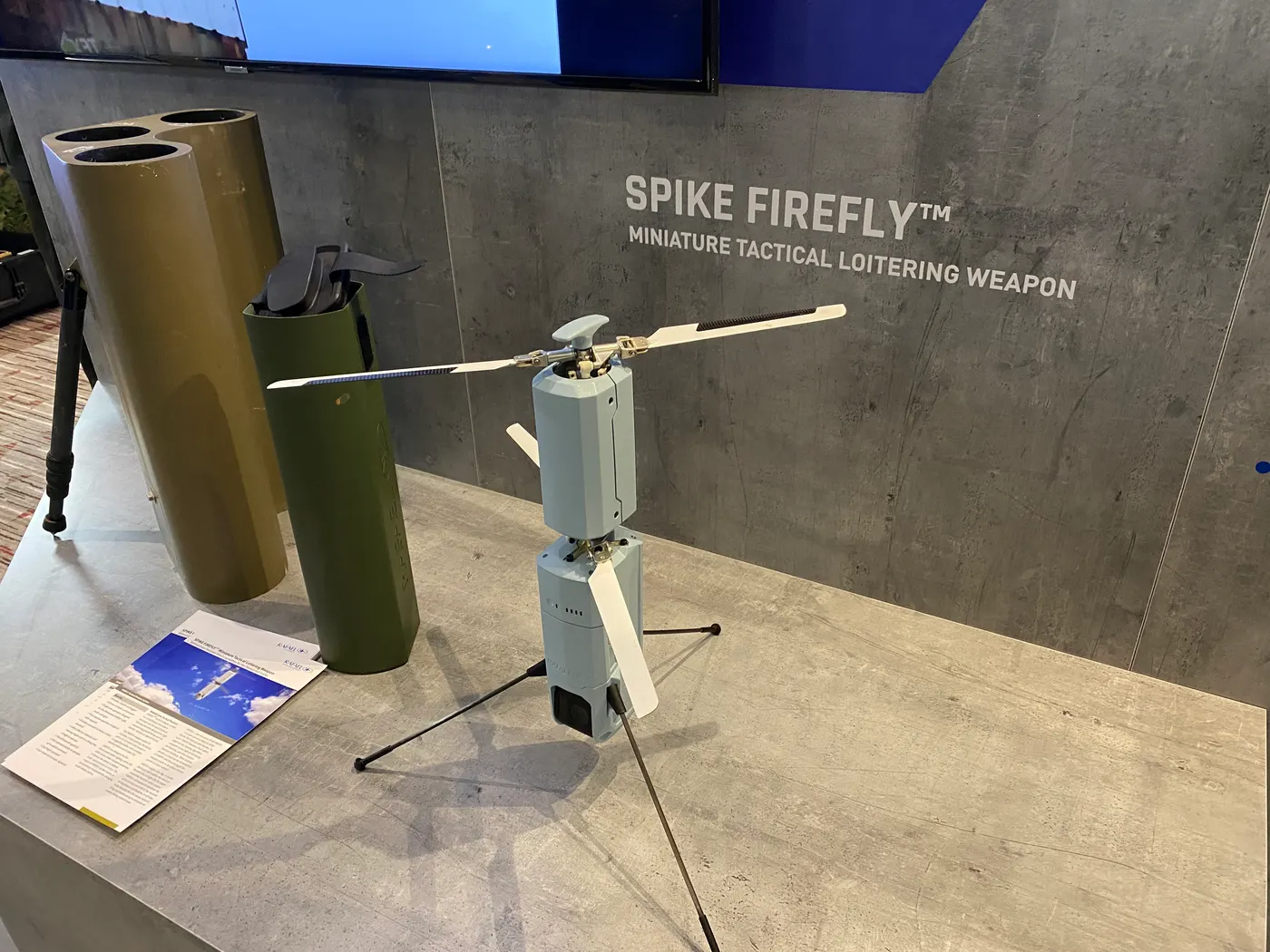

The Spike Firefly is a miniature loitering munition built by Rafael Advanced Defense Systems of Israel, unveiled in June 2018 and fielded to the Israel Defense Forces from May 2020.1,2 It belongs to the loitering munitions class, small precision weapons that combine a reconnaissance drone's sensor and flight time with an integral warhead, but it departs from the rest of Rafael's Spike missile family in one important respect: Spike-SR, -MR, -LR, -ER, and -NLOS are anti-tank guided missiles fired from a launcher at a line-of-sight or relayed target, while the Firefly is a small, hovering, rotor-driven aircraft that a single infantryman carries, launches, and flies by hand.2,1 Rafael's own program name shares only the Spike brand and some subcomponent heritage with the anti-tank missiles; the munition itself functions as an independent airframe, not a missile variant.1
- Complete round weighs about 3 kg and fits, with two others and a control tablet, into a 15 kg backpack system[^2]
- VTOL rotor launch needs no runway, catapult, or separate vehicle; usable inside built-up urban terrain[^2]
- Dual EO/IR seeker with man-in-the-loop abort/wave-off before impact[^2]
- Warhead-for-battery swap turns the same airframe into a 30-minute reconnaissance drone with no strike capability[^2]
- Combat-proven since July 2023 in Jenin and, from October 2023, in Gaza, with Rafael's own confirmation of Gaza use in July 2024[^1][^3][^4]
- Original-configuration range limited to roughly 500 m in dense urban terrain and about 1,000–1,500 m in open terrain, short next to larger loitering munitions[^1][^2]
- Endurance capped at 15 minutes armed (30 minutes in unarmed recon mode), well below systems built for standoff strikes[^2]
- 350 g original warhead is small relative to larger loitering munitions used against armor or fortified structures[^2]
- Confirmed export customer base limited to one country (Vietnam) as of early 2026, alongside Israel itself[^6][^7]
The system is built for dismounted infantry, marines, and special-operations teams engaged in close, urban combat, specifically the problem of a target hiding behind a wall, inside a courtyard, or around a street corner where a rifle or grenade cannot reach it directly.2 Weighing about 3 kg in its original configuration and folding down small enough that three rounds and a control tablet fit into a single backpack, the Firefly can fly over an obstacle, loiter, identify a target with its onboard camera, and strike it directly, with reconnaissance as a secondary use when its warhead is swapped for a spare battery.2,1 The Israeli military's in-service name for the system, "Maoz," was adopted alongside the May 2020 procurement order.2
Combat use followed within a few years of fielding. The Firefly's first documented use in combat came in July 2023 during an Israeli incursion into Jenin in the West Bank, and it saw extensive use in the Gaza Strip after the war there began in October 2023, a fact Rafael itself confirmed on the record on 7 July 2024.1,3,4 In October 2025 Rafael substantially reworked the system and renamed it "L-Spike 1x," a change covered in detail under History below because it affects which weight, warhead, and range figures apply to which version of the munition.5
The Firefly's airframe is compact by design: about 400 mm tall and 80 by 80 mm in cross-section, built around two electric motors driving coaxial, counter-rotating two-blade rotors, with the blades and three landing legs folding for transport and extending automatically before flight.2,1 The original production munition weighs about 3 kg complete with its 350 g warhead, and the full man-portable system, three tubed rounds plus a roughly 1 kg handheld control tablet, weighs about 15 kg total.2,1 The database entries below reflect the October 2025 L-Spike 1x upgrade's updated weight and range figures rather than the original 2018–2024 configuration; the distinction between the two generations is addressed later in this section and under Variants.
Guidance is a dual electro-optical/infrared package: an uncooled thermal imager paired with a color day-vision CMOS sensor, plus a proximity sensor for terminal fusing and a target-tracking mode described by Rafael as capable of following a moving ("agile") target.2 The munition can fly a pre-set autonomous route to a search area or be flown manually end-to-end over a bidirectional military-standard datalink, and the operator retains the ability to abort or wave off a committed attack run until the moment of impact.2 Reported speeds are 60 km/h while maneuvering and up to 70 km/h in a terminal diving attack, with tolerance for wind gusts up to about 36 km/h (10 m/s).2,1
The 350 g original warhead is an omnidirectional blast-fragmentation charge; it is removable, and swapping it for a second battery converts the identical airframe into an unarmed reconnaissance platform with roughly double the flight time, about 30 minutes versus 15 minutes armed.2 This dual-role design lets one item of infantry equipment serve either as a strike weapon or as a scout, depending only on which module is loaded before launch, rather than requiring two separate systems.2
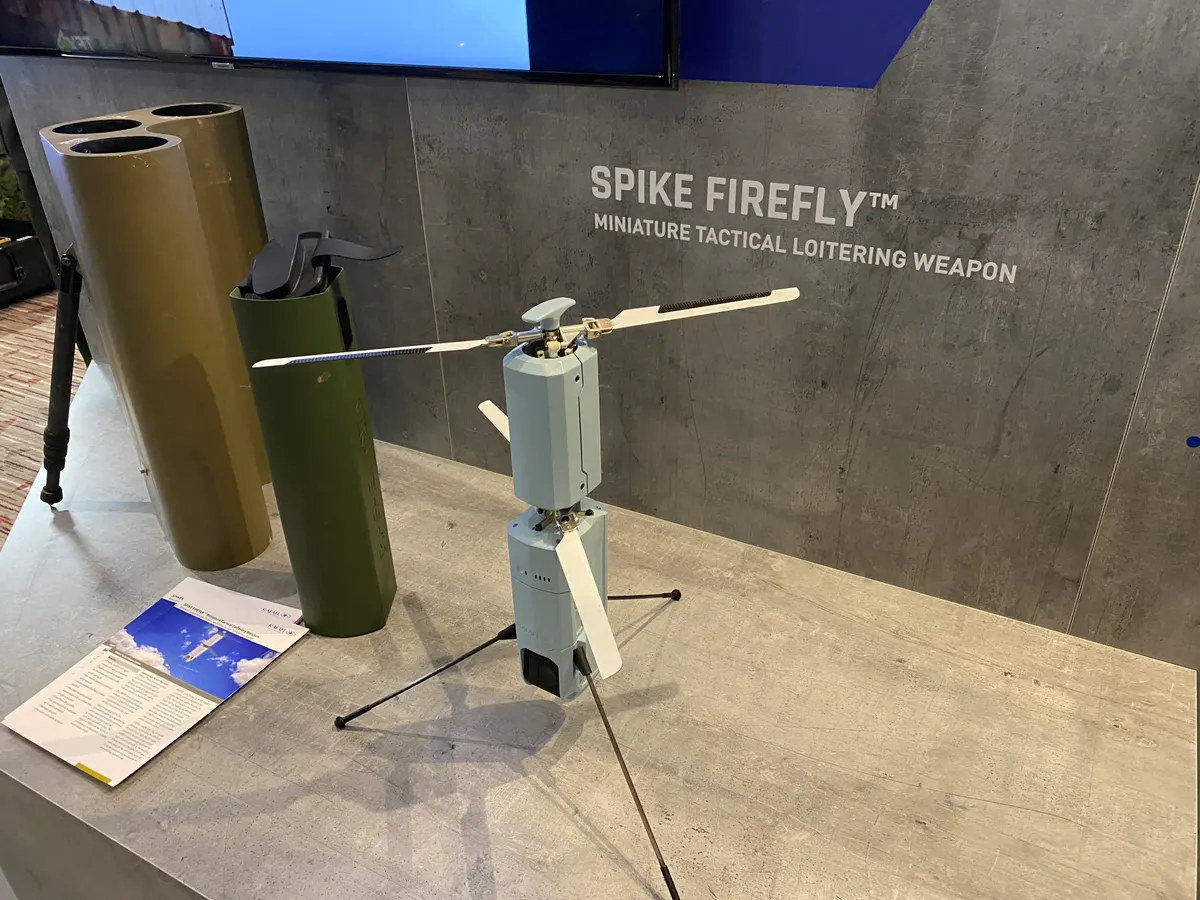
Control is entirely operator-in-the-loop rather than fully autonomous: the tablet interface supports automatic takeoff and stabilized hover, but final target confirmation and strike commitment remain a human decision at every stage.2 Launch itself needs no separate rail, catapult, or vehicle; each munition is carried and released from its own storage tube, after which it lifts off vertically under its own rotors, a method suited to confined urban environments where a runway-style or catapult launch would not be possible.2,1
Set against AeroVironment's Switchblade 300, the closest system to the Firefly by weight class among comparable loitering munitions in this archive, the two share a broadly similar all-up weight, roughly 3 kg for the Firefly versus 2.7 to 3.6 kg across the Switchblade 300's production blocks, but differ sharply in range and launch method: the Switchblade 300 is tube-ejected and reaches 10 to 30 km depending on block, while the Firefly is a hovering VTOL design confined to roughly 500 m to 5 km depending on generation and terrain.2,8
Rafael unveiled the Spike Firefly in June 2018 and gave it its first public display at MILIPOL Paris in November 2019.1,2 Israel's Ministry of Defense ordered the system for IDF ground forces in May 2020 under the Hebrew in-service name "Maoz," explicitly for the urban close-combat role the airframe was built around.2 By September 2023, Breaking Defense reported IDF units training with the Firefly in desert exercise areas ahead of wider fielding.9
Combat use began in July 2023, when the Firefly was used during an Israeli incursion into Jenin in the West Bank; footage circulated in December 2023 appeared to show a Firefly descending into a courtyard in a dense residential neighborhood during a roughly 60-hour IDF operation there.1,12 The system saw substantially wider use after the Gaza war began in October 2023, and by February 2024 Rafael was reporting a rise in export interest at the Singapore Airshow that it attributed directly to the system's combat exposure in Gaza.13 Rafael confirmed operational use of the Firefly in Gaza on the record on 7 July 2024, the manufacturer's own public acknowledgment rather than a claim sourced only to press or open-source video.3
The most significant change to the program came at the AUSA symposium in Washington, D.C. on 13–14 October 2025, when Rafael unveiled an upgraded version and renamed it "L-Spike 1x." Range was extended from roughly 1.5 km to 5,000 m, munition weight was reduced from about 3 kg to about 2.2 kg, and the warhead was enlarged slightly from 350 g to 420 g, alongside updated day-vision software; Rafael's Yaron Lavy, head of the company's precision tactical weapons directorate, attributed the changes to lessons drawn from roughly two years of operational use.5 A November 2025 press release covered the same rebranding.14
Documented combat use of the Spike Firefly is concentrated in two Israeli operations rather than a broad multinational combat record. The first confirmed use was in July 2023, during an Israeli incursion into Jenin in the West Bank.1 A specific instance from that theater was captured on video in December 2023: footage published by a Palestinian Telegram channel showed a Firefly descending into a courtyard in a dense urban neighborhood, coinciding with a roughly 60-hour IDF operation in Jenin in which Israeli forces reported arrests and the seizure of weapons caches.12
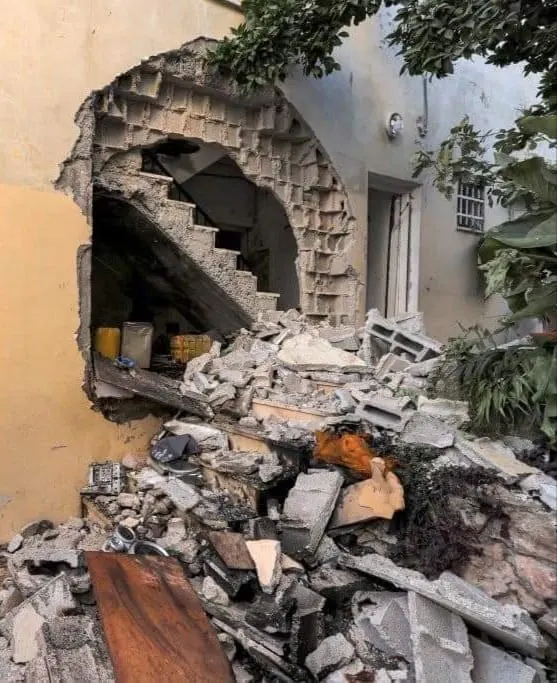
From October 2023 the Firefly was used far more extensively in the Gaza Strip, in both strike and surveillance roles, as part of the wider Israeli campaign following the 7 October attacks.13,1 Rafael's own confirmation of that use, issued 7 July 2024, is the clearest on-record statement of the system's Gaza deployment; open-source reporting reviewed for this article did not surface specific strike counts, casualty figures, or named individual engagements beyond that general confirmation.3 No documented use in Lebanon was found in the sources reviewed for this article.
Two generations of the airframe exist under Rafael's naming. The original Spike Firefly, fielded 2018 to 2024, weighs about 3 kg with a 350 g warhead and a control range of roughly 500 m in urban terrain or 1,000 to 1,500 m in the open, with 15 minutes of armed endurance or 30 minutes in the unarmed reconnaissance configuration.2,1 The October 2025 upgrade, redesignated L-Spike 1x, weighs about 2.2 kg, carries a 420 g warhead, and extends control range to 5,000 m, while retaining the same reported 60 km/h cruise and 70 km/h dive speeds and roughly the same endurance figures.5,2 Rafael has presented the L-Spike 1x as an evolution of the Firefly rather than a separate product line, and no other named sub-variant beyond the recon-only battery configuration has been documented.5,2


| Yıl | Alıcı | Adet | Tutar | Bugünkü Değer (2025) |
|---|---|---|---|---|
| 2026 |  Vietnam | — | $250.0 M | $250.0 M |
Israel is the Firefly's founding and best-documented operator: the Ministry of Defense ordered the system for IDF ground forces in May 2020 under the "Maoz" designation, and it has been in continuous service and combat use since 2023.2,3 Vietnam became the system's second confirmed customer in early February 2026, when its Ministry of National Defense signed a contract worth approximately $250 million with Rafael covering both the acquisition of Spike Firefly ("Maoz") munitions and the establishment of a domestic, technology-transfer licensed production facility inside Vietnam.6,7 The deal sits within a broader expansion of Israeli-Vietnamese defense trade, following an earlier SPYDER air-defense sale worth roughly $600 million and a satellite deal with Israel Aerospace Industries worth roughly $700 million, and has been linked in reporting to Vietnam's tensions with China over the South China Sea.6
The Firefly sits at the small end of the loitering-munition weight range compared with the systems in this database's comparison set. At 2.2 to 3 kg depending on generation, it is roughly a tenth the weight of AeroVironment's own Switchblade 600 (about 22.7 kg airframe weight) or Elbit Systems' SkyStriker (about 40 kg), and its 350–420 g warhead is between a twelfth and a twenty-fifth the size of the payloads carried by Russia's ZALA Lancet (3 to 5-plus kg) or the SkyStriker (5 or 10 kg).1,8 Only AeroVironment's Switchblade 300, at 2.7 to 3.6 kg across its production blocks, falls into a broadly comparable weight bracket, making it the Firefly's closest peer by size even though the two differ in launch method, tube-ejection for the Switchblade versus vertical rotor takeoff for the Firefly.8
| System | Munition weight | Warhead | Range | Endurance |
|---|---|---|---|---|
| Spike Firefly (original) | 3 kg | 350 g | ~500 m (urban) / ~1.5 km (open) | 15 min armed / 30 min recon |
| L-Spike 1x (2025 upgrade) | 2.2 kg | 420 g | 5,000 m | 15 min armed / 30 min recon |
| AeroVironment Switchblade 300 | 2.7–3.6 kg | HE-fragmentation | 10–30 km | 10–20+ min |
| ZALA Lancet | up to 12 kg | 3–5+ kg | 40 km | 40 min–1 hr |
| Elbit Systems SkyStriker | ~40 kg | 5 or 10 kg | ~100 km | 1–2 hr |
Range is the sharpest point of contrast: even after the 2025 upgrade to 5 km, the Firefly's maximum range is well under a tenth of the Switchblade 300's Block 20 range of 30 km, and far short of the 40 to 100 km figures reported for the Lancet and SkyStriker.1,8 That gap reflects a difference in mission rather than a shortfall: the Firefly is built to clear a room or courtyard from a few hundred meters away, not to strike a target at standoff distance the way the larger systems in this comparison set are designed to.

What is the difference between the Spike Firefly and the L-Spike 1x?
They are the same production line under two names. Rafael unveiled the original Spike Firefly in 2018 at about 3 kg with a 350 g warhead and roughly 500 m to 1.5 km of range. In October 2025 the company upgraded and renamed the system L-Spike 1x, cutting weight to about 2.2 kg, enlarging the warhead to 420 g, and extending range to 5,000 m.2,5
Does India operate the Spike Firefly?
Not confirmed. In July 2020, Indian press reported the Indian Army was considering buying the Firefly alongside Raven reconnaissance drones under a combined $66.23 million allocation, but no source through 2026 confirms that proposal was ever finalized or delivered, and current operator lists for the system show only Israel and Vietnam.15,16
Who has bought the Spike Firefly besides Israel?
Vietnam, as of a roughly $250 million contract signed with Rafael around early February 2026 covering both munitions and a licensed local production facility.6,7
Has the Spike Firefly been used in combat?
Yes. It was first used in July 2023 during an Israeli incursion into Jenin, West Bank, and has seen extensive use in Gaza since October 2023, with Rafael officially confirming Gaza operational use on 7 July 2024.1,3
What does the Israeli military call the Spike Firefly?
"Maoz," Hebrew for "stronghold," adopted alongside the Israeli Ministry of Defense's May 2020 order for IDF ground forces.2,10
- "Spike Firefly", Wikipedia — en.wikipedia.org ↩
- "Spike FireFly", Army Technology — army-technology.com ↩
- "Israeli Company Rafael Confirms Operational Use of Spike Firefly Miniature Loitering Munitions in Gaza", Army Recognition — armyrecognition.com ↩
- "Spike (missile)", Wikipedia — en.wikipedia.org) ↩
- "AUSA 2025: Rafael updates Spike Firefly, redesignates as L-Spike 1x", Jane's — janes.com ↩
- "Vietnam signs deal for Israeli-made Spike Firefly loitering munition, local production", The Defense Post — thedefensepost.com ↩
- "Vietnam signs deal for Israel-made Firefly loitering munition", Defence Blog — defence-blog.com ↩
- "Switchblade 300 Block 20", AeroVironment — avinc.com ↩
- "In The Desert With The Israeli Soldiers Training On New Firefly Loitering Munition", Breaking Defense — breakingdefense.com ↩
- "Strong's Hebrew: 4581. מָעוֹז (ma'oz)", Bible Hub — biblehub.com ↩
- "מעוז", Pealim Hebrew Verb Conjugator — pealim.com ↩
- "Israel's 'Firefly' Urban Warfare Drone Spotted In Jenin", The War Zone — twz.com ↩
- "Singapore Airshow 2024: Interest in Rafael's Spike Firefly increases after combat use in Gaza", Shephard Media — shephardmedia.com ↩
- "Rafael Introduces L-Spike 1x Tactical Loitering Munition", ASDNews — asdnews.com ↩
- "Indian Army plans to buy Raven UAV and Spike Firefly platforms", Army Technology — army-technology.com ↩
- "All You Should Know About Spike Firefly, The Loitering Munition That India Army May Buy From Israel", Swarajya — swarajyamag.com ↩
- "Failed Trials Led To Cancellation Of $500m Spike Missile Deal With India", DRDO — drdo.gov.in ↩