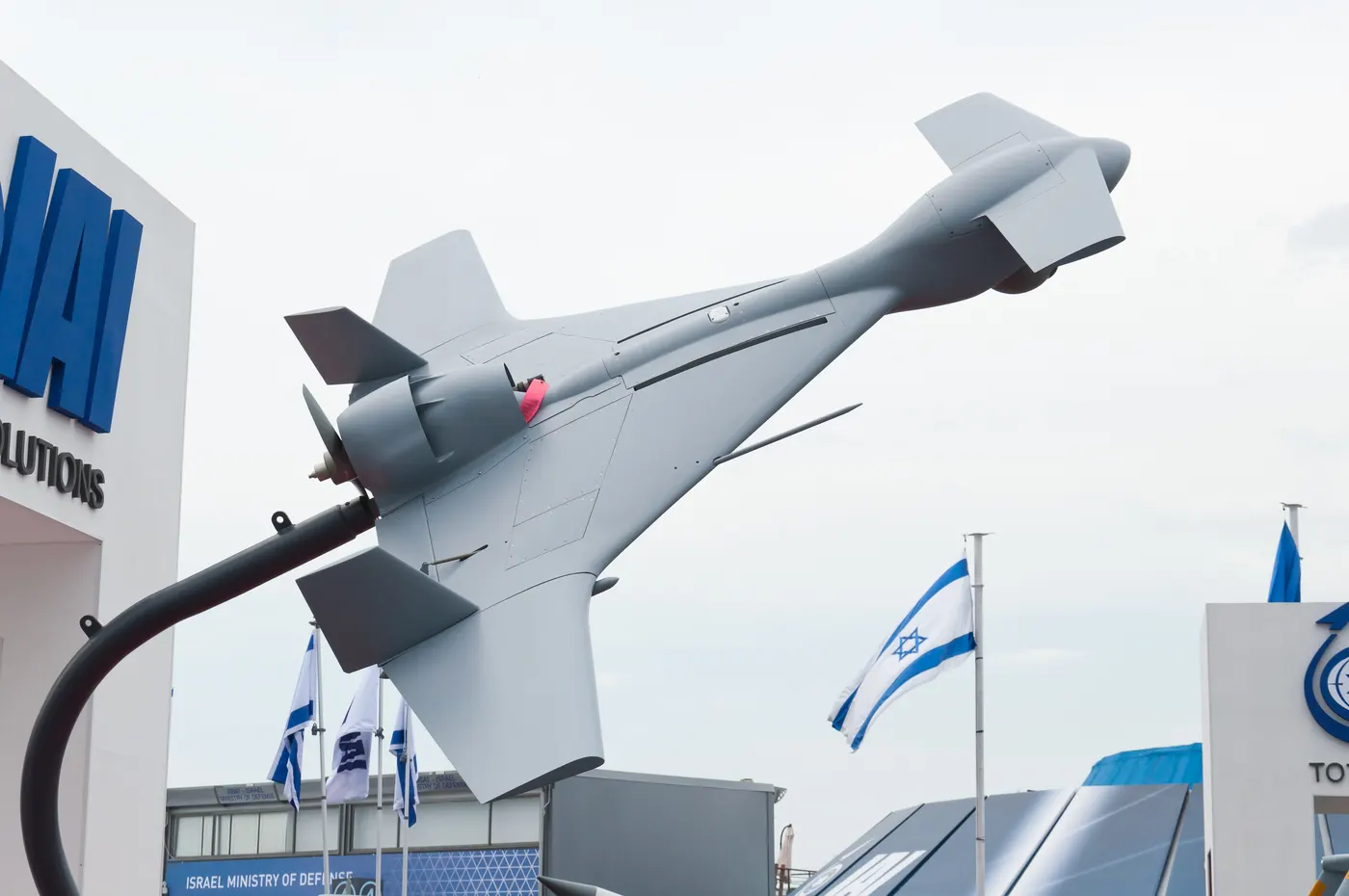

The IAI Harop is a loitering munition developed by Israel Aerospace Industries (IAI) as the successor to the IAI Harpy, an earlier IAI anti-radar munition that Harop has replaced in most of the company's newer export offerings.1 Development work sits within IAI's MBT Missiles Division, and the type became public around February 2009, appearing that year at the Aero India exhibition.1 Harop differs from Harpy in one defining respect: Harpy relies solely on a passive radar-homing seeker and commits to an attack automatically once launched, with no way to call it off, while Harop adds an electro-optical/infrared (EO/IR) seeker together with a two-way datalink, so an operator watching real-time video from the munition can identify a static or moving target, confirm a strike, or abort the attack in mid-dive and send the aircraft back to loiter or return to base.2,3 Harop also keeps the option to fly a fully autonomous anti-radiation profile, giving an operator a choice between Harpy's older automated mode and the newer human-supervised one on the same airframe.2
- EO/IR seeker lets an operator identify and confirm targets that are not emitting radar
- Man-in-the-loop datalink allows a strike to be aborted in mid-dive
- Retains an optional fully autonomous anti-radiation attack mode
- 200 km stated range and 6 or more hours of loiter endurance[^1]
- Circular error probable under 1 m against a confirmed target[^1]
- Warhead of 15-16 kg, smaller than Harpy's 32 kg[^1][^4]
- Endurance figures conflict between sources: roughly 6 hours per independent listings versus IAI's own stated 9 hours[^1][^5]
- Gross/launch weight not confirmed in public sourcing
- Two-way datalink is an additional dependency that Harpy's fully passive design does not require
This combination places Harop within the broader category of loitering munitions: one-way "suicide drones" that combine extended airborne patrol with a warhead delivered on the terminal dive, built around a single expendable mission rather than reusable reconnaissance flight.1
Harop measures 2.5 m in length with a 3.00 m wingspan and a radar cross-section under 0.5 m², figures given consistently by Wikipedia and GlobalSecurity.org's technical listings.1 Maximum speed is listed at 417 km/h, more than double Harpy's 185 km/h top speed, and the stated range (also described as comms range) is 200 km, matching rather than exceeding Harpy's own figure.1,4 Service ceiling is given as 4,600 m.1
Endurance is reported inconsistently between sources: Wikipedia and GlobalSecurity.org both give roughly 6 hours on station, while IAI's own product page states up to 9 hours.1,5 Warhead weight is likewise reported at 15 kg by GlobalSecurity.org and 16 kg by Wikipedia — in either case smaller than Harpy's 32 kg warhead.1 Stated accuracy is a circular error probable of under 1 m against a confirmed target.1
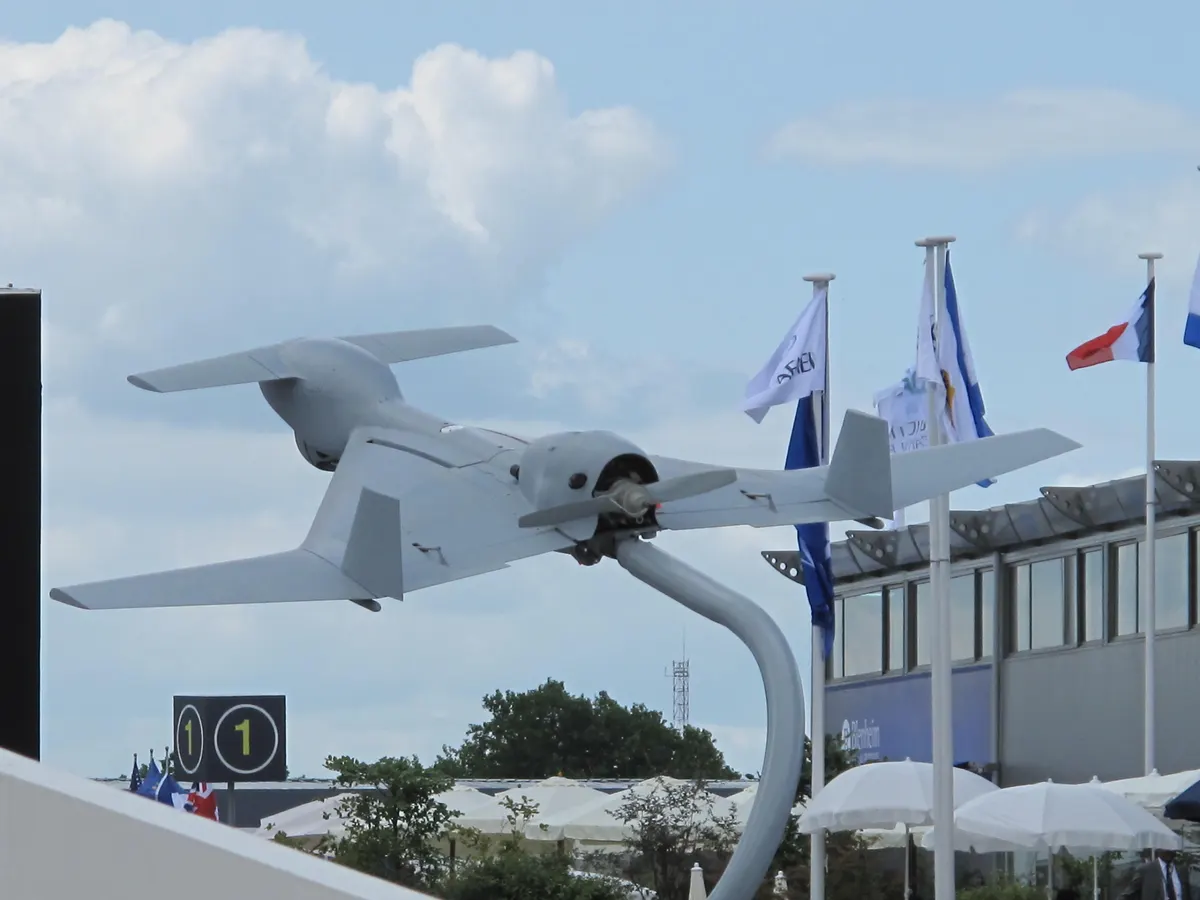
Propulsion is a single piston engine turning a two-blade pusher propeller, according to FlightGlobal's 2008 program coverage; lower-tier aggregator sites describe a hybrid electric/piston arrangement instead, but that claim is not corroborated by trade-press reporting and is not used in this article.6 Harop is fired from a canister launcher that can be mounted on a ground vehicle or a naval vessel, with a ground-based Mission Control Shelter (MCS) providing the man-in-the-loop video feed and control link once the munition is airborne.1,5
Target acquisition uses the EO/IR seeker described above, letting Harop identify and classify a target visually without prior electronic intelligence on its location; the same airframe can additionally home passively on radar emissions in its optional autonomous mode.2,5 IAI credits this combination of visual identification and an abort option with letting Harop engage targets that never emit a detectable signal, addressing Harpy's central operational limitation.2,3
No reliably sourced gross or launch weight distinct from Harpy's own 135 kg figure has been found for Harop, and this article does not assign one pending better sourcing.1 Wikipedia cites a cumulative production figure of approximately 1,200 units, though the date of that count is not specified.1
The panel above places Harop's ten scored categories directly alongside Harpy's own database entry, allowing a direct side-by-side comparison of the two systems across sensor payload, endurance, autonomy, and the other categories curated for this leaf.
Harop was developed at IAI's MBT Missiles Division specifically to close a gap in Harpy's operating envelope: because Harpy's seeker only detects an active radar emission, it cannot engage a target that has powered down or never radiated to begin with.2 Adding an EO/IR seeker and a two-way datalink let an operator visually confirm and, when necessary, retarget or abort a strike regardless of whether the target was emitting.2,3
Harop became public around February 2009, in reporting by defense journalist Bill Sweetman, and was displayed that year at the Aero India exhibition.1 The same reporting separately states that Turkey allegedly became Harop's launch customer in 2005 — four years before the type's public unveiling — a claim resting on that single sourced account and treated in this article as a lower-confidence historical claim rather than a confirmed sale date.1,7

In August 2024, North Korea publicly displayed a drone visually near-identical to Harop during a visit by Kim Jong Un to the Drone Institute of the Academy of Defence Sciences.10 Analysts assess the North Korean system as a reverse-engineered copy rather than an imported or captured IAI airframe; Israel maintains no diplomatic or arms relationship with North Korea, which rules out any legitimate transfer.10,11 Suspected paths to the underlying design include a documented 2020 North Korean cyber-espionage campaign that used fake job offers to target employees of Israeli defense firms, or an Iranian pass-through of recovered Harop or Hero-series hardware, though neither route is confirmed.10,12
Harop's most consequential combat use came during the "Four-Day War" in Nagorno-Karabakh, when Azerbaijani forces struck a bus carrying ethnic-Armenian Yerkrapah volunteer fighters on April 4-5, 2016.13 Armenian officials reported 6 to 7 fighters killed in the strike, and sources diverge on the exact count.13,14 Video of the attack circulated widely and was geolocated and analyzed by multiple outlets as a Harop strike, making it one of the first loitering-munition kills documented on video during an interstate conflict.14,15

The same round of clashes reportedly included Harop strikes on Armenian artillery and air-defense positions, though the bus strike drew the most independent scrutiny given the available video and its confirmed casualty count.13,14
Azerbaijan employed Harop again, and more extensively, during the Second Nagorno-Karabakh War of September-November 2020. Footage from the conflict shows a near-vertical night-time dive attack at a dash speed above 250 mph, with a distinctive engine sound that Azerbaijan's Border Guard later used in its own propaganda-video releases; Azerbaijani presidential aide Hikmet Hajiyev publicly credited the system's effectiveness in the campaign.16
Harop has also been reported in Syria, including a strike credited with destroying a Syrian SA-22 (Pantsir-S1) air-defense system on May 10, 2018, and a further reported use against Syrian government forces on December 9, 2024; the latter report rests on a single secondary summary and carries only moderate confidence.1
During the India-Pakistan clashes of May 7-10, 2025 ("Operation Sindoor"), Indian forces reportedly deployed Harops alongside Polish Warmate 5.0 loitering munitions against Pakistani early-warning radar sites, including HQ-9BE and HQ-16FE surface-to-air missile radars, with strikes reported near four radar sites, seven Pakistan Air Force bases, and one forward operating base, and in the vicinity of Karachi, Lahore, and Rawalpindi.17
No credible reporting places genuine IAI Harops in Ukrainian service. Israel has consistently declined to supply lethal weapons systems to Ukraine, citing a need to preserve freedom of action against Iranian-aligned targets in Syria and concern that Russia could capture and reverse-engineer Israeli hardware; Israeli assistance to Ukraine has been limited to non-lethal equipment.19 Aggregator claims of Harop use in Ukraine are not corroborated by primary reporting and are not treated as established in this article.
IAI markets a smaller, tactical variant named Mini Harop, sized for canister launch from JLTV-class vehicles rather than Harop's larger ground or naval launchers.20 IAI's own listing gives Mini Harop an endurance of about 1 hour, an operating radius of roughly 100 km, a dash speed near 200 knots (about 370 km/h), a 7 kg warhead, and the same sub-1-meter CEP claimed for the full-size Harop.20
Mini Harop should not be confused with Mini Harpy, a separate, smaller variant of the original Harpy rather than of Harop. Mini Harpy pairs an EO/IR seeker with an anti-radiation seeker in what IAI describes as "triple homing," and the company displayed an updated version at the AUSA 2025 exhibition; its published figures — 2.5 m length, 2.9 m wingspan, 41 kg gross weight, 370 km/h top speed, 100 km range, roughly 2 hours of endurance, and up to a 7.7 kg warhead — describe a distinct airframe from Mini Harop despite the similar naming.21


| Yıl | Alıcı | Adet | Tutar | Bugünkü Değer (2025) |
|---|---|---|---|---|
| 2021 |  Fas | — | $22.0 M | $26.1 M |
| 2019 |  Hindistan | 54 | — | — |
| 2009 | Hindistan | 10 | $100.0 M | $150.1 M |
| 2007 | Hindistan | 8 | $100.0 M | $155.3 M |
| 2005 |  Türkiye | — | — | — |
| 2005 |  Birleşik Krallık | — | — | — |
Israel operates Harop as both developer and user.1 India is Harop's largest disclosed export customer: the Indian Air Force contracted for 10 units for a reported $100 million in June 2009, inducting the type that September as its first offensive combat drone, and India's government approved the purchase of 54 additional units in February 2019.22,23,24
Azerbaijan had Harop in service before the April 2016 Nagorno-Karabakh clashes described above and used it again extensively in the 2020 war, making it the system's most combat-proven export operator; no public contract document discloses the size or value of Azerbaijan's purchase.13,16 Morocco signed a reported $22 million deal for the type in 2021, said to include a local-manufacturing component.25,26
Turkey is commonly listed as a Harop operator on the strength of the alleged 2005 launch-customer claim described above under History. Given the collapse of Israel-Turkey defense cooperation after 2010 and Turkey's 2024 trade embargo on Israel, this article treats Turkey as a historical, since-severed claim rather than a current operator.8,9,7
The Kingdom of the Netherlands selected IAI to supply a containerized Harop for two new multifunction support vessels being built for the Royal Netherlands Navy; Dutch state secretary for defense Gijs Tuinman said Harop was the only system on the market sufficiently developed to meet the navy's range requirements.27 As of this selection, the naval Harop remains at the contracted/selected stage rather than a delivered, operational system, and this article does not list it as active in-service equipment.
North Korea is not included among Harop's operators in this article. As described under History, its August 2024 unveiling is best documented as a reverse-engineered copy rather than a transferred or captured genuine system, and Israel has no arms relationship with North Korea through which one could have been supplied.10
Harop's most direct comparison is its own predecessor. Harpy relies solely on a passive radar seeker and commits to an attack automatically once launched, with no ability to abort; Harop adds an EO/IR seeker and a two-way datalink that lets an operator view real-time video, select a static or moving target, and recall the munition mid-dive.2,3 Harop's stated 417 km/h top speed is more than double Harpy's 185 km/h, though the two share the same 200 km stated range figure; Harop's warhead, at 15-16 kg, is smaller than Harpy's 32 kg.1,4 Endurance comparisons are less clean-cut: Harop's reported 6-to-9-hour range is longer than the roughly two hours commonly cited for Harpy, though the two figures come from sources of differing reliability, as flagged above.1,4
Within Israeli industry, Harop's closest current competitor is Elbit Systems' SkyStriker, which pursues the same basic approach — an EO/IR seeker with man-in-the-loop lock-on and abort — in a smaller airframe.2
| System | Range | Endurance | Warhead | Guidance |
|---|---|---|---|---|
| IAI Harop | 200 km | 6-9 hours | 15-16 kg | EO/IR + optional anti-radiation, man-in-the-loop |
| Elbit SkyStriker | 100-200+ km | up to 2 hours (5 kg) / 1 hour (10 kg) | 5 or 10 kg | EO/IR lock-on, man-in-the-loop abort |
Across the wider loitering-munition category, Harop sits toward the long-range, long-endurance end of the spectrum. Tactical, short-range designs — including Rafael's Spike Firefly, AeroVironment's Switchblade 600, Russia's ZALA Lancet, and Poland's WB Electronics Warmate 2 — operate at ranges from roughly 1.5 km to about 240 km and endurances measured in tens of minutes to two hours, short of Harop's 200 km stated range and multi-hour loiter time.2

What is the IAI Harop? An Israeli loitering munition built by Israel Aerospace Industries as the successor to the IAI Harpy, adding an EO/IR seeker and a man-in-the-loop datalink that lets an operator identify, confirm, or abort a strike, while retaining an optional autonomous anti-radiation attack mode.1,2
How is Harop different from Harpy? Harpy carries a passive, radar-only seeker and attacks automatically with no way to abort once committed. Harop adds an EO/IR seeker and a two-way datalink, letting an operator view real-time video and call off a strike in mid-dive, at the cost of a smaller warhead (15-16 kg versus Harpy's 32 kg).2,3,1,4
Which countries currently operate Harop? Israel, India, Azerbaijan, and Morocco are solidly documented current operators. Turkey's link is a historical, since-severed claim from an alleged 2005 purchase; the Netherlands has selected, but not yet fielded, a naval variant; and North Korea's 2024 unveiling is a reverse-engineered copy rather than a supplied system.1,8,9,25,27,10
Was Harop really used in the 2016 Nagorno-Karabakh bus strike? Yes. Video of the April 4-5, 2016 strike on a bus carrying Armenian volunteer fighters was independently geolocated and analyzed by multiple outlets as a Harop attack, with Armenian officials reporting 6 to 7 killed.13,14,15
Did Harop destroy dozens of Pakistani air-defense systems in 2025? Indian forces reportedly used Harops against Pakistani radar sites during May 2025's Operation Sindoor, but Pakistani claims of 77, then 84, then 25 Harops "shot down" are disputed official statements rather than independently verified figures, and India has acknowledged only one loss.17,18
- "IAI Harop", Wikipedia — en.wikipedia.org ↩
- "IAI's Loitering Munitions", The Aviationist — theaviationist.com ↩
- "Harpy vs Harop", DIMSE — dimse.info ↩
- "IAI Harpy", Wikipedia — en.wikipedia.org ↩
- "Harop", Israel Aerospace Industries — iai.co.il ↩
- "Israel Special: IAI's Harop ups the stakes on SEAD missions", FlightGlobal — flightglobal.com ↩
- "Turkey, Israel And Iran Have Built Some Very Lethal Loitering Munitions", Forbes — forbes.com ↩
- "Israel-Turkey defense relations", The Jerusalem Post — jpost.com ↩
- "An Effective Solution? Turkey Pushes for Arms Embargo Against Israel", FDD — fdd.org ↩
- "North Korea Unveils Clones Of Israeli Kamikaze Drones", TWZ — twz.com ↩
- "North Korea Presents Launcher For Copies Of Israeli Harop Kamikaze Drones", Militarnyi — militarnyi.com ↩
- "North Korea Copies Israeli Harop Drone, Debuts New Suicide Drone Launcher", United24 Media — united24media.com ↩
- "Israeli-made kamikaze drone spotted in Nagorno-Karabakh conflict", The Washington Post — washingtonpost.com ↩
- "Kamikaze drone filmed in Nagorno-Karabakh conflict", C4ISRNET — c4isrnet.com ↩
- "Nagorno-Karabakh Kamikaze Drone Debut", RFE/RL — rferl.org ↩
- "The Sound Of This Nighttime Suicide Drone Strike Is Absolutely Terrifying", TWZ — twz.com ↩
- "Operation Sindoor: Harop Drones, India-Israel Precision Strike Technology", Business Standard — business-standard.com ↩
- "India Launched Dozens Of Israeli-Made Harop Attack Drones, Pakistan Claims", TWZ — twz.com ↩
- "The Reasoning Behind Israel's Refusal To Supply Weapons To Ukraine", Jerusalem Strategic Tribune — jstribune.com ↩
- "Mini Harop", Israel Aerospace Industries — iai.co.il ↩
- "AUSA 2025: IAI's Mini Harpy Loitering Munition Reappears with Dual EO/IR and Anti-Radar Seeker", Army Recognition — armyrecognition.com ↩
- "India Orders 10 IAI Harop UAVs", Defense Update — defense-update.com ↩
- "India: Approval for 54 Attack Drones Harop from Israel for Indian Air Force", Army Recognition — armyrecognition.com ↩
- "India Approves Purchase Of 54 Israeli Harop Drones", DefenseWorld — defenseworld.net ↩
- "Israel-Morocco Arms Deal Signed for 'Suicide Drone'", Middle East Eye — middleeasteye.net ↩
- "Israel Aerospace Industries Got USD 22 Mln From Morocco For Kamikaze Drones", Hespress — en.hespress.com ↩
- "Royal Netherlands Navy Selects IAI Harop for New Support Vessels", Naval News — navalnews.com ↩
- "IAI and MBDA Deutschland to Jointly Offer Loitering Munition for German Armed Forces", MilitaryLeak — militaryleak.com ↩