

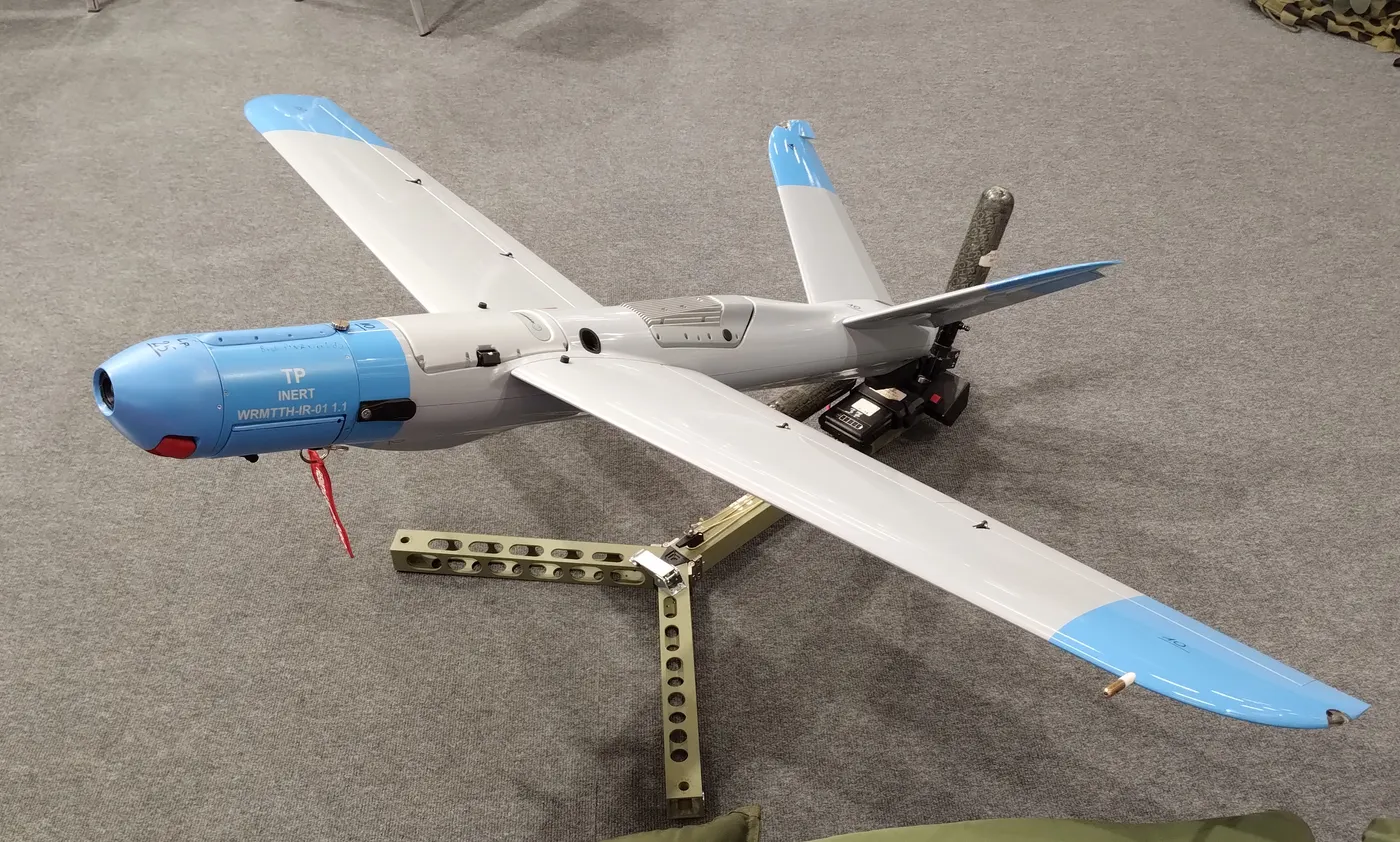
WB Electronics Warmate is a man-portable loitering munition manufactured by WB Electronics, part of WB Group of Poland, one of Europe's largest privately held defense manufacturers, founded in 1997.1 It belongs to the loitering munitions class, small precision-strike drones that combine a reconnaissance aircraft's sensor and endurance with an integral warhead, so a single round can search for, track, and strike a target under an operator's terminal control; WB Electronics markets the concept under the name "Search-Track-Attack."2,3
- Launched by a two-person crew from a pneumatic catapult; no runway or dedicated vehicle required[^3]
- Manufacturer's own product page lists a 30 km range, roughly 70-minute endurance, and a 150 km/h attack speed[^7]
- Combat-proven in Ukraine since 2022 and reportedly used in the May 2025 India-Pakistan clash[^2][^13]
- Shaped-charge warhead co-developed with Poland's own Military Institute of Armament Technology[^3]
- Export customer base spanning at least eight countries across Europe, Asia, and the Middle East by the mid-2020s[^2]
- Baseline specifications are disputed across sources: maximum takeoff weight is cited anywhere from 4 to 5.7 kg and range from 10 to 40 km[^2][^7][^8]
- Reported HEAT-warhead penetration ranges from 100–120 mm to 200–240 mm RHA depending on the source[^2][^3]
- No satellite (beyond-line-of-sight) datalink; control is limited to direct radio range[^2]
- Turkey's operator status rests on a single 2021 public statement, with no disclosed contract quantity or value[^17]
- Estimated unit cost varies sharply by source and configuration, from roughly $26,000 in 2017 to more than $54,000 in a 2024 export contract[^2][^21]
The system originated around 2010 from discussions between WB Electronics engineers and Polish army soldiers. The service itself expressed no initial interest in the concept, and the company funded early development on its own rather than under a Ministry of National Defence program.2 A public concept demonstration followed in 2012, and a production-representative design was later shown at the MSPO defense exhibition in Kielce; sources differ on the exact year of that unveiling, with some reports placing it in 2014 and others in September 2015, though serial production of the baseline Warmate began in 2016.3,6,2
The Warmate's shaped-charge warhead was developed jointly with Poland's Military Institute of Armament Technology, and the baseline system also offers a high-explosive fragmentation warhead alongside a non-explosive, reconnaissance-only configuration.3 WB Electronics has cited a first combat use of the type in 2018, four years before Russia's full-scale invasion of Ukraine, though the specific incident could not be independently corroborated in the open-source reporting reviewed for this article.6
The baseline Warmate airframe is 1.1 m long with a 1.6 m wingspan, an empty weight of about 4 kg, and a maximum takeoff weight of 5.7 kg according to WB Group's own current product literature, the figure this database's specification fields use as the primary source given the disagreement across secondary reporting described below.7,2 It is not built for low observability, relying instead on a small radar cross-section, low acoustic signature, and short exposure time during the terminal attack run.2
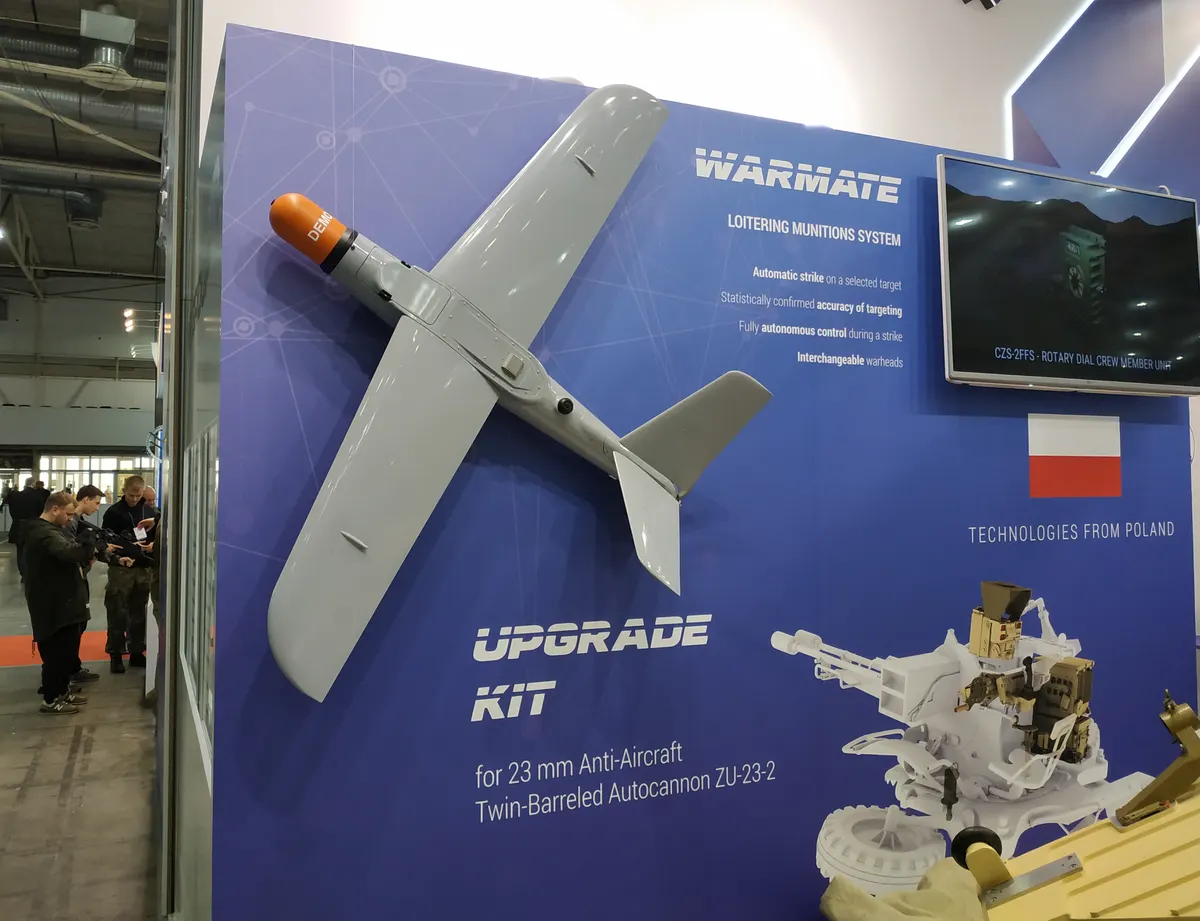
Propulsion is a single electric motor driving a two-bladed pusher propeller, a configuration chosen for mechanical simplicity and a reduced acoustic signature rather than for outright speed.2 WB Group's own figures list an 80 km/h cruise speed and a 150 km/h attack-dive speed, with an operating altitude of roughly 150 to 300 m above ground level during the search-and-loiter phase; Wikipedia separately lists a 3,000 m above-mean-sea-level service ceiling, a figure that likely describes maximum aircraft-performance altitude rather than the low operational altitude the system actually flies during a mission.7,2 Range is listed at 30 km and endurance at approximately 70 minutes on the manufacturer's own page, though this database rounds endurance to 1 hour and other sources report figures as low as 30 minutes or as high as 40 km of range, consistent with the generation-dependent spread described above.7,2,8
The baseline payload is an electro-optical/infrared sensor feeding live video to the operator's ground-control terminal for target identification and terminal guidance, with a reported circular error probable of about 1.5 m.2 Two interchangeable warheads are available: the GO-1, a roughly 300 g high-explosive fragmentation charge with an effective radius against personnel of about 10 m, and the GK-1, a shaped-charge design whose penetration figure is disputed between sources, and a thermobaric option has been referenced for newer variants in the family.2,3 A reconnaissance-only, non-explosive round is also offered, and an optional laser-homing seeker has been referenced by the manufacturer without full technical detail.2
Guidance combines autopilot-driven waypoint navigation for transit and loiter with manual terminal control by the operator over a video downlink for the final attack run.2 A reconnaissance variant, marketed as Warmate-R, substitutes a stabilized multi-camera electro-optical/infrared gimbal for the warhead. The newer "3.0" generation adds multi-layer, GPS-denied navigation intended to maintain guidance under electronic jamming, and can shut down its engine and fold its propeller blades during the final attack dive specifically to reduce acoustic and visual signature moments before impact.9,2 A "Vampire Swarm" concept, combining Warmate munitions with WB's FlyEye reconnaissance drone and FT-5 Łoś target drone, has been marketed for coordinated strikes intended to saturate layered air-defense networks.2
Following its 2012 concept unveiling and 2014–2015 production-representative demonstration, WB Electronics began serial production of the baseline Warmate in 2016, the same year the system secured its first export customer.2,3 A second export customer followed in 2017, and further contracts through 2019–2021 expanded what industry press has termed the Warmate's export "club" of foreign buyers.2 The Polish Armed Forces formally commissioned the Warmate into their own inventory in 2021, a step that followed years of the system already being produced and exported before Poland's own military fully adopted it.5
Russia's February 2022 full-scale invasion of Ukraine reshaped the program's trajectory. Poland began transferring Warmate rounds to Ukrainian forces that year, through a combination of government-to-government transfer and privately organized crowdfunding campaigns.2 The same period saw WB Electronics expand the Warmate family substantially: the heavier, vehicle-launched Warmate 2 (covered under Variants below), the jam-resistant "3.0" generation, a tube-launched variant marketed as Warmate-TL for integration on vehicles, helicopters, and ships, and a longer-range Warmate 5.0/Warmate 50 family unveiled at MSPO 2024.10,11
Poland's own procurement accelerated sharply in the mid-2020s. The Polish Armaments Agency signed a framework agreement with WB Electronics on 15 May 2025 in Warsaw covering roughly 10,000 Warmate 3 units across about 1,000 sets, with executive contracts to run through 2035; unofficial estimates put the framework's total value near €250 million, and the first executive contract under it, for 36 sets (360 drones), was valued at roughly 100 million Polish złoty gross with delivery targeted for the end of 2025.9 A further contract, funded through the European Union's SAFE loan program, was signed on 28 May 2026 for more than 400 additional Warmate systems (each set comprising ten drones) bundled together with roughly 200 FlyEye reconnaissance drones and twelve Gladius counter-drone batteries, with the Warmate portion of that contract valued at approximately 1 billion złoty net.9 A separate Poland-Canada letter of intent covering FlyEye, Warmate, and Gladius cooperation, reported around the same time in May 2026, remains a non-binding statement of interest rather than a signed procurement contract, and does not specify production arrangements, quantities, or pricing.23
Ukraine has been the Warmate's primary combat theater since 2022, with rounds supplied both through Polish government transfer and through privately organized crowdfunding.2 Ukraine's State Border Guard Service used a Warmate to strike a group of Russian personnel in the southern sector of the front, described in a report published 10 February 2023 as killing nine Russian soldiers.12
A more specific and better-documented strike came in January 2024, when Ukraine's Defense Intelligence directorate (HUR), coordinating with the 15th Separate Artillery Reconnaissance Brigade "Chornyi Lis," used a Warmate 3.0 to destroy a Russian Tor short-range air-defense system near the Russia-Ukraine border; a Russian interceptor missile fired at the incoming drone reportedly exploded prematurely and missed it.4 Open-source reporting from the Ukrainian theater should be read carefully on this point: many widely circulated videos of small kamikaze drones destroying Russian armor in Ukraine depict generic commercial first-person-view drones rather than the Warmate specifically, and this article limits its combat claims to incidents that name the Warmate directly.
The Warmate's only other documented combat use outside Ukraine came during the India-Pakistan clash of 7–10 May 2025. India deployed a mixed drone package, Israeli Harop and Harpy loitering munitions, indigenous Nagastra-1 munitions, and Polish Warmate-R and Warmate 3 rounds, across three waves into Pakistani airspace, primarily in a suppression-of-enemy-air-defense role against Pakistani HQ-9BE and HQ-16FE surface-to-air missile radars.13 Pakistani reporting separately claimed that an Indian-operated Warmate was captured intact after being downed or electronically jammed near Lahore, giving Pakistani forces hands-on access to the airframe; this claim originates from Pakistani sources and has not been independently corroborated by Indian or third-party reporting.14
The clearest distinction within the Warmate family is between the baseline Warmate and the heavier Warmate 2, a relationship broadly analogous to how AeroVironment's man-portable Switchblade 300 relates to its larger, vehicle-launched sibling, the Switchblade 600. The baseline Warmate is a light, man-portable system carried and launched by a two-person infantry crew from a pneumatic catapult, at a maximum takeoff weight of roughly 5.7 kg and a 1.4 kg payload.7,2 The Warmate 2, by contrast, is a substantially larger system at roughly 30 kg maximum takeoff weight and about 2.5 m in length and wingspan, launched from a vehicle-mounted elastomeric or tube launcher rather than carried by an infantry crew.2,8 It carries a heavier 5 kg warhead, offered in high-explosive fragmentation, thermobaric, or shaped-charge configurations, with the shaped-charge option credited with penetrating roughly 400 mm of rolled homogeneous armor against the baseline Warmate's disputed 100–240 mm figure.2 Radio control range extends to about 180 km, with a total quoted operational range of 30 to 240 km and roughly two hours of endurance, against the baseline's 30 km and 60–70 minutes.2,8 One source credits the Warmate 2's development in part to a partnership with the United Arab Emirates' Tawazun defense group, though this detail could not be confirmed against a second independent source.2
Several other named variants extend the baseline design without constituting a separate weight class. Warmate-R is a recoverable reconnaissance version carrying a three-camera electro-optical/infrared sensor package instead of a warhead, with a reported 15 km range, 80-minute endurance, and 5.2 kg weight.2 Warmate-TL is a tube-launched configuration intended for integration on ground vehicles, helicopters, ships, or as a payload carried by another drone.2 The "3.0" generation, referenced throughout this article, adds jam-resistant, GPS-denied navigation and a low-signature "stealth" attack mode. A longer-range Warmate 5.0 and Warmate 50 family was unveiled at MSPO 2024, positioned above the baseline system's range envelope.10,11


| Yıl | Alıcı | Adet | Tutar | Bugünkü Değer (2025) |
|---|---|---|---|---|
| 2026 |  Polonya | 400 | — | — |
| 2025 | Polonya | 10,000 | — | — |
| 2024 |  Güney Kore | 200 | $10.8 M | $11.1 M |
| 2022 |  Hindistan | 100 | — | — |
This database lists eight confirmed Warmate operators: Ukraine, Poland, India, Turkey, Georgia, the United Arab Emirates, South Korea, and Libya, each with at least some supporting documentation, though the quality of that documentation varies considerably.
Poland is the type's home-country operator and by far its largest, with the Polish Armaments Agency's 2025 framework agreement alone covering roughly 10,000 units.9 Ukraine has received Warmate rounds continuously since 2022 and has documented combat use of the type, described under Conflicts above.2,12,4 India ran a competitive trial process beginning with a request for information in March 2020, won by WB Electronics, and received more than 100 units by June 2022; the company established a dedicated subsidiary, WB Electronics India, in New Delhi in October 2020 to support the relationship, and Indian forces used the type operationally in the May 2025 clash with Pakistan.15,16 Georgia's arrangement is a joint venture rather than a conventional export sale: Georgian state defense company STC Delta and WB Electronics signed an agreement on 18 May 2022 to establish "Delta-WB," a local assembly line for both the Warmate and WB's FlyEye reconnaissance drone, with demonstration flights held in January 2023 and a public showcase at Krtsanisi in December 2023, targeting a combined output of 1,000 to 1,500 drones per year across both types.19,20 South Korea's Defense Acquisition Program Administration signed a contract with WB Group at the KADEX exhibition in 2024 for 10 sets, roughly 200 Warmate 3 units in both combat and training configurations, valued at approximately $10.85 million, with deliveries beginning in late 2024 and continuing through 2025; no operational use by South Korean forces has been reported as of this writing.21,22
Within the man-portable segment of the loitering-munitions market, the Warmate sits above Rafael's Spike Firefly in most performance figures but below the Russian ZALA Lancet and the Warmate's own larger sibling, the Warmate 2.2,8 The Firefly, at roughly 2.2 to 3 kg depending on generation, is lighter than the baseline Warmate's 5.7 kg and correspondingly shorter-ranged, with a control radius of 500 m to 5 km against the Warmate's 30 km, reflecting the Firefly's design for room-and-courtyard urban engagements rather than standoff strikes. The Lancet, by contrast, is credited with a heavier warhead in its larger variants (up to 3 kg against the Warmate's 300 g HE-FRAG charge) and a confirmed strike radius of about 70 km recorded in a September 2023 attack on the Dolgintsevo airbase, exceeding the Warmate's 30 km figure by a wide margin.
| System | MTOW | Warhead | Range | Endurance |
|---|---|---|---|---|
| Warmate (baseline) | 4–5.7 kg | ~300 g HE-FRAG or HEAT (100–240 mm RHA, disputed) | 15–40 km (30 km per manufacturer) | 30–70 min |
| Warmate 2 | ~30 kg | ~5 kg (HE-FRAG/FAE/HEAT, ~400 mm RHA) | 30–240 km | ~2 hr |
| Spike Firefly / L-Spike 1x | 2.2–3 kg | 350–420 g | 0.5–5 km | 15 min armed |
| ZALA Lancet | up to 12 kg | 1–3+ kg | 40 km nominal; ~70 km confirmed strike | not specified |
MASS scoring gives the Warmate an overall score of 54, below the Lancet's 73 and the larger Warmate 2's 59, largely on range and lethality components. The lighter Spike Firefly nonetheless scores 68 despite its far shorter range, a result driven by the weight MASS scoring places on precision and cost-effectiveness for the lightest-weight systems in the category. Fire Point's FP-2 and Elbit's SkyStriker, both also listed among comparable systems in this leaf, occupy a materially larger weight and range class than any man-portable Warmate variant and function closer to mid-range strike drones than to squad-level loitering munitions.

What is the difference between the Warmate and the Warmate 2?
The baseline Warmate is a man-portable system, roughly 5.7 kg, launched by a two-person crew from a pneumatic catapult, with a 30 km range and a 1.4 kg payload. The Warmate 2 is a substantially larger, roughly 30 kg system launched from a vehicle-mounted launcher, with a heavier 5 kg warhead, a longer 30–240 km range, and about two hours of endurance.2,8
Why do sources disagree on the Warmate's basic specifications?
Reported maximum takeoff weight, range, endurance, and warhead penetration figures vary considerably across sources, most likely because secondary reporting describes different Warmate generations, the original "1.0" hardware and the jam-resistant "3.0" variant fielded from the early 2020s, under the same product name without distinguishing between them.2,3,7,8
Has the Warmate been used in combat?
Yes. Ukraine has used the Warmate against Russian forces since 2022, including a documented January 2024 strike that destroyed a Russian Tor air-defense system and a February 2023 strike credited with killing nine Russian personnel. India also deployed Warmate-R and Warmate 3 rounds against Pakistani air-defense radars during the May 2025 India-Pakistan clash.4,12,13
Which countries operate the Warmate?
This database lists eight confirmed operators: Ukraine, Poland, India, Turkey, Georgia, the United Arab Emirates, South Korea, and Libya. Poland is the largest operator by a wide margin following its 2025 and 2026 procurement agreements; Turkey's status is the most weakly documented, resting on a single 2021 public statement rather than disclosed contract figures.9,17
How much does a Warmate cost?
Estimates vary widely by generation and configuration. Wikipedia cites approximately $26,460 per unit in 2017 dollars for the baseline round, while South Korea's 2024 contract for Warmate 3 combat and training sets implies a per-unit cost above $54,000.2,21
- "WB Group", Wikipedia — en.wikipedia.org ↩
- "WB Electronics Warmate", Wikipedia — en.wikipedia.org ↩
- "Warmate Micro Combat Unmanned Air System (UCAS)", Airforce Technology — airforce-technology.com ↩
- "Intelligence officers hit russian Tor SAM system with Warmate 3.0 loitering munition", Militarnyi — militarnyi.com ↩
- "The Polish Military Is Now Officially Armed With The Warmate 'Suicide Drone'", The War Zone — twz.com ↩
- "WB Group delivered the Warmate system abroad", MILMAG — milmag.pl ↩
- "Warmate Loitering Munition", WB Group — wbgroup.pl ↩
- "Warmate", Military Factory — militaryfactory.com ↩
- "Poland orders Warmate 3 strike drones to prepare for high-intensity conflicts", Army Recognition — armyrecognition.com ↩
- "WB Group New Warmate Family Unveiled at MSPO 2024", Overt Defense — overtdefense.com ↩
- "Poland develops Warmate 5.0 attack UAV", Militarnyi — militarnyi.com ↩
- "Warmate drone of the border guards destroyed a group of invaders", Militarnyi — militarnyi.com ↩
- "The First India-Pakistan Drone War", The Diplomat — thediplomat.com ↩
- "Pakistan's Electronic Ambush: Indian Warmate Drone Captured Intact in EW Intercept", Defence Security Asia — defencesecurityasia.com ↩
- "India received over 100 units of Polish-made Warmate loitering munition", Militarnyi — militarnyi.com ↩
- "Poland, India Sign Deal On Loitering Munitions", The Defense Post — thedefensepost.com ↩
- "WB Group: Turkey acquires Warmate loitering munition", Flight — flight.com.gr ↩
- "WB Group: We Are Ready to Cooperate with Turkish Companies for 3rd Markets with Turkish Systems", Defence Turkey Magazine — defenceturkey.com ↩
- "Delta-WB and MoD sign agreement to develop military industry", Georgia Today — georgiatoday.ge ↩
- "Georgian-Polish Plant Launching 'Kamikaze' UAV Production", DSM Forecast International — dsm.forecastinternational.com ↩
- "South Korea signs contract to purchase Polish Warmate 3 kamikaze drones", Militarnyi — militarnyi.com ↩
- "South Korea to purchase 200 Polish-made Warmate loitering munitions for over $10 million", Army Recognition — armyrecognition.com ↩
- "Poland's FlyEye, Warmate, Gladius drones may head to Canada under SAFE program", Eastern Herald — easternherald.com ↩