

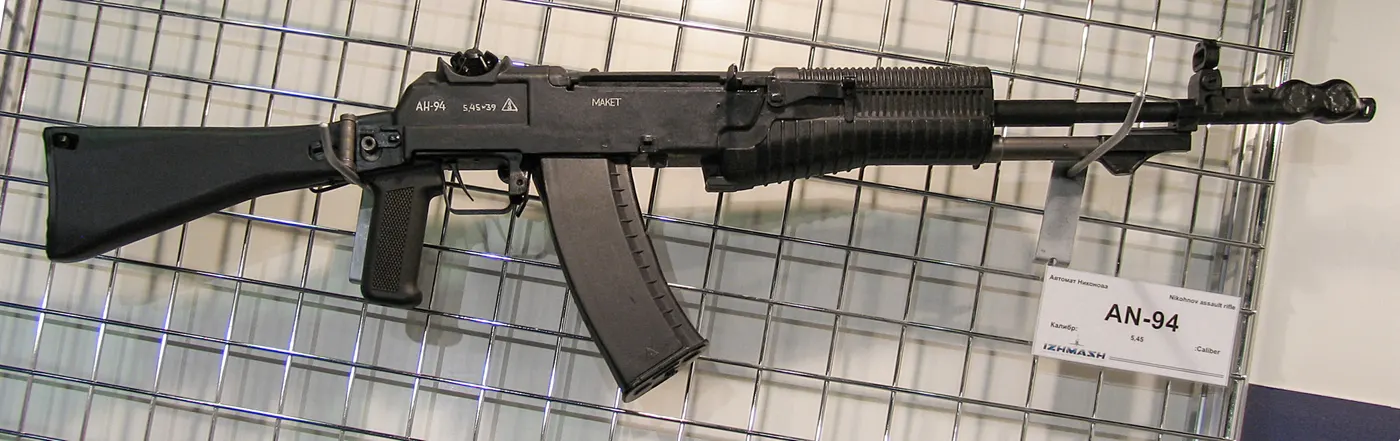

The AN-94 (GRAU index 6P33) is a 5.45×39mm assault rifle from Russia, designed by Gennadiy Nikonov at the Izhmash plant in Izhevsk (today Kalashnikov Concern). It is best known for winning the Abakan competition, a fifteen-year Soviet and then Russian program searching for an infantry rifle that could genuinely out-shoot the AK-74 rather than merely matching it. The AN-94 delivered on that goal in testing, roughly doubling first-round hit probability at 100 meters compared to the AK-74 in official trials.1 It never became the Russian Army's new standard rifle anyway. Total production across 1994 to 2006 is usually put at around 2,000 to 2,500 rifles, a number small enough that most Russian infantry units have never issued one.2
- Near-double first-round burst hit probability vs AK-74
- Two-round hyperburst defeats body armor more reliably
- Accepts 30, 45, and 60-round magazines
- Compatible with optics and the GP-34 grenade launcher
- Extremely complex internal mechanism (13 major components)
- Field-stripping takes far longer to learn than an AK
- Several times more expensive to manufacture than an AK-74M
- Heavier and less forgiving of dirt and cold than the Kalashnikov it was meant to replace
{{photo-req side=left q="AK-74 rifle Russian soldier standard issue" caption="The AK-74, the standard-issue Russian rifle the AN-94 was designed to replace, and the baseline every Abakan-program design had to beat in burst-fire accuracy testing." alt="Russian soldier holding an AK-74 rifle"}}
The AN-94's unit cost is the plainest explanation for why it stayed a niche weapon rather than a mainstream Russian service rifle. Multiple firearms historians put its production cost at somewhere between three and six times that of a standard AK-74M, driven by tight machining tolerances on parts a Kalashnikov rifle simply does not have.3 Combined with the collapse of Soviet-era defense budgets in the 1990s, the Russian military settled instead on the cheaper AK-100 series and, later, the AK-12, leaving the AN-94 fielded mainly by police, Federal Security Service units and select paratrooper and naval infantry formations rather than the whole army.3
The rifle's reputation as the clever alternative to the Kalashnikov formula still draws attention from collectors, video games and firearms writers decades after it lost its own procurement fight. Understanding why requires looking at its firing mechanism, which is unlike anything else fielded by a major army.
The AN-94 is gas-operated with a rotating bolt, like an AK-74, but that description undersells what actually happens when the trigger is pulled. Nikonov built the rifle around what Russian engineers call blowback shifted pulse (BBSP), sometimes shortened by English-language writers to "hyperburst."1 The barrel, gas block, receiver, and bolt group are not fixed to the stock. They form a single unit that recoils backward, together, inside a polymer housing, while a secondary rammer mechanism, driven by a cable and pulley connected to the magazine well, strips and chambers a second round before the shooter's shoulder ever feels the recoil impulse of the first shot.4 The result is two rounds leaving the barrel at a cyclic rate of 1,800 rounds per minute, both shots gone before the recoiling parts strike the rear buffer and transmit felt recoil to the firer. Sustained automatic fire then drops to a practical rate of 600 rounds per minute, closer to a normal rifle.1
- İlk Üretim Yılı1994
- Hizmete Giriş Yılı1994
- TasarımcıGennadiy Nikonov
- Ağırlık (Boş)3,85 kg
- Halen HizmetteEvet
- Önemli KullanıcılarRus silahlı kuvvetleri, Rus Polisi, Federal Güvenlik Servisi, İçişleri Bakanlığı, Rus paraşütçüler, deniz piyadeleri, Kırgızistan
{{photo-req side=right q="AN-94 rifle disassembled field strip parts" caption="The AN-94 field-stripped, showing the recoiling barrel and receiver group, cable-and-pulley rammer, and canted magazine well that make it far more complex than a Kalashnikov." alt="AN-94 rifle disassembled into its component parts"}}
- Fişek5.45×39mm
- Çap5,45 mm
- Kovan Uzunluğu39 mm
- Çap Sınıfıorta güçlü
- Kenar AteşlemeliHayır
- Kovansız MühimmatHayır
The detachable magazine sits canted several degrees off the rifle's centerline, the single most visually distinctive feature of the AN-94 silhouette, because the offset feed path is what the cable-and-pulley rammer needs to strip a second round fast enough for hyperburst to work.1 Standard magazines hold 30 rounds, with 45 and 60-round options also issued.5 Chambered for the Soviet 5.45×39mm intermediate cartridge, the same round used by the AK-74, the AN-94 pushes it to a 900 m/s muzzle velocity from a 405 mm barrel, with an official effective range of 800 meters.5 It weighs 3.85 kg empty, noticeably more than the AK-74's roughly 3.4 kg, a direct consequence of the extra internal hardware needed to make BBSP work.3
- Mekanizma TipiGazlı
- Atış Modlarıyarı otomatik, tam otomatik, 2 atımlı seri
- Seçmeli AtışEvet
- Besleme SistemiÇıkarılabilir Şarjör
- Şarjör Kapasitesi30
- Tambur / Şerit Kapasitesi60
- Teorik Atış Hızı1.800
- Pratik Atış Hızı600
That hardware is also what makes the rifle hard to live with. Disassembled for cleaning, the AN-94 breaks down into 13 distinct parts, including two separate springs, a steel cable, and a pulley wheel, none of which exist in an AK-pattern rifle at all.1 Firearms writers who have handled both note that learning to strip an AK-74 takes a soldier a few hours, while learning the AN-94 properly takes weeks, a serious problem for an army built around short conscript service and mass rather than specialist training.1 The rifle retains a folding stock, standard iron sights, and a side-rail-equipped variant (the AN-94N) accepts an optic rail for day scopes such as the 1L29 or night sights like the NSPU-3, and the rifle can also mount the GP-34 underbarrel grenade launcher.1
- Namlu Çıkış Hızı900 m/sn
- Etkili Menzil (nokta)800 m
- Nişan Menzili700 m
- Namlu Uzunluğu405 mm
- Nişangah TipiDemir nişangah, çeşitli optikler
- Optik RayıEvet
- Açık NişangahEvet
- Dişli NamluHayır
- Susturucuya HazırHayır
- Entegre BipodHayır
- Bombaatar KabiliyetliHayır
- Gaz PistonluEvet
- Toplam Üretim2.500
- Üretim Başlangıcı1994
- Üretim Bitişi2006
- Varyantlar0
Project Abakan began in 1979, in the aftermath of the Soviet invasion of Afghanistan, when Soviet ordnance planners concluded the AK-74's switch to the smaller 5.45×39mm cartridge had not delivered the accuracy gains they wanted from a new-generation rifle.6 The Ministry of Defense opened a formal competition among twelve design teams drawn from five major Soviet small-arms design bureaus, with entrants required to beat the AK-74 baseline by a wide, specified margin in burst-fire hit probability rather than simply match it.6
{{photo-req side=right q="Soviet Russian firearms designer engineer portrait 1990s" caption="Gennadiy Nikonov, the Izhmash engineer who spent roughly fifteen years and more than 20 prototypes developing the AN-94's blowback shifted pulse mechanism." alt="Portrait of a Soviet-era firearms design engineer"}}
Nikonov's own path to the AN-94 ran through more than 20 prototypes over roughly fifteen years.7 His earliest Abakan submissions, the NA-1 through NA-4 series, were bullpup-layout designs, a configuration he abandoned after finding that muzzle blast and ejected cases too close to the shooter's face made the layout uncomfortable and impractical for the burst-delay concept he was chasing.7 The design evolved through the AS and ASM prototype families, eventually settling on the offset-magazine, recoiling-receiver approach that became the AN-94, formally trialed as the model 6P33 in 1991 with the Taman Guards Motor Rifle Division.6
{{photo-req side=left q="Izhmash Izhevsk arms factory Soviet Russia" caption="The Izhmash plant in Izhevsk, where the AN-94 was designed and built, later renamed Kalashnikov Concern." alt="Izhmash arms factory building in Izhevsk"}}
Nikonov's toughest competitor in the final round was not another Kalashnikov derivative but Igor Stechkin's TKB-0146, the only bullpup design to reach the final testing phase and the only other genuinely novel mechanism in the competition.8 Stechkin's rifle used a related but distinct shifted-recoil-pulse concept and tested slightly more accurate than Nikonov's design in some trials, but proved less reliable overall, mostly because it fouled more readily.8 The other Abakan finalist worth noting, the AEK-971 from the Kovrov design bureau, took a completely different route to the same accuracy problem, using a Balanced Automatics Recoil System (BARS) with a counterweight that cancels bolt-carrier recoil impulse mechanically rather than through burst timing.9 Nikonov's ASM design was declared the winner in 1994, and the rifle received its formal Avtomat Nikonova 1994 type designation, later confirmed in a 1997 Russian government decree that adopted it into the Ministry of Defense inventory.6 Nikonov himself was recognized by President Boris Yeltsin in 1992 for the design ahead of its full adoption.7
The AN-94's formal win did not translate into rearmament. Post-Soviet Russia's defense budget in the mid-1990s could not support re-equipping the whole army with a rifle costing several times more than the AK-74M already in every armory, and Izhmash itself was forced to lean on commercial and export sporting-arms sales just to stay solvent through the decade.10 Field feedback from the small numbers that did reach troops was mixed. Naval infantry using the rifle in August 1999 during renewed Chechen fighting reportedly called it excellent in first impressions, but longer use surfaced complaints about a stock and trigger geometry that interfered with each other when folded, and about maintenance and disassembly demands unsuited to a mostly-conscript force.11 Nikonov died in 2003 without the chance to address those complaints in a revised production model, and by the early 2000s Russian procurement had already shifted toward the AK-100 series and, later, the AK-12 and A-545 rifles that reached state trials in the 2010s.11
The AN-94 saw its first documented combat use in the First Chechen War (1994 to 1996), fielded in small numbers to elite Russian units even as the conflict was still ongoing when the rifle was being formally type-classified.6
{{photo-req side=left q="North Caucasus Chechnya Dagestan region map" caption="The North Caucasus, spanning Chechnya and Dagestan, where the AN-94 first saw combat in the 1990s and where Federal Security Service units were still photographed carrying it as recently as late 2024." alt="Map of the North Caucasus region including Chechnya and Dagestan"}}
Its footprint in later conflicts stayed narrow for the same reason production stayed narrow. Russian special police and security units reportedly carried it during the 2014 Russian annexation of Crimea, one of the few operations where photographic evidence of the rifle in the field has surfaced since the Chechen wars.2
More recently, the rifle resurfaced in open-source photography in November 2024, showing Federal Security Service Border Guard Department personnel carrying AN-94s in Dagestan, in the North Caucasus, a sighting firearms observers flagged as the first clear public documentation of the type in roughly 15 years.12
{{photo-req side=right q="Russian FSB border guard Dagestan rifle patrol" caption="A Federal Security Service border guard unit in Russia's North Caucasus, the kind of specialized formation that has kept small numbers of the AN-94 in service long after mainline Russian infantry moved to other rifles." alt="Russian FSB Border Guard personnel on patrol in the Caucasus region"}}
That gap itself is informative. An assault rifle whose signature advantage is superior burst accuracy at range has comparatively little to offer in the high-volume, close and often static fighting that has dominated the 2022 Russian invasion of Ukraine in Ukraine since 2022, and there is no solid documentation of the AN-94 seeing meaningful frontline use in that war, unlike the ubiquitous AK-74M and AK-12. Compare that scarcity to the AK-74M and AK-12, both fielded in far larger numbers by both sides, and the AN-94's near-absence from Ukraine war footage is one more data point confirming just how small its total production run really was.12
Formal AN-94 variation is limited, another symptom of how small the production run stayed. The baseline configuration uses fixed iron sights only. The AN-94N adds a side-mounted rail on the left of the receiver for day and night optics, including the 1L29 4x sight and the NSPU-3 night sight, while keeping identical internal mechanics and ballistics to the standard rifle.1 A Warsaw Pact-pattern accessory rail version and a configuration compatible with the GP-34 40mm underbarrel grenade launcher round out the documented factory variants, but none of these represent a distinct model with its own separate production run or GRAU index the way AK variants typically do.1 Unlike the AK-74 or later AK-12, the AN-94 was never developed into a carbine-length or 7.62mm-chambered sibling, and it was never adapted into a semi-automatic-only commercial export pattern the way many Kalashnikov-family rifles were.

| Yıl | Alıcı | Adet | Tutar | Bugünkü Değer (2025) |
|---|---|---|---|---|
| 2012 |  Kırgızistan | 60 | — | — |
| 2001 |  İrlanda | 20 | — | — |
Russia remains the only confirmed state operator of the AN-94, fielding it in restricted numbers with the Russian Armed Forces, the Federal Security Service, the Ministry of Internal Affairs, police units, paratroopers and naval infantry, rather than as a universal infantry issue rifle.5 Kyrgyzstan received 60 AN-94 rifles in 2012 as part of a Russian military aid package, making it the only other government confirmed to operate the type.1
{{photo-req side=left q="Kyrgyzstan special forces soldiers rifles training" caption="Kyrgyz security forces personnel, among the handful of documented AN-94 operators outside Russia after a 2012 Russian aid transfer." alt="Kyrgyz military personnel with rifles during a training exercise"}}
A database note is worth flagging directly. Some sourcing lists "Ireland" among the AN-94's users with roughly 20 rifles dated to 2001, but that figure traces back to reporting that the Provisional Irish Republican Army, not the Irish state or its Defence Forces, reportedly imported around 20 AN-94s in late 2001, before the group's 2005 decommissioning process.1 That is a non-state paramilitary acquisition, not a national armed forces adoption, and it should not be read as the Irish government fielding the rifle.
No other government has confirmed an AN-94 purchase. Firearms industry analysts attribute the lack of further export sales to the same cost and complexity problems that limited the rifle inside Russia itself, since a buyer willing to pay several times the price of an AK-pattern rifle also has to commit to the specialist maintenance training that most smaller defense forces cannot easily support.3
The AN-94's most direct rival was never the AK-74 it was meant to replace. It was the AEK-971, the other serious Abakan finalist, because both rifles chased the identical problem (uncontrollable dispersion during automatic fire) with completely different engineering answers. Nikonov solved it by timing two shots to leave the barrel before recoil registers with the shooter. The AEK-971's designers solved it with a Balanced Automatics Recoil System, a mechanical counterweight inside a modified long-stroke gas piston that physically cancels bolt-carrier recoil impulse rather than out-running it.9 Trial data favored the AN-94 specifically in its two-round burst mode, where it held a slight accuracy edge, but the AEK-971 pulled ahead again in longer three-to-ten-round bursts and full-automatic fire, and did so while weighing roughly half a kilogram less and costing considerably less to manufacture.9 That cost gap explains why AEK-971 descendants, culminating in the A-545 tested under the Ratnik program, stayed in the Russian procurement conversation into the 2010s while the AN-94 did not.
| AN-94 | AEK-971 | |
|---|---|---|
| Recoil solution | Blowback shifted pulse (timed burst) | Balanced Automatics Recoil System (counterweight) |
| Empty weight | 3.85 kg | ~3.35 kg |
| 2-round burst accuracy | Slight edge | Behind AN-94 |
| Automatic/long-burst accuracy | Behind AEK-971 | Slight edge |
| Manufacturing cost vs AK-74M | 3-6x | Lower than AN-94, still above AK-74M |
Against the plain AK-74 it was designed to succeed, the comparison is less about which rifle shoots better and more about which rifle an army can actually afford to issue by the million. The AK-74 wins on cost, weight, simplicity, and the kind of forgiving reliability a conscript force needs in mud, sand or Siberian cold, exactly the qualities the AN-94's cable-and-pulley rammer sacrifices for its accuracy advantage. Against Western rifles like the Armalite AR-15 family or the Heckler & Koch HK416, the AN-94 is not a fair comparison of modularity or accessory ecosystem at all. Those rifles were built around rail interfaces and swappable components for a professional, well-funded force; the AN-94 was built around one specific mechanical trick that only a small, well-trained cadre of operators was ever likely to master and maintain.


What makes the AN-94 different from a normal assault rifle? Its blowback shifted pulse mechanism fires the first two rounds of any burst at 1,800 rounds per minute, fast enough that both bullets leave the barrel before the shooter feels the recoil of the first shot, which is meant to keep the pair grouped tightly on target even at range.1
Is the AN-94 still in service today? In restricted numbers, yes. Russian security and police units, rather than the mainline army, still operate some AN-94 rifles, and Federal Security Service Border Guard personnel were photographed carrying them in Dagestan as recently as November 2024.12 It was never withdrawn outright, it simply never became the standard-issue Russian rifle the AK-100 series and later the AK-12 became instead.
How many AN-94 rifles were ever made? Estimates converge on roughly 2,000 to 2,500 rifles produced between 1994 and 2006, though a handful of sources cite figures as high as 10,000 to 20,000 total procured; the lower figure from arms historians who have directly researched Izhmash production records is generally treated as more reliable.2
Why didn't Russia adopt the AN-94 as its main service rifle after it won the Abakan trials? Cost. Manufacturing estimates put the AN-94 at three to six times the unit cost of an AK-74M, driven by tight tolerances on its recoiling receiver and cable-driven rammer, at exactly the moment Russia's post-Soviet defense budget could least afford re-equipping the whole army.3
What cartridge does the AN-94 fire? The same 5.45×39mm intermediate cartridge as the AK-74, at a muzzle velocity around 900 m/s from its 405 mm barrel.5
- "AN-94", Wikipedia — en.wikipedia.org ↩
- "AN-94 - the weird Soviet weapon (with photos!)", Safar Publishing — safar-publishing.com ↩
- "Why were AN-94 assault rifles expensive to make?", Historical Firearms — historicalfirearms.info ↩
- "The Last Nail In The Coffin Of Soviet Small Arms - The AN-94", TheFirearmBlog — thefirearmblog.com ↩
- "Nikonov AN-94 Abakan assault rifle (Russia)", Modern Firearms — modernfirearms.net ↩
- "Project Abakan", Wikipedia — en.wikipedia.org ↩
- "The Secret Story of The AN-94 Abakan Assault Rifle", Small Arms Review — smallarmsreview.com ↩
- "TKB-0146: Igor Stechkin's Rifle in Abakan Trials", TheFirearmBlog — thefirearmblog.com ↩
- "AEK-971", Wikipedia — en.wikipedia.org ↩
- "Gennadiy Nikonov", Wikipedia — en.wikipedia.org ↩
- "Russian 5.45x39mm AN-94 Nikonov Rifle: Better Than the AK-74?", Firearms News — firearmsnews.com ↩
- "For the first time in a long time, Russians have used AN-94 Abakan assault rifles", Militarnyi — militarnyi.com ↩