

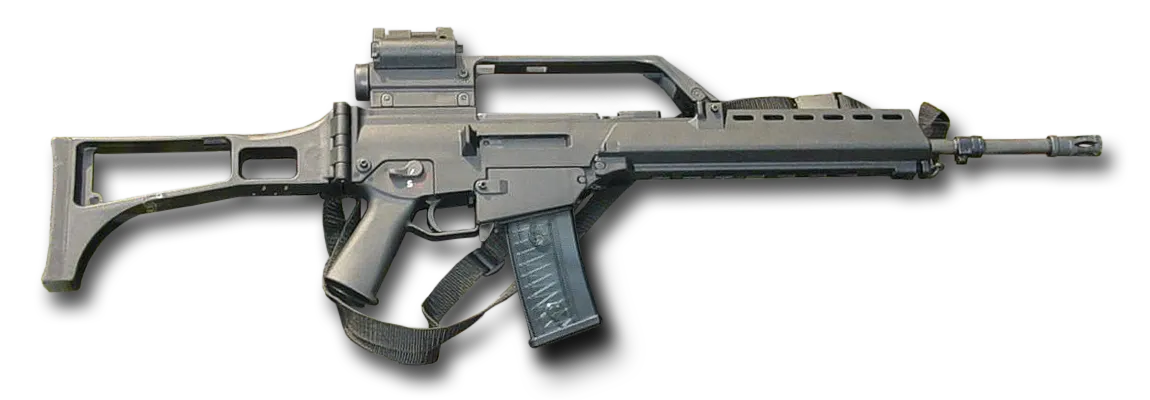

The Heckler & Koch G36 is a 5.56x45mm NATO gas-operated select-fire assault rifle that entered service with the German Bundeswehr in 1997, replacing the heavier, wood-and-steel Heckler & Koch G3 battle rifle after more than three decades. It was never supposed to exist in this form. Heckler & Koch spent most of the 1980s and early 1990s betting the company's future on the G11, a radical caseless-ammunition rifle developed for West Germany. When German reunification gutted the defense budget and a 1991 change of ownership pulled the firm toward Royal Ordnance, the G11 program collapsed, and H&K needed a conventional replacement rifle on a compressed timeline.
- Very low unloaded weight (3.63 kg) for a full-size service rifle
- Distinctive dual reflex/3x optical sight built into every rifle, no separate optics purchase needed
- Compact folding stock and modular family (G36K, G36C, MG36) share the same receiver and controls
- Simple, tool-free field strip for a conscript-heavy army
- Documented accuracy loss under sustained rapid fire once the barrel and receiver heat up
- Proprietary magazine well not compatible with STANAG-pattern magazines from other rifle families
- Not ambidextrous in its original form, ejection port and controls favor right-handed shooters
- Free-floating polymer handguard flexes under mounted accessories, affecting zero retention
That replacement, developed under the internal name Projekt 50 (HK50), became the G36. Roughly 260,000 units have been produced since 1996, and the rifle has been adopted by more than 40 countries, including Spain, Croatia, Egypt, Saudi Arabia, and Lithuania, alongside German federal police units like GSG 9. The G36 is built almost entirely from carbon-fiber-reinforced polyamide rather than steel or aluminum, which brought its unloaded weight down to 3.63 kg, well under the G3's 4.7 kg equivalent-caliber cousins and even under many rival 5.56mm rifles of the same generation.
Nowhere has the G36 generated more headlines than in Germany itself, where a decade-long political fight over its accuracy under sustained fire eventually forced the Bundeswehr to declare the rifle had "no future" in German service, even while the same weapon continued performing without major complaint in dozens of other armies. That contradiction, a rifle simultaneously deemed unfit for its home military and good enough for 40-plus export customers, is the defining story of the G36's service life and runs through every section below. The rifle also sits alongside the FN SCAR-L, the IWI Tavor X95, and H&K's own later HK416 as one of the defining post-Cold War answers to the question of what a NATO assault rifle should look like once steel-and-wood construction gave way to polymer and modularity.
The Heckler & Koch G36 uses a short-stroke gas piston system driving a rotating bolt with six radial locking lugs, a mechanism H&K carried forward almost unchanged into the later HK416 and HK433. Unlike the direct-impingement AR-15 pattern, the piston keeps combustion gases out of the receiver, which reduces fouling and was a deliberate reaction to the G11's own reliability lessons. The rifle fires from a closed bolt, feeds from 30-round detachable magazines made of translucent polymer (a small but genuinely useful feature that lets a soldier see remaining ammunition at a glance), and cycles at roughly 750 rounds per minute in automatic fire.
- İlk Üretim Yılı1995
- Hizmete Giriş Yılı1997
- TasarımcıHeckler & Koch
- Ağırlık (Boş)3,63 kg
- Halen HizmetteEvet
- Önemli Kullanıcılar40'tan fazla ülke
The Twin-Optic Carrying Handle That Defines the G36's Silhouette
The single most recognizable feature of the German-issue G36 is its integrated sighting unit, a combined 1x reflex sight stacked above a 3x magnified telescopic sight, both built into the carrying handle rather than sold as separate accessories.1 The reflex dot is meant for close, fast engagements, while the 3x scope below it covers longer shots, and a soldier switches between the two simply by raising or lowering the head rather than swapping optics. Export-pattern rifles built for customers outside Germany, badged G36V (formerly G36E), instead ship with a simpler dual-sight housing using a 1.5x fixed scope, reflecting the fact that most foreign contracts did not want to pay for the more elaborate German optic package.2 The rifle also carries conventional iron sights folded into the carrying handle as a backup, and Bundeswehr-pattern rifles keep a Picatinny-style accessory rail on later A1 through A4 revisions for night-vision and modern red-dot mounts, something the original 1997 rifle lacked.
- Fişek5.56×45mm NATO
- Çap5,56 mm
- Kovan Uzunluğu45 mm
- Çap Sınıfı5.56mm
- Kenar AteşlemeliHayır
- Kovansız MühimmatHayır
{{photo-req side=right q="Heckler Koch G36 rifle right side detail" caption="A standard G36 with its distinctive carrying-handle dual optic, translucent polymer magazine and low-profile folding stock." alt="Heckler and Koch G36 assault rifle shown from the right side"}}
- Mekanizma TipiGazlı
- Atış Modlarıseçmeli ateş
- Seçmeli AtışEvet
- Besleme SistemiÇıkarılabilir Şarjör
- Şarjör Kapasitesi30
- Tambur / Şerit Kapasitesi0
- Teorik Atış Hızı750
The carrying handle that houses that optic is also the source of one of the rifle's oldest ergonomic complaints. Reviewers have long noted that the handle sits high enough above the bore axis to force an awkward cheek weld for shooters used to a lower-mounted red dot, and the compact G36C variant compounds the problem, its shortened forend leaves little room for a conventional two-hand grip once a foregrip or light is mounted.7 The rifle is also light enough, at 3.63 kg unloaded, that it transmits more felt recoil back into the shoulder during sustained automatic fire than heavier steel-framed contemporaries, a tradeoff for the weight savings that most operators accept in exchange for easier carry.
- Namlu Çıkış Hızı920 m/sn
- Etkili Menzil (nokta)600 m
- Azami Menzil2.860 m
The G36's barrel is chrome-lined, comes in three standard lengths (480mm on the full-length rifle, 318mm on the G36K carbine, and 228mm on the compact G36C), and is genuinely free-floating, meaning it touches the receiver only at its base and never contacts the polymer handguard during firing. That free-float design is precisely what later became the center of the rifle's biggest controversy (see History below). Overall length with the folding stock extended is roughly 999mm, shrinking to about 758mm folded, short enough to stow in a vehicle or fast-rope pouch.
- Namlu Uzunluğu373 mm
- Nişangah Tipi1× büyütmeli refleks nişangah, 3× büyütmeli teleskopik nişangah (ihracat versiyonunda 1,5× büyütmeli nişangah bulunur)
- Optik RayıEvet
- Açık NişangahEvet
Muzzle velocity sits at roughly 920 m/s, giving an effective point-target range around 600 m and a maximum range near 2,860 m with the standard 5.56x45mm NATO cartridge, figures broadly in line with contemporary gas-piston operated rivals such as the Steyr AUG and the SIG SG 550. The rifle mounts a standard NATO bayonet lug and can fire rifle grenades and underslung grenade launchers such as the AG36. What the G36 does not offer is ambidextrous controls in its original configuration, the ejection port, charging handle, and magazine release all sit on the right-hand side, a limitation H&K only partially addressed in the later A3/A4 revisions with a reversible ejection port. Nor is it a bullpup design, unlike the rival Steyr AUG or the French FAMAS, keeping the magazine forward of the trigger group in a conventional rifle layout that trades compactness for a more familiar shoulder-to-hand relationship.
- Katlanır / Toplanır DipçikEvet
- Bullpup DüzeniHayır
- Çift Yönlü KumandalarHayır
- Modülerlikyüksek
- Süngü TakozuEvet
- Bombaatar KabiliyetliEvet
- Gaz PistonluEvet
- Toplam Üretim260.000
- Üretim Başlangıcı1996
- Genişlik64 mm
- Yükseklik320 mm
Heckler & Koch's original bet for the post-1990s Bundeswehr was not the G36 at all. It was the G11, a caseless-ammunition rifle firing at an extraordinarily high cyclic rate that had absorbed years of West German development money and was on the verge of adoption when the Berlin Wall fell.3 German reunification, the resulting defense budget contraction, and Heckler & Koch's 1991 acquisition by British Aerospace's Royal Ordnance subsidiary combined to kill the G11 program outright, leaving the Bundeswehr without a modern rifle and H&K without its flagship product.3 Engineers at Oberndorf began work on a conventional gas-piston 5.56mm rifle under the internal designation Project 50, or HK50, drawing on lessons from the G11 effort but abandoning caseless ammunition entirely in favor of standard NATO cartridges.1
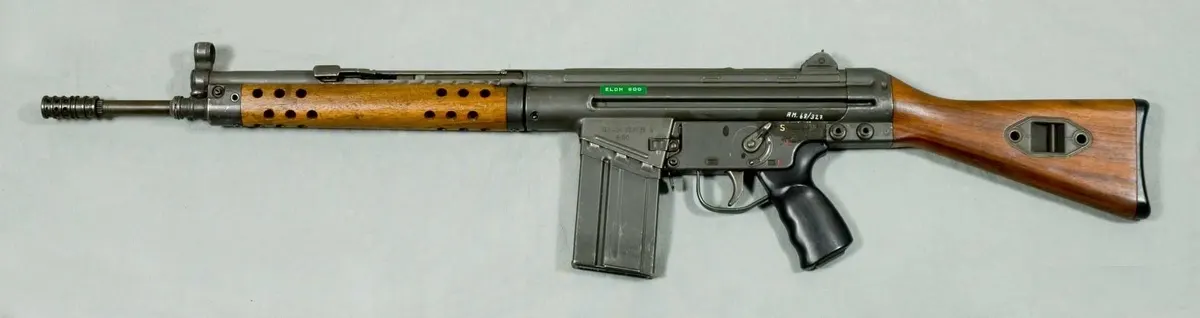
The design was finalized in 1995 and the Bundeswehr selected it later that year under the designation G36, with an initial order of roughly 33,000 rifles.4 Full-rate production began in 1996 and the rifle formally entered German service in 1997, replacing the G3 as the country's standard infantry rifle after 34 years.1 The switch from the G3's 7.62x51mm NATO round to the G36's 5.56x45mm NATO chambering matched the broader NATO shift toward lighter intermediate cartridges that had already reshaped most Western armies a generation earlier, and it let individual soldiers carry roughly twice the ammunition for the same carried weight.
Export success came quickly. Spain adopted the G36 in 1998, with Santa Bárbara Sistemas manufacturing roughly 75,219 rifles under license at the FACOR plant in Coruña, Galicia, between 1999 and 2005, one of the largest licensed-production runs the rifle ever saw outside Germany.5 Saudi Arabia followed with its own licensed line through the Military Industries Corporation, with the first Saudi-built G36 coming off the line on 30 June 2009 after a technology-transfer agreement approved the previous year.1 By the 2000s the rifle equipped Croatia's army (from around 2004), Egypt's forces (from 2003), Lithuania, Latvia, and Estonia among the newer NATO members, and specialist units as far afield as Australia and Japan.
{{photo-req side=left q="Bundeswehr soldier G36 rifle Afghanistan patrol" caption="A German Bundeswehr soldier on patrol in Afghanistan carrying a G36, the deployment that eventually exposed the rifle's accuracy problems under sustained fire." alt="German soldier carrying a G36 rifle on foot patrol"}}
The rifle's reputation, largely positive through its first decade, began to unravel after Germany committed combat troops to the War in Afghanistan. On 2 April 2010, a German airborne platoon from the Bundeswehr's Fallschirmjäger walked into a prolonged nighttime firefight with Taliban fighters near Isa Khel in Kunduz province, a battle that killed three German soldiers and left survivors reporting that their G36 rifles had grown inaccurate the longer the engagement continued.2 The claim did not become a public controversy for another two years. In April 2012, further field reports surfaced describing G36 rifles losing accuracy after several hundred rounds of sustained fire in combat in Afghanistan, with some soldiers describing rounds missing man-sized targets at ranges the rifle was rated to hit reliably.6
{{photo-req side=left q="Kunduz province Afghanistan map" caption="Kunduz province in northern Afghanistan, where the April 2010 Isa Khel firefight first exposed the G36's accuracy problems under sustained fire." alt="Map of Kunduz province Afghanistan"}}
The dispute escalated through 2014. On 22 June 2014, Germany's defense ministry froze new G36 orders worth roughly 34 million euros pending an independent investigation.2 The most damning verdict came from Germany's Fraunhofer Institute, whose 372-page technical report found that the G36's hit rate at 100 meters could collapse to as little as 7 percent once the barrel and receiver temperature rose by 30 degrees Celsius or more during sustained firing, far below the Bundeswehr's own requirement of a 90 percent hit rate at that range.2 The mechanism was thermal, not a manufacturing flaw. As the polymer receiver and free-floating barrel heated unevenly under rapid fire, the barrel's point of impact shifted enough to matter at combat ranges, a problem the original 1990s testing protocol had never been designed to catch because it did not simulate a prolonged firefight.
{{photo-req side=right q="Ursula von der Leyen German defense minister" caption="Then-defense minister Ursula von der Leyen, who announced in April 2015 that the G36 would be phased out of German service over its accuracy under sustained fire." alt="Ursula von der Leyen, former German federal minister of defense"}}
On 22 April 2015, then-defense minister Ursula von der Leyen announced that the G36 would be phased out of German service, stating publicly that the rifle "has no future in the German army in its current state of construction."2
The political fallout included a lawsuit by the German government against Heckler & Koch, which the company won in 2016 when the District Court of Koblenz ruled that the Bundeswehr's own original specifications for the rifle had never clearly defined the accuracy standard it was later judged to have failed, leaving H&K without contractual liability for the defect.4 Germany's replacement search dragged on for years afterward, briefly awarding the contract to a Haenel carbine in September 2020 before that deal collapsed over a patent dispute the following month, ultimately settling on H&K's own newer HK416, adopted as the G95A1, with fielding still ongoing into the mid-2020s.4
The G36 saw its first sustained combat use during the Kosovo War of 1998-1999, carried by early Bundeswehr contingents deploying under NATO command, one of the first times the newly adopted rifle left German soil in an active conflict zone.1 It went on to see far heavier use in the War in Afghanistan from 2001 onward, both with conventional Bundeswehr infantry and with Germany's Kommando Spezialkräfte (KSK) special forces, who adopted G36-family carbines early in the deployment and used them through years of largely classified operations before the unit suffered its first combat fatality in Baghlan province in 2013.8 It was the Afghan deployment, more than any other conflict, that produced the accuracy data eventually used against the rifle in Berlin.
{{photo-req side=right q="German KSK special forces soldier Afghanistan" caption="A Kommando Spezialkräfte operator in Afghanistan, one of the German special forces units that fielded G36-family carbines through the ISAF campaign." alt="German KSK special operations soldier equipped for an Afghanistan deployment"}}
Beyond German forces, the G36 has armed a wide range of national militaries in active conflicts. Spanish units carried it during Iraq War deployments after 2003, and Spain's Guardia Civil rapid-reaction units, including the Grupo de Acción Rápida, have used the rifle in counter-terrorism operations that trace back to the group's original mandate against ETA.9 Georgian forces fielded the G36 during the brief but intense Russo-Georgian War of August 2008, itself an escalation of the longer-running Georgian-Ossetian conflict, one of the more unusual combat tests the rifle received against a near-peer conventional opponent rather than an insurgency.
Egyptian and other North African forces carried the rifle through the unrest of the Arab Spring and the subsequent Libyan Civil War of 2011, while in Mexico, G36-family rifles have appeared in the hands of federal and military units engaged in the long-running Mexican drug war, alongside the far more numerous locally produced AR-platform rifles typical of that conflict. That spread, from a European near-peer war in Georgia to a Latin American counter-narcotics campaign, illustrates how widely the G36 traveled once export licenses started clearing in the late 1990s, well beyond the NATO-aligned buyers H&K originally expected.
The core G36 family shares a common receiver, trigger group, and gas system across every model, which is one reason the rifle proved easy to adapt for different roles without a fresh design program each time. The full-length G36 (480mm barrel) remains the baseline infantry rifle. The G36K carbine shortens the barrel to 318mm and the handguard to match, trading some muzzle velocity and range for a more maneuverable weapon suited to vehicle crews and urban patrol work.
{{photo-req side=left q="G36C compact carbine special forces" caption="The G36C compact variant, with its shortened 228mm barrel and relocated gas block, favored by close-protection and special-operations units." alt="Heckler and Koch G36C compact carbine"}}
The G36C ("Compact"), introduced in 2001, pushes the barrel down to just 228mm, forcing engineers to relocate the gas block much closer to the muzzle and shorten the piston stroke, producing a genuinely submachine-gun-sized weapon that still fires a full-power 5.56mm round, popular with close-protection and special-operations users who need concealability more than reach.1 The MG36 variant reconfigures the rifle as a squad automatic weapon with a heavier barrel intended for sustained automatic fire and a bipod, though it never achieved the widespread adoption of dedicated light machine gun designs and was eventually supplanted in most roles by purpose-built weapons.
Export-market rifles built for customers outside Germany, generically labeled G36V (previously G36E), swap the elaborate German dual reflex/3x optic for a simpler fixed 1.5x scope and use a NATO-standard bayonet mount rather than the German pattern.2 Later domestic revisions, the G36A1 through A4, incrementally added a Picatinny top rail, improved furniture, and accessory mounting points that the original 1997 rifle lacked, changes driven largely by NATO interoperability needs during the Afghanistan deployment rather than by the accuracy controversy itself. Heckler & Koch also sold a semi-automatic-only civilian derivative, the SL8, from 1998 onward, which replaced the folding stock and pistol grip with a fixed thumbhole stock to satisfy civilian firearms law and, in versions exported to the United States, was restricted to single-stack 10-round magazines instead of the military rifle's staggered box magazines.12


Roughly 40 countries have fielded the Heckler & Koch G36 in some capacity, spanning full national-army adoption, specialist police and special-forces use, and smaller demonstration or gift transfers. Germany remains the largest single operator by raw numbers, with well over 180,000 rifles in Bundeswehr and federal police inventories even as the phase-out toward the HK416-derived G95A1 continues.4 Spain operates the second-largest fleet, built almost entirely through the FACOR licensed-production line rather than direct German export.5
Among the notable current and past operators are Croatia (roughly 850 rifles from 2004), Egypt (around 608 rifles from 2003), Canada (about 100 rifles acquired in 2004, primarily for specialist units), Georgia (around 230 rifles, used in the 2008 war with Russia), and France (roughly 204 rifles from 2016, concentrated in gendarmerie intervention units).10 The rifle also equips forces in Ukraine, Serbia, Slovenia, Saudi Arabia (with its own licensed production line), Indonesia, Norway, Australia, Japan, Kosovo, and a long list of smaller operators across the Balkans, Baltic states, and Latin America. In the United Kingdom, the G36 has seen more use with police firearms units and the Special Air Service than with the wider British Army, which retained the SA80 family as its standard rifle.11 In the United States, adoption has been limited to a small number of federal and specialist law-enforcement units rather than any branch of the armed forces, reflecting the country's strong institutional preference for AR-15-pattern rifles.
The most natural comparison for the Heckler & Koch G36 is not a foreign rival but its own corporate successor, the HK416, the rifle Germany ultimately chose to replace it. Both are H&K products using variations of a short-stroke gas piston, but the HK416 borrows the AR-15's magazine well and overall ergonomics, giving it drop-in compatibility with the huge existing base of STANAG magazines and accessories that the G36's proprietary magazine system never offered. Where the G36 gambled on an all-new, radically lighter polymer architecture in the mid-1990s, the HK416 deliberately kept the AR-15's proven control layout and added the piston system mainly to fix that platform's fouling issues, a more conservative engineering choice that avoided the thermal accuracy problem entirely.
Against the Steyr AUG, a rival that reached NATO-adjacent service roughly 15 years earlier, the comparison is closer on paper than the two rifles feel in practice. The AUG's bullpup layout packs a full-length 508mm barrel and better inherent long-range accuracy into a shorter overall package than the conventional-layout G36, at the cost of ergonomics that many left-handed shooters and users switching shoulders in urban combat find awkward. The G36 trades some of that compactness-per-barrel-length efficiency for a more familiar rifle silhouette and a built-in dual optic that the base AUG does not offer.
| Spec | G36 | HK416 | Steyr AUG |
|---|---|---|---|
| Weight (empty) | 3.63 kg | ~3.5-3.7 kg (variant-dependent) | ~3.6 kg |
| Barrel length | 480 mm | Variant-dependent (11-20 in) | 508 mm (standard) |
| Cartridge | 5.56x45mm NATO | 5.56x45mm NATO | 5.56x45mm NATO |
| Magazine compatibility | Proprietary | STANAG-compatible | STANAG-compatible |
| Layout | Conventional | Conventional | Bullpup |
Every number in that table needs the same caveat that runs through this whole article. On paper the G36 is competitive with both rivals across weight, barrel length, and ballistics. What separates it in practice is the accuracy-under-heat problem documented by Germany's own Fraunhofer testing, a failure mode neither the HK416 nor the AUG has been shown to share at anything like the same severity, and a factor no static spec sheet comparison captures.


Is the Heckler & Koch G36 still in service? Yes, in most of its roughly 40 operator countries. Germany itself is actively phasing the rifle out in favor of the HK416-based G95A1, but that replacement program is still ongoing into the mid-2020s, and the G36 remains Germany's standard-issue rifle for many units in the meantime.4
What caliber does the G36 use? The G36 is chambered in 5.56x45mm NATO, the standard intermediate rifle cartridge used across NATO member militaries, fed from 30-round detachable box magazines.1
What caused the G36 accuracy problems? Independent German testing found that the rifle's free-floating barrel and largely polymer receiver shift point of impact as they heat up during sustained rapid fire, with hit rates at 100 meters falling as low as 7 percent once internal temperatures rose 30 degrees Celsius or more above baseline.2
How much does a G36 cost? Heckler & Koch has not published a standard per-unit price, and the rifle was never sold on the open commercial market the way some AR-15-pattern rifles are, so unit cost figures vary heavily by contract volume and included accessories.
What replaced the G36 in German service? The Bundeswehr selected H&K's own HK416 platform, adopted under the designation G95A1 (and the shorter-barreled G95KA1), after an earlier 2020 contract award to a Haenel-made carbine collapsed over a patent dispute.4
Is the G36 compatible with M16/AR-15 magazines? No. The G36 uses a proprietary magazine design with its own coupling-lug system for linking magazines together, and it is not compatible with the STANAG magazines used by AR-15-pattern rifles or many other NATO service rifles.1
- "Heckler & Koch G36", Wikipedia — en.wikipedia.org ↩
- "Revealed: What Made Heckler & Koch's G36 Rifle Selectively Terrible", The National Interest — nationalinterest.org ↩
- "The Heckler and Koch G36 Rifle: Wonder Weapon or Paper Tiger?", The National Interest — nationalinterest.org ↩
- "The German Military Is Replacing the H&K G36 With a Haenel Carbine", The National Interest — nationalinterest.org ↩
- "Heckler & Koch G36", Grokipedia — grokipedia.com ↩
- "Germany's Awful Battle Rifle Causes a Political Crisis", War Is Boring (Medium) — medium.com ↩
- "Heckler & Koch G36: The Rifle Held In All the Wrong Places", DefenceTalk — defencetalk.com ↩
- "Kommando Spezialkräfte", Wikipedia — en.wikipedia.org ↩
- "Grupo de Acción Rápida", Wikipedia — en.wikipedia.org ↩
- "Take a rare glimpse inside France's anti-ISIS unit", NBC News — nbcnews.com ↩
- "Heckler & Koch G36", Internet Movie Firearms Database — imfdb.org ↩
- "Heckler & Koch SL8", Wikipedia — en.wikipedia.org ↩