

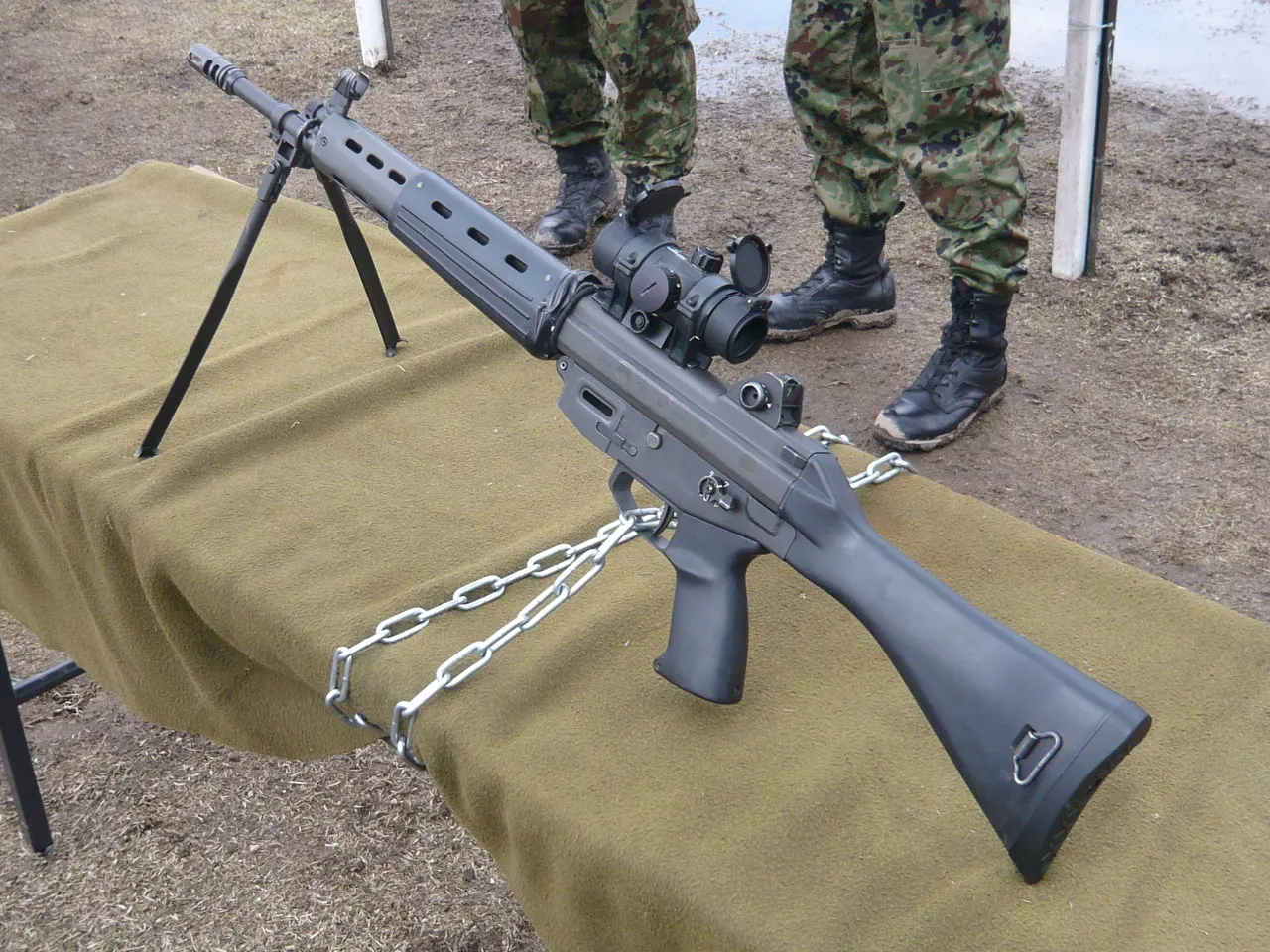

The Howa Type 89 has been the standard 5.56mm service rifle of the Japan Ground Self-Defense Force since 1989, yet it still shares the ranks with the older Howa Type 64 it was supposed to fully replace.1 Howa Machinery built roughly 100,000 examples over three and a half decades of production, a total that never reached the number needed to arm the entire JGSDF, so the 7.62mm Type 64 stayed in reserve and second-line units for years longer than planners originally intended.2 The rifle fires the 5.56×45mm NATO cartridge and is gas-operated with a rotating bolt drawn from the short-stroke gas-piston-operated system of the Armalite AR-18, a rifle Howa already had a commercial license to build before the Type 89 program began.3
- AR-18-derived short-stroke piston, reliable in sand and cold
- light aluminum/polymer build cuts soldier fatigue vs the Type 64
- integral folding bipod standard on every rifle
- folding-stock Type 89-F variant for paratroopers and vehicle crews
- never received an ambidextrous selector or a beveled magazine well
- production run insufficient to fully retire the Type 64
- unit cost stayed well above Japan's own target price for decades
- never exported, so no outside spares base or combat feedback loop
Japan's own arms-export law is the reason the Type 89 has spent its whole service life inside a single country's inventory. Successive versions of the Three Principles on Arms Exports, tightened into a near-total ban in 1976, blocked the sale of any Japanese-designed weapon abroad long before the Type 89 was even drawn up, and no rifle developed after that policy has ever been sold to a foreign customer.4 The restriction has loosened gradually since 2014 and again in 2023, but the changes so far cover finished equipment in categories such as rescue, transport, and surveillance rather than infantry small arms, so a Type 89 export sale remains a hypothetical rather than a real possibility even as Japan continues easing its arms-export posture.5
{{photo-req side=right q="JGSDF soldier Type 89 rifle training exercise" caption="A Japan Ground Self-Defense Force soldier training with the Howa Type 89, the JGSDF's standard rifle since 1989." alt="JGSDF soldier holding a Howa Type 89 rifle during a training exercise"}}
The Type 89 belongs to the broader family of assault rifles fielded across NATO-aligned militaries from the late Cold War onward, chambered for the same 5.56mm SS109/M855-compatible ammunition as the American M16 and its many contemporaries.6 What follows covers the rifle's design in more depth, the political and industrial background of its adoption, its one confirmed brush with a live combat deployment in Iraq, its folding-stock and modernization variants, and how it stacks up against a comparable Cold War era Asian service rifle, the South Korean Daewoo Precision Industries K2.
An AR-18-Derived Gas Piston Without the AR-18's Dual Springs
Howa's engineers built the Type 89 around the same short-stroke gas piston and rotating bolt used in the Armalite AR-18, a design the company already understood well from its own AR-18 production license, but they left out the AR-18's twin recoil springs.3 The rifle weighs 3.5 kg empty, measures 916mm overall with the fixed stock extended, and carries a 420mm barrel that pushes a 4-gram 5.56mm bullet to roughly 920 m/s, giving a quoted effective range of about 500 m.7 Ammunition feeds from a detachable magazine, a 20 or 30-round STANAG-pattern box interchangeable with M16-family magazines, and the cyclic rate of fire runs around 750 rounds per minute.8
- İlk Üretim Yılı1989
- Hizmete Giriş Yılı1989
- Ağırlık (Boş)3,5 kg
- Halen HizmetteEvet
The select-fire control group runs the three-round burst through a separate mechanism rather than gearing it off the standard trigger parts, a choice that adds mechanical complexity but keeps the burst function isolated from full-auto reliability.9 Two details drew persistent criticism from Japanese and foreign observers alike. The magazine well was never beveled or tapered the way the M16's is, making a fast reload noticeably harder under stress, and the JGSDF never fitted an ambidextrous selector switch despite decades of opportunity to do so during Type 89 production.10 The dedicated magazines also carry side inspection holes that let a soldier see the round count at a glance, a feature that doubles as a way for sand and grit to work into the action in the field.10
- Fişek5.56×45mm NATO
- Çap5,56 mm
- Kovan Uzunluğu44,7 mm
- Çap Sınıfıorta güçlü
- Mermi Ağırlığı4 g
- Kenar AteşlemeliHayır
- Kovansız MühimmatHayır
Bayonet, Grenade Launching, and the Integral Bipod
{{photo-req side=left q="Howa Type 89 rifle bayonet fixed" caption="The Type 89's dedicated bayonet, roughly two-thirds the length of the Type 64's, doubles as a wire cutter when paired with its scabbard." alt="Close-up of a Howa Type 89 rifle with bayonet attached"}}
- Mekanizma TipiGazlı
- Atış Modlarıseçmeli ateş
- Seçmeli AtışEvet
- Besleme SistemiÇıkarılabilir Şarjör
- Şarjör Kapasitesi20
- Teorik Atış Hızı750
The Type 89's own bayonet is about two-thirds the length of the Type 64's older blade, and it doubles as a wire cutter when locked against its scabbard, while the scabbard's tip works as a bottle opener, a small but genuine field convenience.10 The muzzle can launch the Type 06 rifle grenade directly without any add-on launcher, though the rifle cannot mount a conventional underbarrel grenade launcher the way many Western 5.56mm rifles of the same period could.11 Every Type 89 also carries an integral bipod as standard equipment, removable with a simple clothes-pin-style spring clip, at a time when many contemporary NATO-pattern rifles had already dropped a fixed bipod in favor of accessory rails.9 The rifle carries iron sights as standard and has since been fitted with an optic rail for red dot sights on rifles issued to units with a realistic chance of combat.12
- Namlu Çıkış Hızı920 m/sn
- Etkili Menzil (nokta)500 m
- Namlu Uzunluğu420 mm
- Nişangah TipiDemir nişangah; optik nişangah
- Optik RayıEvet
- Açık NişangahEvet
- Kabza/Dipçik Malzemesipolimer
- Katlanır / Toplanır DipçikEvet
- Bullpup DüzeniHayır
- Modülerlikray sistemli ve teleskopik dipçikli ACIES karabina varyantı
- Entegre BipodEvet
- Gaz PistonluEvet
- Üretim Başlangıcı1989
- Birim Maliyet2.600 USD
From the AR-18 Production License to the HR-16 Prototype
Howa's route into the Type 89 program began with the company's own commercial license to build the Armalite AR-180, the semi-automatic civilian cousin of the AR-18, giving Howa's engineers direct hands-on experience with the action the Defense Agency's Technical Research and Development Institute eventually chose to base a new Japanese service rifle on.3 Through the 1980s Howa and the Defense Agency ran a sequence of prototypes, designated HR-10, HR-11, HR-13, and HR-15, before the JGSDF settled on the HR-16 configuration and formally adopted it as the Type 89 in 1989.13
{{photo-req side=right q="Howa Machinery Nagoya factory manufacturing plant" caption="Howa Machinery's Nagoya plant, where Type 89 production has run since the rifle's 1989 adoption." alt="Exterior or production floor of Howa Machinery's Nagoya manufacturing plant"}}
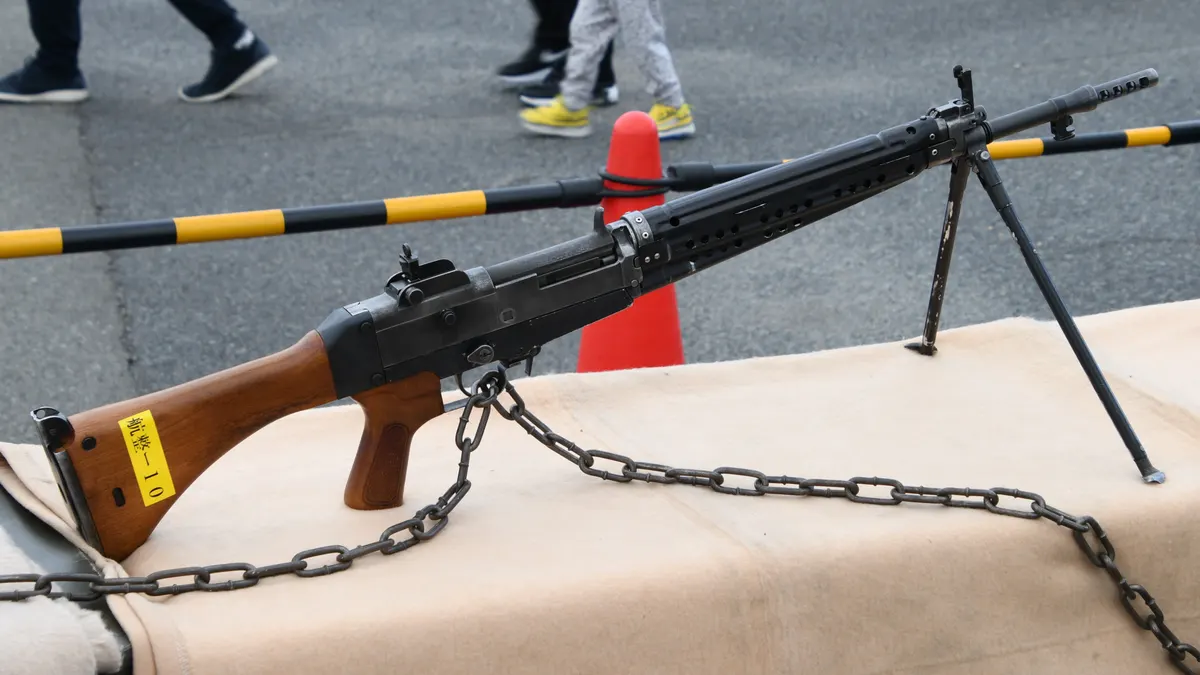
The new rifle replaced the Type 64 in frontline units, cutting the weight a soldier carried for a given amount of ammunition and speeding up handling thanks to aluminum and thermoset-plastic construction in place of the Type 64's steel and wood.1
The 2004 Iraq Deployment and a Rifle Modified for Real Combat Risk
{{photo-req side=left q="Samawah Muthanna province Iraq map" caption="Samawah, in Iraq's Muthanna province, where the Japan Iraq Reconstruction and Support Group was based from 2004 to 2006." alt="Map showing Samawah and Muthanna province in southern Iraq"}}
Around 2003, ahead of sending Japanese Ground Self-Defense Force personnel into Iraq, Howa and the Defense Agency modified a batch of Type 89s issued to the deployed troops, adding a left-side selector switch for ambidextrous use, a mounting bracket and an unmagnified red dot sight, a removable foregrip, and a 25mm Weaver rail under the handguard.14 The Japan Iraq Reconstruction and Support Group, roughly 5,500 personnel over the course of the mission, deployed to Samawah in southern Iraq from January 2004 to 2006 to run water purification, reconstruction, and public-facility repair work under a 2003 special law authorizing the mission, carrying the Type 89 for self-defense only under rules of engagement that barred any offensive use.15
The foregrip attachment was later restricted after it was found to damage the rifle's handguard, and most of the Iraq-specific modifications, including the ambidextrous selector, were reverted once the deployed units returned home, so the standard-issue Type 89 in JGSDF service today looks much like it did before 2003.14 No Japanese unit fired the Type 89 in anger during the deployment, and the mission remains, by design, the closest the rifle has come to combat.
A Rifle That Never Got Cheap
The Type 89 cost roughly 435,000 yen per unit at the start of production in 1989, about half the Type 64's 870,000 yen price, and the figure fell to around 347,000 yen by 1998 and roughly 325,800 to 340,000 yen by fiscal year 2005 as production matured.16 Costs bottomed out near 280,000 yen around 2008 before climbing back to about 320,000 yen by 2018 as annual procurement volumes shrank, a cost curve the Japanese government itself has repeatedly flagged as too high against its own ideal small-arms production price of 10,000 to 100,000 yen per rifle.16 That persistent cost problem, more than any single design flaw, is the main reason the Defense Agency began developing a successor rather than simply keeping the Type 89 in production indefinitely.17
Iraq War
The Type 89's only confirmed link to an active conflict zone is the JGSDF's 2004 to 2006 humanitarian and reconstruction deployment to Samawah during the Iraq War, where Japanese personnel carried the rifle for personal and unit self-defense rather than combat operations.15 Japan's Self-Defense Forces did not engage in offensive combat during the mission, and no confirmed instance exists of a Type 89 being fired at a hostile target during the deployment, a reflection of the strict rules of engagement Tokyo imposed on the mission from the outset.15
{{photo-req side=right q="Japan Ground Self-Defense Force Samawah Iraq reconstruction 2004" caption="Japan Ground Self-Defense Force personnel during the 2004-2006 Samawah reconstruction mission in southern Iraq." alt="JGSDF personnel at their base in Samawah, Iraq during the reconstruction mission"}}
The Type 89-F Folding-Stock "Para" Variant
{{photo-req side=left q="JGSDF paratrooper 1st Airborne Brigade Type 89" caption="A JGSDF 1st Airborne Brigade paratrooper, one of the units issued the folding-stock Type 89-F variant." alt="JGSDF paratrooper equipped with a folding-stock rifle"}}
The folding-collapsing stock Type 89-F, nicknamed the "Para," swaps the standard rifle's fixed polymer stock for a steel tube stock that folds to the left side so it clears the safety selector on the right.18 Folded, the Type 89-F shrinks to 670mm, and the variant is issued to the 1st Airborne Brigade's paratroopers, tank and armored-vehicle crews, and reconnaissance and armored-infantry soldiers who need a compact rifle in confined spaces.18 For JGSDF tank crews specifically, the Type 89-F directly replaced the M3A1 submachine gun that had served as their close-defense weapon for decades, giving armor crews a rifle firing the same cartridge and using the same magazines as the rest of the infantry around them.18
The Experimental ACIES Rail and Carbine Program
Howa and the Defense Agency also built a modernized Type 89 under the Advanced Combat Infantry Equipment System, or ACIES, program, fitting a four-sided rail system and a polymer retractable stock onto both a full-length rifle (about 940mm) and a shortened carbine configuration (about 800mm) with a cut-down barrel.19 A later ACIES iteration added an underbarrel digital interface connected to a foregrip and an oversized top-mounted sighting system for corner-shooting use, but the program stalled without ever reaching general JGSDF issue, overtaken by fiscal constraints and by the parallel development of the Howa Type 20.19
The Defense Agency announced plans for a Type 89 successor in December 2019, and the JGSDF adopted the resulting Howa Type 20 in small numbers starting in 2020, intended to gradually supplement and eventually replace the Type 89 rather than swap it out overnight.20 The Type 20 keeps the same 5.56mm chambering but adds a fully modular rail system, an adjustable-length stock, and improved ergonomics that address several of the Type 89's longest-standing criticisms, including the lack of an ambidextrous selector.21 Because the Type 20 is covered as its own separate entry in this archive, this article treats it only as context for where the Type 89 program has ended up, not as a full account of its design.

Japan Ground Self-Defense Force, Coast Guard, and Police Units
{{photo-req side=right q="Japan Coast Guard Special Security Team boarding team" caption="A Japan Coast Guard Special Security Team, one of the domestic units outside the JGSDF that carries the Type 89 for maritime counter-terrorism duties." alt="Japan Coast Guard Special Security Team personnel"}}
Japan remains the Type 89's only operator, a direct result of the export restrictions described in Overview above.4 Within Japan, the rifle sees service beyond the JGSDF proper. The Japan Coast Guard's Special Security Team carries the Type 89 for maritime counter-terrorism work, and the National Police Agency's Special Assault Team has fielded small numbers for domestic counter-terrorism operations, alongside the JGSDF's own frontline and reserve infantry units.22
With around 100,000 rifles built against a force the size of the JGSDF, the Type 89 never fully displaced the older Type 64 from reserve and second-line units, so a soldier's exact rifle model can still depend on which unit they serve in even decades into Type 89 production.2
The Howa Type 89 vs the Daewoo K2, Two Cold War Asian Rifles With Opposite Export Paths
South Korea's Daewoo Precision Industries K2 and Japan's Type 89 solved a nearly identical late Cold War procurement problem, replacing an aging American-pattern service rifle with an indigenously engineered 5.56mm design, within four years of each other (the K2 adopted in 1985, the Type 89 in 1989).23 The two rifles then took opposite paths outside their home militaries. South Korea exported the K2 to Indonesia, Peru, and several other buyers, and Indonesia's own state arms maker eventually built related rifles under license, while Japan's export law kept every Type 89 inside Japanese government hands with zero foreign sales or license production of any kind.24 Mechanically the two are close cousins of the AR-15/AK design tradition. The K2 borrows its rotating bolt and carrier arrangement loosely from the AR-15 while using an AK-style long-stroke piston, whereas the Type 89 runs the AR-18's short-stroke piston system, giving both rifles a piston-driven action that trades some of the AR-15's raw accuracy potential for tolerance to sand, mud, and heat.
| Howa Type 89 | Daewoo K2 | |
|---|---|---|
| Adopted | 1989 | 1985 |
| Weight (empty) | 3.5 kg | 3.3 kg |
| Cartridge | 5.56×45mm NATO | 5.56×45mm NATO |
| Stock | Fixed (Type 89-F folds) | Folding/adjustable |
| Export status | Never exported | Exported to Indonesia, Peru, others |
The K2's folding stock is standard equipment on every rifle rather than reserved for a separate "Para" model the way the Type 89-F is, reflecting South Korea's greater emphasis on rifle commonality across roles versus Japan's split between a fixed-stock general-issue rifle and a folding-stock variant for paratroopers and vehicle crews.


What caliber does the Howa Type 89 fire? The Type 89 chambers the 5.56×45mm NATO cartridge and is compatible with standard NATO SS109/M855-pattern ammunition, the same round used by the American M16 and most other 5.56mm NATO-aligned service rifles.6
Is the Howa Type 89 still in service? Yes. It remains the JGSDF's standard-issue rifle in 2026, though small numbers of the newer Howa Type 20 have entered service since 2020 as a gradual, partial replacement, and older Type 64 rifles still equip some reserve units.20
Has the Howa Type 89 ever been exported? No. Japan's arms-export restrictions, tightened into a near-total ban in 1976 and only partially eased since 2014, have kept the Type 89 exclusively inside Japanese government service for its entire production run.4
How much does a Howa Type 89 cost? Unit cost has run from about 435,000 yen at the start of production in 1989 down to roughly 280,000 yen around 2008 and back up to about 320,000 yen by 2018, consistently above the level the Japanese government considers ideal for a general-issue service rifle.16
How does the Howa Type 89 compare to the M16? Both fire the same 5.56×45mm NATO family of ammunition and use similar STANAG magazines, but the Type 89 runs an AR-18-derived short-stroke gas piston rather than the M16's direct-impingement system, giving it a reputation for better tolerance of sand and fouling at the cost of a heavier action.3
Has the Type 89 seen combat? Not in any confirmed offensive engagement. JGSDF personnel carried the Type 89 during the 2004 to 2006 Samawah reconstruction mission in the Iraq War under strict self-defense-only rules of engagement, and no source confirms the rifle being fired at a hostile target during that deployment.15
- "Howa Type 89", Wikipedia — en.wikipedia.org ↩
- "The Japanese Army's Assault Rifle Has Some Weird Features", War Is Boring (Medium) — medium.com ↩
- "Howa Type 89", Forgotten Weapons — forgottenweapons.com ↩
- "Japanese arms-export ban", Wikipedia — en.wikipedia.org ↩
- "In major policy shift, Japan scraps limits on lethal arms exports", The Japan Times — japantimes.co.jp ↩
- "Howa Type 89: Meet the Assault Rifle of Japan's Self-Defense Forces", 19FortyFive — 19fortyfive.com ↩
- "Howa Type 89", Wikipedia — en.wikipedia.org ↩
- "Howa Type 89", Wikipedia — en.wikipedia.org ↩
- "The Japanese Army's Assault Rifle Has Some Weird Features", War Is Boring (Medium) — medium.com ↩
- "The Japanese Army's Assault Rifle Has Some Weird Features", War Is Boring (Medium) — medium.com ↩
- "Type 89 - Assault rifle", GlobalMilitary — globalmilitary.net ↩
- "Weapons of the JGSDF", Small Arms Defense Journal — sadefensejournal.com ↩
- "Company History", Howa Machinery — howa.co.jp ↩
- "Weapons of the JGSDF", Small Arms Defense Journal — sadefensejournal.com ↩
- "Howa Type 89", Wikipedia — en.wikipedia.org ↩
- "Howa Type 89", Wikipedia — en.wikipedia.org ↩
- "First Look: Japan's New Type 20 Rifle", The Firearm Blog — thefirearmblog.com ↩
- "Weapons of the JGSDF", Small Arms Defense Journal — sadefensejournal.com ↩
- "Howa Type 89", Wikipedia — en.wikipedia.org ↩
- "Japanese Army Picks New HK VP9, Howa Rifle Variants", Guns.com — guns.com ↩
- "Howa Type 20", Wikipedia — en.wikipedia.org ↩
- "Howa Type 89", Wikipedia — en.wikipedia.org ↩
- "Daewoo Precision Industries K2", Wikipedia — en.wikipedia.org ↩
- "Daewoo Precision Industries K2", Wikipedia — en.wikipedia.org ↩