

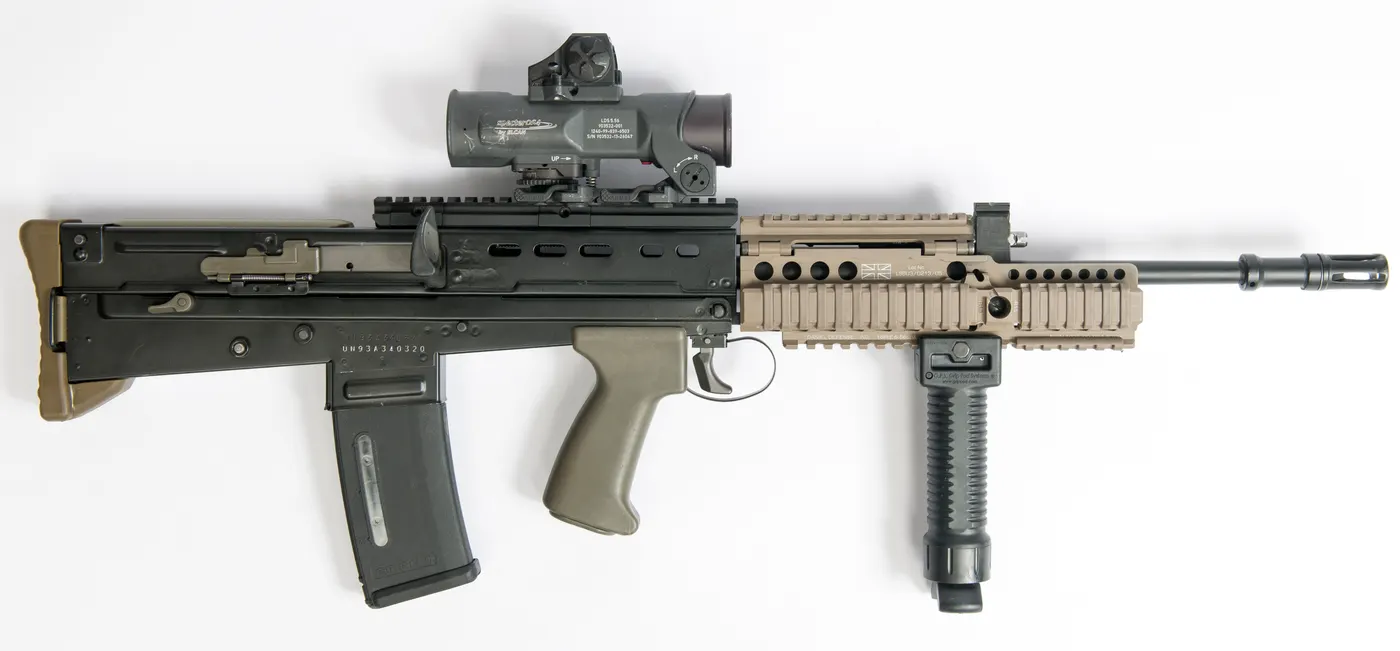
The SA80 is a British bullpup family of infantry weapons built around the assault rifles designation L85 and the light support weapon variant L86, adopted by the British Army in 1985. It replaced the L1A1 self-loading rifle as the standard individual weapon and became one of the most publicly scrutinized small arms programs of the late Cold War, its concept sound but its first decade of production badly executed. Chambered in 5.56×45mm NATO, fed from a 30-round detachable magazine, the rifle uses a gas-operated, gas-piston short-stroke action derived loosely from the American ArmaLite AR-18 and the South African R4/SAR-87 family rather than from any earlier British design.
- compact bullpup length for full-length barrel
- post-A2 reliability rated among the best in its class
- ambidextrous-friendly ergonomics after A2/A3 updates
- integrated SUSAT optic simplified training
- modular rail space for modern sights and lights on A3
- catastrophic early (A1-era) reliability record
- right-hand-only ejection, awkward for left-handed shooters
- heavier than most 5.56mm rivals for its era
- underslung magazine release originally lacked a guard
- extremely expensive multi-decade fix and upgrade program
Roughly 350,000 units were produced between 1985 and 1994 at the Royal Small Arms Factory in Enfield Lock and later at Royal Ordnance's Nottingham plant, the successor to which, BAE Systems, still supports the type today. The rifle is short for its class at just under a metre overall, a direct consequence of its bullpup layout, which places the action and magazine behind the trigger group rather than ahead of it. That layout let the British Army field a full-length 518mm barrel in a package barely longer than many carbines, but it also concentrated nearly every early manufacturing defect right beside the firer's face, which is part of why the rifle's troubled first years became so widely reported.
The L85A1 entered troops' hands with severe problems. The L85A2 upgrade, executed by Heckler & Koch in the early 2000s, is widely credited with turning the design around, and the further-modernized L85A3 remains in British service into the 2020s even as the Ministry of Defence runs a formal replacement competition. Ukraine has also become associated with the rifle, though mainly through UK-based training rather than combat issue. This article covers the SA80's design, its documented failures and fixes, its combat record from the Gulf War onward, and how it compares with contemporaries such as the Steyr AUG.
The L85 individual weapon weighs 3.82 kg empty and about 4.98 kg loaded, noticeably heavier than most other NATO 5.56mm rifles of its generation despite its short overall length. Muzzle velocity is rated around 935 m/s, generating roughly 1,700 joules of muzzle energy, with an effective point-target range near 400 m and area-fire effectiveness out to about 600 m, figures broadly comparable to the M16-family rifles it was designed to rival.1 The action cycles at a theoretical 610 rounds per minute, though practical sustained fire is far lower, and it offers select-fire between single shot, three-round burst (later dropped on some builds in favor of simple semi/full-auto selection) and full automatic.2
- İlk Üretim Yılı1985
- Hizmete Giriş Yılı1985
- TasarımcıRoyal Small Arms Factory
- Ağırlık (Boş)3,82 kg
- Ağırlık (Yüklü)4,98 kg
- Halen HizmetteEvet
- Önemli Kullanıcılarİngiliz Ordusu, Bermuda Kraliyet Alayı, Falkland Adaları Savunma Kuvvetleri, Cebelitarık Kraliyet Alayı, Ukrayna kuvvetleri
Every early-production L85 shared the same core bullpup architecture. The trigger group sits well forward of the bolt carrier, and the magazine well and ejection port are both fixed on the right side of the receiver, a decision inherited from the weapon's origin as a rebuild of the American AR-18 design study conducted at Enfield in the 1970s.3 That fixed right-side ejection makes the rifle genuinely difficult to fire from the left shoulder, since hot brass ejects directly across a left-handed shooter's face, a limitation the British Army worked around operationally rather than fixing mechanically, generally by training left-handed soldiers to shoot right-handed or issuing them different weapons.4
- Fişek5.56×45mm NATO
- Çap5,56 mm
- Kovan Uzunluğu44,7 mm
- Çap Sınıfıorta güçlü
- Mermi Ağırlığı4 g
- Kenar AteşlemeliHayır
- Kovansız MühimmatHayır
{{photo-req side=left q="SUSAT sight L85 rifle close-up" caption="The SUSAT (Sight Unit Small Arms, Trilux) telescopic sight fitted as standard on the L85, an unusual choice for a Western service rifle of the mid-1980s." alt="Close-up of the SUSAT telescopic sight mounted on an L85 rifle"}}
- Mekanizma TipiGazlı
- Atış Modlarıtekli, seri, otomatik
- Seçmeli AtışEvet
- Besleme SistemiÇıkarılabilir Şarjör
- Şarjör Kapasitesi30
- Teorik Atış Hızı610
- Pratik Atış Hızı100
- Tetik Tipitek kademeli
- Emniyet Tipiseçici kol
The standard optic is the SUSAT (Sight Unit Small Arms, Trilux), a fixed 4x telescopic sight with a tritium-illuminated reticle for low-light aiming, integrated onto the carrying handle from the outset, an unusual choice for a Western rifle of its era when most NATO forces still issued iron sights as standard.3 Later Picatinny-rail equipped variants also mount ACOG and ELCAN LDS optics, and the weapon retains folding iron sights as backup. The rifle is ambidextrous in its selector and magazine release placement even though the ejection port itself is not, and it accepts an underslung 40mm grenade launcher and a bayonet lug for the standard British bayonet.2
- Namlu Çıkış Hızı935 m/sn
- Namlu Enerjisi1.700
- Etkili Menzil (nokta)400 m
- Etkili Menzil (alan)600 m
- Azami Menzil3.600 m
- Nişan Menzili400 m
- Delme (Penetrasyon)8 mm
- İsabet1,5
The Aluminium Magazine and the Snow-Compaction Fault
Two specific, well-documented mechanical faults defined the L85A1's reputation. The original magazine body was aluminium rather than steel, which flexed under rough handling and let its feed lips distort, producing misfeeds that steel-bodied AR-15-pattern magazines used by NATO allies did not suffer to the same degree.5 Separately, the trigger blade's flat rear face was found to compact packed snow behind it during Arctic and cold-weather trials, physically preventing the trigger from traveling far enough rearward to release the sear, a fault that was eventually fixed simply by re-profiling the blade into a wedge shape that could cut through compacted snow rather than trap it.5 The magazine release catch also originally had no protective guard, so magazines would sometimes drop free simply from the rifle knocking against a soldier's webbing or vehicle interior during normal movement.6
- Namlu Uzunluğu518 mm
- Yiv Adımı1:7
- Yiv Sayısı6
- Nişangah TipiTeleskopik SUSAT, ACOG ve ELCAN LDS dürbünler, dioptrik mekanik nişangah
- Nişangah Mesafesi450 mm
- Optik RayıEvet
- Açık NişangahEvet
- Dişli NamluHayır
- Gövde Malzemesi (Receiver)Çelik
- Kabza/Dipçik Malzemesipolimer
- Katlanır / Toplanır DipçikHayır
- Bullpup DüzeniEvet
- Çift Yönlü KumandalarEvet
- Modülerliknamlu altı bombaatar uyumlu
- Susturucuya HazırHayır
- Süngü TakozuEvet
- Entegre BipodHayır
- Bombaatar KabiliyetliEvet
- Gaz PistonluEvet
- Toplam Üretim350.000
- Üretim Başlangıcı1985
- Üretim Bitişi1994
- Birim Maliyet1.300 USD
- Varyantlar4
- Genişlik70 mm
- Yükseklik250 mm
Development traces back to Cold War-era work at the Royal Small Arms Factory, Enfield Lock, where engineers began experimenting in 1969 with a new intermediate rifle cartridge, the 4.85×49mm, intended to give British infantry a lighter, more controllable round than the existing 7.62×51mm NATO battle rifle cartridge.9 Prototype weapons built around that cartridge, initially bullpup conversions of the American AR-18 and the Stoner 63 system, evolved through the 1970s into the XL64/XL65 family, the direct ancestors of the L85 and L86.9
{{photo-req side=right q="Royal Small Arms Factory Enfield Lock building" caption="The Royal Small Arms Factory at Enfield Lock, where SA80 development and early production took place before manufacturing moved to Nottingham." alt="Historic Royal Small Arms Factory building at Enfield Lock"}}
{{photo-req side=left q="map NATO member states Cold War Europe 1980s" caption="NATO's 1977 cartridge-standardization trials, which rejected Britain's 4.85mm proposal in favor of 5.56mm, forced Enfield to rechamber the nearly finished SA80 family before it reached troops." alt="Map showing NATO member states in Europe during the Cold War"}}
NATO's 1977 trials to standardize a second rifle cartridge alongside 7.62mm ultimately selected the Belgian SS109 loading of the existing 5.56×45mm round rather than Britain's 4.85mm proposal, forcing Enfield's engineers to rechamber their nearly finished rifle family for 5.56mm NATO before it could enter production.9 The L85A1 individual weapon and L86A1 light support weapon were formally adopted in 1985 under the Small Arms for the 1980s program, from which the SA80 designation derives, replacing the 7.62mm L1A1 self-loading rifle across the British Army.10
Total program development and remediation costs eventually reached roughly £500 million over about fourteen years, according to a Ministry of Defence disclosure to Parliament, a figure that made the SA80 one of the most expensive small-arms programs in British military history relative to the size of the force it equipped.11 Early production quality was poor enough that it became a recurring subject of Parliamentary questions and defense press coverage through the late 1980s and into the 1990s, with soldiers in cold-weather NATO exercises in Norway and Gulf War desert conditions both reporting stoppages that a standard-issue combat rifle should not have exhibited.6
Manufacturing quality improved somewhat once production consolidated at the new Royal Ordnance facility in Nottingham after the Enfield Lock factory closed in the late 1980s, but the fundamental design faults in the bolt, extractor, firing pin, and magazine catalogued by 1990 were not properly addressed until a dedicated fix program more than a decade later.6 That program, contracted to the German manufacturer Heckler & Koch (which by then owned the former Royal Ordnance small arms manufacturing rights), converted roughly 200,000 L85A1 rifles to the improved L85A2 standard at a cost of about £400 per rifle, with conversions running from 2000 through completion in February 2006.12 The upgrade replaced the cocking handle, bolt, extractor and hammer assembly, and the Ministry of Defence subsequently described the L85A2 as the most reliable weapon of its type in the world, backed by trial results showing a mean of roughly 25,200 rounds between stoppages for the L85A2 and 12,897 rounds for the L86A2 light support weapon.12
{{photo-req side=right q="General Patrick Sanders Chief of the General Staff Ukrainian training" caption="General Sir Patrick Sanders, Chief of the General Staff, visited British-run training for Ukrainian troops in 2022, imagery that featured British instructors carrying SA80-family rifles." alt="Senior British Army officer visiting a Ukrainian troop training exercise in the UK"}}
The L85A1 saw its first major combat test in the 1991 Gulf War, where reliability problems that had been visible in training exercises translated directly into battlefield complaints. A Special Air Service sergeant later described the SA80s issued to his unit as poor-quality, unreliable weapons at the best of times, prone to stoppages, a characterization widely repeated in subsequent British press coverage of the program's failures.8 Sand ingress compounded the lubrication problem in the desert environment, and several units reportedly favored captured or alternate weapons where practical.8
{{photo-req side=right q="British Army soldier Gulf War 1991 desert rifle" caption="A British soldier during the 1991 Gulf War, the conflict where the L85A1's early reliability problems first drew wide public attention." alt="British Army infantry soldier in desert combat gear during the Gulf War"}}
The rifle was also issued during the 1998-1999 Kosovo War and, more consequentially for its reputation, during British intervention in the Sierra Leone Civil War around 2000, including Operation Palliser and the SAS-led hostage-rescue raid known as Operation Barras.7 Pathfinder Platoon soldiers operating in Sierra Leone's heat and humidity found that plastic safety-catch components swelled and jammed weapons in the safe position, one of several environment-specific faults that fed directly into the case for a comprehensive fix rather than incremental patches.7
{{photo-req side=left q="Freetown Sierra Leone West Africa map" caption="Sierra Leone, where the 2000 Operation Barras hostage-rescue raid and the wider British intervention exposed several environment-specific SA80 faults, including safety catches that swelled shut in humid heat." alt="Map of Sierra Leone and the surrounding West African coast"}}
By the time of the War in Afghanistan that began in late 2001, the improved L85A2 was rushed into frontline issue ahead of its planned introduction date specifically because commanders wanted the more reliable rifle available for combat operations rather than waiting for the full conversion program to finish.12 The L85A2, and later the further-modernized L85A3, subsequently equipped British forces through the length of Operation Enduring Freedom and the 2003-2011 Iraq War, conflicts in which the rifle's post-conversion reputation was markedly better than its Gulf War debut, though soldiers and officers continued to debate its weight and ergonomics relative to lighter conventional-layout rivals.13
More recently, SA80-family rifles have become associated with the ongoing Russo-Ukrainian War, though primarily through the British-run training programs for Ukrainian recruits rather than direct combat issue to Ukrainian units. British instructors used L85A2/A3 rifles fitted with blank-firing adapters during urban and field combat training for Ukrainian troops rotating through UK training centres from mid-2022 onward, imagery of which was released alongside visits by senior British defence officials.14
The L85 designation covers the individual weapon (rifle) variant, while the L86 designates the Light Support Weapon, a heavier-barreled, bipod-equipped version intended to give infantry sections a belt-free automatic fire support option analogous to the American M16-derived squad automatic role, though the L86 was never as successful in that role as a true belt-fed light machine gun and was progressively supplemented by other weapons.15
{{photo-req side=right q="L85A3 rifle Picatinny rail modernized" caption="The L85A3 modernization, introduced from 2018, adds a free-floating barrel and a longer top rail while keeping the internal reliability fixes from the L85A2 program." alt="L85A3 rifle with modern rail furniture and optics"}}
The L22 carbine is a shortened version developed during the A2 upgrade program specifically for vehicle crews, helicopter pilots, dog handlers, and other roles where the standard rifle's length is impractical, issued in two sub-variants, L22A1 and L22A2, the latter adding an extra section of Picatinny rail.16 The L98 Cadet General Purpose Rifle, used for basic weapons training by the Combined Cadet Force, strips out the gas system entirely in favor of a manually operated bolt action and cannot fire automatically, existing purely as a safe training analogue of the service rifle's manual of arms.17
The most significant recent variant is the L85A3, an incremental modernization introduced from 2018 that adds a free-floating barrel for improved accuracy, a lighter modular handguard with a longer top rail, a refined trigger, and weight reduction through removal of now-unnecessary parts, while retaining the A2-era internal reliability fixes.18 BAE Systems and Heckler & Koch jointly delivered the A3 upgrade contract, valued at roughly $95 million, underscoring that the SA80 program's cost has remained high even decades after initial production ended.19


| Yıl | Alıcı | Adet | Tutar | Bugünkü Değer (2025) |
|---|---|---|---|---|
| — |  Afganistan | — | — | — |
| — |  Jamaika | — | — | — |
| — |  Mozambik | — | — | — |
| — |  Nepal | — | — | — |
| — |  Papua Yeni Gine | — | — | — |
| — |  Sierra Leone | — | — | — |
| — |  Zimbabve | — | — | — |
{{photo-req side=right q="British Army soldier L85A2 rifle training exercise" caption="A British Army soldier carrying an L85A2 rifle during a field exercise, the improved variant credited with fixing the type's early reliability failures." alt="British soldier holding L85A2 bullpup rifle during training"}}
The British Army remains the SA80's primary operator, alongside other UK service branches, and the rifle also equips several British Overseas Territory forces including the Royal Bermuda Regiment, the Royal Gibraltar Regiment, and the Falkland Islands Defence Force.10 Outside British territories, smaller numbers were exported to or adopted by Jamaica (from 1992), Nepal, Zimbabwe, Mozambique, Bolivia, Papua New Guinea, and Afghanistan, generally through British defence assistance or surplus transfers rather than large competitive export contracts.15
The SA80 has never achieved the broad multinational adoption of rivals like the Steyr AUG or the American AR-15 family, largely because its reputation for unreliability was already well established internationally by the time the L85A2 fix resolved the underlying faults, and few foreign militaries were willing to reconsider a design they had already passed over. The Sierra Leone Civil War and other British-led interventions account for some of the rifle's presence among smaller African forces, generally supplied alongside British training missions rather than sold as standalone arms deals.7
The SA80's closest design relative among fielded NATO rifles is the Austrian Steyr AUG, the rifle that essentially proved the bullpup concept viable at scale years before the L85 reached troops, having entered Austrian service in 1978. Where the two designs diverge is execution quality at introduction, the AUG built its reputation on reliability from day one using a polymer housing and a simpler rotating-bolt system, while the L85A1 spent its first fifteen years actively damaging the reputation of the bullpup layout itself in the eyes of NATO planners.3 Both rifles solved the same ergonomic problem, a full-length barrel in a shortened receiver, but only one needed an emergency remanufacturing program to make that solution trustworthy in combat.
| Spec | SA80 (L85A2) | Steyr AUG |
|---|---|---|
| Cartridge | 5.56×45mm NATO | 5.56×45mm NATO |
| Weight (empty) | 3.82 kg | ~3.6 kg |
| Layout | Bullpup | Bullpup |
| Service entry | 1985 (A1), 2001 (A2 fix) | 1978 |
| Reliability record | Poor pre-2001, strong after | Strong from introduction |
Against American AR-15-derived rifles such as the HK416, the comparison runs differently. The AR-15 family uses a conventional (non-bullpup) layout that is roughly 10-15cm longer overall for an equivalent barrel length but offers unrestricted left-handed operation and a simpler, more universally serviced parts ecosystem across NATO logistics chains, an advantage the SA80's fixed right-side ejection cannot match.4 The SA80's post-A2 mean-rounds-between-failure figures are competitive with or better than most rivals on paper, yet its reputation never fully recovered from the A1 era, a gap between measured reliability and perceived reliability that is unusually persistent for a modern service rifle and is part of the argument British planners have made for a clean-sheet replacement under Project Grayburn rather than a further SA80 upgrade.20


Is the SA80 still in service? Yes. The L85A3 remains the standard British Army individual weapon as of the mid-2020s, though the Ministry of Defence's Project Grayburn program is actively assessing replacement candidates, with an out-of-service date for the current rifle projected around 2030.20
What caliber does the SA80 use? The SA80 family fires the standard NATO 5.56×45mm rifle cartridge, having been redesigned from its original experimental 4.85×49mm chambering after NATO's 1977 cartridge trials selected 5.56mm instead.9
Why was the SA80 considered unreliable? The original L85A1, issued from 1985, suffered from a combination of poor manufacturing quality, a flexible aluminium magazine, an unguarded magazine catch, and several small parts failures including cracked extractors and firing pins, more than two dozen distinct faults catalogued within its first five years of service.6 The L85A2 upgrade, carried out by Heckler & Koch between 2000 and 2006, addressed the great majority of these issues.12
How much does an SA80 rifle cost? Individual unit production cost has been estimated around $1,300, though the SA80 program's total development and remediation cost, including the roughly £400-per-rifle L85A2 conversion of 200,000 weapons, made it one of the most expensive small-arms programs in British history on a whole-of-program basis.11
What replaced the SA80 in British service? Nothing has replaced it yet. The Ministry of Defence's Project Grayburn, launched to select a successor, was still in its concept and early assessment phase as of 2026, with candidates reportedly including the Heckler & Koch HK416 and HK433, the FN SCAR, and the CZ BREN 2.20
- "SA80", Wikipedia — en.wikipedia.org ↩
- "Enfield SA-80: L85A1 L85A2 L85A3 assault rifle (UK)", Modern Firearms — modernfirearms.net ↩
- "Why the L85A1L Rifle Was a Total Failure", The National Interest — nationalinterest.org ↩
- "SA80 - Left handed?", Army Rumour Service — arrse.co.uk ↩
- "A Brief History of the L85A1: The Most Hated Rifle in the British Army?", Surplus Store — surplusstore.co.uk ↩
- "Introducing the SA80: A Serious Contender for the Worst Military Rifle Ever", The National Interest — nationalinterest.org ↩
- "Operation Barras", Wikipedia — en.wikipedia.org ↩
- "The Lads Don't Trust This Assault Rifle", Medium (War Is Boring) — medium.com ↩
- "SA80 (Small Arms for the 1980s): The Sorry Saga of the British Bulldog's Bullpup", History of War — historyofwar.org ↩
- "Enfield L85 IW (Individual Weapon) (SA80) Infantry Assault Rifle / Assault Carbine", Military Factory — militaryfactory.com ↩
- "Is the SA80 the WORST Modern Military Rifle EVER Made?", Survival World — survivalworld.com ↩
- "L85A1 to A2 assault rifle: How Heckler & Koch fixed the SA80 family's problem child", Forces News — forcesnews.com ↩
- "SA80 Rifle: Want To Know All Of The Gen?", Forces News — forcesnews.com ↩
- "Ukrainians Training with SA80s", The Armourer's Bench — armourersbench.com ↩
- "SA80", Gun Wiki (Fandom) — guns.fandom.com ↩
- "SA80 Rifle Explained: History, Variants & Why It Was Replaced", Churchill Shooting Range — churchillshootingbudapest.com ↩
- "The Enfield SA80 rifle variants and training devices, plus the 5.56mm General Purpose (GP) Cadet Rifles - L98A1 & L98A2", Rifleman.org.uk — rifleman.org.uk ↩
- "L85A2 to A3: How the upgraded variant of the SA80 combined function with form", Forces News — forcesnews.com ↩
- "UK Award Heckler & Koch $95 million Contract to Upgrade SA80 Rifles", Overt Defense — overtdefense.com ↩
- "Project Grayburn", Wikipedia — en.wikipedia.org ↩