

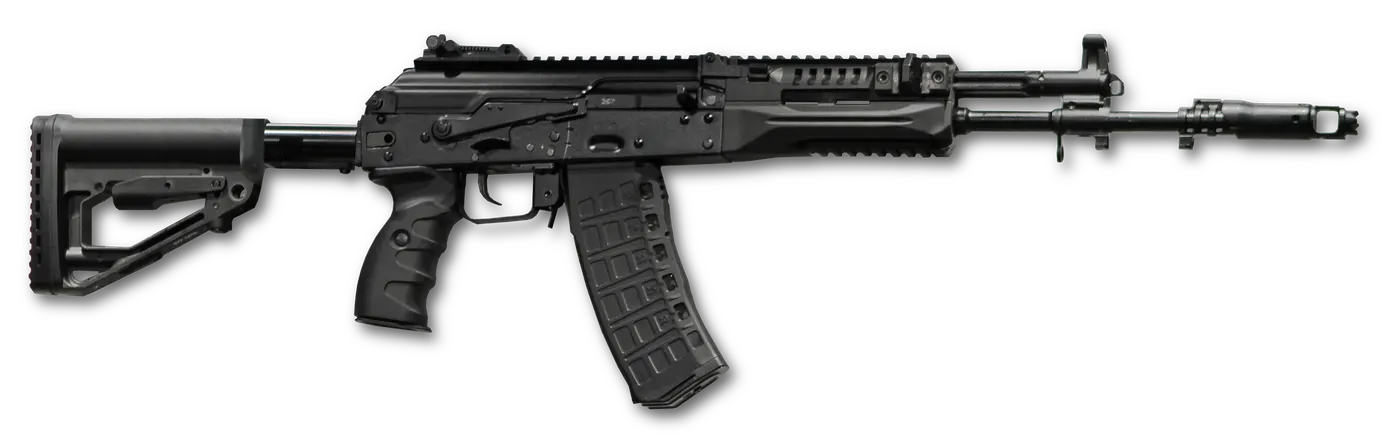

The AK-12 is a 5.45×39mm gas-operated assault rifle developed by Kalashnikov Concern (formerly Izhmash) as the standard infantry weapon of Russia's Ratnik future-soldier program. It entered production in 2018 after one of the longest and most troubled small-arms development cycles in modern Russian history, a project that ran through three failed prototype generations before the rifle Russian troops actually carry was finalized. Roughly 150,000 examples have been built since, and the design remains the subject of open disagreement among the Russian military establishment about whether it delivered a real improvement over the AK-74 it was meant to replace.
- ambidextrous controls, reversible charging handle
- integrated Picatinny rail, no separate side-mount needed
- familiar AK manual of arms, fast retraining
- compatible with the deep AK spare-parts and armorer base
- development took seven years and three failed prototypes
- combat feedback in Ukraine flagged zeroing and selector faults
- costs several times more per unit than an AK-74M
- two-round burst mode proved useless and was later deleted
The rifle chambers the same 5.45×39mm intermediate cartridge as the AK-74 family, keeping it interoperable with existing Russian ammunition stockpiles, and it feeds from the standard AK 30-round detachable magazine as well as 45-round and 95-round drum options. It shares its receiver architecture with a wider family, the 7.62×39mm-chambered AK-15, the NATO-caliber export AK-19, and the 7.62×51mm AK-308 battle rifle, all built on the same AK-400 platform that Kalashnikov Concern finalized in 2016. Outside Russia the AK-12 has been adopted in smaller numbers by Qatar, Armenia, Belarus, and, since late 2024, by North Korea, whose troops deployed alongside Russian forces in the full-scale Russo-Ukrainian war have been photographed carrying it.
Kalashnikov Concern lists the production AK-12's action type as long-stroke gas-piston operated with a rotating bolt, the same basic operating principle every Kalashnikov since the original AK-47 has used, adapted around a new free-floating barrel that is no longer clamped by the handguard. That single change addressed one of the oldest accuracy complaints about the AK-74M, whose barrel harmonics shifted whenever a shooter gripped the handguard tightly or mounted an underbarrel accessory.2
- İlk Üretim Yılı2018
- Hizmete Giriş Yılı2018
- TasarımcıMikhail Kalashnikov, Vladimir Zlobin, Sergey Urzhumcev
- Ağırlık (Boş)3,7 kg
- Halen HizmetteEvet
- Önemli KullanıcılarRusya, Katar, Ermenistan, Belarus, Kuzey Kore
{{photo-req side=right q="AK-12 rifle Kalashnikov exhibition display" caption="A production AK-12 on display, showing the Picatinny top rail and folding stock introduced over the AK-74M" alt="AK-12 assault rifle on a display stand"}}
- Fişek5.45×39mm
- Çap5,45 mm
- Kovan Uzunluğu39 mm
- Çap Sınıfıorta güçlü
- Kenar AteşlemeliHayır
- Kovansız MühimmatHayır
The rifle weighs 3.7 kg empty with a 415 mm barrel, and its side-folding, length-adjustable polymer stock brings overall length to roughly 940 mm extended or 690 mm folded.3 Muzzle velocity for the 5.45×39mm loading runs close to 890 m/s, and Kalashnikov Concern's own published aiming range is out to 800 meters with the stock optical or iron sight combination, figures that some open-source spec sheets understate by quoting the slower 7.62×39mm AK-15 loading instead.3 Cyclic rate of fire is 700 rounds per minute, and the rifle originally shipped with select-fire safe, semi-automatic, full-automatic and a two-round burst setting, a fourth mode that Russian units found added complexity without a measurable accuracy benefit and that Kalashnikov Concern deleted from the design entirely in the 2023 revision.4
- Mekanizma TipiGazlı
- Atış Modlarıemniyet, yarı otomatik, tam otomatik, 2 atımlı seri
- Seçmeli AtışEvet
- Besleme SistemiÇıkarılabilir Şarjör
- Şarjör Kapasitesi30
- Tambur / Şerit Kapasitesi95
- Teorik Atış Hızı700
- Tetik Tipitek kademeli
- Emniyet Tipiseçici kol
Ambidextrous Controls and the New Top Rail
Where the AK-74M offered only a right-side safety lever and a fixed dust cover, the AK-12 introduced ambidextrous controls, a reversible charging handle that can be moved to either side of the receiver, and a hinged, more rigid receiver cover carrying a full-length Picatinny optic rail, replacing the old side-rail bracket that Russian troops had complained about for decades. Iron sights remain fitted as a back-up, a folding rear aperture matched to a shrouded front post, in case the optic is lost or damaged in the field.2 The rifle keeps a folding, collapsing stock, a steel receiver, and polymer furniture, and it is grenade-launch capable, accepting the same underbarrel GP-25/GP-34 launchers used on earlier AK variants.
- Namlu Çıkış Hızı715 m/sn
- Etkili Menzil (nokta)440 m
- Azami Menzil3.150 m
The Seven-Year Road to a Finished Rifle
The design that finally reached Russian troops in 2018 was not the one shown to President Vladimir Putin at the Izhevsk plant in February 2012. That first prototype, developed hastily by chief engineer Vladimir Zlobin after an earlier balanced-recoil design, the AK-107, failed Ratnik trials when its recoil-canceling mechanism could not handle the underbarrel grenade launcher's kick, suffered a bent receiver and a fractured charging handle under drop testing.5 A heavily revised second prototype followed in 2013 to 2014, with a new stock, receiver cover, bolt stop and magazine release, and a third generation was tested in spring 2015. All three were ultimately set aside in favor of a fresh internal program, the AK-400, whose finalized design Kalashnikov Concern unveiled on September 6, 2016, and it is the AK-400 layout, not the 2012 prototype, that became the production AK-12.6
- Namlu Uzunluğu415 mm
- Nişangah TipiYedek mekanik nişangah ve çeşitli optik nişangahlar için entegre Picatinny ray
- Optik RayıEvet
- Açık NişangahEvet
- Gövde Malzemesi (Receiver)Çelik
- Kabza/Dipçik Malzemesipolimer
- Katlanır / Toplanır DipçikEvet
- Bullpup DüzeniHayır
- Çift Yönlü KumandalarEvet
- Modülerlikyüksek
- Toplam Üretim150.000
- Üretim Başlangıcı2018
- Varyantlar5
The AK-12 exists because of Ratnik ("Warrior"), a future-soldier modernization program that grew out of an earlier Russian research effort called Barmitsa and that pushed the Russian army to replace WWII-era load-bearing gear, body armor and small arms with a genuinely 21st-century soldier system.7 Pressure to include an entirely new rifle in the trials, rather than simply another AK-74M variant, came largely from Russian special-forces (Spetsnaz) units, who also demanded the new weapon be offered in two calibers, the standard 5.45×39mm and the older 7.62×39mm, the latter valued for better performance against light cover and superior ballistics when fired subsonic through a suppressor. That request produced the AK-12's sister rifle, the 7.62×39mm AK-15.7
{{photo-req side=right q="Vladimir Putin Izhevsk Kalashnikov plant visit" caption="Vladimir Putin was shown the first AK-12 prototype at the Izhevsk plant in February 2012, six years before the finished rifle entered service" alt="Russian officials touring a firearms factory production line"}}
Izhmash, which became part of Kalashnikov Concern during the project, originally developed the rifle as a private venture rather than a state-directed program, betting that it could win the Ratnik contract on its own initiative. Development authority passed from Vladimir Zlobin, the original chief designer who had spent four years on the project, to Sergey Urzhumcev around the end of 2015, coinciding with the pivot to the AK-400 architecture.5 Trials against a rival state design, the AEK-971 successor known as the A-545, ran through 2017, and although some Russian small-arms engineers argued the A-545's balanced-action recoil system was technically the more advanced of the two, the AK-12 won the contract in large part because it was cheaper to retool existing AK production lines for and because Russian units were reluctant to retrain on a mechanically unfamiliar action.8 The Russian Ministry of Defense formally adopted both the AK-12 and the AK-15 into service in January 2018, following the conclusion of state testing in December 2017.1
Initial fielding proved slower than planned. Reported production issues and continuing complaints from testing units led Russia's Ministry of Defense to request a further round of design fixes as early as the summer of 2019, well before the rifle saw any large-scale combat test.11 A three-year state contract for 150,000 rifles, signed in 2019, gradually re-equipped first-line Russian units through the early 2020s, alongside smaller shipments to the National Guard (Rosgvardia) and Interior Ministry forces from late 2023 onward.1
{{photo-req side=left q="3rd Assault Brigade Ukraine soldiers rifle" caption="Ukrainian troops of the 3rd Assault Brigade, whose soldiers were filmed using captured AK-12 rifles" alt="Ukrainian infantry soldiers in the field"}}
Russia's full-scale invasion of Ukraine in February 2022 gave the AK-12 its first real combat exposure at scale, and the results were widely reported as damaging to the rifle's reputation. Deployed alongside older AKM and AK-74M rifles issued to mobilized reservists, the AK-12 drew persistent field complaints, most notably that the rifle would not reliably hold its zero after the receiver's dust cover was removed and reseated, a routine field-stripping step, and that the ambidextrous selector lever could be pushed too far down, partially obstructing the trigger guard.12 Ukrainian forces captured a number of AK-12s early in the full-scale Russo-Ukrainian war, and soldiers of Ukraine's 3rd Assault Brigade posted videos of themselves using captured examples, turning a captured AK-12 into something of a trophy and status symbol documented across Ukrainian social media.13
The negative field reports fed directly into Kalashnikov Concern's next design cycle. In May 2023 the company publicly confirmed it was reworking the AK-12 based specifically on lessons from the Russo-Ukrainian War, and state media reported the changes as a direct response to complaints from troops fighting in Ukraine.14 The reworked AK-12 model of 2023 replaced the muzzle brake/bayonet-lug device with a birdcage-style flash suppressor, strengthened a handguard that had been prone to overheating, fitted a new ambidextrous safety flag, and dropped the two-round burst mode outright, on the grounds that it added mechanical complexity without a real accuracy payoff in combat.4 One widely circulated field-modification, an AK-12 taken as a battlefield trophy from a killed Wagner Group mercenary by a Ukrainian special-operations unit, was cited in Ukrainian and Russian defense press as further evidence that even Russia's own contractor troops were adapting the rifle informally rather than trusting the factory configuration.15
{{photo-req side=right q="Wagner Group PMC fighters Russia Ukraine" caption="Wagner Group contract fighters in the field, a Wagner-issued AK-12 was among the trophies later displayed by Ukrainian special operations troops" alt="Armed fighters in field uniform with rifles"}}
Even the redesigned rifle has not settled the argument. Defense commentators who had already criticized the original AK-12 during state trials revived that criticism once wartime field reports confirmed the same complaints, describing the 2023 update as addressing symptoms without resolving why a rifle billed as Russia's most advanced Kalashnikov needed a public factory rework within five years of full adoption.19 Some Russian special-operations troops reportedly kept issuing older AKM-pattern rifles in preference to early-production AK-12s during the first year of the invasion, a preference driven less by any single catastrophic failure than by the accumulated weight of the zeroing, selector and handguard complaints described above.12
The AK-12 also saw earlier, smaller-scale use outside Russia and Ukraine. Syria's 25th Special Mission Forces Division, an elite formation of the Syrian Arab Army that fought throughout the Syrian Civil War, fielded small numbers of the rifle, a detail that places the AK-12 in a conflict that ran in parallel with the broader instability of the Arab Spring across the region, though it saw far less documented combat exposure there than the far more numerous AK-47 and AKM types already in Syrian government stocks.16
The core AK-12 family shares a single receiver architecture across several caliber and length variants. The AK-15 is mechanically identical apart from its 7.62×39mm chamber and bolt, developed in parallel specifically to satisfy the Spetsnaz demand for a subsonic-capable, suppressor-friendly option.7 The AK-19 is a dedicated export configuration chambered for 5.56×45mm NATO, unveiled at the ARMY-2020 defense exhibition alongside an upgraded AK-12 (2020 model) and intended to let Kalashnikov Concern compete for contracts in countries already committed to NATO-standard ammunition. A 7.62×51mm NATO battle-rifle variant, the AK-308, extends the same family further up the caliber scale.
{{photo-req side=right q="Kalashnikov AK-19 rifle NATO 5.56mm export" caption="The AK-19, a 5.56x45mm NATO export derivative of the AK-12 aimed at markets already committed to Western ammunition" alt="AK-19 export rifle on display"}}
Shortened derivatives, the AK-12K and AK-15K, cut the barrel to 290 mm for vehicle crews and close-quarters use, and a still shorter sub-compact pairing, the AK-12SK and AK-15SK with 228 mm barrels, was unveiled in January 2025 for special-operations and concealment roles.3 Special-forces-oriented AK-12SP and AK-12SPK variants add M-LOK accessory slots in place of some Picatinny rail sections, and a semi-automatic civilian-market derivative sold under the TR3 designation lets Kalashnikov Concern offer the platform to sport shooters inside Russia.1
The most operationally significant "variant" is arguably the AK-12 model of 2023, a mid-production revision rather than a distinct model name, incorporating the flash suppressor, handguard, safety and burst-mode changes described above. Kalashnikov Concern completed initial deliveries of the 2023-pattern rifle to Russian assault and airborne units in early 2025.14


| Yıl | Alıcı | Adet | Tutar | Bugünkü Değer (2025) |
|---|---|---|---|---|
| 2021 |  Hindistan | 70,000 | — | — |
| 2021 | Hindistan | 600,000 | — | — |
| 2021 |  Belarus | — | — | — |
| 2018 |  Ermenistan | — | — | — |
| — |  Katar | — | — | — |
{{photo-req side=left q="Qatar Emiri Land Force parade rifle" caption="Qatari troops on parade, the AK-12's first confirmed export customer" alt="Qatari military parade formation"}}
Russia is the AK-12's primary and largest operator, having adopted the rifle for frontline army units in January 2018 and progressively extended issue to the National Guard (Rosgvardia) and Interior Ministry forces from late 2023.1 Qatar became the first confirmed export customer, with Qatari Emiri Land Force troops shown carrying the AK-12 at a December 2018 parade.10 Armenia signed a licensed-production agreement with Kalashnikov Concern at the Army-2018 exhibition and received an initial 50 rifles for evaluation in 2019, with Armenian special-operations troops photographed using the rifle in a 2021 training exercise.1 Belarus announced small-scale issue to its internal troops in February 2021.
North Korea is the most recent addition to the operator list. North Korean troops sent to reinforce Russian forces were issued AK-12s ahead of frontline deployment against Ukraine starting in November 2024, and North Korean soldiers who had served in that deployment were shown carrying AK-12s during Pyongyang's October 2025 military parade marking the 80th anniversary of the Workers' Party.17 Ukraine operates a small number of captured examples on an ad-hoc basis rather than as an issued standard rifle, taken as battlefield trophies since 2022.13 Syria's use, tied to the 25th Special Mission Forces Division under the former Assad government, ended with that government's 2024 collapse and is listed here as retired.16
The AK-12's most direct rival was never a foreign rifle but a competing domestic design, the A-545, the production evolution of the balanced-action AEK-971 that Kalashnikov Concern's Ratnik trial competitor TsNIITochMash (through its Tochmash design bureau) pushed as the technically superior option.8 The A-545 used a balanced-operating-group action that largely cancels reciprocating recoil, giving it markedly better full-automatic controllability on paper than the AK-12's conventional long-stroke gas piston, and Tochmash publicly argued the AK-12 was flawed by comparison.18 The AK-12 won the contract anyway, mainly on cost and retooling grounds. It let Kalashnikov Concern reuse existing AK-74M-pattern production tooling and kept the manual of arms close enough to decades of Soviet and Russian rifle training that units did not need to relearn a mechanically unfamiliar action, a procurement logic that favored continuity over the A-545's raw controllability advantage.
Against the AK-74 it replaces, the AK-12 is best understood as an accessory and ergonomics upgrade built on the same 5.45×39mm ballistics rather than a new weapon class. Both rifles share essentially the same muzzle velocity and effective range, so the real difference a Russian soldier notices is the AK-12's Picatinny rail, ambidextrous controls, and adjustable stock, features Western rifles like the Heckler & Koch HK416 had already normalized more than a decade earlier.
| Spec | AK-12 | AK-74M |
|---|---|---|
| Cartridge | 5.45×39mm | 5.45×39mm |
| Weight (empty) | 3.7 kg | 3.6 kg |
| Optic mounting | Full-length Picatinny top rail | Side-rail bracket only |
| Controls | Ambidextrous, reversible charging handle | Right-side only |
| Fire modes | Safe / semi / full-auto (burst deleted 2023) | Safe / semi / full-auto |
Set against Western rifles built to a similar modular-optics standard, such as the Steyr AUG or the SIG SG 550, the AK-12 trades the AUG's bullpup layout and inherent compactness, and the SG 550's tighter accuracy reputation, for the AK platform's much larger global spare-parts base and simpler armorer-level maintenance. Whether the AK-12 is still worth its higher unit cost over a plain AK-74M remains an open and genuinely contested question inside Russian defense commentary, not a settled verdict, precisely because the Ukraine war exposed real reliability complaints against a design that was supposed to have already solved the AK-74M's known weaknesses.


What caliber does the AK-12 use? The AK-12 is chambered for the Soviet-standard 5.45×39mm intermediate cartridge, the same round used by the AK-74 family it replaces. Its 7.62×39mm sister rifle is the separately designated AK-15.3
Is the AK-12 still in service? Yes. It remains the standard-issue rifle for Russian first-line army units, along with Rosgvardia and Interior Ministry forces, and Kalashnikov Concern continued delivering the upgraded 2023-pattern model into 2025.14
How does the AK-12 compare to the AK-74M it replaced? The AK-12 keeps the AK-74M's 5.45×39mm ballistics essentially unchanged and adds a Picatinny optics rail, ambidextrous controls, a free-floating barrel and an adjustable stock, at several times the AK-74M's unit cost.5
What is the AK-12's unit cost? Reported pricing at introduction put the AK-12 near $1,000 per rifle for military orders, roughly five to six times the cost of a comparable AK-74M according to figures reported during state trials.5
Why did the AK-12 get criticized in the Russo-Ukrainian War? Field reports from Ukraine described the rifle losing zero after routine dust-cover removal and a selector lever that could obstruct the trigger guard if pushed too far, complaints serious enough that Kalashnikov Concern issued a public mid-production redesign in 2023.12
- "AK-12", Wikipedia — en.wikipedia.org ↩
- "Kalashnikov AK-12 and AK-15 assault rifle (Russia)", Modern Firearms — modernfirearms.net ↩
- "Assault Rifle - Kalashnikov AK-12 (AK-200)", Military Factory — militaryfactory.com ↩
- "The AK-12 Model of 2023", The Firearm Blog — thefirearmblog.com ↩
- "The Strange Story of How Russia's AK-12 Rifle Came Into Being", The National Interest — nationalinterest.org ↩
- "The Unknown History of Russian AK-12 Kalashnikov Rifle: Part 1", The Firearm Blog — thefirearmblog.com ↩
- "The AK-12 and AK-15: A Kalashnikov for the 21st Century", Ronin's Grips — blog.roninsgrips.com ↩
- "Russia's new AK-12 assault rifle is flawed, says Tochmash", Army Technology — army-technology.com ↩
- "AK-12", Internet Movie Firearms Database — imfdb.org ↩
- "Weapons: AK-12 Finds An Export Customer", StrategyPage — strategypage.com ↩
- "Infantry: Russian AK-12 In Ukraine", StrategyPage — strategypage.com ↩
- "A Captured Kalashnikov Has Become a Status Symbol in Ukraine", SOFREP — sofrep.com ↩
- "Kalashnikov AK-12: Gunmaker upgrades assault rifle based on Ukraine combat experience", CNN — cnn.com ↩
- "Russian gunmaker unveils upgraded AK-12 assault rifle based on Ukraine combat experience", TASS — tass.com ↩
- "The russians Found a Radical Solution to the russian AK-12 Rifle's Flaw, and It's Hilarious", Defense Express — en.defence-ua.com ↩
- "Avtomat Kalashnikov AK-12", GlobalSecurity.org — globalsecurity.org ↩
- "North Korean AKs: The Most Popular Export of DPRK. Part 2", The Firearm Blog — thefirearmblog.com ↩
- "The Unknown History of Russian AK-12 Kalashnikov Rifle: Part 2", The Firearm Blog — thefirearmblog.com ↩
- "Greed Takes Over Reason in the New AK-12 of the 2023 Edition", Defense Express — en.defence-ua.com ↩