

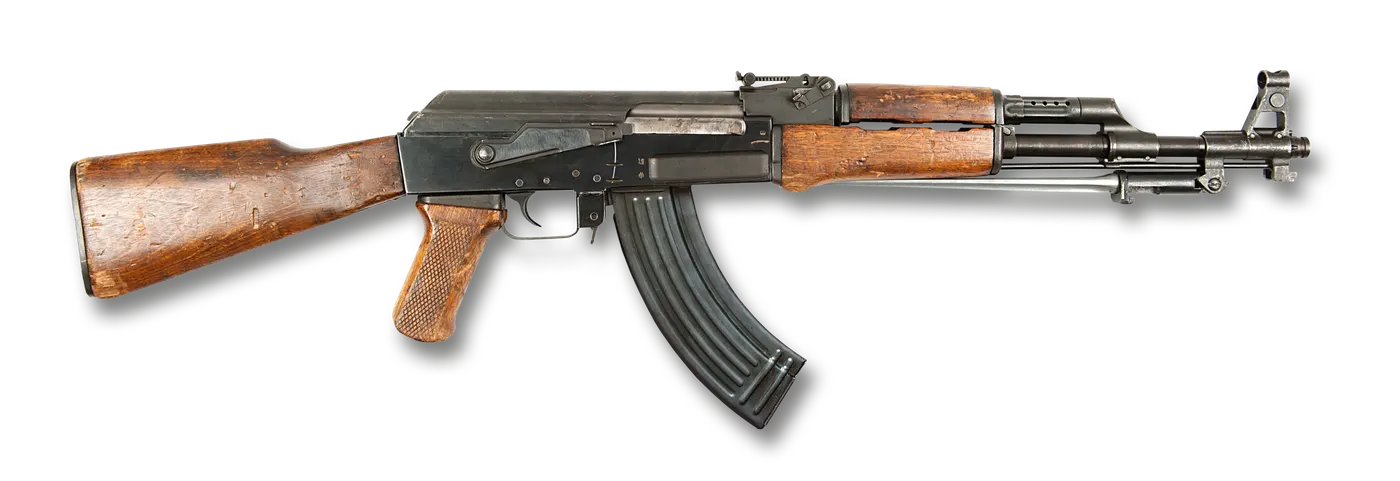

More Type 56 rifles have been produced than almost any other assault rifle in history. Estimates put total Chinese output at 10 to 15 million units since 1956, spread across a plain milled-receiver original, two folding-stock export models, and a compact carbine, making the Type 56 the single most widely proliferated member of the Kalashnikov family worldwide.1 It is a licensed, later reverse-engineered, Chinese production of the Soviet AK-47, built by Norinco (the China North Industries Group Corporation Limited) under the state arms-industry system of the People's Republic of China.1 The rifle fires the intermediate 7.62×39mm cartridge from a 30-round detachable box magazine, using a long-stroke gas-operated piston action inherited directly from the Soviet design.2
- extremely simple, low-cost mass production
- exceptional reliability in mud, sand, and neglect
- enormous parts and ammunition commonality worldwide
- folding spike bayonet doubles as a compact melee tool
- iron sights and stamped-metal build limit precision at range
- fixed or basic folding stocks give mediocre ergonomics
- wood/steel construction is heavier than modern polymer rifles
- no factory provision for optics or accessory rails on early models
The Type 56 entered production in 1956 at State Factory 66 after the Soviet Union transferred AK-47 technical documentation and tooling to China the previous year, part of a broader mid-1950s wave of Soviet arms assistance.1 From there it became China's standard infantry rifle through the Vietnam War era and the single most commonly encountered Kalashnikov-pattern weapon in the hands of Viet Cong guerrillas and North Vietnamese regulars, before going on to arm militaries, insurgencies, and militias across Africa, the Middle East, and Southeast Asia for the rest of the Cold War and well beyond it.3 It remains in front-line and reserve service in dozens of countries today, and unlicensed or semi-licensed copies are still being produced.4
The assault rifles category the Type 56 belongs to was itself defined by the Kalashnikov pattern it copies, and few weapons illustrate the category's Cold War trajectory as completely as this one, from Soviet blueprint, to Chinese state production, to a rifle so widely copied and exported that the name Type 56 became almost a byword for a Chinese-made AK in conflict-monitoring literature.4
The Type 56 assault rifle chambers the 7.62×39mm intermediate cartridge, the same round used by the Soviet AK-47 and the SKS carbine it was produced alongside.2 Empty weight is 3.8 kg, muzzle velocity is approximately 715 m/s, and the rated select-fire trigger group cycles at roughly 650 rounds per minute, all figures consistent with the parent AK-47 design it licenses.2 Barrel length is 414 mm, and the rifle is fed from a curved 30-round detachable magazine.2 Chinese military doctrine rated it for aimed single shots out to about 400 meters and short automatic bursts against area targets closer to 300 meters, broadly in line with other Kalashnikov-pattern rifles of the era.5
- İlk Üretim Yılı1956
- Hizmete Giriş Yılı1956
- Ağırlık (Boş)3,8 kg
- Halen HizmetteEvet
The earliest production Type 56 rifles, built through the early-to-mid 1960s, used a milled steel receiver machined from a solid steel block, an exact structural copy of the final-pattern Soviet AK-47.1 Deteriorating Sino-Soviet relations after 1960 meant China never received technical documentation for the improved Soviet AKM, which replaced the milled receiver with a lighter stamped-sheet-metal one. Chinese engineers reverse-engineered the stamped-receiver approach independently, and Norinco's own production shifted to stamped receivers sometime between roughly 1967 and 1970, mirroring the AKM's weight savings without ever licensing it.1
- FişekType 56 variants -7.62×39mm Type 84S – 5.56×45mm
- Çap7,62 mm
- Kovan Uzunluğu39 mm
{{photo-req side=right q="Type 56 rifle folding spike bayonet detail" caption="The Type 56's hinged folding spike bayonet locks under the barrel, a distinctly Chinese departure from the Soviet AK-47's detachable blade bayonet." alt="Close-up of a Type 56 rifle's folding spike bayonet extended under the barrel"}}
- Mekanizma TipiGazlı
- Atış ModlarıYarı otomatik, tam otomatik
- Seçmeli AtışEvet
- Besleme SistemiÇıkarılabilir Şarjör
- Şarjör Kapasitesi30
- Teorik Atış Hızı650
Commercial and export production for the American civilian market in the 1980s used the same standard configuration, but rifles built after 1989 were altered to comply with a U.S. presidential Executive Order restricting the import of certain semi-automatic military-style rifle configurations, replacing the separate wood buttstock and pistol grip with a one-piece thumbhole stock and adding a magazine-well rivet that blocked standard AK, AKM, and RPK magazines.7 The 1994 U.S. federal Assault Weapons Ban ended new Chinese firearm imports into the United States altogether, so no factory-new Type 56 has legally entered the American civilian market since, and existing pre-ban examples now command a real collector premium.7
- Namlu Çıkış Hızı715 m/sn
- Etkili Menzil (nokta)400 m
The rifle carries a fixed front-post and rear-notch iron sight arrangement adjustable out to several hundred meters, no factory optics rail on early models, and a bayonet lug welded to the front sight base.2 Chinese armorers also fielded a dedicated Type 65/67 spigot-type rifle-grenade launcher fitted over the muzzle, propelled by a blank cartridge in the same way as contemporary Yugoslav and Soviet rifle-grenade systems, giving infantry squads an improvised close-support option without a separate grenade launcher weapon.8
- Namlu Uzunluğu414 mm
- Nişangah TipiAyarlanabilir Mekanik nişangah
- Açık NişangahEvet
- Süngü TakozuEvet
- Bombaatar KabiliyetliEvet
- Gaz PistonluEvet
- Toplam Üretim10.000.000
- Üretim Başlangıcı1956
{{photo-req side=right q="Mikhail Kalashnikov portrait designer AK-47" caption="Mikhail Kalashnikov, designer of the AK-47 the Type 56 was licensed to build, photographed later in life." alt="Portrait photograph of Soviet firearms designer Mikhail Kalashnikov"}}
Soviet technical assistance to the People's Republic of China in 1955 included complete AK-47 and SKS production documentation and machine tooling, part of Moscow's broader arms-transfer relationship with Beijing before the Sino-Soviet split.1 Production of the rifle, now designated Type 56 for the year it entered Chinese service, began in 1956 at State Factory 66, with manufacturing later consolidated under Norinco and its sister firm Poly Technologies, which continued producing commercial variants for export decades after the rifle left first-line PLA service.1
{{photo-req side=left q="Norinco factory China small arms production Cold War" caption="Chinese state arms factories scaled up Type 56 production through the late 1950s after receiving Soviet AK-47 tooling and documentation." alt="Historical photograph of a Chinese state small-arms factory floor"}}
The People's Liberation Army did not fully replace its SKS carbines with the Type 56 as the primary infantry rifle until relatively late, continuing to issue semi-automatic carbines through much of the 1960s even as Type 56 production expanded, partly because the SKS was already established doctrine and partly due to production capacity limits in the early years.9 Export volumes, by contrast, grew quickly. China supplied North Vietnam with large quantities of Type 56 rifles and 7.62×39mm ammunition well before the mid-1960s, and Chinese-made rifles ultimately became more common in Vietnamese hands than Soviet-made AK-47s or AKMs.3
By the late 1970s the Type 56's role inside China itself was already changing. During the brief 1979 Sino-Vietnamese War, the People's Liberation Army began fielding the newer Type 81 assault rifle alongside the Type 56, the Type 81 offering better automatic-fire control and accuracy while retaining the same 7.62×39mm cartridge.11 (The Type 81 is not yet a separately published entry in this archive.) The Type 56 nonetheless remained in PLA reserve and militia inventories for years afterward, and export production for foreign militaries and the international commercial market continued largely uninterrupted.
Two major factory variants followed the original fixed-stock rifle. The Type 56-1, adopted for export and airborne/vehicle-crew use, replaced the wooden stock with an underfolding steel strut stock modeled on the Soviet AKS, folding forward beneath the receiver.12 The Type 56-2, introduced in 1980, replaced that with a side-folding stock that swings over the right side of the receiver, dropped the fixed spike-bayonet lug in favor of standard AK/AKM-pattern detachable bayonets, and added a small cleaning-kit compartment built into the folding stock itself, a feature neither the underfolder nor most Soviet side-folders included.12 Both folding variants share the same 874 mm overall length with the stock extended and 654 mm folded.12
{{photo-req side=left q="China Vietnam border map Sino-Vietnamese War 1979" caption="The China-Vietnam border region where the 1979 Sino-Vietnamese War was fought, with Chinese and Vietnamese infantry on opposing sides both carrying the same Chinese-made Type 56 rifle." alt="Map of the China-Vietnam border region"}}
The Type 56 saw its first major combat exposure during the Vietnam War, arming both Viet Cong irregulars and North Vietnamese Army regulars from the early 1960s onward, and American infantry encountered it in the field more often than Soviet-made Kalashnikovs.3 Robustness under jungle conditions of mud, moisture, and minimal maintenance became central to its wartime reputation among both the soldiers who carried it and the troops who fought against it.3
{{photo-req side=right q="Viet Cong soldier AK type rifle Vietnam War jungle" caption="Viet Cong and North Vietnamese Army units fielded the Type 56 in large numbers throughout the Vietnam War, more commonly than Soviet-made Kalashnikovs." alt="Vietnam War era photograph of an armed guerrilla fighter with a Kalashnikov-pattern rifle"}}
The rifle's most ironic engagement came in 1979, when China and Vietnam went to war directly. By then both the People's Liberation Army and the Vietnamese People's Army held large stocks of the same Chinese-made rifle, so opposing infantry in the brief Sino-Vietnamese War frequently fired an identical weapon at each other.11 Further south, the Type 56 armed the Khmer Rouge-aligned Cambodian People's National Liberation Armed Forces during the Cambodian Civil War, one of several Chinese-supplied infantry weapons that equipped that force alongside armor from the same source, and later remained in Khmer Rouge hands into the following decades of intermittent fighting.13 Communist Pathet Lao forces carried it through the parallel Laotian Civil War.
{{photo-req side=left q="Soviet Afghan war mujahideen Kalashnikov rifle 1980s" caption="Kalashnikov-pattern rifles including Chinese Type 56s armed mujahideen fighters throughout the Soviet-Afghan War." alt="1980s photograph of Afghan mujahideen fighters carrying Kalashnikov-pattern rifles"}}
Chinese arms transfers put the Type 56 in the hands of insurgent and government forces across multiple later conflicts, among them the Soviet-Afghan War, where Chinese small arms reached mujahideen fighters through Pakistani and other conduits, and the Iran–Iraq War, in which Iran both imported Chinese-made Type 56 rifles directly and later reverse-engineered its own KL-7.62 copy to sustain wartime infantry rifle production.10 The Rhodesian Bush War and the long-running Somali Civil War both drew on Chinese exports and, later, unregulated regional arms flows to keep Type 56-pattern rifles circulating among government, guerrilla, and militia forces across southern and eastern Africa for decades after the weapons were first delivered.4
More recently, the rifle has continued to surface in active conflicts far removed from its Cold War origins, including the Iraq War and the subsequent Iraqi insurgency, the Sri Lankan civil war against the Tamil Tigers, the ongoing Kivu conflict in the Democratic Republic of the Congo, and irregular forces in the Russo-Ukrainian War, a testament to how many millions of surplus and second-hand Type 56 rifles remain in circulation on the used and illicit small-arms market worldwide.4
The Type 56 is documented as the most frequently used Kalashnikov-pattern rifle in American film and television productions depicting Vietnam-era combat, largely because Norinco exported large numbers of semi-automatic civilian variants into the United States during the 1980s before import restrictions ended the supply.14 In Francis Ford Coppola's Apocalypse Now, Viet Cong fighters shown during the film's helicopter-assault sequence are armed with Norinco Type 56 rifles, and Oliver Stone's Platoon arms its North Vietnamese Army characters with milled-receiver Type 56 rifles fitted with folding spike bayonets, correctly reflecting the wartime weapon.14

{{photo-req side=right q="Type 56-2 rifle side folding stock Norinco" caption="The export-oriented Type 56-2, introduced in 1980, replaced the underfolding stock with a side-folding design and dropped the fixed spike bayonet for a standard detachable bayonet." alt="Norinco Type 56-2 rifle with side-folding stock"}}
The baseline Type 56 used a fixed wooden stock, a milled receiver on early production and a stamped receiver from roughly 1967-70 onward, and the distinctive folding spike bayonet.1 The Type 56-1 substituted an AKS-style underfolding metal stock for airborne and mechanized troops, while the Type 56-2, introduced in 1980 primarily for export customers, used a side-folding stock, dropped the integral spike bayonet in favor of a standard detachable bayonet lug, and added an internal cleaning-kit storage compartment in the stock itself.12 A compact Type 56C carbine with a shortened barrel and permanently folded-length receiver followed later for close-quarters and paramilitary use.
Outside China, the design spawned direct and near-direct foreign copies rather than only licensed transfers. Iran's Defense Industries Organization reverse-engineered the rifle as the KL-7.62, fielded in wood-stocked (KLS) and folding-stock (KLF) forms that were originally near-indistinguishable from the Chinese original before later Iranian production diverged with polymer furniture and a ribbed AKM-style receiver cover.10 Sudan's Military Industry Corporation built its own licensed Type 56 derivative, known locally as the MAZ rifle.10 Both programs underline how far the Type 56's manufacturing footprint extended beyond direct Chinese exports, into genuinely independent foreign production lines built entirely around the Chinese pattern rather than the original Soviet one.
 AfganistanAKTİF
 Amerika Birleşik DevletleriAKTİF
 ArnavutlukAKTİF
 AzerbaycanAKTİF
 BangladeşAKTİF
 BeninAKTİF
 BolivyaAKTİF
 Bosna-HersekAKTİF
 BrezilyaAKTİF
 BurundiAKTİF
 ÇadAKTİF
 CezayirAKTİF
 CibutiAKTİF
 Çin Halk CumhuriyetiAKTİF
 EkvadorAKTİF
 EstonyaAKTİF
 Fildişi SahiliAKTİF
 FinlandiyaAKTİF
 Güney SudanAKTİF
 HırvatistanAKTİF
 IrakAKTİF
 İranAKTİF
 KamboçyaAKTİF
 KatarAKTİF
 KongoAKTİF
 Kongo Demokratik CumhuriyetiAKTİF
 KosovaAKTİF
 Kuzey KoreAKTİF
 LaosAKTİF
 LiberyaAKTİF
 LibyaAKTİF
 MaliAKTİF
 MaltaAKTİF
 MyanmarAKTİF
 NepalAKTİF
 NijerAKTİF
 Orta Afrika CumhuriyetiAKTİF
 PakistanAKTİF
 RuandaAKTİF
 RusyaAKTİF
 Sierra LeoneAKTİF
 SomaliAKTİF
 Sri LankaAKTİF
 SudanAKTİF
 SuriyeAKTİF
 TacikistanAKTİF
 TanzanyaAKTİF
 UgandaAKTİF
 UkraynaAKTİF
 VietnamAKTİF
 YemenAKTİF
 ZimbabveAKTİF
The Type 56's operator list runs to dozens of states across every inhabited continent, a direct consequence of Cold War-era Chinese arms diplomacy and the low unit cost that kept it attractive to newly independent and resource-limited militaries long after wealthier states had moved to newer designs.4 China itself adopted the rifle first in 1956, before later transitioning front-line service to the Type 81 and Type 95 bullpup family while retaining Type 56s in reserve and militia stocks.11 North Korea, Vietnam (from 1960), Cambodia, Laos, and Myanmar (from 1965) all received rifles as part of China's direct regional-alliance arms support through the 1960s and 1970s.
{{photo-req side=right q="African soldiers militia Kalashnikov pattern rifle patrol" caption="Chinese Cold War arms exports and later unregulated small-arms flows made the Type 56 one of the most common rifles across multiple African conflicts." alt="Photograph of African soldiers or militia members carrying Kalashnikov-pattern rifles on patrol"}}
Across the Middle East and South Asia, Pakistan (from 1965), Iran (from 1975, alongside its own KL-7.62 production), Syria (from 1970), Yemen, Afghanistan, Bangladesh, and Nepal all list the Type 56 among their inventories, while Libya (from 1975) redistributed Chinese-supplied rifles further across North and sub-Saharan Africa through the following decades.4 African operators span Algeria (from 1962, one of the earliest African recipients), Tanzania, Uganda, Rwanda, Zimbabwe, the Democratic Republic of the Congo, the Republic of the Congo, Chad, Mali, Niger, Benin, Ivory Coast, Liberia, Sierra Leone, Central African Republic, South Sudan, Sudan, Somalia, Burundi, and Djibouti, reflecting both direct state-to-state Chinese transfers and the weapon's long afterlife moving through regional conflict economies.4
The rifle also equipped forces well outside its original Cold War distribution pattern. Post-Yugoslav successor states including Croatia (from 1991), Bosnia and Herzegovina (from 1992), and Kosovo drew on Type 56 stocks during and after the Yugoslav Wars and the Kosovo War. Ukraine has held Type 56 stocks since 1992, some of which have resurfaced in the Russo-Ukrainian War. Small numbers are also documented in service or seizure records in the United States, Iraq, Ecuador, Bolivia, Brazil, Russia, Estonia, Azerbaijan, Malta, Sri Lanka, and Qatar, illustrating just how far a rifle originally built for a single Cold War client relationship eventually traveled.4
The Type 56's most direct point of comparison is its own parent design, the Soviet AK-47. Both share the same 7.62×39mm cartridge, the same long-stroke gas piston operating system, and near-identical external geometry, but the two diverged sharply in production method after 1960. Denied access to Soviet AKM documentation once relations soured, Chinese engineers kept building milled receivers years longer than Soviet factories did, then independently reverse-engineered a stamped-receiver AKM equivalent rather than manufacturing it under license, a genuinely unusual case of parallel industrial development inside a single weapon family.1 The clearest external difference remained the Type 56's fixed folding spike bayonet against the AK-47's detachable knife bayonet, a small but immediately recognizable design fork between the two.6
| Spec | Type 56 | AK-47 |
|---|---|---|
| Cartridge | 7.62×39mm | 7.62×39mm |
| Muzzle velocity | ~715 m/s | ~715 m/s |
| Weight (empty) | 3.8 kg | ~4.3 kg (milled) |
| Bayonet | Fixed folding spike | Detachable knife |
| Receiver (early) | Milled steel | Milled steel |
The Type 56's most consequential rivalry, though, was fought on the ground rather than on a spec sheet. In Vietnam, it was the Kalashnikov-pattern rifle most American troops actually met in combat, set against the M16 and M16A1 rifles issued to U.S. forces.3 The comparison became one of the defining small-arms narratives of the war. The Type 56 (and Soviet AK-47s alongside it) earned a reputation for functioning reliably after being dragged through mud, rice paddies, and jungle humidity with minimal cleaning, while the early M16 suffered well-documented reliability failures in the same conditions before the improved M16A1 and revised ammunition largely resolved them.15 The M16 platform offered a lighter 5.56mm cartridge, flatter trajectory, and better inherent accuracy at range, trading some of the Type 56's brute mechanical tolerance for precision and lower recoil, a role split between rugged simplicity and aimed-fire performance that has largely persisted between AK- and AR-pattern rifles ever since.15

Is the Type 56 still in service today? Yes. Beyond China's own reserve and militia stocks, dozens of the operator countries listed above, spread across Africa, the Middle East, and Asia, continue to list the Type 56 as an active-service rifle, and it remains a fixture of irregular and militia forces in ongoing conflicts including the Kivu conflict and various African insurgencies.4
How many Type 56 rifles were produced? Estimates for total Chinese production run from 10 to 15 million units across the Type 56, Type 56-1, Type 56-2, and Type 56C variants, plus separate foreign-built copies in Iran and Sudan, making it one of the most heavily produced Kalashnikov-pattern rifles ever built.1
What is the difference between the Type 56 and the Type 56-1 or Type 56-2? The base Type 56 has a fixed wooden stock and a folding spike bayonet. The Type 56-1 replaces the stock with an AKS-style steel underfolder. The Type 56-2, introduced in 1980, uses a side-folding stock instead, drops the fixed bayonet lug for a standard detachable bayonet, and adds an internal cleaning-kit compartment.12
Can I still buy a Type 56 rifle in the United States? No new Type 56 rifles have legally entered the U.S. civilian market since the 1994 federal Assault Weapons Ban ended Chinese arms imports, following earlier 1989 configuration restrictions. Pre-1994 imported examples still circulate on the collector market at a premium over comparable AK-pattern rifles.7
What cartridge and magazine capacity does the Type 56 use? The Type 56 fires the 7.62×39mm intermediate cartridge from a curved 30-round detachable box magazine, identical in caliber and standard capacity to the Soviet AK-47 it copies.2
- "Type 56 assault rifle", Wikipedia — en.wikipedia.org ↩
- "NORINCO Type 56 (AK47) Assault Rifle / Assault Carbine", Military Factory — militaryfactory.com ↩
- "Type 56 assault rifle", Vietnam War Wiki (Fandom) — vietnamwar.fandom.com ↩
- "Guerilla's Choice: The Type 56 Rifle and its Lasting Impression on Asymmetric Warfare", SOFREP — sofrep.com ↩
- "Type 56 Chinese 7.62mm Assault Rifle", OE Data Integration Network (ODIN), U.S. Army — odin.t2com.army.mil ↩
- "Chinese Type 56 Folding Spike Bayonet", Kalashnikov Bayonets of the World — akbayonets.info ↩
- "Norinco Type 56 Value 2026, Current Prices & Worth Guide", CashMyGuns — cashmyguns.com ↩
- "Chinese Type 67 Rifle Grenade Launcher for Type 56 Chinese SKS", Gunboards Forums — gunboards.com ↩
- "Why didn't the Chinese Army fully switch to the Type 56 assault rifle in the late fifties/early sixties, instead using domestic copies of the SKS as their main service rifle until after the Sino-Vietnam War in 1979?", Quora — quora.com ↩
- "AK Models by Country, Complete Kalashnikov Variants & Global Production Guide", Thinline Weapons — thinlineweapons.com ↩
- "Type 56 Rifle, China's 7.62mm Military Workhorse", IIR (Institute for International Relations) — dl.iir.edu.ua ↩
- "Type 56", Modern Firearms — modernfirearms.net ↩
- "List of weapons of the Cambodian Civil War", Wikipedia — en.wikipedia.org ↩
- "Type 56 assault rifle", Internet Movie Firearms Database (IMFDB) — imfdb.org ↩
- "Platoon", Internet Movie Firearms Database (IMFDB) — imfdb.org ↩