

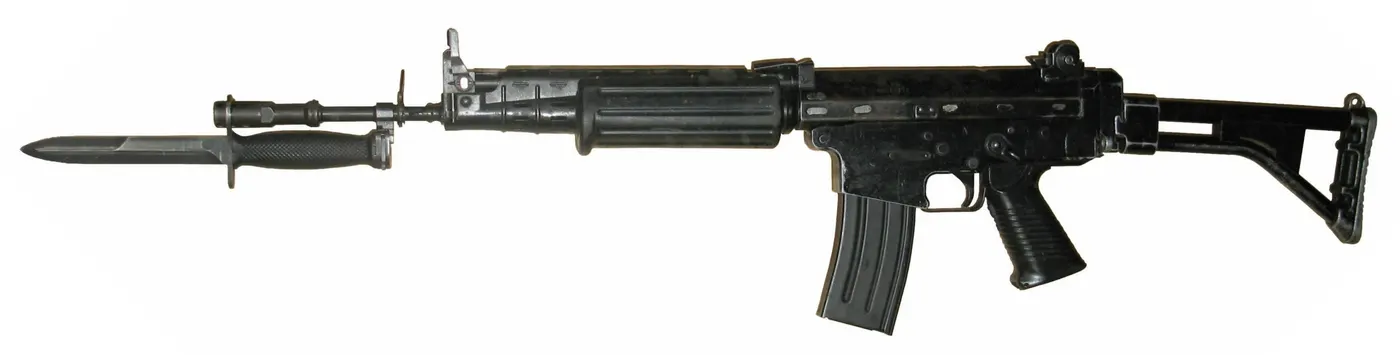

The FN FNC (Fabrique Nationale Carabine) is a Belgian gas-operated, select-fire assault rifle chambered in 5.56x45mm NATO, built by FN Herstal to recover from the commercial failure of its own predecessor, the FN CAL.1 It entered production in 1979 and stayed in production until 2004, a run of a quarter century that outlasted most of the rifles it was originally designed to beat in trials.2 The FNC never became a single NATO-wide standard rifle (no such single rifle standard ever existed), but it became the service weapon of Belgium, was built under license in Indonesia as the Pindad SS1, and was adapted by Sweden into the Ak 5.
- Simple, AK-derived long-stroke piston reliability
- Cheaper to manufacture than milled competitors
- Compact folding-stock Para variant for airborne use
- Proven in three separate licensed production lines
- Handles heat, dust and sand well in field reports
- Heavier than later polymer-framed rivals at 3.84 kg empty
- Lost the original 1970s NATO trial cycle outright
- Limited rail/accessory modularity by modern standards
- Three-round burst ratchet quirk confuses some shooters
- Largely superseded in first-line service by the FN SCAR
FN built the FNC around a gas-operated long-stroke piston system and a rotating bolt, a mechanical layout that borrows heavily from the Kalashnikov family rather than from FN's own earlier FAL.3 The upper receiver is stamped steel, the lower receiver and magazine housing are aluminum alloy, and the whole rifle was engineered from the outset to be cheaper to build than a fully machined design like the Heckler & Koch G41 or the American ArmaLite AR-15 family.3 It weighs 3.84 kg empty, cycles at roughly 700 rounds per minute, and feeds from a 30-round detachable magazine.4 Belgium, Sri Lanka, Vietnam, Venezuela, Mali, Libya, Nigeria, Mongolia, Tonga, Timor-Leste, and, since 2022, Ukraine have all fielded FNC-pattern rifles.5
{{photo-req side=right q="FN FNC rifle Belgian army soldier" caption="A Belgian soldier with the FN FNC, adopted as Belgium's standard rifle in 1989." alt="Soldier holding an FN FNC assault rifle"}}
The rifle's history is really a story of a second attempt succeeding where a first attempt failed. FN's earlier CAL rifle had been too complex and too fragile for troops to maintain in the field, and it performed poorly in early 1970s France-hosted NATO rifle trials.1 The FNC, developed as a deliberate simplification of the CAL between 1975 and 1977, was rushed into the subsequent NATO evaluation cycle and lost there too. FN did not give up. A reworked prototype tested well with the Swedish and Belgian armies in 1981 and 1982, and from that point the FNC's export and licensing story took off, eventually putting FNC-pattern rifles into the hands of soldiers on four continents.
The FN FNC's mechanism is often summarized simply as AK internals, FN manufacturing. The bolt carrier group rides on a long-stroke gas piston mounted above the barrel, and the rotating bolt locks into the barrel extension with two lugs, cammed open and closed by a guide slot in the carrier, the same basic geometry Mikhail Kalashnikov used decades earlier, but reworked for CNC-era production tolerances.3 Unlike a true AK, the FNC's gas piston rod can be separated from the bolt carrier during routine field-stripping, a small but genuinely useful maintenance improvement.3 The fire selector offers safe, semi-automatic, three-round burst, and full-automatic settings, and the burst mechanism has an unusual quirk worth noting for anyone comparing it to the American M16A2, its three-position ratchet resets the instant the trigger is released rather than only after a complete three-round burst fires, so a shooter who taps the trigger gets fewer than three rounds and picks up the count again on the next pull.6
- İlk Üretim Yılı1979
- Hizmete Giriş Yılı1979
- TasarımcıFN Herstal
- Ağırlık (Boş)3,84 kg
- Halen HizmetteEvet
- Önemli KullanıcılarBkz. Kullanıcılar bölümü
Two barrel lengths were offered from the start, a 450 mm standard-length Model 2000 rifle barrel and a 363 mm Model 7000 short carbine barrel for the FNC Para variant used by airborne and special-purpose units.7 Barrel rifling twist also came in two flavors, a 178 mm (one turn in 7 inches) twist for the military-standard heavier SS109/M855-type bullets, and a slower 305 mm (one turn in 12 inches) twist offered on some commercial and law-enforcement-pattern carbines built for lighter civilian ammunition.8 The FNC's muzzle velocity runs around 965 m/s, with an effective point-target range near 250 m and a maximum range figure closer to 450 m, numbers broadly in line with other 5.56x45mm NATO service rifles of the period.4 A folding stock, a bayonet lug, and grenade-launching capability round out the standard package, though FN itself has always described the FNC's accessory modularity as limited compared to what followed it.9
- Fişek5.56×45mm NATO
- Çap5,56 mm
- Kovan Uzunluğu44,7 mm
- Çap Sınıfıorta güçlü
- Kenar AteşlemeliHayır
- Kovansız MühimmatHayır
{{photo-req side=left q="FN FNC rifle field stripped disassembled parts" caption="The FN FNC field-stripped, showing the long-stroke gas piston and stamped-steel upper receiver." alt="FN FNC assault rifle disassembled into its main components"}}
- Mekanizma TipiGazlı
- Atış Modlarıseçmeli ateş
- Seçmeli AtışEvet
- Besleme SistemiÇıkarılabilir Şarjör
- Şarjör Kapasitesi30
- Teorik Atış Hızı700
- Tetik Tipihoroz tipi
- Emniyet Tipiseçici anahtar
- Namlu Çıkış Hızı965 m/sn
- Etkili Menzil (nokta)250 m
- Azami Menzil450 m
- Namlu Uzunluğu450 mm
- Yiv Adımı178 mm (1:7) veya 305 mm (1:12)
- Yiv Sayısı6
- Nişangah TipiKatlanır halka gez ve arpacık
- Açık NişangahEvet
- Katlanır / Toplanır DipçikEvet
- Bullpup DüzeniHayır
- Modülerliksınırlı
- Süngü TakozuEvet
- Bombaatar KabiliyetliEvet
- Gaz PistonluEvet
- Üretim Başlangıcı1979
- Üretim Bitişi2004
- Genişlik70 mm
- Yükseklik238 mm
FN Herstal's road to the FNC began with failure. The company's first 5.56mm rifle, the FN CAL, reached the market in the late 1960s but proved too complicated to manufacture cheaply and too delicate for sustained field use, and it performed poorly when FN entered it in the early-1970s NATO trials held in France.1 Rather than abandon the caliber, FN's engineers spent 1975 to 1977 stripping the CAL design down, producing the FNC 76 prototype as a deliberately simplified successor.1 That prototype was submitted to the wider NATO evaluation process running through the late 1970s, and it lost again, this time because the design was still too immature and under-tested to compete against more polished submissions.1
The rifle's best-known screen appearance came in Michael Mann's 1995 crime film Heat, where Lt. Vincent Hanna, played by Al Pacino, carries a real select-fire FNC cut down to a Para-length barrel and fitted with an M16-style flash hider during the downtown Los Angeles shootout.10 Mann had Pacino fire it in semi-automatic only, a deliberate contrast with the robbers spraying full-automatic fire into a crowded street, and the choice of an unusual Belgian rifle for a lead character's weapon is still remembered by firearms-focused film critics decades later.10
FN did not walk away from the redesign. A further-refined prototype went through trials with the Swedish and Belgian armies in 1981 and 1982, and this time the rifle earned genuinely positive marks from both countries' testers.1 Indonesia became the first foreign buyer, purchasing roughly 10,000 FNC rifles in 1982 for its air force, a purchase that led directly to a February 1983 licensing agreement between FN and Indonesia's state technology agency BPPT.12 Under that agreement, Pindad began domestic production at its Bandung factory in 1984, was obligated to build a minimum of 200,000 rifles under license, and issued its own version, the SS1, into full Indonesian service by 1991.12
{{photo-req side=right q="Pindad factory Bandung Indonesia small arms production" caption="Pindad's Bandung facility began licensed production of the FNC as the SS1 in 1984." alt="Firearms production facility in Indonesia"}}
Sweden followed a similar path. The Swedish army selected the FNC over the Heckler & Koch G41, and after further Swedish-specific modifications, licensed production began at Bofors' Karl Gustaf works, with the first Belgian-made deliveries arriving in 1986 and Swedish-built rifles, redesignated Ak 5, entering service from 1987.13 The Swedish modifications dropped the three-round burst setting entirely, enlarged the trigger guard for gloved winter use, thickened the handguard, and applied a more corrosion-resistant metal finish suited to Sweden's coastal and arctic conditions.13 Belgium itself came last among the major early adopters. The FNC had already equipped Belgian airborne infantry in small numbers for several years before it was finally adopted service-wide in 1989, replacing the older 7.62x51mm FAL across the whole Belgian army.1
Belgian FNC rifles saw their first extended overseas deployment with the 1st Parachute Battalion during the United Nations Operation in Somalia II (UNOSOM II) between December 1992 and March 1995, where Belgian paratroopers used the rifle for security patrols, convoy escort, and protection of humanitarian aid distribution around Kismayo and Mogadishu in Somalia.14 Field reports from the deployment describe the rifle handling Somalia's dust and heat without the widespread stoppages that plagued some other NATO-pattern rifles in similar climates, though the mission's emphasis on stabilization rather than sustained combat limited how hard the rifle was tested.14
{{photo-req side=left q="UNOSOM Somalia Belgian peacekeepers 1993" caption="Belgian peacekeeping troops during the UNOSOM II mission in Somalia, where the FNC saw its first extended overseas use." alt="UN peacekeeping troops on patrol in Somalia in the early 1990s"}}
Outside formal state service, FNC-pattern rifles surfaced repeatedly in African and South Asian conflicts through captured stocks, arms transfers, and regional proliferation. Militants in Nigeria's conflict in the Niger Delta carried FNC rifles alongside a wide mix of other small arms during clashes over oil infrastructure and territorial control from 2003 onward.15 The rifle was also documented among small arms in circulation during Libya's post-Gaddafi weapons proliferation and appears on inventory lists for Sri Lanka's armed forces, which fought a decades-long counter-insurgency during the Sri Lankan civil war against the Tamil Tigers.16 During the Tuareg rebellion (1990-1995) in Mali and Niger, captured FNC rifles were of comparatively little use to Tuareg fighters specifically because the rifle's 5.56x45mm NATO chambering was an unusual, hard-to-resupply caliber in a region still dominated by Warsaw Pact-pattern 7.62x39mm weapons.17
The most consequential recent chapter came after Belgium began replacing the FNC in front-line units with the FN SCAR-L. Rather than destroy the surplus rifles, Belgium donated 5,000 FNC-pattern rifles to Ukraine in 2022, alongside ammunition, 200 M72 LAW anti-tank weapons, and fuel, as part of the broader Western response to the Russo-Ukrainian War following the 2022 Russian invasion of Ukraine.18 The donated FNCs became one of the more common Western rifles carried by Ukraine's International Legion, valued for reliability and for firing the increasingly standard 5.56x45mm NATO round even though volunteers frequently described the rifle as heavier and less accessory-friendly than more modern designs.19
{{photo-req side=right q="Ukrainian soldier 2022 NATO rifle donated western weapons" caption="A Ukrainian volunteer fighter with a Western-supplied rifle in 2022, the year Belgium donated 5,000 surplus FNC rifles to Ukraine." alt="Soldier in Ukraine holding a NATO-pattern service rifle in 2022"}}
The baseline FN FNC 80 covers two configurations, the full-length Model 2000 rifle with a 450 mm barrel and the shortened Model 7000 Para carbine with a 363 mm barrel intended for airborne troops and vehicle crews, internally designated FNC M2 and FNC M3 in Belgian service.7 FN also sold semi-automatic-only civilian and law-enforcement carbines, the Model 7030 (short barrel, 1 to 7 twist) and the Model 6040 (longer 410 mm barrel, 1 to 12 twist for commercial ammunition), both still capable of mounting a bayonet and launching rifle grenades despite lacking the military rifle's automatic fire modes.8
The most significant foreign variant is Indonesia's Pindad SS1, built under the 1983 FN license and modified for tropical use and Indonesian ergonomics, which stayed in front-line Indonesian service from 1991 until being progressively replaced by the newer, domestically developed Pindad SS2.12 Sweden's Ak 5 family went further than any other licensee in diverging from the base FNC, spawning the Ak 5B designated-marksman variant with a fixed 4x SUSAT L9A1 telescopic sight and a cheek-raised stock, the railed Ak 5C with no iron sights at all, and the shortened Ak 5D commando variant with an integral carrying-handle sight, built for Swedish paratroopers.13
{{photo-req side=left q="Ak 5 rifle Swedish army soldier" caption="A Swedish soldier with the Ak 5, the Bofors-built licensed derivative of the FN FNC that dropped the three-round burst setting." alt="Soldier holding an Ak 5 rifle, the Swedish variant of the FN FNC"}}

| Yıl | Alıcı | Adet | Tutar | Bugünkü Değer (2025) |
|---|---|---|---|---|
| 1986 |  İsveç | — | — | — |
Belgium remains the FNC's home operator, though front-line units have largely transitioned to the FN SCAR-L, leaving the FNC in reserve, training, and support roles.18 Indonesia still fields large numbers of the Pindad-built SS1 derivative, and Sweden's Ak 5 family remains a current-issue rifle across multiple variants. Smaller-scale operators span a wide geographic range, Vietnam, Venezuela, Mali, Libya, Nigeria, Mongolia, Sri Lanka, El Salvador, Timor-Leste, and the small Pacific kingdom of Tonga, whose entire defense force still issues the FNC as its standard rifle.5 Since 2022, Ukraine has fielded thousands of Belgian-donated FNC rifles, making it one of the newest operators on the list decades after the rifle's original adoption cycle ended.18
{{photo-req side=right q="Tonga Defence Services soldiers rifle" caption="Tonga's small defense force is among the more unusual operators still issuing the FN FNC as a standard rifle." alt="Pacific island nation's soldiers on parade with rifles"}}
Two rifles chased the same post-1980 SS109 standardization opportunity with opposite results, the Heckler & Koch G41 and the FN FNC. Both were pitched at NATO militaries looking for an affordable 5.56x45mm rifle, but the G41 stuck with Heckler & Koch's roller-delayed blowback action inherited from the G3, while the FNC used a simpler, cheaper AK-style gas piston and rotating bolt.20 The FNC won real national contracts in Belgium, Sweden, and Indonesia. The G41 never won a major production contract of its own, losing out to the FNC in Sweden's own trials and later losing an Irish Army competition to the Austrian Steyr AUG.20
| Spec | FN FNC | Heckler & Koch G41 |
|---|---|---|
| Cartridge | 5.56x45mm NATO | 5.56x45mm NATO |
| Action | Gas-operated, rotating bolt | Roller-delayed blowback |
| Empty weight | 3.84 kg | approx. 4.1 kg |
| Major adopters | Belgium, Sweden, Indonesia | None (no major contract) |
Set against the Steyr AUG, the comparison is less about mechanism and more about layout philosophy. The AUG's bullpup design packs a full-length barrel into a submachine-gun-length receiver and was adopted by more than thirty countries, a scale of international success the conventionally-laid-out FNC never matched.21 Where the FNC wins the argument is familiarity and simplicity of training, its layout, controls, and manual of arms sit close enough to the AK pattern that instructors in countries with mixed Cold War-era inventories found it an easier transition than the AUG's reversed, trigger-integrated fire selector.


What caliber does the FN FNC use? The FN FNC fires the 5.56x45mm NATO cartridge, the same intermediate round used by the M16 and most modern NATO-pattern rifles, fed from a 30-round detachable box magazine.4
Is the FN FNC still in service? Yes, though mostly in secondary roles. Belgium has moved its front-line infantry to the FN SCAR-L, but the FNC remains in Belgian reserve and training use, and it is still a current-issue rifle in Sweden (as the Ak 5), Indonesia (as the Pindad SS1), and a number of smaller operators including Tonga and Timor-Leste.5
How does the FN FNC compare to the M16? The FN FNC and the M16 share a caliber but use completely different mechanisms, the FNC's gas piston and rotating bolt are closer to Kalashnikov-family designs, while the M16 uses direct gas impingement. FN specifically marketed the FNC as a cheaper, simpler-to-maintain alternative to the M16 during the late-1970s NATO trials.1
What is the FN FNC's unit cost today? Original military production prices are not publicly documented, but on the modern US civilian collector market, transferable pre-1986 select-fire FNC rifles sell for roughly $18,000 to $22,000, while imported semi-automatic-only commercial models trade in the $3,500 to $5,750 range depending on condition.11
Why did Indonesia and Sweden build the FNC under license instead of importing it? Both countries pursued domestic small-arms production for industrial and strategic self-sufficiency reasons. Indonesia's Pindad license, signed in 1983, required a minimum production run of 200,000 rifles before royalty obligations to FN ended, while Sweden's Bofors-built Ak 5 let Swedish industry retool the design with its own corrosion-resistant finish and ergonomics for Nordic conditions.12,13
- "FN FNC", Wikipedia — en.wikipedia.org ↩
- "FN FNC: The Belgian 5.56mm NATO Carbine", Forgotten Weapons — forgottenweapons.com ↩
- "Fabrique Nationale (FN) FNC", Modern Firearms — modernfirearms.net ↩
- "Fabrique Nationale FN FNC Assault Rifle / Assault Carbine", Military Factory — militaryfactory.com ↩
- "FN FNC", War on West Papua — waronwestpapua.org ↩
- "FN FNC: Underappreciated Icon?", Gun Digest — gundigest.com ↩
- "FN FNC | Weaponsystems.net" — weaponsystems.net ↩
- "Fabrique Nationale's Carbine: The FNC in America", Small Arms Review — smallarmsreview.com ↩
- "FN FNC Assault Rifle", Military Today — militarytoday.com ↩
- "FN FNC from the Heat Shootout Scene", Breach Bang Clear — breachbangclear.com ↩
- "FNC New and Used Price, Value, & Trends 2026", True Gun Value — truegunvalue.com ↩
- "Pindad SS1", Wikipedia — en.wikipedia.org ↩
- "Ak 5", Wikipedia — en.wikipedia.org ↩
- "United Nations Operation in Somalia II", Wikipedia — en.wikipedia.org ↩
- "Conflict in the Niger Delta", Wikipedia — en.wikipedia.org ↩
- "Sri Lanka Infantry Arms List (Current and Former Types)", Military Factory — militaryfactory.com ↩
- "Tuareg rebellion (1990-1995)", Wikipedia — en.wikipedia.org) ↩
- "Belgium offers 5,000 FNC assault rifles and 200 M72 LAW anti-tank weapons to Ukraine", Army Recognition — armyrecognition.com ↩
- "Meet the FN FNC: The Deadly Rifle of Ukraine's Foreign Legion", 19FortyFive — 19fortyfive.com ↩
- "Heckler & Koch G41", Wikipedia — en.wikipedia.org ↩
- "Steyr AUG", Wikipedia — en.wikipedia.org ↩