

Data Quality85%
MASS(Military Archive Scoring System)
ⓘ Regardless of era, the same scoring system applies to all units in the tanks category.
01 / Overview
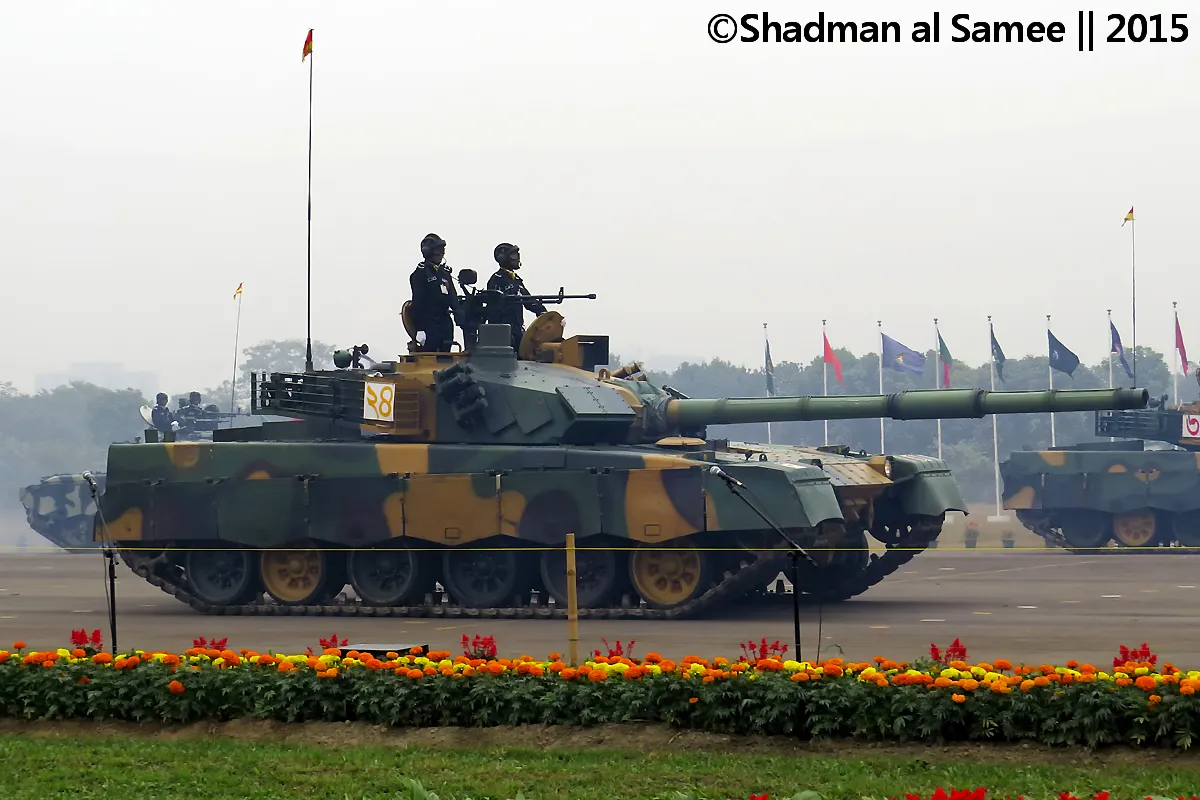
MBT-2000
Category
Prime contractor
Production
2001–
Operators
💰 PERFORMANCE / PRICE ASSESSMENT Methodology ↗
ⓘ Performance/Price and MASS score are computed across all units in the tanks category, regardless of era.
02 / Specs & Design
◎General4MOD.4
- Tank ClassificationMain Battle Tank (MBT)
- GenerationModern
- Combat Weight48 t
- Crew Size3
◈Firepower11MOD.11
- Main Gun Calibre125 mm
- Main Gun TypeSmoothbore
- Main Gun Length (Calibres)48
- Muzzle Velocity (Max)1,760 m/s
- Effective Range (Main Gun)3,000 m
- Ammunition Stowage39
- Can Fire APFSDSYes
- Can Fire HEATYes
- Can Fire HE-FragYes
- Can Fire ATGMYes
- Coaxial / Secondary MG Count1
▣Protection5MOD.5
- Armour TypeReactive Composite
- Has ERAYes
- Has APSNo
- NBC ProtectionYes
- Smoke GrenadesYes
◇Mobility8MOD.8
- Engine Power1,200 hp
- Power-to-Weight Ratio25 hp/t
- Fuel TypeDiesel
- Transmission TypeManual
- Suspension TypeTorsion Bar
- Max Road Speed65 km/h
- Max Off-Road Speed45 km/h
- Operational Range (Road)450 km
◆Dimensions4MOD.4
- Length (Hull)6.8 m
- Width3.5 m
- Height2.3 m
- Ground Clearance0.45 m
▤Electronics & Optics8MOD.8
⬢Amphibious & Special3MOD.3
▲Production & Service1MOD.1
- Current Service StatusActive Service
03 / History
SERVICE LIFESPANStill in Service
- 2001Production started
25
years in service
4
countries operating


05 / MASS Score
TANKS RANKING Tanks · Post-Cold War


MASS RANKINGSMASS ↗
ⓘ Rankings are within theTankscategory.
📖 TERMS ON THIS PAGE20terms
Armour-piercing fin-stabilized discarding sabot: a type of kinetic energy penetrator ammunition.
Anti-Tank Guided Missile: a missile designed to destroy tanks.
Automated loading system for tank guns, reducing crew workload.
A Battle Management System (BMS) is a command‑and‑control software suite that gathers, processes, and shares battlefield data to provide situational awareness and coordinate the actions of military units.
Computerised Advanced: a tank fire‑control system generation that uses digital computers to calculate ballistic solutions and integrate sensor data for enhanced targeting accuracy.
Type of internal combustion engine fuel, refined from crude oil.
Explosive Reactive Armor (ERA): Modular armor system that detonates upon impact to disrupt incoming warheads, reducing penetration of shaped charges and kinetic energy projectiles.
High-Explosive Fragmentation: ammunition that explodes on impact, releasing fragments.
High-Explosive Anti-Tank: a type of projectile that uses a shaped charge to penetrate armor.
Optical device that uses laser pulses to measure the distance to a target with high precision.
A main battle tank is a heavily armored vehicle with a large caliber gun, used for front-line combat.
Manual: a tank transmission in which the driver selects gear changes manually, typically using a clutch pedal and gear lever to engage gears.
Nuclear, Biological, Chemical protection for tank crews.
Enhanced low-light visibility through specialized optics or sensors.
Reactive composite armor is a tank armor type that combines layers of composite material with embedded reactive elements that detonate on impact to disrupt incoming projectiles.
Handheld or vehicle-mounted devices that release dense smoke to obscure vision, conceal movements, or screen friendly forces from enemy observation.
A smoothbore gun is a firearm with an unrifled barrel, allowing projectiles to travel without spin; it is commonly used in modern tank main guns for firing fin‑stabilized ammunition.
Thermal sights are infrared imaging devices mounted on a tank's gunner station that detect heat emitted by objects, enabling target identification and aiming in low‑visibility conditions.
A torsion bar is a steel rod that resists twisting and serves as a spring in tank suspensions, with one end fixed to the hull and the other connected to a lever arm moving the road wheel.
These terms are listed automatically because they appear on this page.full encyclopedia →
📚 Sources