

Data Quality86%
MASS(Military Archive Scoring System)
ⓘ Regardless of era, the same scoring system applies to all units in the tanks category.
01 / Overview
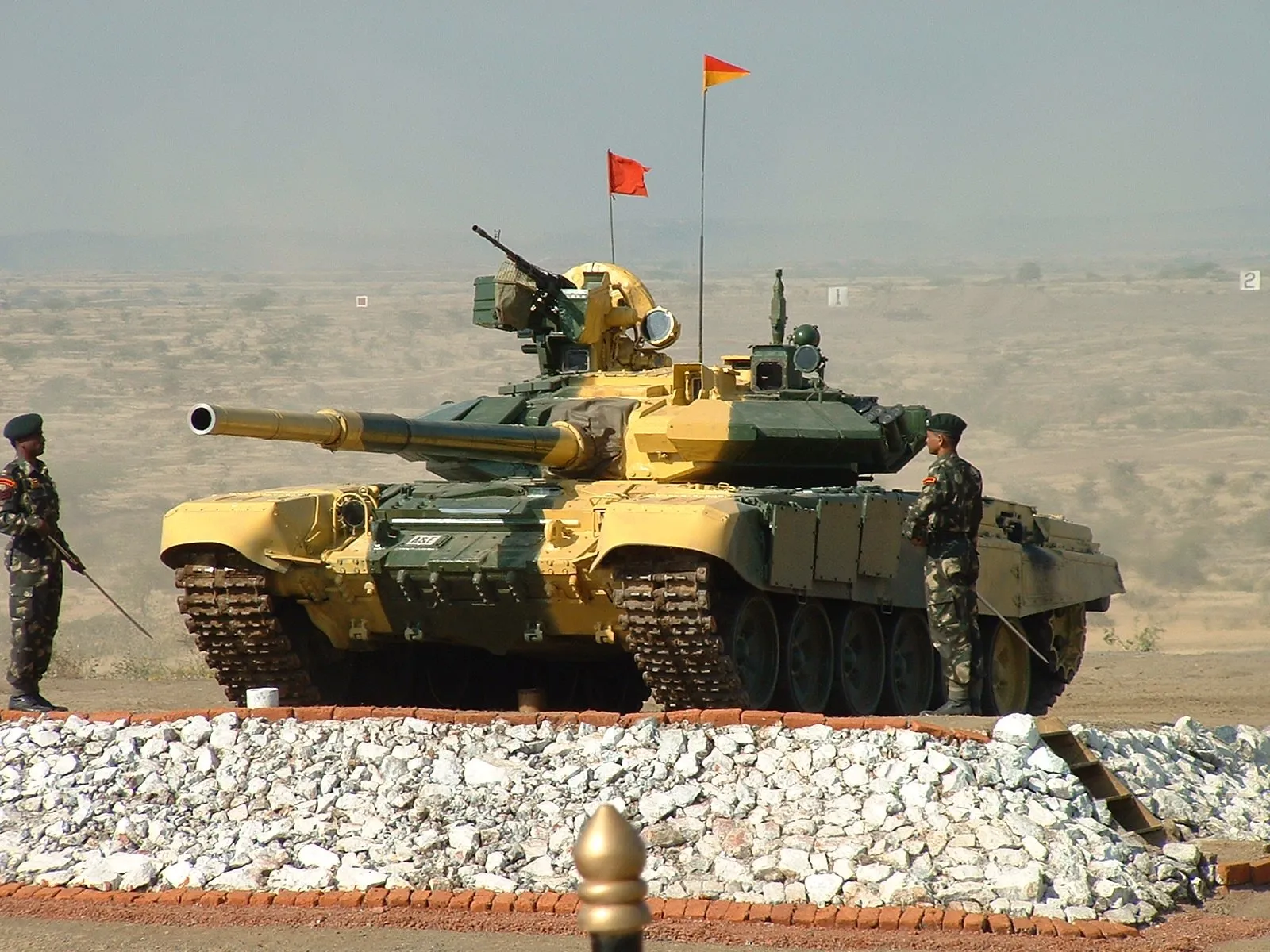
Bhishma tank
Category
Country
Production
2001–
Quantity
1,400
Unit Price (current)
$6.0M↗ 34% inflation · 2016→2025
Original Price
$4.5M (2016)
Operators
Conflicts
💰 PERFORMANCE / PRICE ASSESSMENT Methodology ↗
TANKS · POST-COLD WAR
23
PERFORMANCE/PRICE
82
UNIT COST (2025 USD)
$6.0M
Original: $4.5M (2016)
Inflation: +%34
ⓘ Performance/Price and MASS score are computed across all units in the tanks category, regardless of era.
02 / Specs & Design
◎General5MOD.5
- Tank ClassificationMain Battle Tank (MBT)
- GenerationPost-Cold War
- Combat Weight48 t
- Crew Size3
- Service Entry Year2001
◈Firepower11MOD.11
- Main Gun Calibre125 mm
- Main Gun TypeSmoothbore
- Main Gun Length (Calibres)48
- Muzzle Velocity (Max)1,700 m/s
- Effective Range (Main Gun)4,000 m
- Ammunition Stowage43
- Can Fire APFSDSYes
- Can Fire HEATYes
- Can Fire HE-FragYes
- Can Fire ATGMYes
- Coaxial / Secondary MG Count1
▣Protection9MOD.9
- Armour TypeReactive Composite
- Hull Front Thickness (Max)800 mm
- Turret Front Thickness (Max)1,000 mm
- Frontal RHA Equivalent (KE)1,000 mm
- Frontal RHA Equivalent (CHEM)1,550 mm
- Has ERAYes
- Has APSYes
- NBC ProtectionYes
- Smoke GrenadesYes
◇Mobility9MOD.9
- Engine Power1,130 hp
- Power-to-Weight Ratio23.54 hp/t
- Fuel TypeDiesel
- Transmission TypeFully Automatic
- Suspension TypeTorsion Bar
- Max Road Speed60 km/h
- Max Off-Road Speed45 km/h
- Operational Range (Road)550 km
- Fording Depth1.2 m
◆Dimensions5MOD.5
- Length (Hull)6.86 m
- Length (Overall, Gun Forward)9.63 m
- Width3.78 m
- Height2.22 m
- Ground Clearance0.47 m
▤Electronics & Optics8MOD.8
⬢Amphibious & Special2MOD.2
- Snorkel / Deep Wading Depth5 m
- Dozer Blade CapabilityYes
▲Production & Service4MOD.4
- Total Production Units1,400
- Years in Production22 year
- Current Service StatusActive Service
- Notable Variants Count1
03 / History
SERVICE LIFESPANStill in Service
- 2001Production started
- 2010First deployment: Arab Spring
25
years in service
1,400
units produced
15
countries operating
ⓘ The producing country still actively operates it. 1 countries retired it.
04 / Conflicts
BHISHMA TANK · CONFLICTS SERVED IN0% win·100% loss
Total Conflicts
1
Victories
0
Ongoing
0
Losses
1
ⓘ Shown only from conflicts recorded in our database.
05 / Variants
▚ WEAPON FAMILY
 Bhishma tank
06 / Operators
Operator Inventory9country · 2,579units


2,579active
07 / MASS Score
TANKS RANKING Tanks · Post-Cold War


MASS RANKINGSMASS ↗
122TANKS23POST-COLD WAR · TANKS818RUSSIA · ALL WEAPONS18PRICE · TANKS363PRICE · ALL WEAPONS39PERFORMANCE/PRICE · TANKS
ⓘ Rankings are within theTankscategory.
📖 TERMS ON THIS PAGE22terms
Armour-piercing fin-stabilized discarding sabot: a type of kinetic energy penetrator ammunition.
Active Protection System. A defensive system that detects and intercepts anti-tank threats.
Anti-Tank Guided Missile: a missile designed to destroy tanks.
Automated loading system for tank guns, reducing crew workload.
A Battle Management System (BMS) is a command‑and‑control software suite that gathers, processes, and shares battlefield data to provide situational awareness and coordinate the actions of military units.
Computerised Advanced: a tank fire‑control system generation that uses digital computers to calculate ballistic solutions and integrate sensor data for enhanced targeting accuracy.
Type of internal combustion engine fuel, refined from crude oil.
A front-mounted armored plate on a tank, primarily used for clearing obstacles, creating cover, or breaching fortifications.
Explosive Reactive Armor (ERA): Modular armor system that detonates upon impact to disrupt incoming warheads, reducing penetration of shaped charges and kinetic energy projectiles.
A fully automatic tank transmission shifts gears without driver intervention, using hydraulic or electronic controls to select appropriate gear ratios based on engine speed and vehicle load.
High-Explosive Fragmentation: ammunition that explodes on impact, releasing fragments.
High-Explosive Anti-Tank: a type of projectile that uses a shaped charge to penetrate armor.
Optical device that uses laser pulses to measure the distance to a target with high precision.
A main battle tank is a heavily armored vehicle with a large caliber gun, used for front-line combat.
Nuclear, Biological, Chemical protection for tank crews.
Enhanced low-light visibility through specialized optics or sensors.
Reactive composite armor is a tank armor type that combines layers of composite material with embedded reactive elements that detonate on impact to disrupt incoming projectiles.
Handheld or vehicle-mounted devices that release dense smoke to obscure vision, conceal movements, or screen friendly forces from enemy observation.
A smoothbore gun is a firearm with an unrifled barrel, allowing projectiles to travel without spin; it is commonly used in modern tank main guns for firing fin‑stabilized ammunition.
Thermal sights are infrared imaging devices mounted on a tank's gunner station that detect heat emitted by objects, enabling target identification and aiming in low‑visibility conditions.
A torsion bar is a steel rod that resists twisting and serves as a spring in tank suspensions, with one end fixed to the hull and the other connected to a lever arm moving the road wheel.
These terms are listed automatically because they appear on this page.full encyclopedia →
📚 Sources