


The M48 Patton is a first-generation Cold War medium/main battle tank developed in the United States and introduced into service in 1953.1 It was named after General George S. Patton, commander of the U.S. Third Army in World War II and an early advocate of American armored doctrine; the M48 was the third and final tank type to carry the Patton name.2 Designed to replace the earlier M47 Patton, it was, according to The Army Historical Foundation, the first U.S. medium gun tank with a four-man crew, achieved through a centerline driver's compartment that eliminated the bow machine gunner (a fifth crew member).2
The first functioning prototype, with both chassis and turret, was built by Chrysler in Michigan in January 1952 and standardized as the "90mm Gun Tank M48."2 Roughly 12,000 were built between 1952 and 1961, principally by Chrysler, the Ford Motor Company, Fisher Body, and the American Locomotive Company.1,2
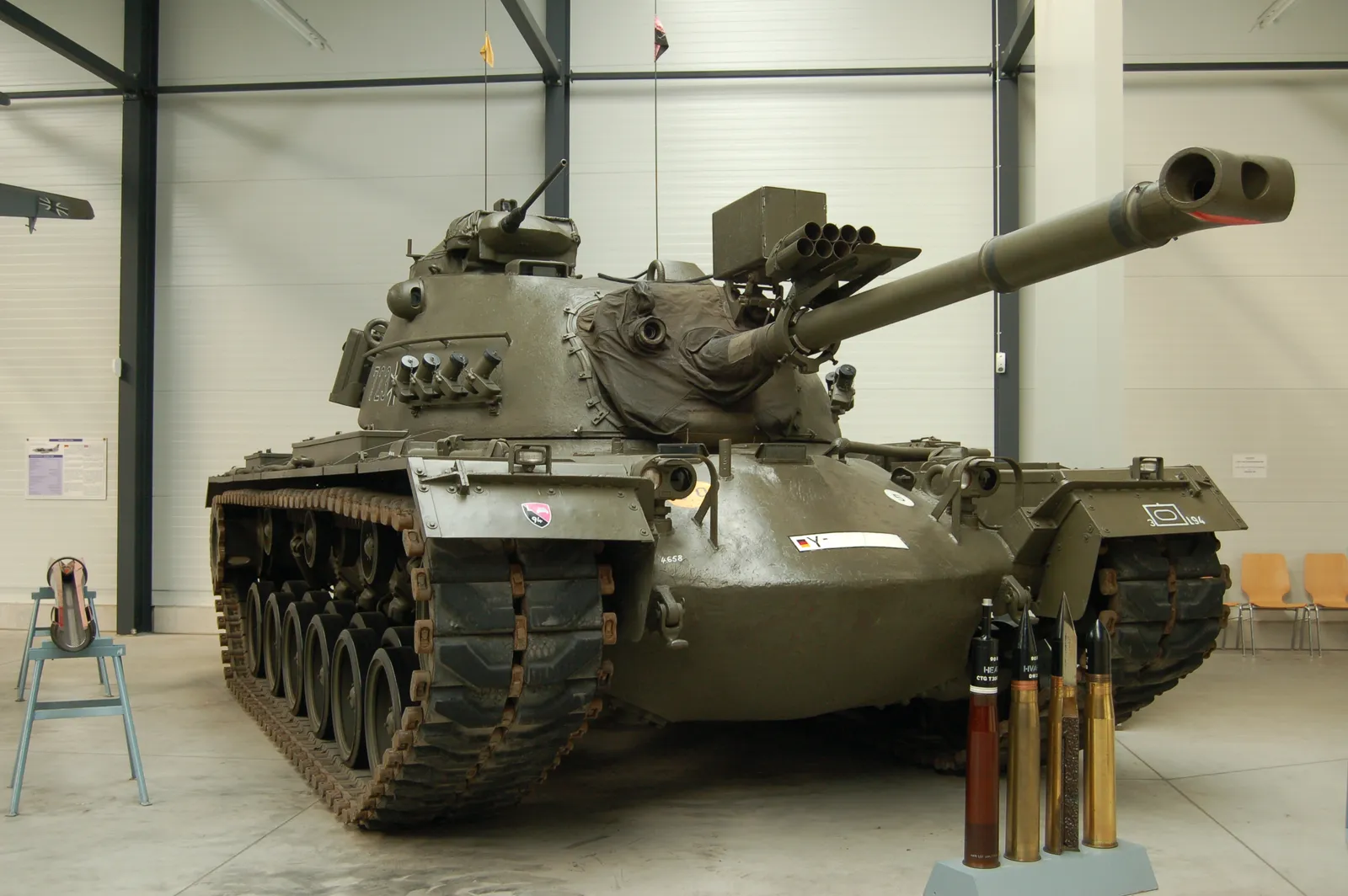
The M48 became the principal tank of the U.S. Army and Marine Corps in the Vietnam War and was widely supplied to NATO and allied armies.1 The standard M48 carried a 90 mm rifled gun from the era preceding high-velocity modern tank guns; the design was rearmed with a 105 mm gun in the 1975 M48A5 version.1
The M48's technical data is grouped below into firepower, protection, mobility, and electronics; each group's figures appear as a separate panel beneath the relevant commentary.
The main armament was the 90 mm M41 rifled gun, with the tank carrying 60 to 64 rounds of 90 mm ammunition depending on variant.1,2 Secondary armament consisted of a 12.7 mm (.50 cal) M2 Browning heavy machine gun in the commander's cupola and one 7.62 mm (originally .30 cal) machine gun mounted coaxially with the main gun.1 In the M48A5 upgrade the 90 mm gun was replaced by the 105 mm M68 gun, shared with the M60.1
The armor was made of cast steel. The hull front (glacis) plate was 110 mm thick at 60°, which corresponds to roughly 220 mm of effective line-of-sight thickness.1 The cast turret front was about 110 mm according to GlobalSecurity data.4 The tank was fitted with an NBC (nuclear-biological-chemical) protection system and smoke-grenade capability; like its contemporaries, it had no explosive reactive armor (ERA) or active protection system (APS).1
Early M48 versions used the Continental AV-1790 12-cylinder gasoline engine, producing 810 hp in the M48/M48A1 and 825 hp in the fuel-injected M48A2.1 Because of the gasoline engine's fire risk and limited range, the M48A3 and M48A5 versions were converted to the Continental AVDS-1790 turbo-diesel (750 hp).1 The practical effect was a marked increase in range: the early gasoline M48 had a road range of about 113 km, whereas the diesel M48A3 reached 463–499 km.1 Maximum road speed was 48 km/h; the tank used torsion-bar suspension and an Allison CD-850 hydromechanical transmission.1
The M48's fire control was, in keeping with its era, manual and optical; it lacked later-generation equipment such as a laser rangefinder, thermal sights, an autoloader, or a battle management system.1 Infrared (IR) night-vision equipment was added in later versions.1
General classification, dimensions, amphibious/special capability, and production/service data also appear as separate panels below. The M48 was not amphibious and had a fording depth of about 1.22 m.1
The M48 originated in the U.S. search, in 1950–1951, for a more modern medium tank to replace the M47 Patton. Development was assigned to Chrysler under the T48 program; the first prototype was completed in January 1952 and trialed at Fort Knox, Kentucky.2 The design moved the driver to the hull-front centerline, reducing the crew to four, and used a cast, hemispherical turret.1,2
Development Timeline
- 1950 — Requirement identified for a new medium tank to replace the M47
- 1951 — T48 development contract awarded to Chrysler
- 1952 — First prototype; standardized as "90mm Gun Tank M48," named Patton
- 1953 — M48A1 entered service
- 1955 — M48A2 — fuel-injected gasoline engine, redesigned engine deck
- 1957 — M48A3 — conversion to Continental AVDS-1790 diesel engine
- 1965 — Deployment to Vietnam (U.S. Marine Corps)
- 1975 — M48A5 — rearmed with the 105 mm M68 gun
The M48 saw combat across many conflicts during its service life. U.S. forces used it heavily in the Vietnam War; the first M48s came ashore in 1965 with the U.S. Marine Corps' 1st and 3rd Tank Battalions, and more than 600 Pattons were deployed over the course of the war.2 The U.S. 1st Infantry Division operated the M48A3 in Vietnam in roles including clearing roads to keep communication routes open and protecting troop and supply convoys.3
Israel purchased M48s, forming the basis of the Magach series; the Magach 1, 2, 3, and 5 marks were all based on the M48.1 Israeli M48s engaged Soviet-built T-54/55 tanks in the Sinai during the 1967 Six-Day War and were used in the 1973 Yom Kippur War.1 Pakistan used M48s (alongside M47s) in the 1965 and 1971 Indo-Pakistani Wars; at the Battle of Asal Uttar in September 1965, about 97 Pakistani tanks were lost, the majority of them Pattons (M47s and M48s).1 Turkey used M48s in the 1974 Cyprus operation.1
The recorded conflict list below summarizes the documented operations in which the tank served.
The M48 spawned a family of variants distinguished by engine, fire control, and armament. The principal versions are listed below.


The M48 was one of the most widely exported Western tanks of the Cold War. Beyond the United States, many countries took it into inventory, including Germany, Turkey, Greece, Spain, Israel, Pakistan, South Korea, Iran, Jordan, and Taiwan.1 According to the brief data, operators include Turkey with about 630 vehicles, Israel with 561, Greece and Taiwan with 450 each, Pakistan with 300, and Morocco with 225.
The United States operated the M48 until 1994; many countries kept the tank in inventory for decades through versions upgraded with the 105 mm gun.1 The operator list below shows the countries that used the tank.
Because the M48 is a first-generation tank (1953), placing it alongside later third-generation main battle tanks quantifies the generational gap in Cold War armored technology. Against the M48's 90 mm rifled gun and manual optical fire control, tanks such as the M1 Abrams and Leopard 2 use 120 mm smoothbore guns, composite armor, and digital fire-control systems.1 The table below compares basic characteristics.
The score components reflect the same generational gap: the M48 trails later-generation tanks in firepower and technology.


Where does the M48 get its name?
The tank is named after General George S. Patton; it is the third and final tank type to carry the Patton name.2
Why did the M48 switch from a gasoline engine to diesel?
The Continental AV-1790 gasoline engine of early M48 versions posed a fire risk and had limited range (about 113 km on roads). The Continental AVDS-1790 diesel introduced with the M48A3 raised range to 463–499 km.1
What is the main difference between the M48 and the M48A5?
The M48A5 (1975) replaced the 90 mm gun with the 105 mm M68 gun shared with the M60; it also received the diesel engine, an NBC system, and a 7.62 mm coaxial machine gun.1
How many M48s were built?
About 12,000 were built across all variants between 1952 and 1961; the principal manufacturers were Chrysler, Ford, Fisher Body, and the American Locomotive Company.1,2
The numerical values on this page are drawn from museum, official/academic reference, and encyclopedic sources; figures that vary by variant (range, engine power, gun caliber) are given with the relevant version noted.
- "M48 Patton" (specifications, variants, engine, armor, combat history), Wikipedia — en.wikipedia.org ↩
- "The M48 Patton Main Battle Tank", The Army Historical Foundation — armyhistory.org ↩
- "M48 Patton Tank", First Division Museum (Cantigny) — fdmuseum.org ↩
- "M48 Patton Tank — Specifications" (for armor thickness values), GlobalSecurity.org — globalsecurity.org ↩
- "M67 flame thrower tank" (for the M67 Zippo variant), Wikipedia — en.wikipedia.org ↩