

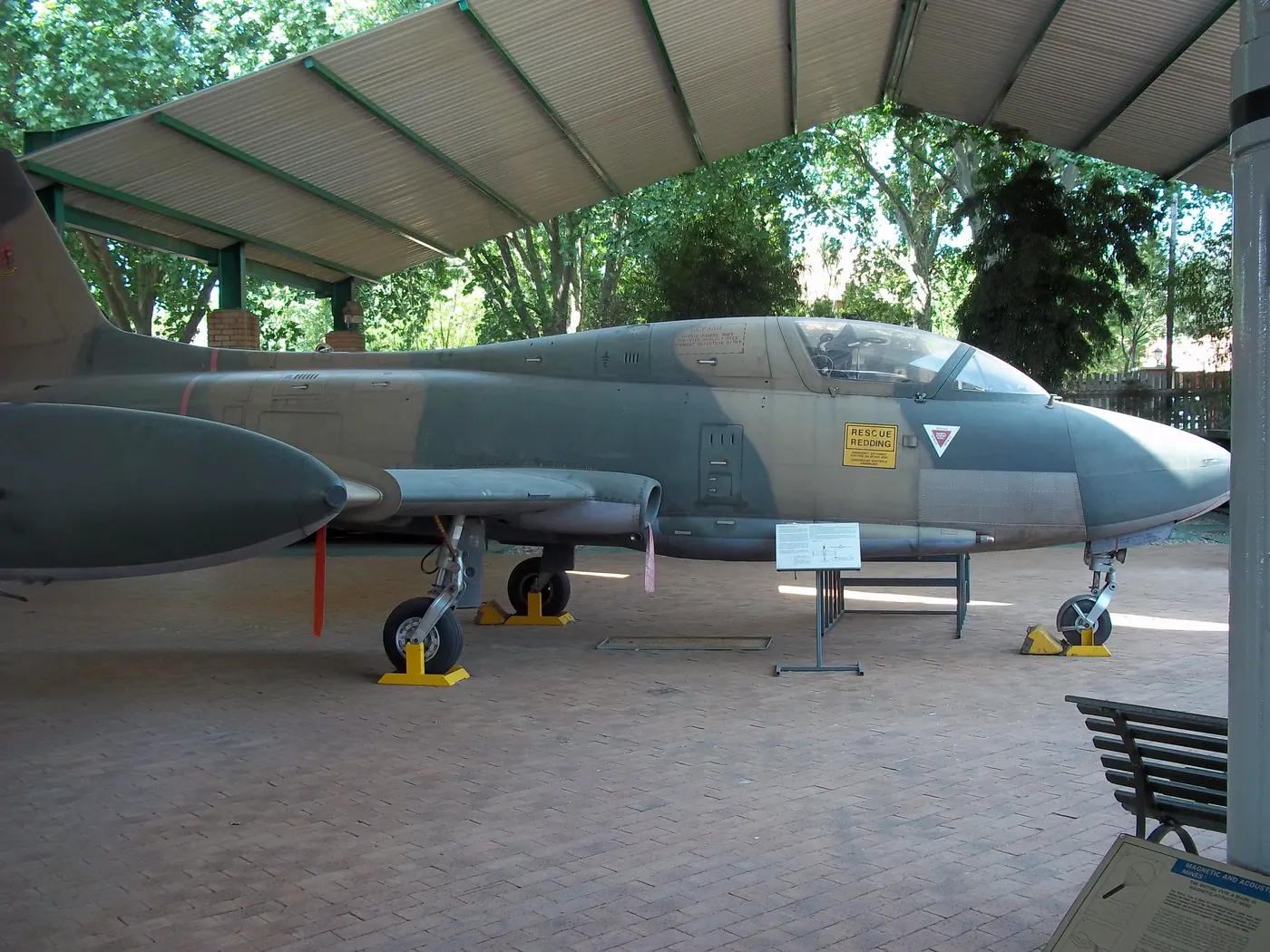
The Atlas Impala is the South African licence-built version of the Italian Aermacchi MB-326 jet trainer, produced from 1966 by the state-owned Atlas Aircraft Corporation under the Armaments Corporation of South Africa (Armscor). It exists in two forms sharing an airframe lineage but almost nothing else in role: the Impala Mk I, a two-seat trainer built to the Italian MB-326M standard, and the Impala Mk II, a single-seat light-attack aircraft derived from the export MB-326K and built to carry a war load the trainer never could.1 South Africa acquired the manufacturing licence in 1964, three years before it needed one for political reasons — the 1977 UN mandatory arms embargo made the domestic production line the only way to keep a jet-trained air force and a credible strike capability running. That accident of timing turned an ordinary trainer contract into a strategic asset.
- twin 30 mm cannon gives disproportionate punch for its size
- simple, rugged airframe suited to bush strips
- trainer and attack roles share one type, one supply chain
- built and sustained entirely outside the arms embargo
- subsonic performance, no answer to contemporary fighters
- limited range and payload next to purpose-built attack jets
- ejection performance and cockpit protection dated by the 1980s
- single-engine type with no redundancy over hostile territory
Production ran in two waves. Forty Italian-built MB-326Ms arrived first, followed by roughly 125 Mk Is assembled at Atlas's Kempton Park plant from 1966.1 The single-seat Mk II followed in the mid-1970s: seven complete MB-326Ks were imported in 1974, another fifteen arrived as assembly kits, and Atlas then built about 78 more locally, for a total in the region of 100 — though the SAAF's own historical strength figure (73) differs from the manufacturing tally, a discrepancy typical of embargo-era production where kit-built and cannibalised airframes were not always counted consistently.1,2 What is not disputed is what the Mk II became: the aircraft that gave the SAAF a light-attack type it could arm and maintain without asking anyone's permission, and that ended up, almost by accident, shooting down helicopters over Angola.
The Rolls-Royce Viper Turbojet and Its Embargo-Era Irony
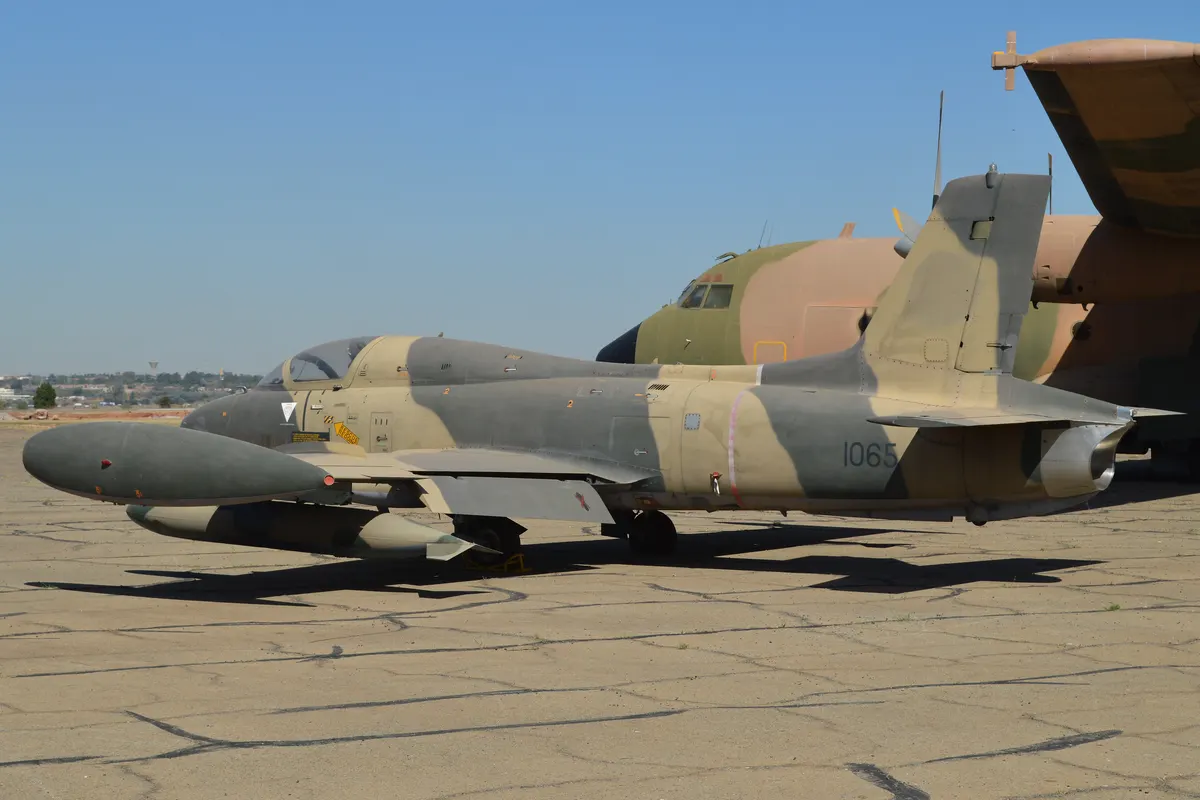
Both marks share a single non-afterburning Rolls-Royce Viper turbojet, but not the same one. The Mk I trainer uses the Viper 20, rated at about 15.2 kN (3,410 lbf) of thrust, while the Mk II's heavier airframe and war load are matched to the more powerful Viper 632-43 in the region of 17.8 kN (4,000 lbf).1 The irony is that the engine at the heart of South Africa's sanctions-defying attack aircraft was never South African: the Viper was a British Bristol Siddeley design built under licence in Italy by Piaggio, and every example fitted to an Impala, whether shipped complete or as part of a kit, was an import.1 Performance for the Impala Mk II in South African service is usually quoted at around 770 km/h at low level, a range in the order of 1,665 km, and a service ceiling near 12,500 m, figures noticeably lower than the lightly loaded Italian MB-326G trainer (rated at 867 km/h), reflecting the extra structure, cannon, and ordnance the South African single-seater carries.3,1
Twin 30 mm Cannon and a Trainer's Improvised Weapons Bay
Where the two-seat Mk I typically carried light underwing stores or a single gun pod for weapons training, the Mk II was built around a pair of 30 mm DEFA cannon with 300 rounds, mounted low in the forward fuselage — a French-designed gun also fitted to the Mirage III, giving the Impala a punch well beyond its trainer ancestry.1,4 Six hardpoints could carry 68 mm SNEB rocket pods (in clusters of six or eighteen), up to six 120 kg bombs or four 250 kg bombs, and, on some aircraft, a South African-developed electronic countermeasures fit absent from the trainer version.1 Late in its service life a batch of Mk IIs was cleared to carry the indigenously developed Kentron V3B Kukri, a short-range infrared-homing missile cued through a helmet-mounted sight that let the pilot lock the seeker simply by looking at the target — itself another embargo-driven weapon, built because South Africa could no longer buy a Western equivalent.5,6 A handful of single-seaters also carried the French Matra R550 Magic for self-defence.1
Atlas Aircraft Corporation assembled the Impala's airframe locally at Kempton Park from South African-fabricated structure and Italian-supplied or licence-built subassemblies, but the aircraft's most critical component, the Rolls-Royce Viper turbojet, was never produced in South Africa; it was built under licence in Italy by Piaggio and imported complete or as a major assembly.1 The 30 mm DEFA cannon was a French design, shared with the Mirage III fleet, while the Kukri missile and its helmet sight were genuinely South African, developed by what became Kentron specifically to replace embargoed imports.5,6 On balance the Impala sat roughly in the middle of the embargo-era localisation spectrum: airframe assembly and some systems were domestic, but the engine, the aircraft's single largest cost item, was always foreign.
Two-Seat Trainer Versus Single-Seat Attack Airframe
Beyond the powerplant, the two marks differ enough that South African crews treated them as separate aircraft types. The Mk I retains the full tandem cockpit and the lighter structure of a pure trainer, feeding pilots through basic and advanced training before their operational type, historically the Mirage III.7 The Mk II trades the second seat for fuel and structure, and its undercarriage and wing were strengthened to absorb a full war load from short, rough strips.1,7
Atlas Aircraft Corporation was established in 1965 as an Armscor subsidiary tasked with building aircraft the SAAF could no longer be guaranteed to buy abroad.2 South Africa had signed the MB-326 production licence with Aermacchi in 1964, before apartheid-related arms restrictions hardened into the mandatory UN embargo of 1977 (Security Council Resolution 418), and that early timing proved decisive: it gave the country a working jet-aircraft production line already in place once the embargo bit, rather than one built from nothing under sanctions.2 Mk I production began in 1966, and the type immediately became the SAAF's standard advanced trainer, feeding pilots toward the Mirage III and, later, the Mirage F1 and Impala Mk II squadrons.1,7 Unlike the far more famous Atlas Cheetah fighter program of the 1980s, which needed extensive foreign help to rebuild Mirage III airframes under embargo, the Impala line simply kept running on a licence signed before anyone needed to hide it.
The single-seat Mk II arrived in the mid-1970s, precisely as the Border War in Angola and Namibia was intensifying, and six SAAF squadrons plus a combat flying school operated the type through the 1970s and 1980s.7 The Impala Mk I also had a public, unarmed life: the SAAF's Silver Falcons aerobatic display team flew the type well into the 1990s, giving the trainer a visibility at civilian airshows that its single-seat sibling, restricted mostly to operational bases near the border, never had.1
By the early 1990s, with the Border War over and Atlas absorbed into the newly formed Denel group in 1992, the Impala's remaining role was almost entirely training and light domestic security work.2 The SAAF retired the type around 2005 to 2006, replaced under the post-apartheid Strategic Defence Package by the BAE Systems Hawk Mk 120.11
The Impala Mk II's defining conflict was the South African Border War, fought from 1975 to 1989 across northern Namibia and southern Angola against the People's Armed Forces for the Liberation of Angola (FAPLA), Cuban expeditionary units, and Angolan and Namibian insurgent movements. In that theatre the aircraft flew close air support, armed reconnaissance, and interdiction, typically at 550 to 650 km/h and as low as 15 m above the ground to stay under Angolan radar and shoulder-fired missile coverage.7 The tactic worked most of the time but not always: at least one Impala was brought down by an SA-7 Grail infrared-homing missile during the war, and another returned to base with an unexploded SA-7 still lodged in its jet pipe, a detail that circulated among SAAF pilots as proof of both the missile's unreliability and the aircraft's toughness.1
The aircraft's most improbable achievement came in September 1985, during the fighting around Mavinga later codenamed Operation Wallpaper, part of the broader SADF and UNITA response to the Angolan government's Congresso II offensive.12 South African reconnaissance had established that FAPLA brigades cut off in the bush were being resupplied and reinforced by helicopter, so Impala Mk IIs, an aircraft with no air-to-air radar, no dedicated fighter armament beyond its two cannon, and a top speed barely faster than the helicopters' escort jets, were sent up as opportunistic interceptors. In one engagement Impalas shot down two Mi-24 Hind gunships escorting a helicopter formation; two days later they returned and downed a further four helicopters, accounts differ on the exact mix of Mi-24s and Mi-17/Mi-8 transports, but the total across the two actions is consistently put at six.7,12 The attacks were flown at extreme range for the type, at low level to avoid detection until the moment of the ambush, using only the two 30 mm cannon; official South African statements at the time reportedly credited the kills to shoulder-fired missiles rather than the Impala, to avoid revealing how far the aircraft was operating from its bases.7

Away from the helicopter engagements, the Impala's Border War record was mostly the unglamorous daily work of a light-attack aircraft: bombing and rocketing SWAPO and FAPLA positions, escorting transport aircraft, and flying alongside heavier Canberra, Buccaneer, and Mirage strike packages that carried the bulk of the tonnage on larger targets. Its low cost per sortie and ability to operate from short, unprepared airstrips made it the workhorse for the frequent, small-scale close-support missions that made up most of the war, even without the range or payload to lead a major strike alone.7
By 1987 and 1988, as fighting intensified around Cuito Cuanavale and Angolan MiG-23s flew under increasingly capable air defence cover, the Impala's low-level approach grew harder to sustain and the SAAF leaned more on Mirage F1s and Buccaneers for contested airspace. When the war ended with the 1988 Angola-Namibia peace accords and Namibian independence in 1990, the type's cross-border operational history was effectively complete, though it served at home for another decade and a half.7,2
Impala Mk I (MB-326M). The two-seat basic and advanced trainer, built to the Italian MB-326M standard with light underwing stores capability, powered by the Viper 20. Around 125 were assembled locally after an initial batch of 40 Italian-built aircraft, with production beginning in 1966; it remained the SAAF's standard advanced trainer into the 1990s and equipped the Silver Falcons display team.1
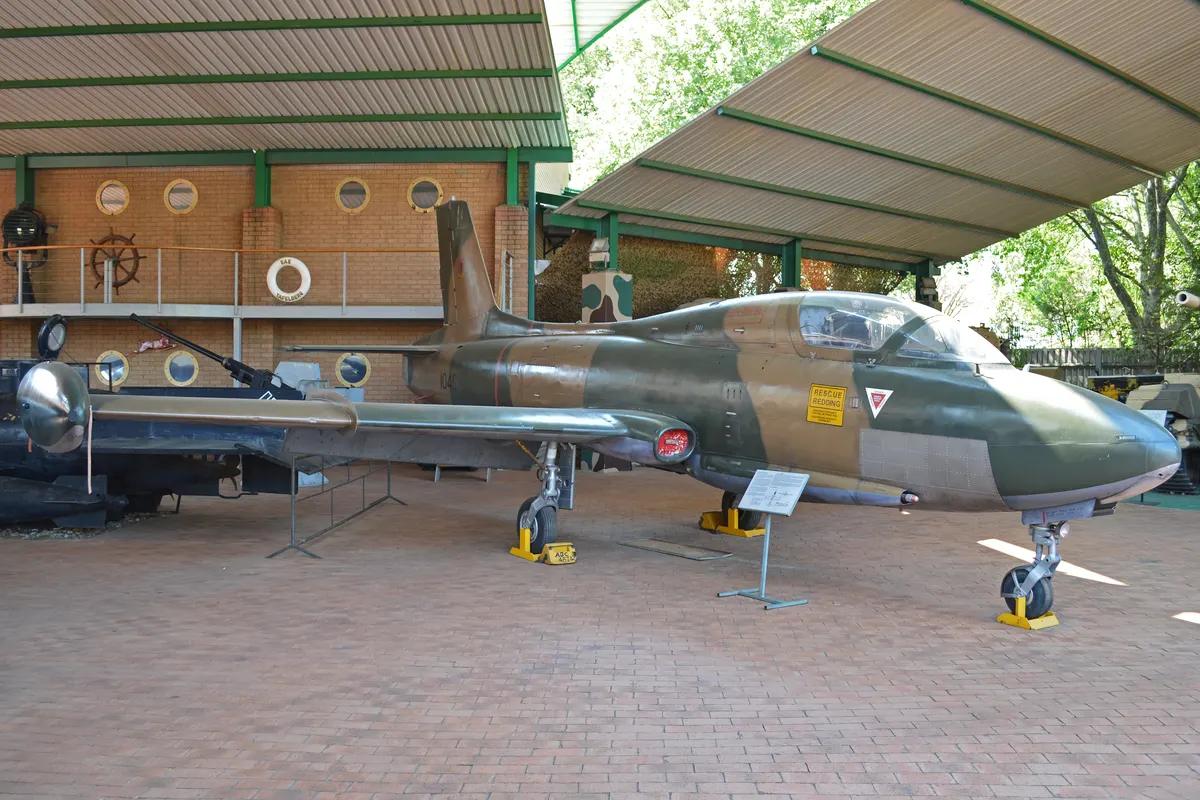
Impala Mk II (MB-326K). The single-seat light-attack derivative, built to the export MB-326K standard with the more powerful Viper 632-43, twin 30 mm DEFA cannon, six weapons hardpoints, and, on some airframes, a locally developed ECM fit. Roughly 100 were acquired from 1974 through complete imports, kit assembly, and local manufacture, though the SAAF's own strength records put the in-service total closer to 73.1,2 Some later or upgraded Mk IIs gained wiring and a helmet sight to carry the V3B Kukri infrared-homing missile, a genuine, if limited, air-to-air self-defence capability the type was never designed for.5,6
No further South African production marks followed the Mk II; unlike the Mirage-derived Cheetah program, the Impala was not substantially rebuilt or re-engined during its SAAF career, and its eventual replacement, the Hawk Mk 120, was an entirely different, imported design rather than a further Impala derivative.11


The South African Air Force was the type's only major military operator, flying both marks from bases across South Africa and, for much of the Border War, forward airstrips in Namibia. Small numbers of retired aircraft later went to other operators: Cameroon received six ex-SAAF Impala Mk Is and Mk IIs, and Brazil purchased twelve ex-SAAF Impalas to supplement its own, separately licence-built fleet of 182 AT-26 Xavantes (Embraer's version of the same Italian design).8,1
Civilian operation has kept a small number of airframes flying long after military retirement. In the United States, the National Test Pilot School at Mojave, California operated an MB-326 as a chase and test-support aircraft before retiring it to the Estrella Warbird Museum, which counts it among only three known examples of the type in the country.9
In South Africa itself, private owners and warbird operators kept ex-SAAF Impalas airworthy for display flying decades after the type left military service, a scene active enough that the fatal loss of a civilian Impala Mk I at the 2025 West Coast Air Show was treated as a significant event within the local warbird community rather than a routine accident of an obscure old type.10
The Impala Mk II's closest Western contemporary is the British Aircraft Corporation Strikemaster, and the comparison is instructive because both aircraft solved the same problem, a cheap, exportable jet trainer doubling as a counter-insurgency attacker, from opposite starting points. The Strikemaster descended from the docile Hunting Jet Provost basic trainer and kept a strong training emphasis even after weapons were added; the Impala Mk II descended from a trainer too, but was built as a single-seat attacker with the second cockpit deleted entirely, prioritising war load over instructional flexibility.13 Both share a Rolls-Royce Viper turbojet lineage: the Strikemaster's Viper 535 produces less thrust than the Impala's Viper 632-43, yet top speeds end up close, around 770 km/h for the Impala against roughly 772 km/h (480 mph) for the Strikemaster, with near-identical service ceilings around 12,000 to 12,500 m.13,1 Firepower is where they diverge: the Strikemaster's standard armament was a pair of 7.62 mm machine guns, adequate against unarmoured insurgents but far short of the Impala's twin 30 mm DEFA cannon, which could damage armour and, as 1985 showed, bring down a helicopter gunship. Both found their real market among air forces facing embargoes or tight budgets, the Strikemaster with Oman, Kenya, Saudi Arabia and Sudan fighting counter-insurgency wars, the Impala restricted by politics to South Africa and a handful of secondary buyers, but flying substantially the same kind of war.


What are the Atlas Impala's specifications? The single-seat Mk II is powered by a Rolls-Royce Viper 632-43 turbojet of roughly 4,000 lbf thrust, reaches about 770 km/h at low level, has a range near 1,665 km, and a service ceiling around 12,500 m; it typically carries twin 30 mm DEFA cannon plus rockets and bombs on six hardpoints.1
How many Atlas Impalas were built? Roughly 125 two-seat Mk Is were locally assembled after an initial batch of 40 Italian-built aircraft, and around 100 single-seat Mk IIs were acquired through complete imports, kit assembly, and local manufacture, though the SAAF's own historical strength figures for the Mk II (73) are lower than the manufacturing totals usually quoted.1,2
Is the Atlas Impala still in service? No. The South African Air Force retired the type between 2005 and 2006, replaced by the BAE Systems Hawk Mk 120. A small number of ex-military airframes remain airworthy in civilian hands in South Africa, the United States, and Brazil.11,9,8
Atlas Impala vs BAC Strikemaster: how do they compare? They are close contemporaries with similar Viper-family engines, near-identical top speeds, and near-identical service ceilings, but the Impala's twin 30 mm cannon gave it far heavier gun firepower than the Strikemaster's rifle-calibre machine guns.1,13
Did the Impala really shoot down helicopters? Yes. In September 1985, during Operation Wallpaper in Angola, SAAF Impala Mk IIs destroyed six Angolan and Cuban-flown helicopters, a mix of Mi-24 gunships and Mi-8/Mi-17 transports, in two separate engagements using only their cannon.7,12
- "Aermacchi MB-326", Wikipedia — en.wikipedia.org ↩
- "Atlas Aircraft Corporation", Wikipedia — en.wikipedia.org ↩
- "Atlas MB.326K Impala II", Aviations Militaires — aviationsmilitaires.net ↩
- "The Aermacchi MB-326 - Atlas Impala", Flightline Weekly — flightlineweekly.com ↩
- "V3B Kukri", The South African Air Force — saairforce.co.za ↩
- "Information Pack: Kentron V3B Kukri Infrared Air-to-Air Missiles and Launchers", ArtMan Delta — artmandelta.com ↩
- "Impala Mk II", The African War Stories Archive — africanwars.org ↩
- "Aermacchi MB-326", Wikipedia (Brazilian AT-26 Xavante and ex-SAAF sales) — en.wikipedia.org ↩
- "Aermacchi MB 326 Impala", Estrella Warbird Museum — ewarbirds.org ↩
- "West Coast Air Show ends in tragedy after fatal Impala crash", DefenceWeb — defenceweb.co.za ↩
- "History and final phasing-out of the Impala MK I & MK II", South African Air Force — af.mil.za ↩
- "Operation Wallpaper", Wikipedia — en.wikipedia.org ↩
- "BAC Strikemaster", Wikipedia — en.wikipedia.org ↩