

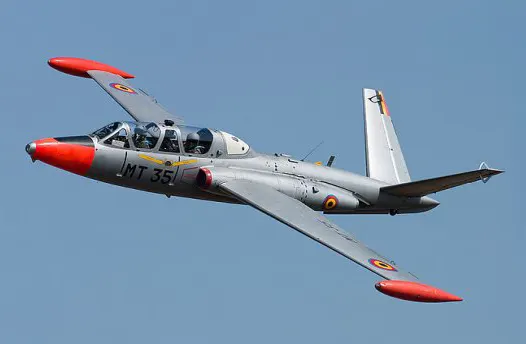

The Fouga CM.170 Magister is a French twin-engine jet trainer that first flew on 23 July 1952 and entered service with the French Air Force in 1956.1 It was one of the first purpose-built jet trainers anywhere, designed around a pair of small Turbomeca Marboré turbojets rather than a single larger engine, and it is instantly identifiable by its V-shaped "butterfly" tail, a feature borrowed directly from an earlier Fouga glider rather than invented for the trainer role.1,3 Production ran to 868 airframes once French output and three separate foreign licence lines are counted, and the type went on to serve with more than twenty air forces across Europe, the Middle East, Africa, and Latin America over a service life stretching past four decades.1,2
- Twin-engine layout gives single-engine-out safety margin rare in a light trainer
- Simple, robust metal structure with low maintenance demands
- Docile, forgiving handling suited to low-hours student pilots
- Proven combat versatility on austere underwing hardpoints
- Cheap and available on the civilian warbird market today
- No standard ejection seats on the vast majority of production aircraft
- Modest thrust leaves little performance margin fully loaded for strike missions
- Armament limited to two hardpoints and light forward-firing guns
- Ageing airframes now well past 60 years old, with rising fatigue and parts concerns
- Outclassed in speed and payload by turbofan-era trainers that followed it

Unlike most trainers of its generation, the Magister did not stay confined to flight schools. Israel flew armed Fougas as ground-attack aircraft in the 1967 Six-Day War, a single Katangese-operated example became internationally notorious during the 1961 Congo crisis, and El Salvador flew a dozen ex-Israeli and ex-French Magisters against FMLN guerrillas through most of the 1980s.7,10,14 In France itself the aircraft had a very different second career: from 1964 to 1980 it was the mount of the Patrouille de France, the national aerobatic team, making it as familiar to airshow crowds as it was to student pilots.18 Production ended in France in 1962 and in Finland, the last licensee still building it, in 1967, but the design's simplicity and twin-engine redundancy have kept dozens of ex-military examples flying today as civilian warbirds on both sides of the Atlantic.1,25
The database entry for this aircraft that accompanied this research contained two internally contradictory performance figures and one obvious unit error, addressed in the Specs and Design section below; none of the corrections change the basic picture of a modest, forgiving, twin-jet trainer that happened to be pressed into combat far more often than its designers ever intended.
The Butterfly Tail: Borrowed From a Glider, Not Designed for a Jet
The Magister's V-tail did not originate with the jet trainer at all. Fouga's chief designer, Pierre Mauboussin, had already used a butterfly tail on the CM.8 series of aerobatic sailplanes in the late 1940s, gliders that Fouga subsequently fitted with small dorsal-mounted turbojets as flying testbeds for jet propulsion.4 When the French Air Force rejected Fouga's original CM.130 primary-trainer proposal in the early 1950s as underpowered, and Fouga enlarged the design around a pair of Turbomeca Marboré engines to become the CM.170, the tail configuration came along with it largely unchanged.1,3 Company records indicate a conventional single-fin tail was tried during development and found aerodynamically inferior at the trainer's higher speeds, which is the closest thing to a formal engineering justification for the layout; in practice, the V-tail survived because it already worked on the glider testbeds, not because it was purpose-derived for a jet aircraft.3
- İlk Uçuş1952
- Hizmete Giriş Yılı1956
- Mürettebat (koltuk)2
- Eğitim Uçağı TipiTemel jet eğitim uçağı
- HizmetteEvet
The airframe around that tail is a conventional all-metal, low-wing monoplane with a stepped tandem cockpit seating instructor and student one behind the other, a configuration by then already standard for jet trainers.2 Its dimensions are unremarkable for the class: length of 10.06 meters, wingspan of 12.15 meters over its wingtip fuel tanks, and height of 2.80 meters, figures that match across every technical reference consulted for this article and required no correction.1,2
- Motor TipiTurbomeca Marboré IIA
- İtki4,7
- Güç (turboprop)3,9 kW
Twin Turbomeca Marboré Turbojets, and a Thrust Figure That Depends on the Variant
The Magister's defining engineering choice, alongside the tail, was to use two small turbojets rather than one larger one. The baseline CM.170-1 was powered by a pair of Turbomeca Marboré IIA engines, each rated at 3.9 kN (880 lbf) of thrust, an arrangement Fouga marketed as giving "twin-engine safety with single-engine handling," since asymmetric thrust from one engine failing was mild enough not to seriously complicate flying the aircraft home.1,2 From 1960 a re-engined version, the CM.170-2, adopted the more powerful Turbomeca Marboré VI, rated at roughly 4.7 to 4.8 kN (about 1,058 to 1,100 lbf) per engine, a jump of around 23 percent in thrust for only a modest fuel-burn penalty; 137 CM.170-2 airframes were built.5,6 The DB spec file's Engine Type field named the Marboré IIA specifically, but its accompanying Thrust value of 4.7 corresponds to the later Marboré VI, not the IIA it names; the two fields describe different engine standards and should not be read together as consistent (see SPEC CORRECTIONS).
- Azami Hız560 km/sa
- Seyir Hızı650 km/sa
- Hizmet Tavanı11.000 m
- Menzil1.200 km
- Tırmanma Hızı17 m/sn
- G Limiti6
- Havada/Görevde Kalış Süresi2

Reliability was generally regarded as good for the era. Association records kept by former Magister maintainers describe recurring, minor starting problems traced to worn micro-pumps and carbon buildup on relay contacts, rather than any deeper design fault, and engine changes could reportedly be completed in around 45 minutes thanks to straightforward accessibility.1 The airframe's twin-engine layout, rather than any single technological breakthrough, is what pilots and instructors most consistently credit for the type's benign safety reputation over six decades of service.
- Kokpit DüzeniTandem iki koltuklu
- Cam KokpitHayır
- Gömülü SimülasyonHayır
- Hafif Taarruz KabiliyetliEvet
- Silah İstasyonları2
- Fırlatma KoltuklarıEvet
Speeds, Weights, and Two Database Corrections
Published performance figures for the Magister cluster fairly consistently once cruise and maximum speed are not confused with one another. Maximum speed for the baseline aircraft is most commonly given as 715 km/h (444 mph) at altitude, or around 650 km/h (405 mph) at low level depending on the reference; economical cruise speed sits well below that, typically cited around 460 to 560 km/h.1,2,23 The database spec file supplied for this research listed a Top Speed of 560 km/h and a Cruise Speed of 650 km/h, which inverts the relationship: an aircraft cannot cruise faster than its top speed, and the two figures as given are simply swapped relative to how every technical source describes the type (see SPEC CORRECTIONS).
- Uzunluk10,06 m
- Kanat Açıklığı12,15 m
- Yükseklik2,8 m
- Maks Kalkış Ağırlığı3,8 kg
Maximum takeoff weight is consistently given across sources as 3,200 kg (7,055 lb), against an empty weight of about 2,150 kg (4,740 lb).1,2 The database spec file's Max Takeoff Weight field showed a value of 3.8 kg, off by roughly three orders of magnitude and almost certainly a unit-entry error rather than a factual disagreement between sources (see SPEC CORRECTIONS). Range, service ceiling, and rate of climb in the same spec file, 1,200 km, 11,000 m, and 17 m/s respectively, matched published figures closely enough that no correction is warranted for those three values.1,2
- Toplam Üretim868
- Kullanıcılar20
One further figure worth flagging concerns ejection seats. The overwhelming majority of Magisters built, across every licensee, had none: pilots escaped by jettisoning the canopy and bailing out manually, with the rear-seat crew member reportedly briefed to slide down and over the wing after the front-seat pilot had cleared the aircraft.1,24 The single documented exception was the one-off CM.173 "Super Magister" prototype, fitted with uprated Marboré Super VI engines and ejection seats as standard, which never entered series production.1 The DB spec file's Ejection Seats field was marked "Yes" for the type generally, which does not reflect the standard production aircraft (see SPEC CORRECTIONS).
- Üretim Başlangıcı1954
- Operasyonel Durumaskeri hizmetten emekli edildi; tarihi savaş uçağı olarak kullanılıyor
For the baseline French-built CM.170, domestic content by value was very high. The airframe was designed and built by Fouga (later absorbed into Potez and then Sud Aviation) at Béziers in southern France, and both engines came from Turbomeca's own plant at Bordes, also in France, making the Magister an almost entirely French-sourced aircraft rather than one built around a critical foreign import.1,6 Cockpit instruments and the airframe's aluminium structure were likewise sourced domestically. The single largest deviation from full self-sufficiency was not a foreign component in the French aircraft itself but the reverse: France exported the design and its Turbomeca engines wholesale to three licensees, West Germany, Finland, and Israel, each of which then built the airframe locally around imported or licence-built Marboré engines rather than developing a substitute powerplant of their own.1
From a Rejected Primary Trainer to a NATO-Wide Jet
Fouga's design team, led by Pierre Mauboussin with Robert Castello and Jacques Henrat, began work in 1948 on a jet-propelled primary trainer, initially designated CM.130, intended to replace the French Air Force's piston-engined Morane-Saulnier trainers.1 The French Air Force reviewed the project and judged it underpowered on its original pair of small Turbomeca Palas engines; Fouga responded by enlarging the airframe and adopting the more powerful Marboré, and the redesigned aircraft, now called the CM.170, flew for the first time on 23 July 1952.1 The French Air Force placed its first production order on 13 January 1954, and the type entered squadron service in 1956.1
License Production in Germany, Finland, and Israel — and a Fourth Country That Only Bought, Never Built
French production, split between Fouga's own line and later Potez/Sud Aviation, accounted for 576 of the 868 total airframes.1,2 Three foreign manufacturers built the rest under licence. West Germany placed an initial direct order for 62 aircraft, then had a further 194 built domestically by Flugzeug Union Süd, a joint venture between Heinkel and Messerschmitt, for the reconstituted Luftwaffe.1
In Finland, state manufacturer Valmet built 62 examples between 1958 and 1967, continuing production for five years after the French line had closed, which makes Valmet's the last Magister assembly line to shut down anywhere.1 Israel Aircraft Industries built 36 as the locally designated IAI Tzukit, entering service from 1960 and eventually developing into the Israeli Air Force's primary basic jet trainer for half a century.1,21
Austria is sometimes listed alongside these three as a licensee, but the available production and delivery records point to a simpler arrangement: Austria bought 18 French-built CM.170R Magisters outright rather than assembling them domestically.16 Four of those Austrian airframes were later refurbished and sold on in the mid-1970s, re-emerging as part of Ireland's small "Super Magister" fleet, itself never a licence-production programme but a straightforward secondhand purchase supplemented by Aerospatiale-managed upgrades.15,16
The Israeli-built Tzukit derivative even had a brief screen career: an Israeli Air Force Tzukit appears overflying a desert wadi in the 1973 film adaptation of "Jesus Christ Superstar," in a scene set after Judas's betrayal.22
The Patrouille de France's Signature Aircraft, 1964–1980
France's national aerobatic display team, the Patrouille de France, adopted the Fouga Magister in 1964 and flew it for sixteen years, longer than any other aircraft type in the team's history to that point, before switching to the Alphajet in 1980.18
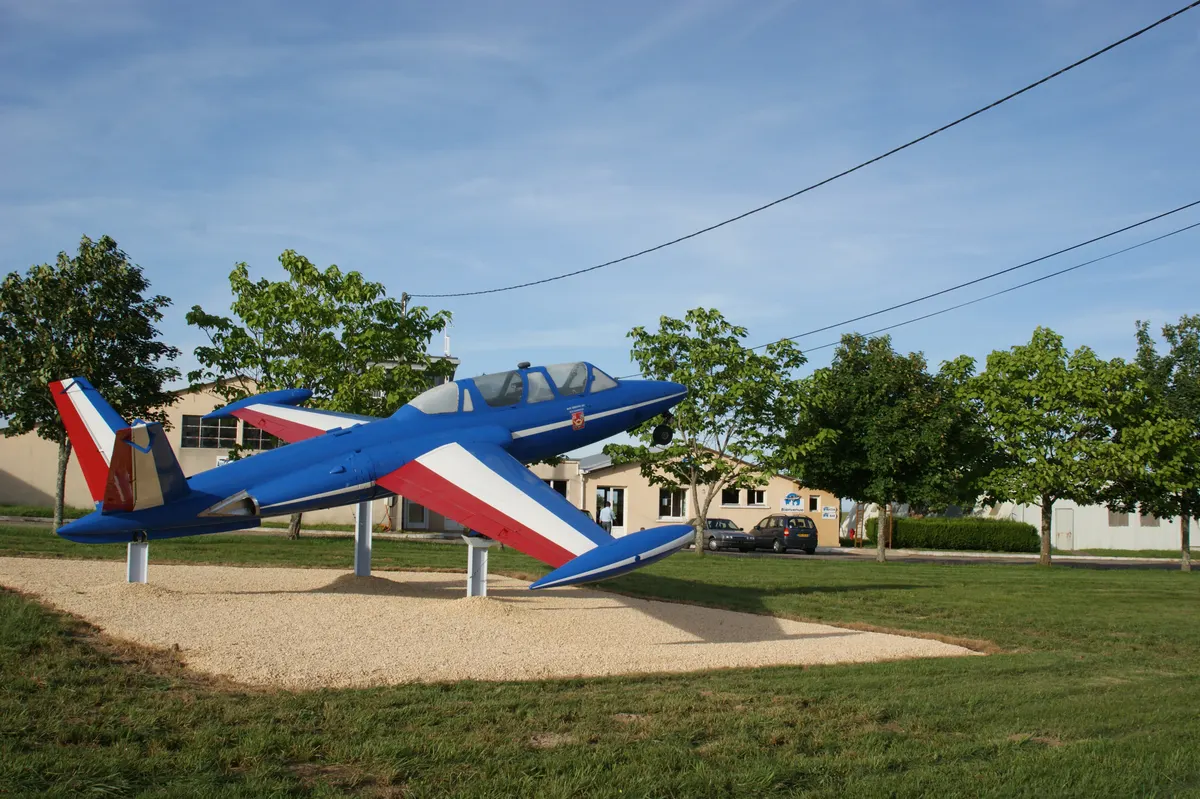
Six Magisters, based at Salon-de-Provence, carried the team through most of its formative years on the international airshow circuit, and three Patrouille de France Magisters are today displayed at the entrance of France's national Air and Space Museum.18 The choice reflected the aircraft's core virtues rather than raw performance: forgiving handling, twin-engine redundancy for tight formation work at low altitude, and, by the mid-1960s, a large domestic fleet from which airworthy display aircraft could be drawn without disrupting front-line training.
Katanga, 1961: A Single Jet Grounds a UN Airlift
The breakaway Katangese state acquired three Fouga Magisters in February 1961, flown in aboard a chartered Boeing Stratocruiser by a company later identified as a CIA contractor, giving the Katangese Air Force the only fixed-wing jet combat capability on either side of the Congo Crisis.11 One aircraft was lost when its pilot attempted to fly beneath rather than over a power line; a second was captured intact by UN forces when they seized Elisabethville's airfield on 28 August 1961, leaving a single Belgian-mercenary-flown Magister still operational by September.10,11
That lone aircraft, nicknamed the "Lone Ranger," destroyed transport aircraft on the ground, strafed UN positions including UN headquarters in Katanga, and effectively suppressed the UN's air resupply operation for weeks, an outsized effect for a single lightly armed trainer.10,11 The threat it posed is also cited as a reason UN Secretary-General Dag Hammarskjöld's DC-6 flew a circuitous, radio-silent route on the night of 17-18 September 1961, shortly before it crashed near Ndola under circumstances that remain formally unresolved.12
Operation Focus, 1967: France's Trainer Becomes Israel's Anti-Tank Aircraft
Israel's air force had begun organizing a fighting squadron around the Magister as early as 1964, years before the aircraft's most famous combat outing.1 On 5 June 1967, the opening day of the Six-Day War, roughly 44 Fougas of 147 Squadron flew alongside Israel's fighter-bombers in Operation Focus, the surprise strike that crippled Egyptian, Jordanian, and Syrian air power within hours.7,9
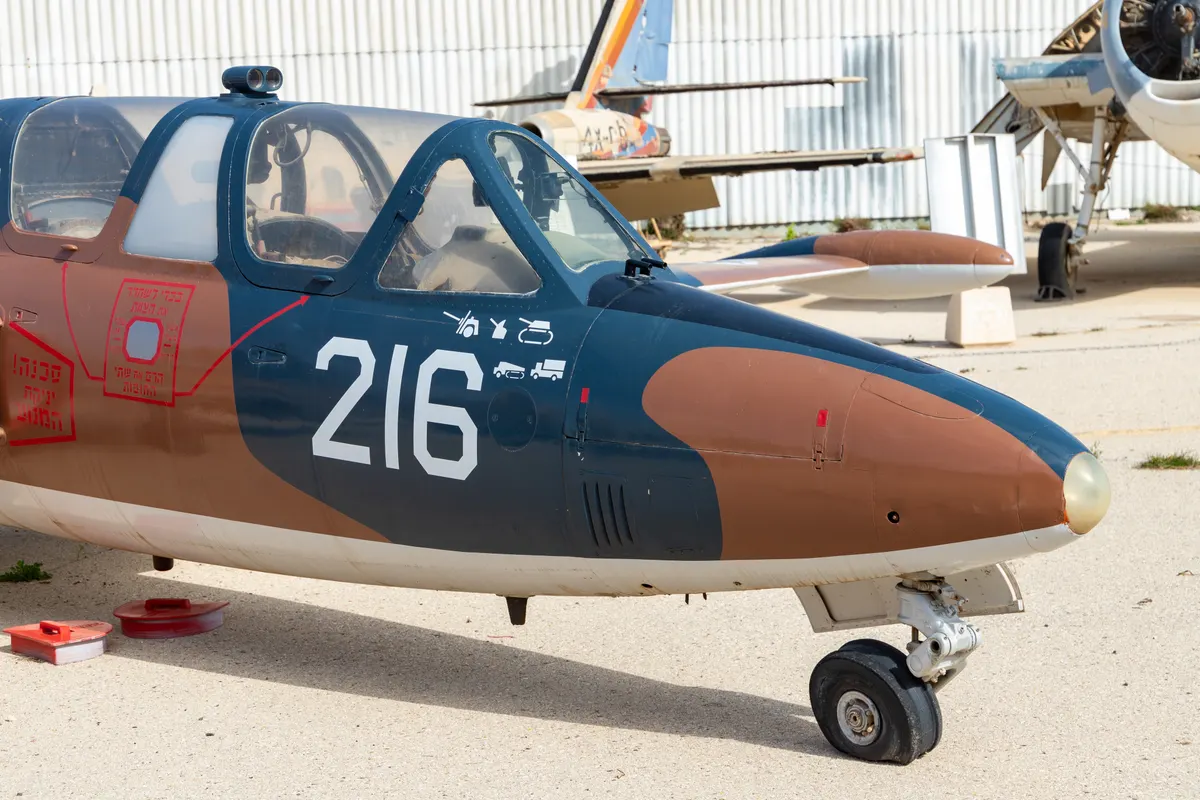
Equipped with underwing rockets rather than any dedicated anti-armour weapon, the Fougas attacked Jordan's 40th Brigade as it advanced south from the Damia Bridge, reportedly knocking out dozens of tanks and destroying a 26-vehicle ammunition convoy, and were credited more broadly with over fifty tanks and seventy other armoured vehicles destroyed across the Sinai and Jordanian fronts during the war's first days.7,8 The mission came at real cost: seven Fougas and six pilots were lost, among the highest loss rates of any Israeli aircraft type in the conflict, a reminder that a lightly built trainer flying low over defended armour has little margin for error.7
A Second Combat Career: El Salvador, 1979–1992
More than a decade after the Six-Day War, the Fouga found a second and less well-known combat role. El Salvador's air force acquired its first Magisters in 1974, and by the start of its long civil war against the FMLN in 1979 fielded twelve second-hand examples, nine bought from Israel and three from France, fitted with bombs and nose-mounted 7.62mm machine guns for ground attack alongside its Ouragan jets and A-37B Dragonflies.14 None were lost to enemy fire over the war's thirteen years, but sustained attrition through wear, maintenance shortfalls, and the general difficulty of keeping a 1950s airframe flying through a prolonged low-intensity conflict left only five still operational by the time the war ended in 1992.14 Morocco flew a smaller Magister fleet operationally during the Western Sahara conflict through the 1980s, taking losses that contributed to the type's eventual withdrawal from Moroccan combat duty.1
The baseline CM.170-1 Magister, powered by twin Turbomeca Marboré IIA engines, was the version built in the largest numbers in France and the version most foreign licensees initially adopted.1 From 1960 the CM.170-2 introduced the more powerful Marboré VI engine described above, with 137 built to that improved standard.5 A single CM.173 "Super Magister" prototype, fitted with uprated Marboré Super VI engines and, notably, standard ejection seats absent from every other production version, was built by Potez but never entered series manufacture.1
The French Navy fielded its own carrier-capable derivative, the CM.175 Zéphyr, first flown in 1956 under the internal designation CM.170M Esquif before being renamed. It added an arrester hook, strengthened structure and undercarriage for deck operations, and, because it lacked ejection seats, new sliding canopies that could be locked open during launch and recovery. Thirty production Zéphyrs, plus two prototypes, were built between 1959 and 1960 and remained in French naval service until 1994.13
Israel's IAI Tzukit, built under licence from 1959 and entering service in 1960, went on to receive avionics and structural updates over decades of Israeli Air Force use and remained the service's basic jet trainer until the type was finally retired from front-line training around 2010, when the aerobatic role passed to the Beechcraft T-6 Texan II.1,20,21 Ireland's "Super Magister" designation, despite the name's overlap with Potez's unrelated ejection-seat prototype, referred simply to secondhand CM.170Rs delivered to the Irish Air Corps from 1975, several rebuilt from retired Austrian air force airframes, which served as basic jet trainers until 1999.15,16


France, West Germany, Finland, and Israel formed the type's core operator-and-licensee group, joined as direct purchasers by Austria, Belgium, Brazil, Ireland, and Morocco.1 Katanga's brief, unrecognised operation of three aircraft during the 1961 Congo Crisis is covered above under Conflicts. Beyond Europe, the Magister spread widely through French-aligned Africa and the Middle East, with Algeria, Cameroon, Gabon, Lebanon, Libya, Rwanda, Senegal, and Uganda all fielding the type at various points, alongside Bangladesh, Cambodia, and Guatemala further afield.1 El Salvador's operational history is covered above under Conflicts.
Ireland's Air Corps deserves particular mention for how it used the aircraft after the training role: from 1986 to 1998 its Light Strike Squadron fielded four Magisters as the "Silver Swallows" aerobatic display team, which won the Royal International Air Tattoo's award for best overseas display in 1997 before the type was retired from Irish service in 1999.17
France retired its last Magisters from military use in the 1980s and 1990s, and most other air forces followed within a decade or two either side of that window; Israel's Tzukits, the longest continuously serving version, lasted into the 2010s.1,20 None of the type's roughly two dozen former military operators still fly it today. What survives is a substantial civilian population: over fifty ex-military Magisters are on civil registers in the United States, New Zealand, and the United Kingdom, flown as warbirds and airshow performers, with asking prices in recent years ranging from roughly 70,000 to 175,000 euros depending on condition and upgrades.25
The Fouga Magister Versus the Aero L-29 Delfín
The closest genuine rival to the Magister, in role, era, and market reach, was the Aero L-29 Delfín, the Warsaw Pact's standard jet trainer from 1961 onward. The comparison highlights a basic design fork between the two blocs. The Magister used two small turbojets for redundancy at the cost of some complexity, while the L-29 relied on a single, more powerful Motorlet M701 turbojet, prioritising mechanical simplicity and ruggedness for operation from poorly surfaced Eastern Bloc training fields over the safety margin of a second engine.19 On paper the Magister is the faster aircraft, with a maximum speed around 715 km/h against the Delfín's roughly 655 km/h, and it also carries further, 1,200 km against about 895 km, though the L-29 climbs to a marginally higher service ceiling of around 11,500 meters versus the Magister's 11,000.19 Neither margin was large enough in practice to make either aircraft clearly superior as a trainer; pilots who have flown both consistently describe the Magister as the more agile of the two and the Delfín as the easier and cheaper to maintain in numbers, which is precisely the trade a training command has to weigh.
| Spec | Fouga CM.170 Magister | Aero L-29 Delfín |
|---|---|---|
| Engine(s) | 2 x Turbomeca Marboré turbojet | 1 x Motorlet M701 turbojet |
| Max speed | ~715 km/h | ~655 km/h |
| Range | ~1,200 km | ~895 km |
| Service ceiling | ~11,000 m | ~11,500 m |
| Total built | 868 | ~3,600-3,700 |
Where the two designs diverge sharply is scale and reach rather than performance. The L-29 was built in roughly 3,600 to 3,700 examples, overwhelmingly for a single treaty bloc's flying schools, whereas the Magister's 868 airframes were spread across a much wider and more varied set of customers, from NATO's southern and central flank to newly independent African states to Central American civil-war combatants.1,19 The Delfín's numbers reflect the sheer size of the Warsaw Pact's centralized pilot-training pipeline; the Magister's smaller, more scattered production run reflects a Western export market built one country-by-country sale at a time, a pattern that also explains why the Magister, unlike the Delfín, ended up improvised into combat roles across at least four separate conflicts on three continents.
A Brief Word on the Cessna T-37 Tweet
It is worth noting, if only because the connection is often missed, that the Magister's closest American counterpart, the Cessna T-37 Tweet, used side-by-side rather than tandem seating and a conventional tail, but drew on the same underlying engine lineage: the T-37's Continental J69 turbojets were licence-built derivatives of Turbomeca's Marboré design, the very engine powering the Magister itself.1 Performance between the two was broadly similar, with the Tweet generally regarded as very slightly slower, but the deeper similarity is that both airframes, designed a continent apart in the same decade, arrived at twin small turbojets as the era's default answer to the jet-trainer problem before turbofans changed the calculation for the generation that followed both types.


What are the Fouga CM.170 Magister's specifications? The Magister is a tandem two-seat jet trainer 10.06 meters long with a 12.15-meter wingspan, weighing about 2,150 kg empty and up to 3,200 kg at maximum takeoff weight, powered by two Turbomeca Marboré turbojets (3.9 kN each on the baseline CM.170-1, or roughly 4.7 to 4.8 kN each on the later CM.170-2).1,2
What is the Fouga Magister's top speed? Commonly cited figures put maximum speed around 715 km/h (444 mph) at altitude, with a lower-altitude figure closer to 650 km/h (405 mph); cruise speed is considerably lower, typically quoted around 460 to 560 km/h, which is a different figure from top speed and should not be confused with it.1,2,23
How many Fouga Magisters were built? A total of 868 airframes were completed: 576 in France, 194 by the Heinkel-Messerschmitt consortium Flugzeug Union Süd in West Germany, 62 by Valmet in Finland, and 36 by Israel Aircraft Industries as the IAI Tzukit.1,2
Is the Fouga Magister still in service? No air force still operates the type; Israel's IAI Tzukit, the last military user, was withdrawn from front-line training use around 2010 in favour of the Beechcraft T-6 Texan II.20,21 Over fifty former military airframes remain airworthy in civilian hands in the United States, New Zealand, and the United Kingdom, flown as warbirds and airshow aircraft.25
How does the Fouga Magister compare with the Aero L-29 Delfín? The Magister is somewhat faster and longer-ranged and uses two engines for redundancy, while the single-engine L-29 is simpler to maintain and was built in far greater numbers, roughly 3,600 to 3,700 against the Magister's 868, almost entirely to supply the Warsaw Pact's much larger centralized training pipeline.19
Did the Fouga Magister see real combat? Yes, repeatedly, despite being designed purely as a trainer. It flew ground-attack sorties for Israel in the 1967 Six-Day War, for the breakaway Katangese state during the 1961 Congo Crisis, for El Salvador through most of its 1979–1992 civil war, and for Morocco during the Western Sahara conflict.7,10,14
- "Fouga CM.170 Magister", Wikipedia — en.wikipedia.org ↩
- "Fouga / Potez CM.170 Magister - Specifications", flugzeuginfo.net — flugzeuginfo.net ↩
- "The Fouga Magister, the butterfly-tailed training aircraft", Fly a Jet Fighter — flyajetfighter.com ↩
- "Fouga CM.8", Wikipedia — en.wikipedia.org ↩
- "Fouga CM-170 Magister / CM-170-II Super Magister", GlobalSecurity.org — globalsecurity.org ↩
- "Turbomeca Marboré", Wikipedia — en.wikipedia.org ↩
- "The Israeli Air Force & Operation Moked", The Military Historian — military-historian.squarespace.com ↩
- "How Israeli Warplanes Smashed Their Way to Victory in the Six Day War", The National Interest — nationalinterest.org ↩
- "Six-Day-War... 1/48 Fouga CM.170 Magister Israeli Airforce", iModeler — imodeler.com ↩
- "Katangese Air Force", Wikipedia — en.wikipedia.org ↩
- "Katangese Air Force", WarHistory.org — warhistory.org ↩
- "Did a Belgian mercenary pilot shoot down the DC-6 of UN Secretary-General Dag Hammarskjöld in 1961?", Aviation24.be — aviation24.be ↩
- "Fouga CM.175 Zéphyr", Wikipedia — en.wikipedia.org ↩
- "Salvadoran Air Force", Wikipedia — en.wikipedia.org ↩
- "Fantastic Fouga Magisters of the Irish Air Corps", Key.Aero — key.aero ↩
- "Fouga SUPER MAGISTER '218'", Ulster Aviation Society — ulsteraviationsociety.org ↩
- "Silver Swallows", Wikipedia — en.wikipedia.org ↩
- "Patrouille De France CM.170 Fouga Magister Gallery", Aerobatic Teams — aerobaticteams.net ↩
- "Aircraft comparison: CM 170 Magister vs L-29 Delfin", GlobalMilitary.net — globalmilitary.net ↩
- "IAF Aerobatic Team", Wikipedia — en.wikipedia.org ↩
- "Fouga CM.170 Magister (Zukit)", Jewish Virtual Library — jewishvirtuallibrary.org ↩
- "Jesus Christ Superstar", The Internet Movie Plane Database — impdb.org ↩
- "Fouga CM. 170 Magister", M.S.Ö. Hava ve Uzay Müzesi — msomuseum.com ↩
- "Magister crash pilot probably lost consciousness during tight display turn", FlightGlobal — flightglobal.com ↩
- "Warbird Alley: Fouga CM-170 Magister", Warbird Alley — warbirdalley.com ↩