

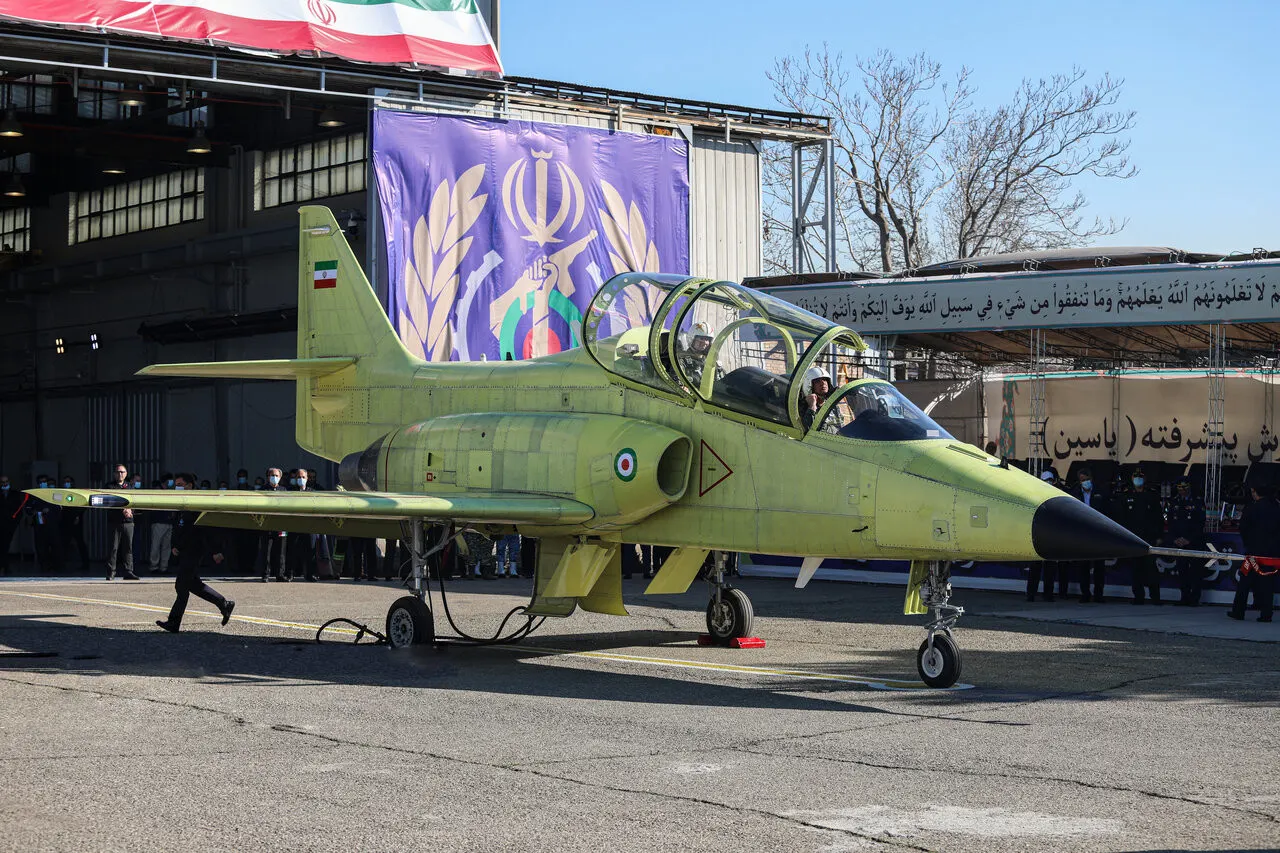

The HESA Yasin is a twin-engine, tandem-seat advanced jet trainer developed by Iran Aircraft Manufacturing Industries (HESA) under the Iran Aviation Industries Organization (IAIO), intended to carry Islamic Republic of Iran Air Force (IRIAF) cadets from basic instruction into fast-jet and light-attack work.1 It first flew on 17 October 2019 at the 3rd Tactical Fighter Base near Hamedan, under the interim designation Kowsar-88, a project IAIO had been contracted to pursue a decade earlier, in February 2009.2
- Domestically produced under sanctions, reducing reliance on imports
- Tandem cockpit and ejection seats built around a mature K-36-derived design
- Five hardpoints give a genuine secondary light-attack option
- Lower cost and complexity than importing a Western or Russian trainer
- Underpowered non-afterburning engines limit growth and hot-and-high performance
- No confirmed operational squadron service despite years of "mass production" announcements
- Design still leans on 1960s-era F-5 airframe and engine technology
- Cannot realistically bridge pilots to single-seat types like the Su-35
- Independent verification of most performance figures is unavailable
Iran's requirement dates back roughly three decades, driven by the need to retire around 15 Northrop F-5B Freedom Fighters and 18 Chengdu FT-7N Air Guards that had been serving as the IRIAF's advanced trainers well past their intended service lives.2 The Yasin, renamed from Kowsar-88 shortly before its 2019 first flight, shares clear design DNA with that F-5 lineage: its airframe and engine layout both trace back to reverse-engineering work Iran undertook on Northrop-supplied hardware after 1979.3
English-language reporting on the program is thin and leans heavily on Iranian state media and a handful of Western trade outlets; independent verification of performance claims, build quality, and current fleet status is largely unavailable. A production-standard prototype, incorporating a new engine fit, updated avionics, and redesigned ejection seats, was unveiled in March 2023 alongside the formal launch of a production line, though only two airframes are confirmed built as of the most recent reporting and the program has not been shown to have reached operational squadron service.4 This article flags those gaps rather than papering over them.
The Twin Owj Turbojets and Iran's F-5 Engine Lineage
The Yasin is powered by two Owj non-afterburning turbojets, each rated at roughly 16 kN (3,600 lbf) of thrust, giving a claimed maximum speed of about 1,000 km/h and a service ceiling of 11,000 m.3 The Owj itself is not a clean-sheet design: it is Iran's reverse-engineered derivative of the General Electric J85, built up from components and technical knowledge Iran retained from its Northrop F-5 fleet after the 1979 revolution cut off official US support, and it was first publicly unveiled in 2016.5 That lineage matters for judging the Yasin honestly: its powerplant is a 1960s-vintage American design reproduced domestically, not an indigenous new-generation engine.
- İlk Uçuş2019
- Hizmete Giriş Yılı2023
- Mürettebat (koltuk)2
- Eğitim Uçağı Tipiİleri jet eğitim uçağı
- HizmetteEvet
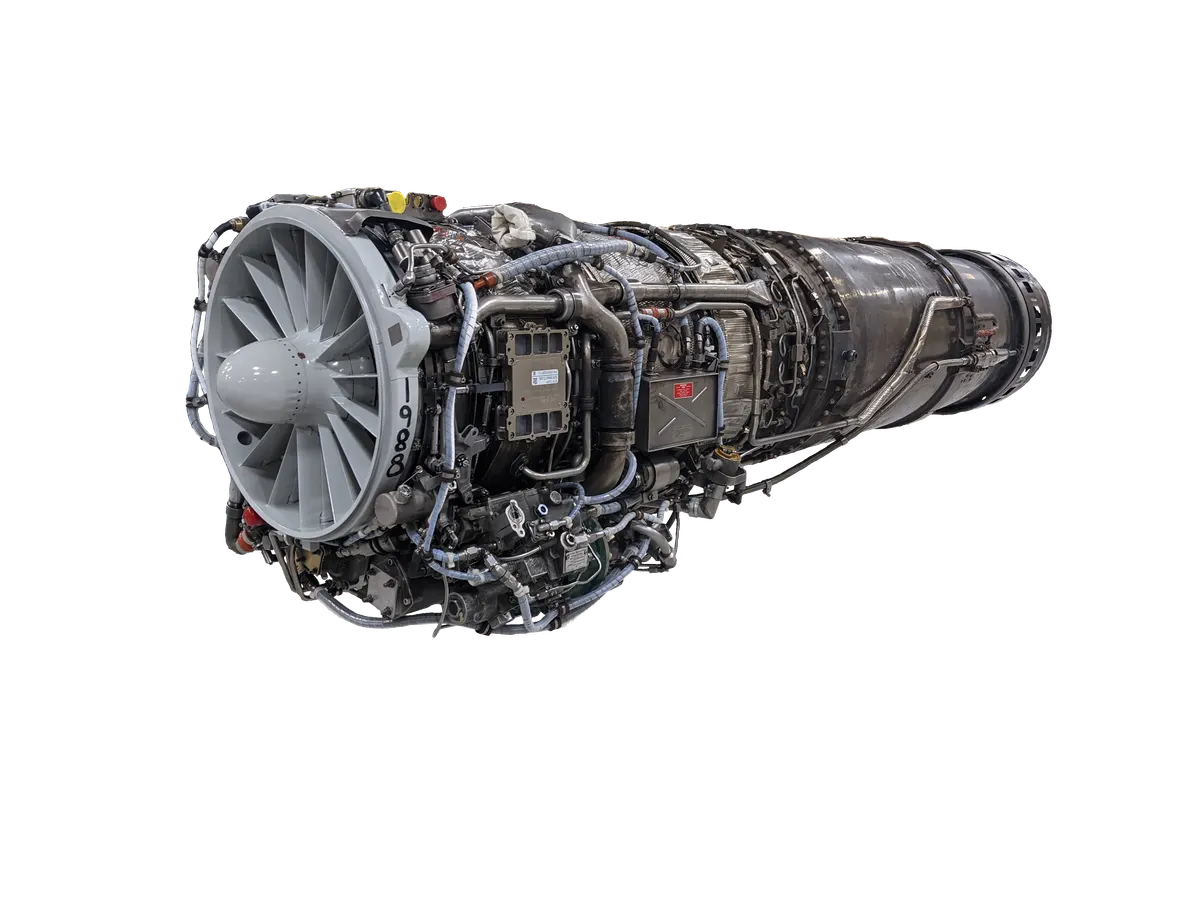
Notably, Iran also pursued a more capable alternative. According to aviation trade reporting, IAIO negotiated with Russia's JSC Salyut for a license to assemble Ivchenko-Progress AI-222-25F afterburning turbofans, rated around 24.5 kN with thrust vectoring, as a substantial upgrade over the Owj.2 That deal appears to have stalled, and the aircraft that reached the production-standard prototype stage in 2023 is still described in available reporting as Owj-powered, so any switch to a Russian engine should be treated as an unrealized proposal rather than a confirmed feature.
- Motor TipiOwj turbojet engines
- İtki16
Tandem Cockpit, Sarir Ejection Seats and the F-5 Airframe Heritage
The Yasin seats an instructor and student in tandem under a single clear-view canopy, with the airframe measuring 12.25 m long, spanning 10.4 m, and standing 4 m tall, for a maximum takeoff weight of about 6,600 kg.3 Both crew positions use Sarir ejection seats, an Iranian-built adaptation of the Russian K-36DM "zero-zero" seat capable of safe ejection at zero altitude and zero airspeed.3
- Azami Hız1.000 km/sa
- Hizmet Tavanı11.000 m
- Menzil900 km
- Havada/Görevde Kalış Süresi1,5
Development was not smooth. Reporting on the program's slow progress through the early 2020s points to funding shortfalls, engine-sourcing problems, and ejection-seat issues, including accidental ground activations during testing that forced a redesign and delayed flight trials.2 Those difficulties, more than any single design flaw, explain why a program that began in 2009 did not reach a production-standard prototype until 2023.
- Kokpit DüzeniTandem
- Hafif Taarruz KabiliyetliEvet
- Fırlatma KoltuklarıEvet
HESA and IAIO market the Yasin as a domestically engineered platform, and the airframe, tandem cockpit structure, and Sarir ejection seats are Iranian-built, drawing on decades of licensed and reverse-engineered F-5 production experience at HESA's Isfahan facilities.3 The powerplant is the clearest imported-technology dependency in spirit if not in final assembly: the Owj turbojet is manufactured domestically by Iran's Turbine Industries Organization rather than sourced abroad, but it embodies foreign design knowledge rather than an original Iranian engine.5 A parallel, unconsummated plan to import Russian-made AI-222-25F turbofans under license from Salyut would have made the engine a genuinely foreign import; since that deal reportedly stalled, the flying prototypes remain Owj-powered.2 Avionics, including an Iranian-produced weather radar fitted to the 2023 production-standard prototype, are also claimed as domestic, though none of this can be independently verified from outside Iran.
- Uzunluk12,25 m
- Kanat Açıklığı10,4 m
- Yükseklik4 m
- Maks Kalkış Ağırlığı6.600 kg
- Toplam Üretim2
- Kullanıcılar1
- Üretim Başlangıcı2023
- Operasyonel Durumüretimde
From a 1990s IRIAF Requirement to the Kowsar-88 Prototype
The IRIAF's advanced-trainer requirement long predates the Yasin. With its Vietnam-era F-5B and Chinese-built FT-7N trainers aging out, Iran spent decades searching for a domestic replacement before formally contracting IAIO in February 2009 to design a twin-engine advanced jet trainer under the project name Kowsar-88.2
Design and construction took place at IAIO's Aerospace Research Institute northwest of Tehran, and an initial prototype was unveiled publicly on 15 April 2017, still years before it flew.2 The aircraft, renamed Yasin shortly before this milestone, made its first flight on 17 October 2019 at Hamedan, with then-Defense Minister Amir Hatami and then-Vice President Sorena Sattari attending the public unveiling.1 The prototype that flew that day was, by most accounts, an early-generation airframe; a more refined, production-standard prototype followed years later.
Mass Production Announcement and the December 2024 Fatal Crash
On 11 March 2023, Iran's Ministry of Defense unveiled an upgraded, production-standard Yasin prototype, with a new engine fit, avionics, ejection seats, and landing gear, and formally launched a production line at a ceremony attended by Defense Minister Mohammad Reza Ashtiani and IRIAF commander Hamid Vahedi.4 Officials said mass production would "soon" follow, and a further prototype completed taxi trials that September before making its own first flight on 1 December 2023.1
As of the most recent reporting, only two Yasin airframes are confirmed to have been built, and independent trade press assessed that sanctions on aerospace components have kept the aircraft from reaching genuine serial production despite the 2023 announcements.6 The program suffered its most serious setback on 4 December 2024, when one of the two known prototypes crashed in mountainous terrain near Firouzabad, roughly 130 km south of Shiraz, while flying toward the Kish Island air show. Both pilots aboard, Colonel Hamid Reza Ranjbar and Colonel Manouchehr Pirzadeh, were killed. Iranian state television described it as a test flight following an overhaul; Iranian authorities did not disclose the cause, and unconfirmed reports have speculated about a double engine failure, which this article cannot verify.7 Given that only two prototypes are known to exist, the loss of one to a fatal accident is a significant setback for a program already running years behind its own announced schedule.
Iran has shown two distinct iterations of the design rather than a family of named export or attack variants. The original Kowsar-88/early Yasin configuration, which flew in 2019, represented the initial flight-test airframe built at IAIO's research institute.
The 2023 production-standard prototype is described as a distinct refinement: it received an updated engine fit, new avionics including an Iranian-built airborne weather radar, redesigned ejection seats, and new landing gear, and it is this version Iran has presented as the basis for eventual mass production.4 Beyond the trainer role, Iranian officials and Western analysts have both floated an armed light-attack configuration using the aircraft's five external hardpoints for gun pods, rocket pods, guided or unguided bombs, and air-to-air or air-to-surface missiles, though no dedicated attack variant has been named or shown separately from the baseline trainer.3,5

The Yasin's only confirmed or claimed operator is Iran, specifically the IRIAF, which has driven the requirement since the 1990s and hosted both the 2019 and 2023 unveilings.1
No export customer, and no confirmed transfer to the separate Islamic Revolutionary Guard Corps Aerospace Force, has been reported. Given that only two prototypes exist and the program has not been shown to have entered squadron service, describing the Yasin as "in service" anywhere is premature based on available English-language sourcing; Iran's own program milestones describe production-line launch and prototype testing, not delivery to an operational training unit.4,6
The most instructive comparison is not with a Western trainer but with the Yakovlev Yak-130, which Iran itself began receiving from Russia in September 2023 as part of a broader military exchange reportedly tied to Iranian support for Russia's war in Ukraine.8 The Yak-130 is a mature, combat-proven design: it entered Russian service in 2010, is powered by two afterburning-capable AI-222-25 turbofans producing around 24.5 kN each, reaches roughly Mach 0.93, and carries up to 3,000 kg across nine hardpoints.9 The Yasin's non-afterburning Owj turbojets produce well under half that combined thrust, and its five hardpoints and lower top speed leave it closer to a basic-to-intermediate trainer than a Yak-130-class advanced trainer with genuine light-combat performance. That gap explains why Western analysts view the Yak-130 delivery as a hedge against the Yasin program's slow progress, rather than a redundant purchase.
| Spec | HESA Yasin | Yak-130 |
|---|---|---|
| Engines | 2x Owj turbojet, ~16 kN each, no afterburner3 | 2x AI-222-25 turbofan, ~24.5 kN each9 |
| Max speed | ~1,000 km/h3 | ~Mach 0.93 (~1,060 km/h)9 |
| Hardpoints | 53 | 99 |
| Status with Iran | 2 prototypes, in production per manufacturer4 | In active IRIAF service since 20238 |
The other useful reference point is the aircraft the Yasin is meant to replace: the Northrop F-5B and Chengdu FT-7N trainers still in IRIAF service after roughly six decades between them.2 Even an underpowered, non-afterburning Yasin represents a more modern cockpit and structure than either legacy type, which is the real case for the program regardless of how it stacks up against a Yak-130. The honest assessment is that the Yasin's value to Iran is less about matching foreign trainers spec-for-spec and more about sustaining a domestic aircraft-manufacturing base under sanctions that block most alternatives.


What is the top speed of the HESA Yasin? Iranian-sourced figures put the maximum speed at about 1,000 km/h (620 mph), with a service ceiling of 11,000 m; these figures come from state-linked reporting and have not been independently flight-tested by outside observers.3
How many Yasin jets have been built? Two prototypes are confirmed as of the most recent reporting: the original 2019 flight-test airframe and the 2023 production-standard prototype. One of the two was destroyed in the December 2024 crash.1,7
Is the Yasin still in service? No confirmed operational squadron service has been reported. Iran's Ministry of Defense describes the program as being in production, and Wikipedia's own infobox for the type lists its status as "in production" rather than "in service."1,4
How does the Yasin compare to the Yak-130 Iran also operates? The Yak-130 is substantially more powerful and combat-capable, with roughly 50 percent more thrust, afterburning engines, and nearly double the hardpoints; Iran appears to be using Russian Yak-130 imports to cover capability gaps the slower-moving Yasin program has not yet closed.8,9
What happened to the Yasin that crashed in 2024? A prototype crashed in mountainous terrain near Firouzabad on 4 December 2024 while en route to an air show on Kish Island, killing both pilots aboard. The cause has not been officially disclosed.7
- "HESA Yasin", Wikipedia — en.wikipedia.org ↩
- "Is Iran's 33-year search for an advanced jet trainer over?", Key.Aero — key.aero ↩
- "HESA Yasin Advanced Jet Trainer (AJT) / Light Attack Aircraft", Military Factory — militaryfactory.com ↩
- "Iran Begins Mass Production Of Yasin Jet Trainer Aircraft", Overt Defense — overtdefense.com ↩
- "IAIO Owj", Wikipedia — en.wikipedia.org ↩
- "Iran Unveils Indigenous Trainer Aircraft; Expert Says Will Help IRIAF Pilots To Train On Russian Su-35 Fighters", Eurasian Times — eurasiantimes.com ↩
- "Military training jet crashes in southern Iran, killing both pilots", Iran International — iranintl.com ↩
- "Iran Receives Russian Yak-130 Advanced Trainer Jets", The War Zone — twz.com ↩
- "Yakovlev Yak-130", Wikipedia — en.wikipedia.org ↩