

The SIAI-Marchetti S.211 is a light, two-seat jet trainer developed in Italy and first flown on 10 April 1981.1 It is a compact, shoulder-wing monoplane powered by a single Pratt & Whitney Canada JT15D-4C turbofan rated at about 11.1 kN (2,500 lbf) of thrust, a business-jet engine adapted for military training rather than a purpose-built military turbojet, and that choice shaped the design brief: low fuel burn, simple maintenance, and a price small air forces could actually afford.1,2 SIAI-Marchetti launched the programme in 1976 as a private venture, betting that operators of its piston-engined SF.260 trainer would eventually want a jet from the same company, and unveiled the project at the 1977 Paris Air Show without a government contract behind it.1,3
- Fully aerobatic handling, closer to a fighter than a typical trainer
- Low-cost turbofan keeps fuel burn and running costs down
- Extensive composite structure, advanced for its era
- Simple systems and modest maintenance demands
- Single small engine gives no redundancy if the turbofan fails
- Never won a major order beyond three small air forces
- Lost the lucrative U.S. JPATS competition despite strong reviews
- Ageing airframes now hard to support with a shrinking parts pool
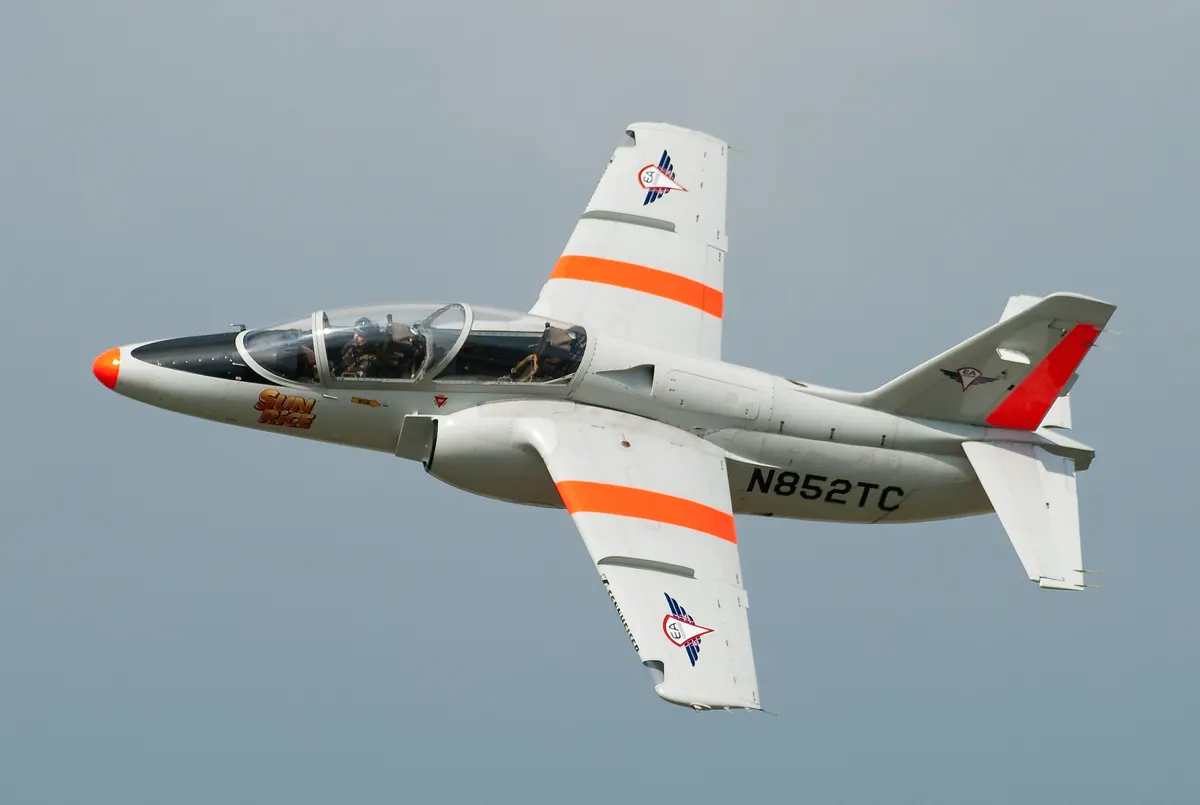
That gamble found a narrow but real market. Roughly 58 to 60 airframes were built between 1981 and 1994 for three military customers, Singapore (which assembled most of its own fleet under licence), the Philippines, and Haiti, plus a handful of prototypes and demonstrators.1,11 It never became a mass-production trainer on the scale of the Cessna T-37 or the BAe Hawk, but it found a durable niche: an aerobatic, jet-fast basic trainer cheap enough for air forces that could not justify a twin-engine type, and, in Philippine hands, an improvised light-attack aircraft that ended up flying far more combat than SIAI-Marchetti ever designed it for.1,4
The airframe leans heavily on composite construction for its era: roughly 61 percent of the external surface is Kevlar, Nomex honeycomb, or carbon-fibre composite bonded rather than riveted to a metal structure, an unusual proportion for a trainer designed in the mid-1970s.3 Combined with a swept, thick-section wing and boosted flight controls, the result is an aircraft pilots describe as flying closer to a fighter than a trainer, rated for a full aerobatic sequence, while its single small turbofan keeps operating costs down near those of a large piston twin.2,12
A Business-Jet Engine Bolted Into a Military Trainer
The S.211's single Pratt & Whitney Canada JT15D-4C turbofan, rated at roughly 11.1 kN (2,500 lbf) of thrust, is drawn from an engine family better known for powering small civilian business jets than military trainers.1,12 Pilots who have flown the type describe throttle response as almost instantaneous, without the spool-up lag of older low-bypass military turbojets.2 Cruise speed at 25,000 ft is about 667 km/h (414 kn), never-exceed speed is 740 km/h (400 kn), rate of climb is roughly 1,280 m/min (4,200 ft/min), and service ceiling is 12,200 m (40,000 ft).1,11
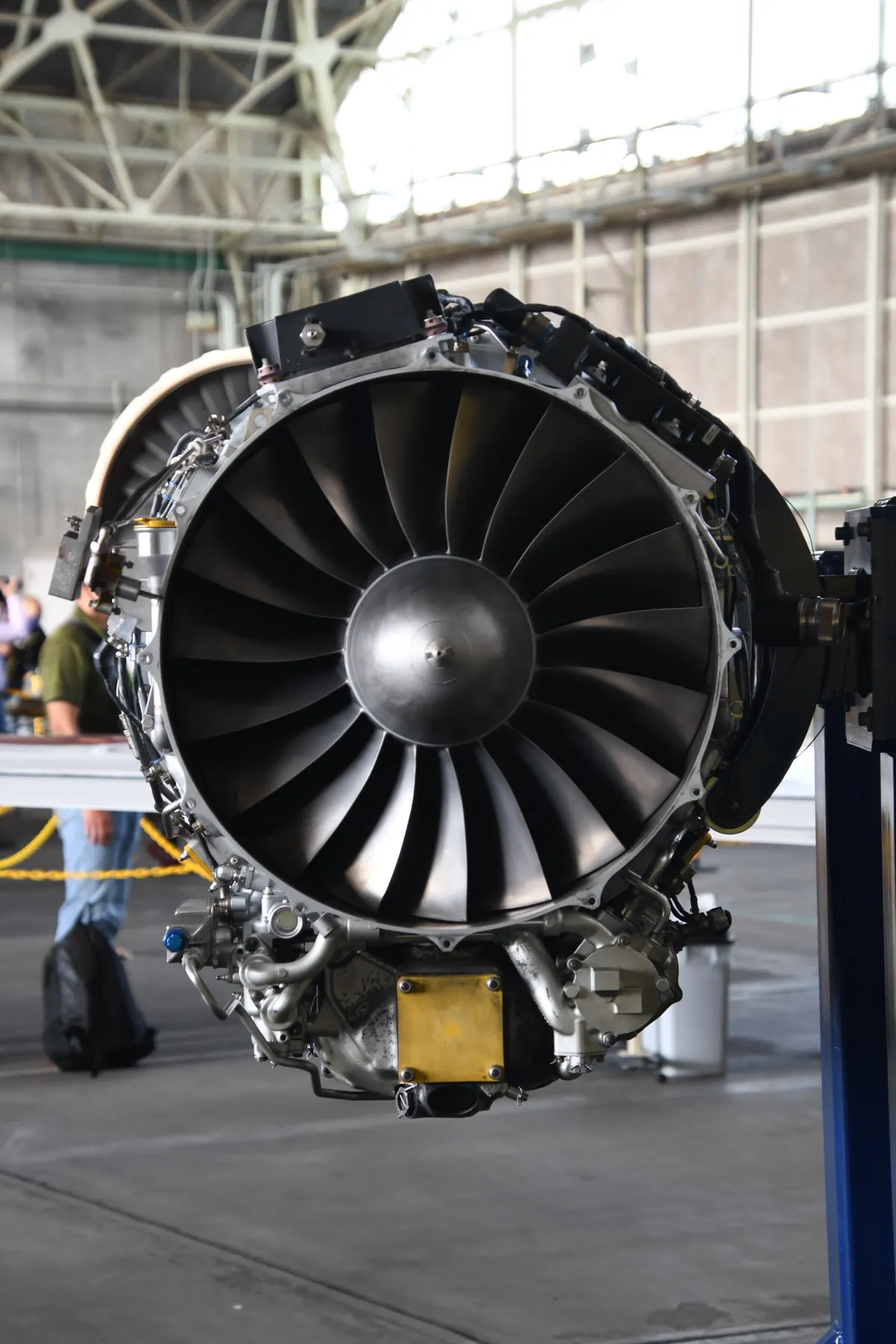
At 9.31 m (30 ft 7 in) long with an 8.43 m (27 ft 8 in) wingspan and a wing area of 12.6 m² (136 sq ft), the S.211 is a genuinely small aircraft, weighing roughly 1,850 kg (4,079 lb) empty and up to 2,750 kg (6,063 lb) at maximum take-off weight as a trainer, or 3,150 kg (6,940 lb) fully loaded with external stores.1,12 Internal fuel of 800 litres (210 US gal) gives a range around 1,670 km (901 nm), extendable with two 540-litre (140 US gal) external tanks to a ferry range beyond 2,480 km (1,340 nm).1
Tandem Seating, Boosted Controls, and Four Hardpoints for a Secondary Attack Role
The two-seat cockpit is arranged in tandem under a single-piece bubble canopy, with the rear instructor's seat raised for forward visibility, a layout shared with most fighter-lineage trainers rather than the side-by-side arrangement chosen by contemporaries such as the Canadair CT-114 Tutor.1 One American owner-pilot has described the low-slung front seat as making runway centrelines look oddly gigantic on approach.2 Flight controls use conventional push-pull rods for the elevator, but the ailerons, landing gear, and airbrake are hydraulically actuated at 200 bar, giving a light, fighter-like roll response; pilots who have flown both the S.211 and its stablemate the Aermacchi MB-339 describe the smaller aircraft as noticeably more nervous in roll, if just as fully aerobatic.1,3
For a secondary combat role, four underwing hardpoints carry up to 660 kg (1,460 lb) of stores between them; gun pods, unguided bombs, and SNEB 68 mm rocket launchers were all cleared for the type, letting the same basic airframe serve as a pure trainer for one customer and a genuine, if lightly armed, attack aircraft for another.1,11 The airframe's heavy use of bonded composite construction, again Kevlar, Nomex honeycomb, and carbon fibre, was chosen mainly to cut weight and part count rather than to meet any stealth or survivability requirement.3
SIAI-Marchetti designed and built the S.211's airframe in Italy, with production later consolidated at Aermacchi's Venegono Inferiore plant, though the company's original works were centred on Vergiate, near Varese.1,19 The aircraft's single most consequential component, the Pratt & Whitney Canada JT15D-4C turbofan, was never built in Italy; it came from Pratt & Whitney's Canadian plants as a militarised derivative of a civilian business-jet engine.1,12 Avionics fits varied by customer: Philippine AS-211 upgrades, for instance, later added an American Norsight optical sight and AN/ARC-34 radios salvaged from retired Northrop F-5s rather than anything supplied new from Italy.5,6 For a baseline Italian-built airframe, domestic content is modest once the imported Canadian engine and foreign avionics are counted, likely well under a quarter of total aircraft value; licence-assembled examples built abroad, such as Singapore's and the Philippines', pushed the Italian share lower still.
A Private Venture Aimed at SF.260 Customers
SIAI-Marchetti began design work on what became the S.211 in 1976, entirely on its own funds, aiming the new jet at the same smaller air forces that already flew its piston-engined SF.260 basic trainer.1 The company announced the programme publicly at the 1977 Paris Air Show, well before either prototype had flown, and enough customer interest followed to justify building two flying prototypes rather than one.1,3 The first of them flew from Malpensa airport near Milan on 10 April 1981.1,3
Singapore placed the type's first order in 1983, initially for ten aircraft, later expanded; by the time deliveries and licensed local assembly were complete, the Republic of Singapore Air Force operated a fleet of 32, twenty-four assembled in Singapore itself by Singapore Aircraft Industries from kits and knocked-down components, plus two added later as attrition replacements from Haiti's retired fleet.1 Haiti, a far smaller customer, bought just four S.211s, delivered from June 1985, giving its small air corps its first and only jet aircraft.1,9
The Philippines, Local Assembly, and an Accidental Combat Role
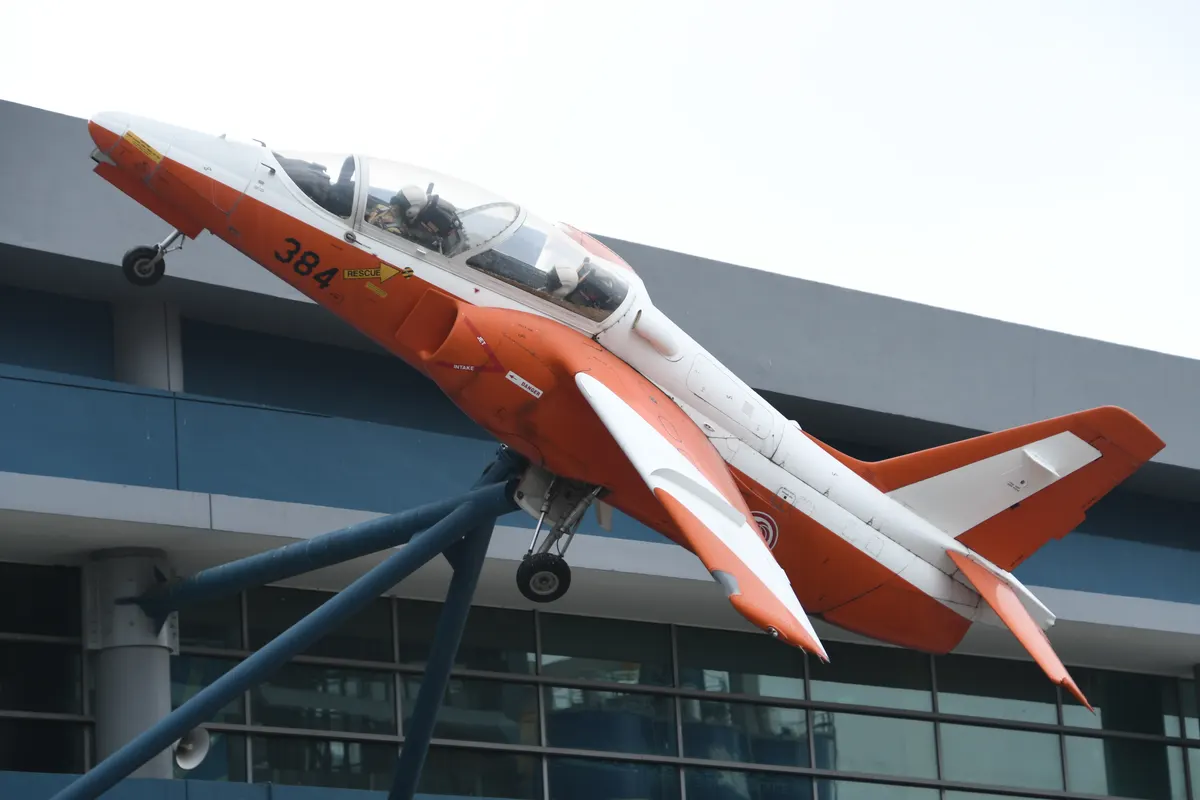
The Philippines became the type's other major operator, eventually fielding 25 aircraft: nine built in Italy, fifteen assembled locally by the state-owned Philippine Aerospace Development Corporation under licence between 1989 and 1991, and one incomplete airframe kept for spare parts.13,14 The order was meant to replace older piston and early-jet trainers, but it took on a second, unplanned life once the air force's Northrop F-5 fighters began retiring in the early 2000s.4,6
With no dedicated replacement funded, the Philippine Air Force redesignated its surviving trainers AS-211 "Warriors" and pressed them into a combined training, air-defence, and light-attack role the original design was never optimised for.4,5 Small, internally funded upgrade programmes followed: Project Falcon fitted a Norsight optical gunsight salvaged from retired F-5s, Project Falcon Uniform applied a low-visibility two-tone grey paint scheme, and a companion effort added AN/ARC-34 UHF radios, also recovered from the F-5 fleet, to improve air-to-ground communication.5,6 Some AS-211s were also fitted with a locally manufactured .50-calibre gun pod under the fuselage, giving the type genuine, if modest, strafing capability.6
Sale to Aermacchi, Retirement, and a Modern Successor
Aermacchi bought SIAI-Marchetti in 1997 and moved S.211 production and support to its Venegono Inferiore plant, ending the type's run as an independently marketed product but keeping spares alive for existing customers.1 Singapore retired its S.211 fleet from late 2008, replacing it with the Pilatus PC-21 turboprop trainer, and later sold surplus airframes to an Australian buyer, several of which have since found their way onto Australian and American civil registers as aerobatic and upset-recovery trainers.1,2
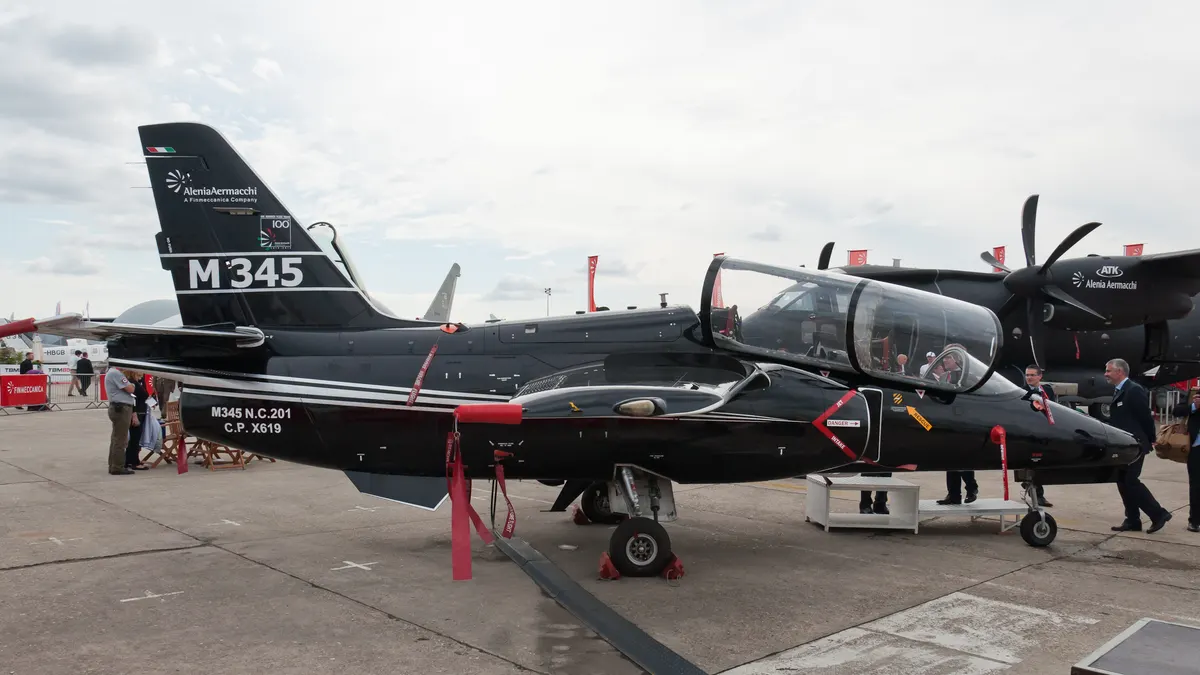
Aermacchi used the S.211 as the starting point for a more heavily redesigned successor: announced in 2004 as the M-311 with a new cockpit, more composite structure, and a more powerful JT15D-5C engine, it was revised again in 2012 as the M-345 High Efficiency Trainer, switched to a Williams International FJ44-4M turbofan, first flew in production form in December 2016, and entered Italian Air Force service in December 2020, a separate design lineage descended from, but structurally distinct from, the original S.211.10
Rebel Air Power in the December 1989 Coup Attempt
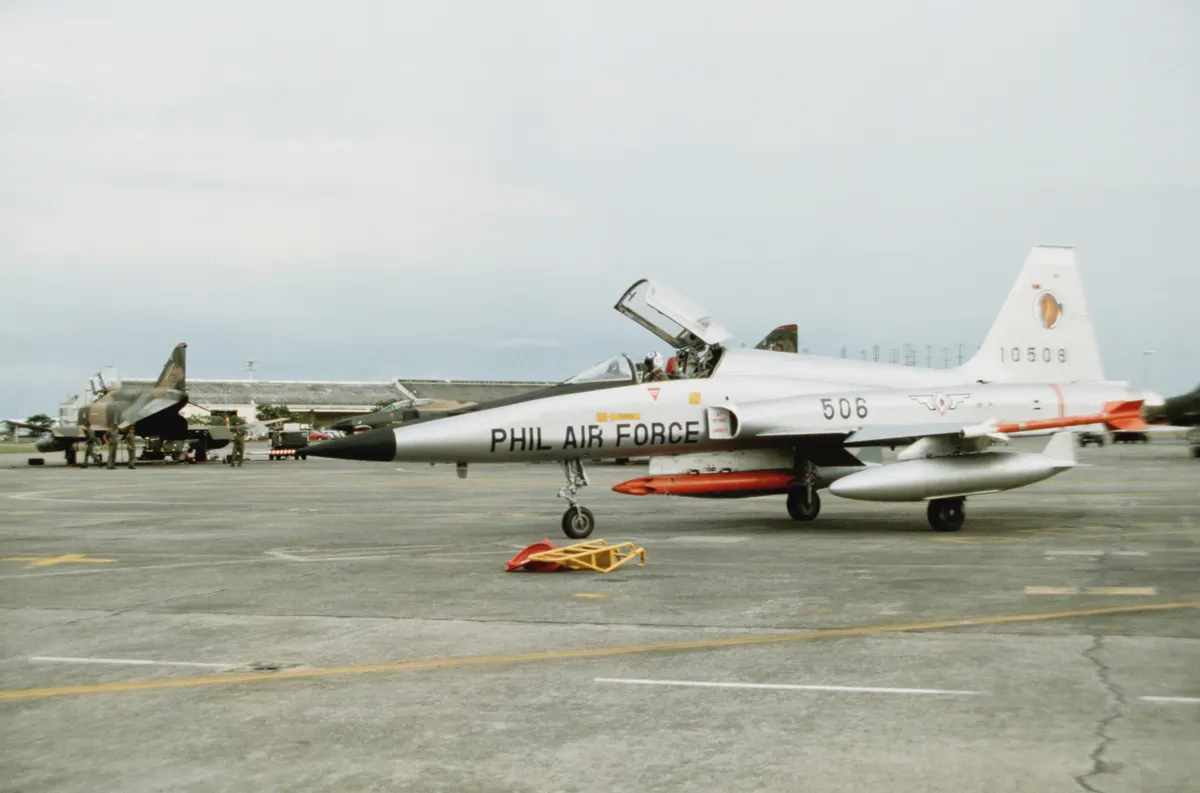
During the bloodiest of the coup attempts against President Corazon Aquino, launched on 1 December 1989 by officers of the Reform the Armed Forces Movement, mutinous units seized Sangley Point air base near Manila along with Villamor Air Base and parts of two army camps.7 From Sangley, rebel aircrew flew a mixed force of vintage North American T-28 Trojans and Philippine Air Force S.211 jets on strike sorties against Malacañang Palace and loyalist positions at Camp Aguinaldo and Camp Crame, using armament the S.211 had rarely if ever been expected to deliver in anger.7,8 The rebellion collapsed only after loyalist Northrop F-5 fighters, backed by a show of force from U.S. Air Force units based in the Philippines, contested the airspace and destroyed the rebel T-28s; by the time the fighting ended on 9 December, it had killed around 99 people, including roughly 50 civilians, and wounded close to 570.7,8
A Long-Running Counter-Insurgency Role
Outside that one dramatic episode, the S.211's Philippine combat record is steadier but less documented in detail. After the AS-211 upgrade programmes of the mid-2000s, the type flew air-to-ground missions supporting army operations against the New People's Army and, in the southern Philippines, against Moro separatist and Islamist armed groups, alongside its continuing training workload.4,6 From 2005, with the F-5 fleet gone, the AS-211 briefly became the air force's only jet capable of an air-defence intercept role too, a stopgap the air force openly acknowledged stretched an already ageing trainer well past its design brief.4
More recently the type's role has shifted toward presence and patrol rather than strike: in the 2020s the Philippine Air Force has repeatedly deployed small detachments of AS-211s to Palawan for maritime patrol sorties over the West Philippine Sea, using the aircraft's speed and endurance to cover disputed waters even as newer FA-50 fighters take over most front-line combat taskings.6,5
The two S.211 prototypes were company-funded aircraft used to prove the design before any government order existed.1 The baseline production S.211 is the version bought by all three military customers, Singapore, the Philippines, and Haiti, in the standard trainer configuration with the option of four underwing hardpoints for light armament.1,11
The S.211A was a one-off adaptation of two former Haitian airframes, re-engineered with Grumman's help and offered, unsuccessfully, into the U.S. Joint Primary Aircraft Training System competition of the mid-1990s.1,15 The Philippine Air Force's AS-211 "Warrior" designation covers locally upgraded trainers fitted with a retired F-5's optical sight, salvaged UHF radios, low-visibility paint, and, on some airframes, a .50-calibre gun pod, adaptations bolted onto the existing airframe rather than a factory variant.5,6
Separately, Aermacchi's M-311, later renamed M-345, took the S.211 concept in a new direction: a new engine family, a heavily revised composite structure, and a modern glass cockpit, entering Italian Air Force service in December 2020 as a fresh design rather than an upgrade path for existing S.211 airframes.10
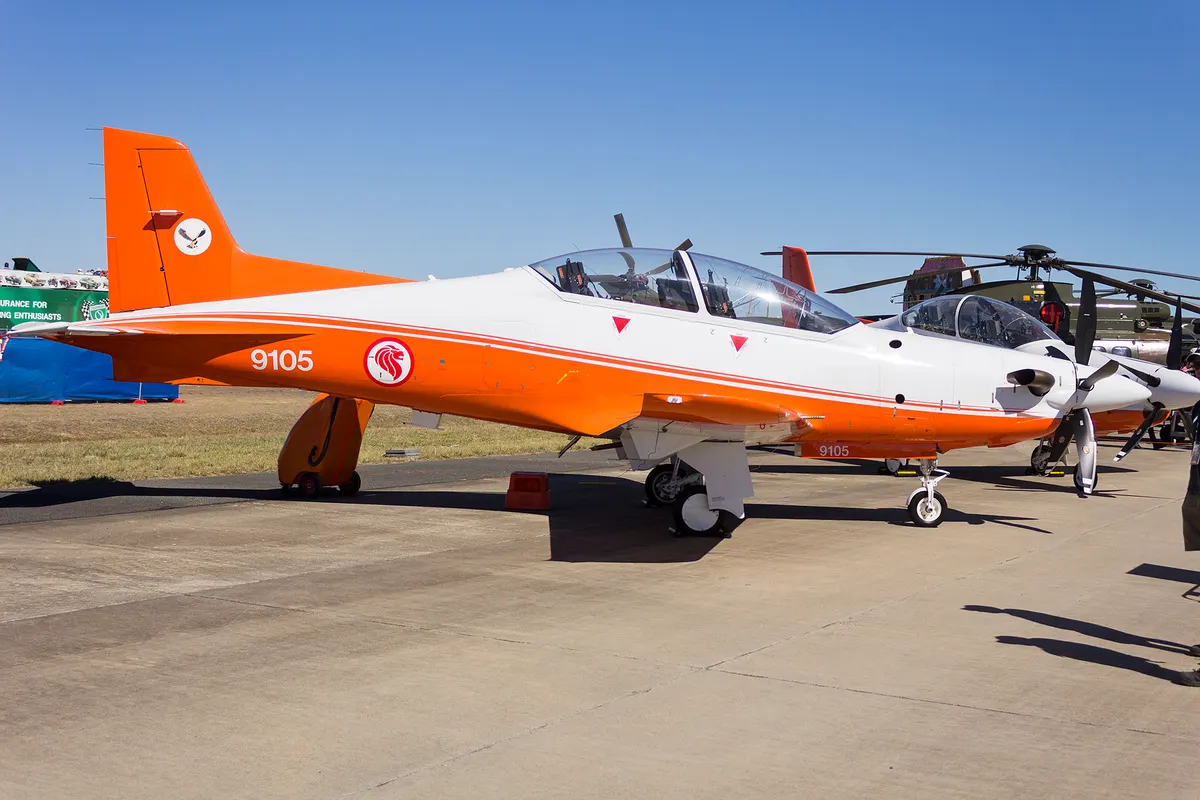
Singapore was the S.211's largest operator, flying a fleet that eventually totalled 32 airframes, most of them assembled locally by Singapore Aircraft Industries, with 130 Squadron and, until its 1996 disbandment, 131 Squadron providing basic jet training; seven airframes were lost to accidents, including a February 1989 crash near the Endau River traced to a fuel-supply system failure that prompted fleet-wide inspections.1,16 The Republic of Singapore Air Force retired the type from late 2008 in favour of the Pilatus PC-21, later selling most retired airframes to an Australian buyer.1
The Philippines remains the type's only current military operator, though its fleet has shrunk considerably from a peak of 25 airframes; by the mid-2010s only a handful remained fully operational, split between training units at Fernando Air Base and Basa Air Base, with the air force citing the difficulty of sourcing spare parts as the sole remaining military user of the type worldwide.14,4 Haiti flew four S.211s from June 1985 until financial and political turmoil forced their sale in 1990, two to Singapore and two into private American hands, ending the aircraft's brief career as Haiti's only jet type.1,9
A number of retired military S.211s have since moved into civilian hands, particularly in the United States and Australia, where flight schools and private owners fly them for upset-recovery training and aerobatics, a second career that has kept part of the roughly 58 to 60 airframes built still airworthy decades after the type left military production.2,3
The S.211 Versus the Aermacchi MB-339: Cheaper Cousin, Bigger Seller
The S.211's closest relative, once both companies came under the same corporate roof in 1997, is the Aermacchi MB-339, and the comparison is a study in what a single-engine turbofan trainer trades away against a single-engine turbojet built for a different market tier. The MB-339 first flew in August 1976, five years before the S.211, and uses a Rolls-Royce Viper turbojet of around 17.8 to 19.6 kN (4,000 to 4,400 lbf) thrust, considerably more powerful than the JT15D-4C, giving it a higher top speed near 898 km/h (485 kn) at sea level against the S.211's 667 km/h (414 kn) cruise, and a service ceiling around 14,600 m (48,000 ft) versus 12,200 m (40,000 ft).18,1,12 That extra performance came with heavier fuel burn and a higher price, precisely the customer base SIAI-Marchetti's private venture was designed to avoid; production numbers reflect the split, with around 230 MB-339s built against the S.211's roughly 58 to 60.18,1 Both aircraft, tellingly, competed for the same American JPATS contract in the 1990s and lost to the same rival, the T-6 Texan II, even though the S.211 was, by some accounts, rated ahead of its own more powerful stablemate in that evaluation.15,1
The S.211 Versus the CASA C-101 Aviojet: Two Answers to the Same Budget Problem
A more direct market rival is Spain's CASA C-101 Aviojet, which set out to solve almost exactly the same problem, a single-engine, moderately priced jet trainer with a secondary attack option, using a broadly similar-thrust turbofan, the Garrett/Honeywell TFE731, in place of the S.211's JT15D.1 The C-101 is the larger and, in its attack-optimised CC/A-36 form, more heavily armed of the two, with six hardpoints and a dedicated ventral gun bay against the S.211's four hardpoints and no built-in cannon position, but the two aircraft ended up serving similar customer profiles; Spain and Chile flew the C-101 much as the Philippines flew the S.211/AS-211, as a trainer quietly pressed into light-attack and, at times, limited air-defence duty once other options ran out.1 Neither aircraft won a major export order beyond a handful of small air forces, and both saw their most intensive use not against a peer air force but in counter-insurgency roles their designers had treated as secondary.
| Aircraft | First flight | Engine | Top speed | Total built |
|---|---|---|---|---|
| S.211 | 1981 | 1 × P&W Canada JT15D-4C turbofan | ~667 km/h (414 kn) cruise | ~58 to 60 |
| Aermacchi MB-339 | 1976 | 1 × Rolls-Royce Viper turbojet | ~898 km/h (485 kn) | ~230 |
| CASA C-101 Aviojet | 1977 | 1 × Garrett/Honeywell TFE731 turbofan | ~685 to 834 km/h | ~149 to 166 |
What are the SIAI-Marchetti S.211's specifications? The S.211 is a two-seat jet trainer 9.31 m (30 ft 7 in) long with an 8.43 m (27 ft 8 in) wingspan, weighing about 1,850 kg (4,079 lb) empty and up to 2,750 kg (6,063 lb) at maximum take-off weight as a trainer, powered by a single Pratt & Whitney Canada JT15D-4C turbofan rated around 11.1 kN (2,500 lbf).1,12 Commonly cited performance figures include a cruise speed of about 667 km/h (414 kn) at 25,000 ft, a service ceiling of 12,200 m (40,000 ft), and a range of roughly 1,670 km (901 nm) on internal fuel.1,11
How many SIAI-Marchetti S.211s were built? Sources put total production at roughly 58 to 60 airframes between 1981 and 1994, including prototypes: about 32 for Singapore (24 assembled locally), 25 for the Philippines (nine Italian-built, fifteen assembled locally, and one spares airframe), and four for Haiti, two of which later transferred to Singapore.1,13,14
What is the SIAI-Marchetti S.211's top speed? Cruise speed is quoted at about 667 km/h (414 kn, 359 mph) at 25,000 ft, with a never-exceed speed of 740 km/h (400 kn); the aircraft's maximum Mach number is listed at around Mach 0.8 in a dive.1,11
Is the SIAI-Marchetti S.211 still in service? Only barely. The Philippine Air Force is the sole remaining military operator, flying a small, ageing fleet for training, limited attack, and maritime patrol duties as spare parts grow scarcer; Singapore retired its fleet in 2008 and Haiti sold its aircraft in 1990.14,1,5
Did the S.211 ever see combat? Yes. Rebel-flown Philippine Air Force S.211s took part in the December 1989 coup attempt against President Corazon Aquino, flying strike sorties from Sangley Point air base, and later, upgraded AS-211 Warriors flew counter-insurgency missions against the New People's Army and separatist groups in the southern Philippines.7,8,4
How does the S.211 compare with the Aermacchi MB-339? The MB-339 is faster, higher-flying, and considerably more numerous, reflecting its more powerful Rolls-Royce Viper turbojet and higher price point, while the S.211 is smaller, cheaper to operate, and aimed at air forces the MB-339 was never priced for; both, curiously, lost the same American JPATS competition to the same rival aircraft.18,1,15
- "SIAI-Marchetti S.211", Wikipedia — en.wikipedia.org ↩
- "The Italian job", AOPA — aopa.org ↩
- "Flying the Little Italian Stallion - The SIAI-Marchetti S.211", Vintage Aviation News — vintageaviationnews.com ↩
- "Philippines Seeks S.211 Jet Trainer Replacement", Aviation Week Network — aviationweek.com ↩
- "PAF's remaining S-211 jets used for training, support missions", Philippine News Agency — pna.gov.ph ↩
- "Philippines Deploy AS.211s Light Attack Aircraft for Sea Patrols", Key.Aero — key.aero ↩
- "1989 Philippine coup attempt", Wikipedia — en.wikipedia.org ↩
- "Manila Turns Back Coup Bid With Help of U.S. Air Power", The Washington Post — washingtonpost.com ↩
- "Haitian Aviation Corps", Wikipedia — en.wikipedia.org ↩
- "Aermacchi M-345", Wikipedia — en.wikipedia.org ↩
- "Alenia Aermacchi S-211 Advanced Jet Trainer / Light Strike Aircraft", Military Factory — militaryfactory.com ↩
- "SIAI-Marchetti S.211 - Specifications - Technical Data / Description", flugzeuginfo.net — flugzeuginfo.net ↩
- "Philippine Aerospace Development Corporation", Wikipedia — en.wikipedia.org ↩
- "Is it Time to Replace the Philippine Air Force's S-211 Aircraft?", MaxDefense Philippines — maxdefense.blogspot.com ↩
- "Joint Primary Aircraft Training System", Wikipedia — en.wikipedia.org ↩
- "RSAF AIRCRAFT CRASH (Measures to prevent)", Singapore Parliamentary Debates (Telescope) — telescope.gov.sg ↩
- "Royal Brunei Air Force", Wikipedia — en.wikipedia.org ↩
- "Aermacchi MB-339", Wikipedia — en.wikipedia.org ↩
- "SIAI-Marchetti", Wikipedia — en.wikipedia.org ↩