

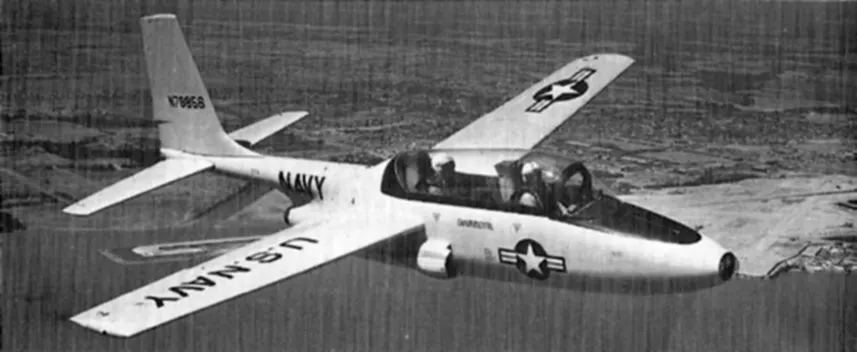

The Temco TT-1 Pinto was a small, single-engine jet trainer built by Temco Aircraft of Dallas, and flown briefly by the US Navy from 1959. It tested one idea: put a cadet with zero flight time straight into a jet, skipping propeller training entirely. The Navy bought 14 production aircraft to find out, picking Temco's design over a rival largely on price.12 The verdict, after about a year of trials at NAS Pensacola, was no. The single Continental YJ69-T-9 turbojet, a licensed Turbomeca Marboré, made only 920 lb of thrust, and roughly an hour of usable endurance was too thin for a syllabus of pattern work, cross-countries, and go-arounds.2 It remains the Navy's only real attempt at all-through jet primary training.
- genuine ejection seats and jet systems in a primary trainer
- low unit cost that won the Navy contract
- docile, forgiving handling for first-time jet students
- proved ab-initio jet solos were possible
- roughly one hour of usable endurance
- underpowered for safe wave-offs / go-arounds
- no growth margin once syllabus demands became clear
- never adopted beyond the trial batch
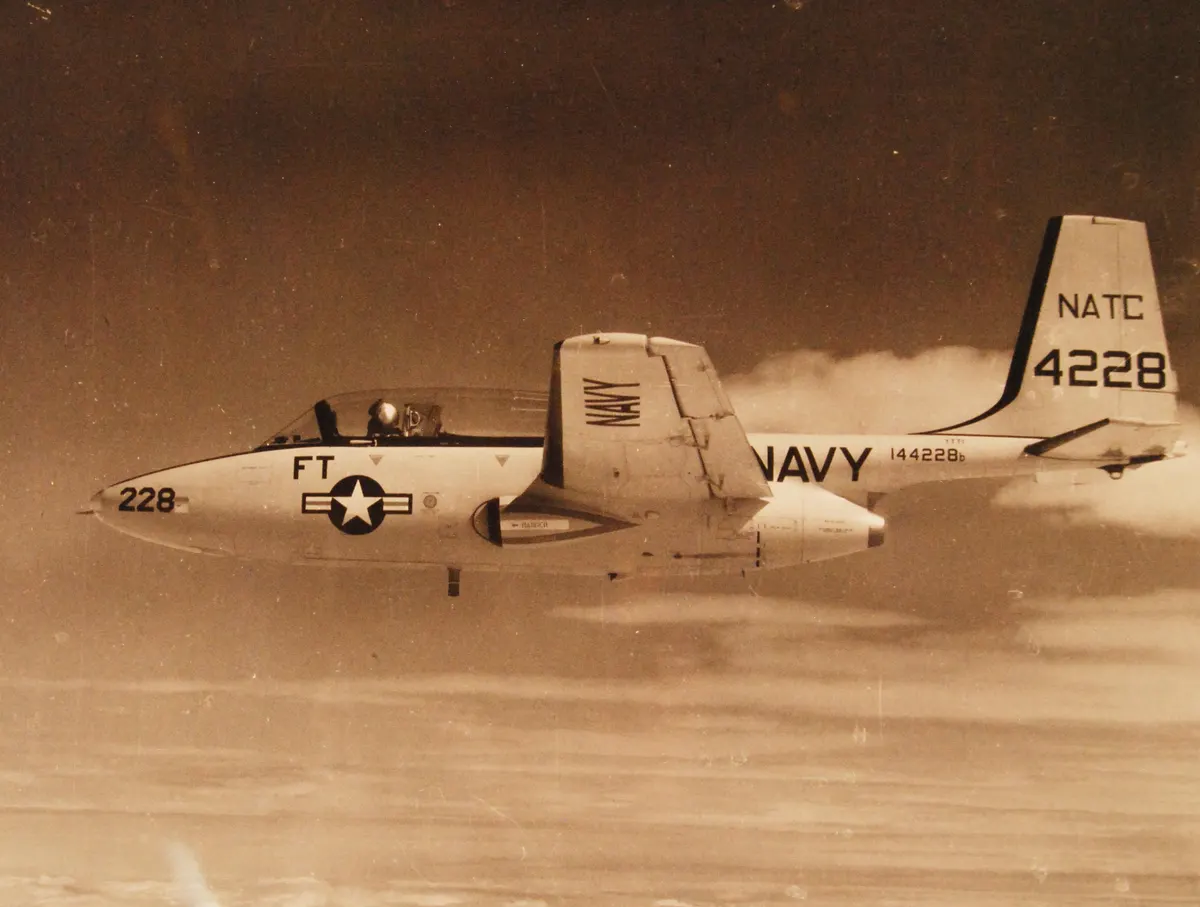
The airframe was conventional: mid-set straight wing, tricycle gear, tandem two-seat cockpit. What set it apart was jet-era equipment fitted at the bottom of the training pipeline — ejection seats, liquid oxygen, speed brakes — gear a cadet would otherwise not see until an intermediate jet.3 Evaluators liked the handling but rated "wave-off" (go-around) power marginal; the small engine left little in reserve near the runway, and that weakness killed the program.4
Temco's design began as the Model 51, entered in a mid-1950s US Air Force jet-primary-trainer contest that Cessna's T-37 Tweet won.1 When the Navy separately sought a jet trainer to replace the Beechcraft T-34, Temco's design and a jet-converted Beechcraft, the Model 73 "Jet Mentor," competed.2 The prototype first flew 26 March 1956 and beat the Jet Mentor in evaluation at Patuxent River; the Navy ordered 14 aircraft on 29 June 1956 as the TT-1.3
- İlk Uçuş1956
- Hizmete Giriş Yılı1959
- Mürettebat (koltuk)2
- Eğitim Uçağı TipiTemel jet eğitim uçağı
- HizmetteHayır
The Continental YJ69-T-9 and Its Reputation
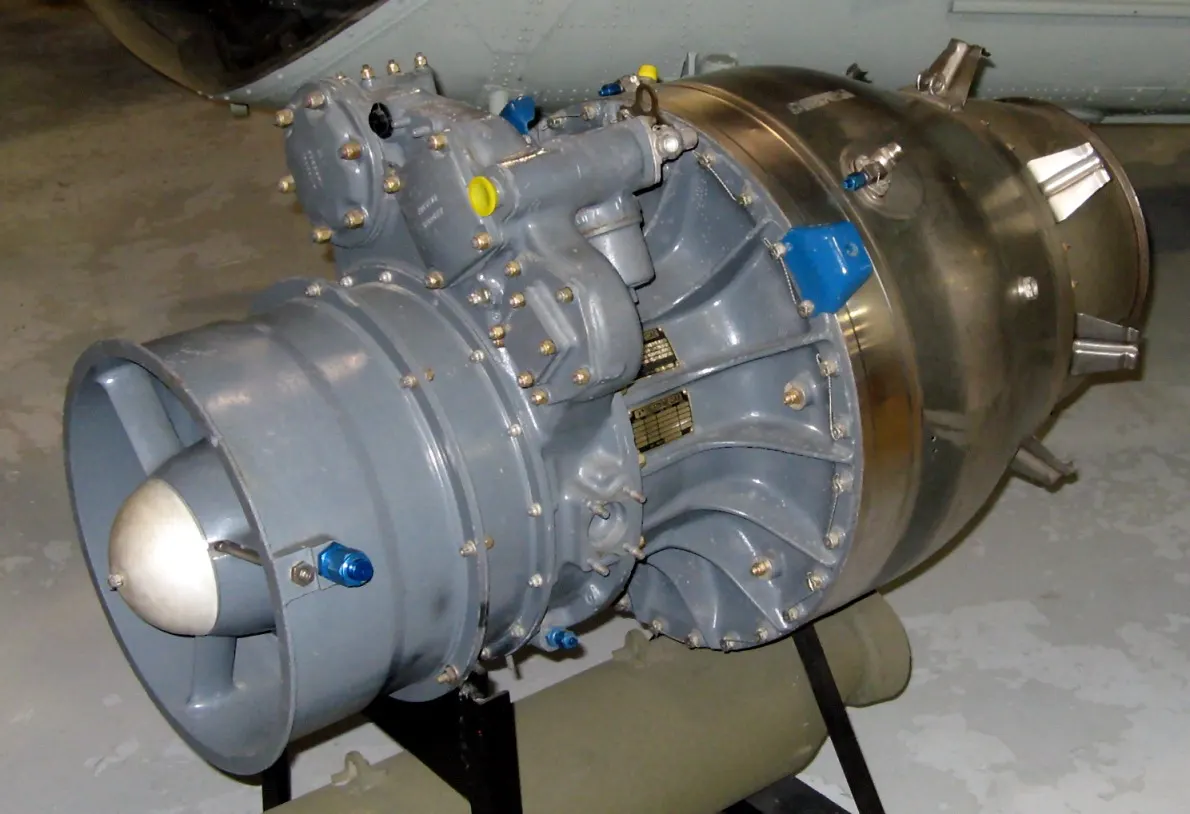
The YJ69-T-9, an American-built version of the French Turbomeca Marboré II, made only about 920 lb of thrust — the same engine family later used in the T-37.5 It gave the Pinto a top speed near 345 mph (555 km/h), cruise around 247 mph (397 km/h), and a 30,000 ft ceiling: decent for 1956, but almost no thrust margin at the low speeds and altitudes where students fly.6
- Motor TipiContinental YJ69-T-9
- İtki4,09
The airframe was designed and built entirely in the US by Temco. The one foreign-origin element was the engine lineage: the YJ69-T-9 was a US-built derivative of the French Turbomeca Marboré II, license-manufactured rather than imported complete.5 Ejection seats, oxygen system, and instruments were standard American hardware of the period; only the core engine architecture traced abroad.
At roughly 9.3 m long with a 9.1 m wingspan and a takeoff weight just under 2,000 kg, the Pinto was smaller and lighter than the T-34 Mentor it was meant to succeed, and carried no armament or hardpoints.5
- Azami Hız555 km/sa
- Seyir Hızı397 km/sa
- Hizmet Tavanı9.144 m
- Menzil322 km
- Tırmanma Hızı9,652 m/sn
- Havada/Görevde Kalış Süresi1,5
- Kokpit DüzeniTandem iki koltuklu
- Cam KokpitHayır
- Gömülü SimülasyonHayır
- Hafif Taarruz KabiliyetliHayır
- Silah İstasyonları0
- Fırlatma KoltuklarıEvet
- Uzunluk9,14 m
- Kanat Açıklığı8,84 m
- Yükseklik3,05 m
- Maks Kalkış Ağırlığı2,014 kg
- Toplam Üretim15
- Kullanıcılar1
- Hizmetten Çıkış Yılı1960
- Üretim Başlangıcı1955
- Üretim Bitişi1957
- Operasyonel Durumemekli
Deliveries ran through 1957; the all-jet training demonstration began at Pensacola in 1959.2 Cadets went straight into the TT-1 with no prior propeller instruction — the scenario the trial existed to test — and it worked narrowly: Clark's solo proved the concept flyable.
But the syllabus exposed the airframe's limits fast. With about an hour of endurance, instructors had little slack for a student needing a second approach, and marginal wave-off power meant a bad landing attempt could not always be salvaged with a go-around.4 By the end of 1960 the Navy shut the program down and returned to the piston-powered T-34B; surplus TT-1s were sold off.2
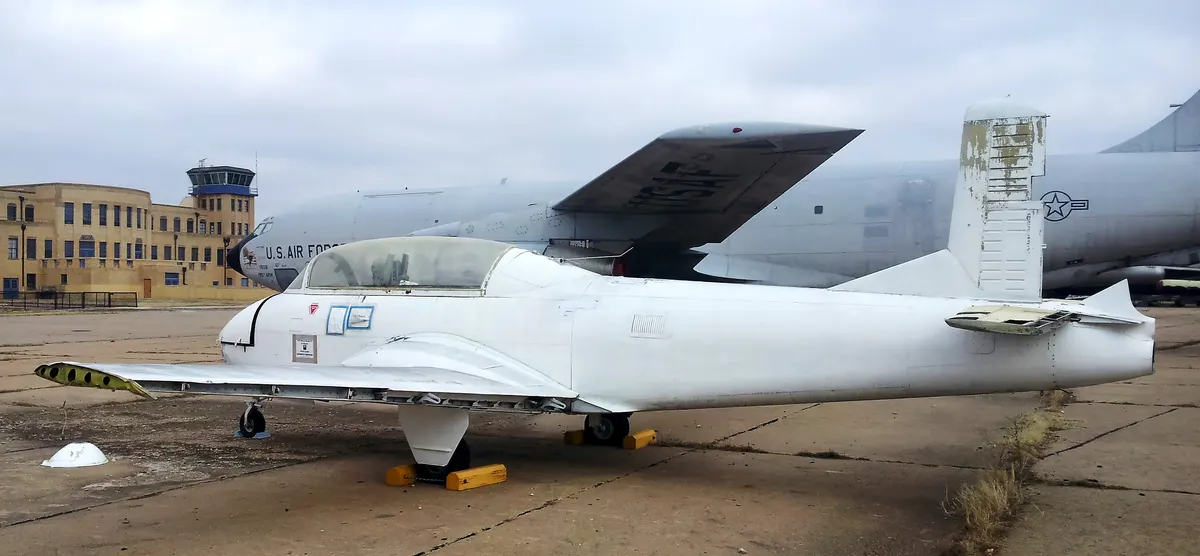
One revival followed: in 1968 American Jet Industries re-engined a surplus TT-1 with a General Electric CJ610 turbojet, flying it as the T-610 Super Pinto and marketing it as a light-attack/COIN aircraft with underwing hardpoints.1 In 1976 the Philippine Air Force bought the rights and built a second airframe locally as the "T-610 Calí"; both flew, but the program collapsed with the Marcos-era government.8
The TT-1 never saw combat and was never exported; its entire uniformed career was training duty at Pensacola. The only combat-adjacent lineage is the civilian T-610 Super Pinto, sold as a counter-insurgency aircraft and pursued by the Philippines for domestic manufacture before the program was shelved.8
- Model 51 / Pinto — Temco's company-funded prototype, first flown 26 March 1956.1
- TT-1 — the 14 production aircraft for the Navy's all-jet training trial.3
- AJI T-610 Super Pinto — 1968 civilian conversion with a General Electric CJ610 turbojet, marketed as light attack/COIN.1
- T-610 Calí — Philippine Air Force locally built version under a 1976 deal; one prototype survives in a museum.8

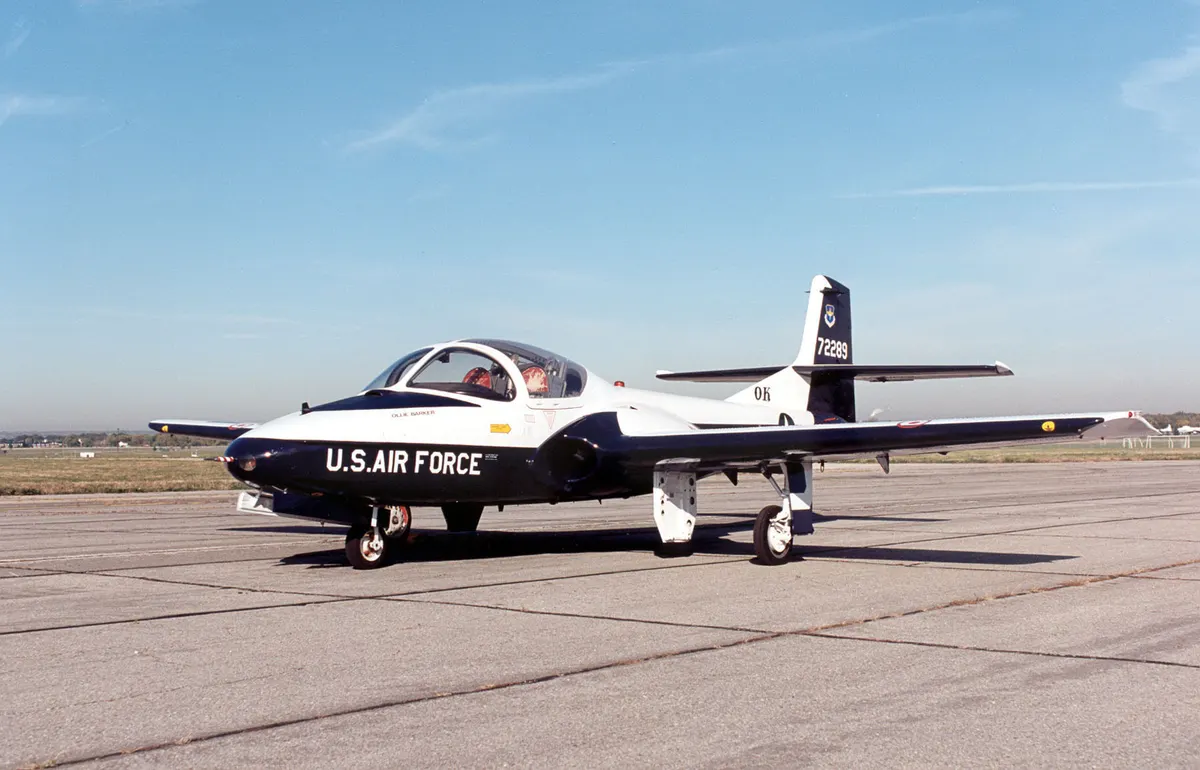
The TT-1's only operator was the US Navy, flying all 14 through Pensacola's Naval Air Training Command between 1959 and 1960.2 The only foreign link is the Philippine Air Force's rights purchase for the T-610 Calí, which never reached squadron service.8
A handful of ex-Navy TT-1s and Super Pinto conversions remain on the US civil register, flown by private owners and groups such as the Commemorative Air Force.9
The clearest comparison is the Beechcraft Model 73 Jet Mentor, the Navy's other finalist, of which only one example was built. Both used the identical 920 lbf Continental J69 engine, yet the heavier Jet Mentor was actually slower, near 295 mph against the Pinto's 345 mph.10 Temco's layout won on handling and price, though neither solved the real problem: too little thrust for the mission.
A sharper contrast is the Air Force's Cessna T-37 Tweet, built around the same Marboré/J69 family but with two engines and far more fuel, reaching about 425 mph.11 That margin let the Air Force run its own ab-initio jet syllabus on the T-37 for fifty years, 1957 to 2009, with 1,269 built — the same concept the Navy tried and abandoned, with the reserve thrust and fuel the Pinto never had.11


What were the Temco TT-1 Pinto's specifications? A tandem two-seat jet trainer about 9.3 m long with a 9.1 m wingspan, powered by a single 920 lb-thrust Continental YJ69-T-9, giving a top speed near 345 mph (555 km/h) and a 30,000 ft ceiling.6
How many Temco TT-1 Pintos were built? One Model 51 prototype plus 14 production TT-1s — 15 airframes total.5
Is the Temco TT-1 Pinto still in service? No; the Navy retired all 14 by the end of 1960. A few ex-Navy airframes, some as Super Pinto conversions, remain airworthy in private hands, including the Commemorative Air Force.9
How does the TT-1 Pinto compare to the T-37 Tweet? Both shared the same turbojet family and ab-initio jet-training idea, but the twin-engined T-37's far greater thrust and fuel margin let the Air Force fly it for 50 years while the Navy shelved the Pinto after one.11
Why did the Navy stop using the TT-1 Pinto? About an hour of endurance and marginal wave-off power, both consequences of its small engine, were judged inadequate for primary training, so the Navy ended the trial by December 1960.2
- "Temco TT Pinto", Wikipedia — en.wikipedia.org ↩
- "TT-1 Pinto", Naval History and Heritage Command — history.navy.mil ↩
- "Today In Aviation History: First Flight of the Temco TT Pinto", Vintage Aviation News — vintageaviationnews.com ↩
- "The Temco TT-1 Pinto", Aero-News Network — aero-news.net ↩
- "TEMCO TT-1 Pinto Two-Seat Jet-Powered Basic Jet Trainer", MilitaryFactory — militaryfactory.com ↩
- "Temco TT Pinto - Specifications (TT-1)", Liquisearch — liquisearch.com ↩
- "Temco TT Pinto Forced Landing | Delayed Fuel Transfer", General Aviation News — generalaviationnews.com ↩
- "Philippine Government T-610 Calí jet trainer", Secret Projects Forum — secretprojects.co.uk ↩
- "Commemorative Air Force Soars to New Heights with Acquisition of a TT-1 Pinto Jet", Commemorative Air Force — commemorativeairforce.org ↩
- "Econo-Jet – the Model 73", King Air Magazine — kingairmagazine.com ↩
- "Cessna T-37 Tweet", Wikipedia — en.wikipedia.org ↩
- "Beechcraft T-34 Mentor", Wikipedia — en.wikipedia.org ↩