

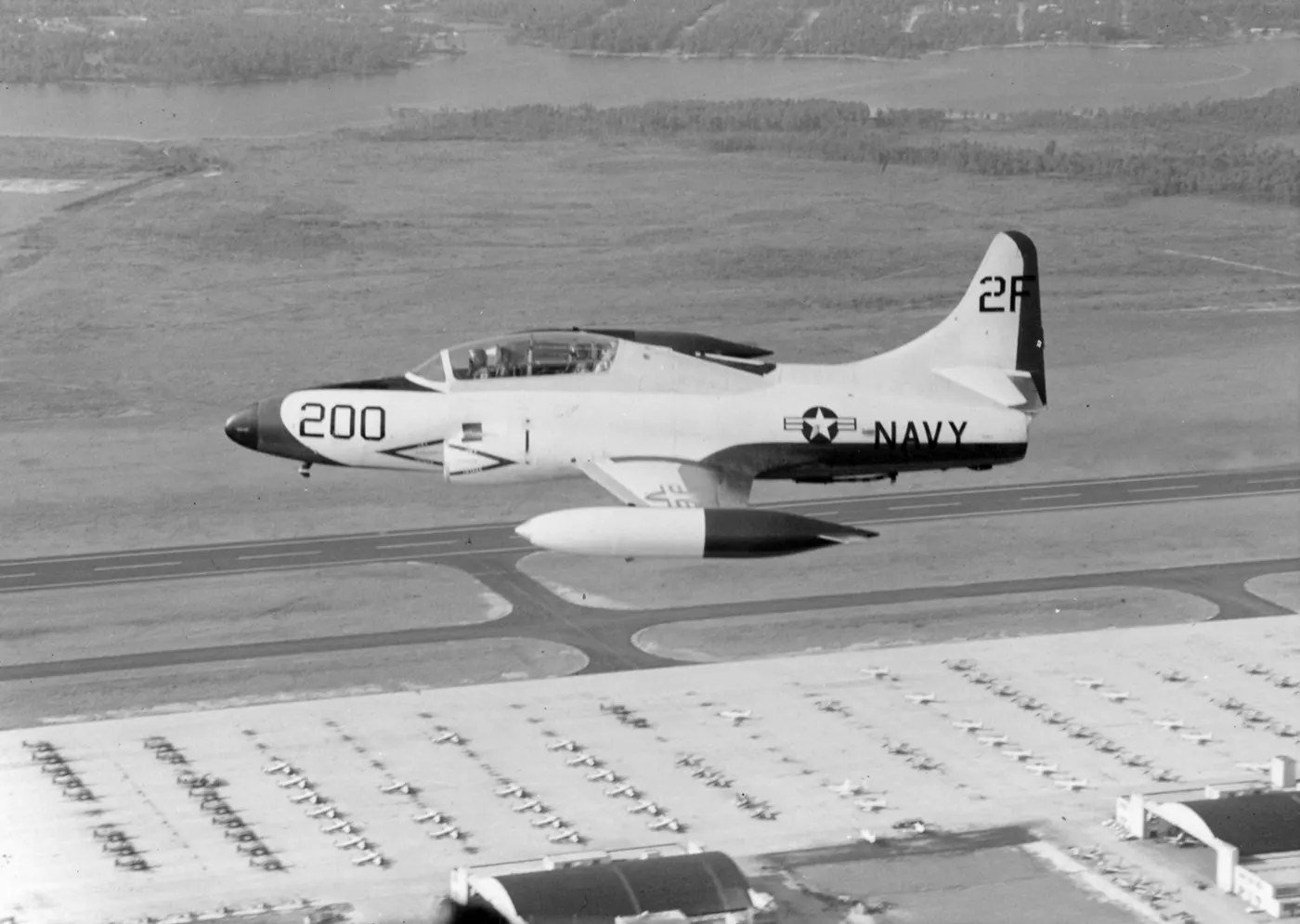

The Lockheed T2V-1 SeaStar was the US Navy's carrier-capable version of the Lockheed T-33 jet trainer, built around the same fuselage and wing but re-engineered almost from scratch for deck operations. The Navy had flown the T-33 since 1949 under its own designation, TV-2, but the type's landing speed and structure made it unfit to operate from a carrier.1 Lockheed answered with Model L-245, a privately funded 1952 project that added an arrestor hook, catapult fittings, a strengthened airframe, a taller tail, and a boundary-layer control system to slow the aircraft down for deck landings.2 The demonstrator flew on 16 December 1953, the Navy ordered eight development aircraft in May 1954, and production T2V-1s reached the fleet in 1957.2
- Purpose-built for carrier deck landing training
- Boundary-layer control lowered approach speed
- Raised instructor seat improved visibility
- Naval avionics and corrosion-proofing for shipboard use
- Boundary-layer control system was maintenance-heavy and unreliable
- Heavier than the T-33, cutting range and ceiling
- Small production run limited spares and unit cost efficiency
- Superseded within about a decade by newer trainers

Only 150 were built against an original order for 390, and the type spent barely over a decade in service before being redesignated T-1A SeaStar in 1962 and phased out by 1970.1,3 Set beside the T-33, which Lockheed and its licensees built more than 6,500 of over an eleven-year run, the SeaStar was a small, short-lived production.
Its story is really what it cost, in weight, speed, and reliability, to turn a capable land trainer into a machine that could be caught by a wire on a pitching flight deck.
The Allison J33 and a Heavier Airframe
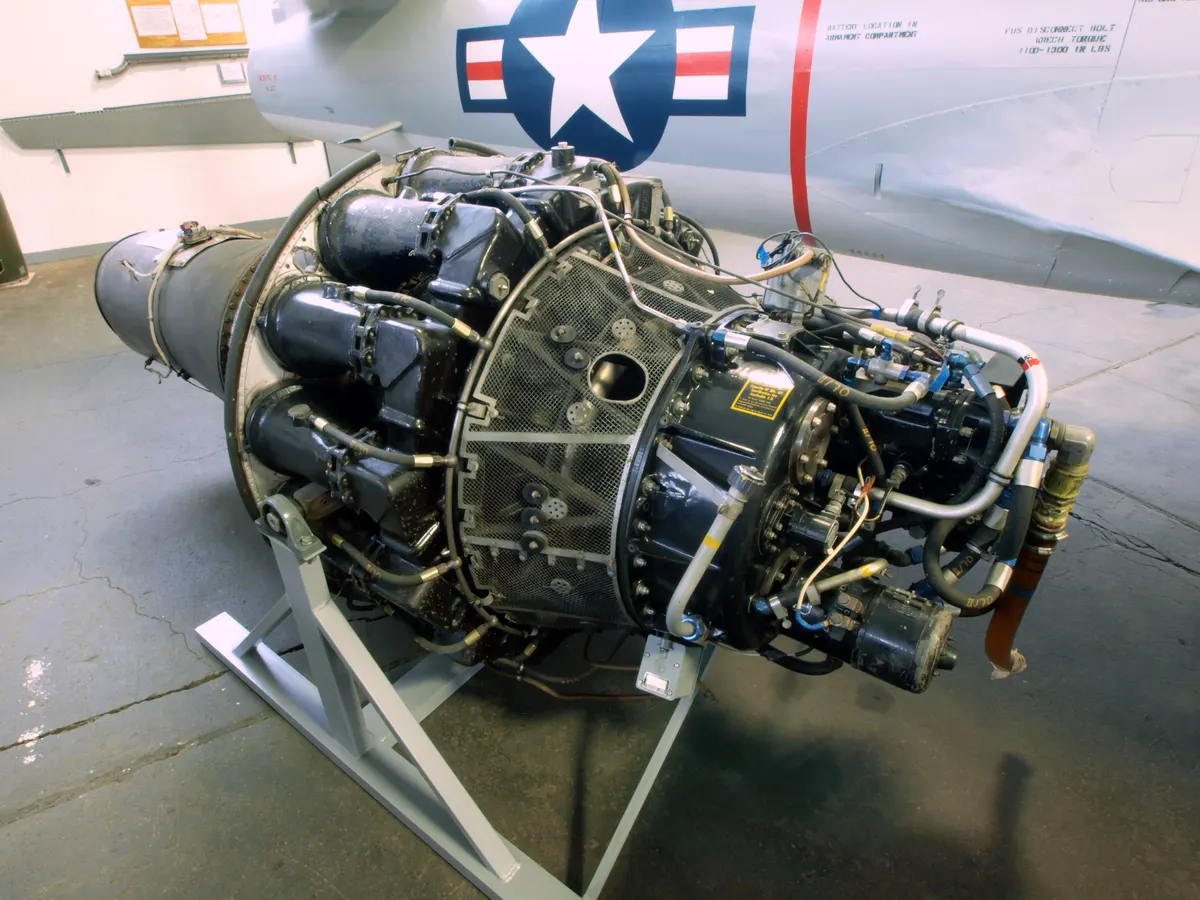
The SeaStar kept the T-33's Allison J33 centrifugal-flow turbojet but fitted the J33-A-24/-24A, rated at about 6,100 lbf (27 kN), roughly 13 percent more thrust than the J33-A-35 in late-production T-33As.2,4 It needed the extra power: naval equipment, a strengthened undercarriage, catapult gear, and the arrestor hook pushed empty weight from 8,365 lb (3,794 kg) to 11,965 lb (5,427 kg), a nearly 43 percent increase, with maximum takeoff weight rising to 16,800 lb (7,636 kg).1,4 Top speed at altitude, about 580 mph (933 km/h) at 35,000 ft, and a 40,000 ft (12,190 m) service ceiling both came in below the land trainer's figures, the price of extra naval hardware.1
- İlk Uçuş1953
- Hizmete Giriş Yılı1957
- Mürettebat (koltuk)2
- Eğitim Uçağı TipiGemiden operasyon yapabilen eğitim uçağı
- HizmetteHayır
Boundary-Layer Control and the Redesigned Wing
The most consequential change was aerodynamic rather than structural. Lockheed fitted automatic leading-edge slats and a boundary-layer control (BLC) system that bled compressed air from the engine compressor over the flaps, cutting landing speed by about 7.4 km/h (4 kt) and takeoff speed by roughly 13 km/h (7 kt) compared with an unmodified T-33.1,5 On paper this was a modest, workable fix for carrier approach speeds. In service the BLC plumbing proved troublesome and maintenance-intensive, a recurring complaint that historians of the type single out as its weakest feature and a real contributor to its short career.2
- Motor Tipiturbojet
- İtki27,2
Arrestor Hook, Catapult Gear, and the Raised Instructor's Seat
Below the wing, Lockheed added a retractable arrestor hook, a catapult attachment with a hydraulically extendable nose gear, and a strengthened lower fuselage to absorb repeated deck landings.1,5 The tail was enlarged and given a dorsal fillet for low-speed control, and fuselage speed brakes were added aft of the wing.5 Inside, the rear instructor's seat was raised about 15 cm (6 in), with an asymmetrical canopy to match, so the instructor could see over the student's head on approach.2,5 Production aircraft also received Martin-Baker Mk L-5 ejection seats, naval UHF/VHF radios, TACAN, a radar altimeter, and salt-water corrosion proofing.5
- Azami Hız933 km/sa
- Hizmet Tavanı12.190 m
- Menzil1.560 km
- Tırmanma Hızı32 m/sn
The T2V-1 was a wholly American design and build. Lockheed's Burbank, California plant produced the airframe, and the Allison Division of General Motors, in Indianapolis, built the J33-A-24/-24A turbojet.2,4 Naval avionics, including TACAN and UHF/VHF radio sets, and the Martin-Baker Mk L-5 ejection seat were the only significant components sourced from established specialist suppliers rather than built in-house by Lockheed, and even the ejection seat, though of British design lineage, was built under license in the United States.5 No part of the airframe, engine, or major systems was imported.
- Kokpit Düzeniİki (öğrenci ve eğitmen)
- Uzunluk11,75 m
- Kanat Açıklığı13,06 m
- Yükseklik4,06 m
- Maks Kalkış Ağırlığı7.636 kg
- Toplam Üretim150
- Kullanıcılar2
- Üretim Başlangıcı1956
- Operasyonel Durumemekli
From TV-2 to L-245: A Private Venture
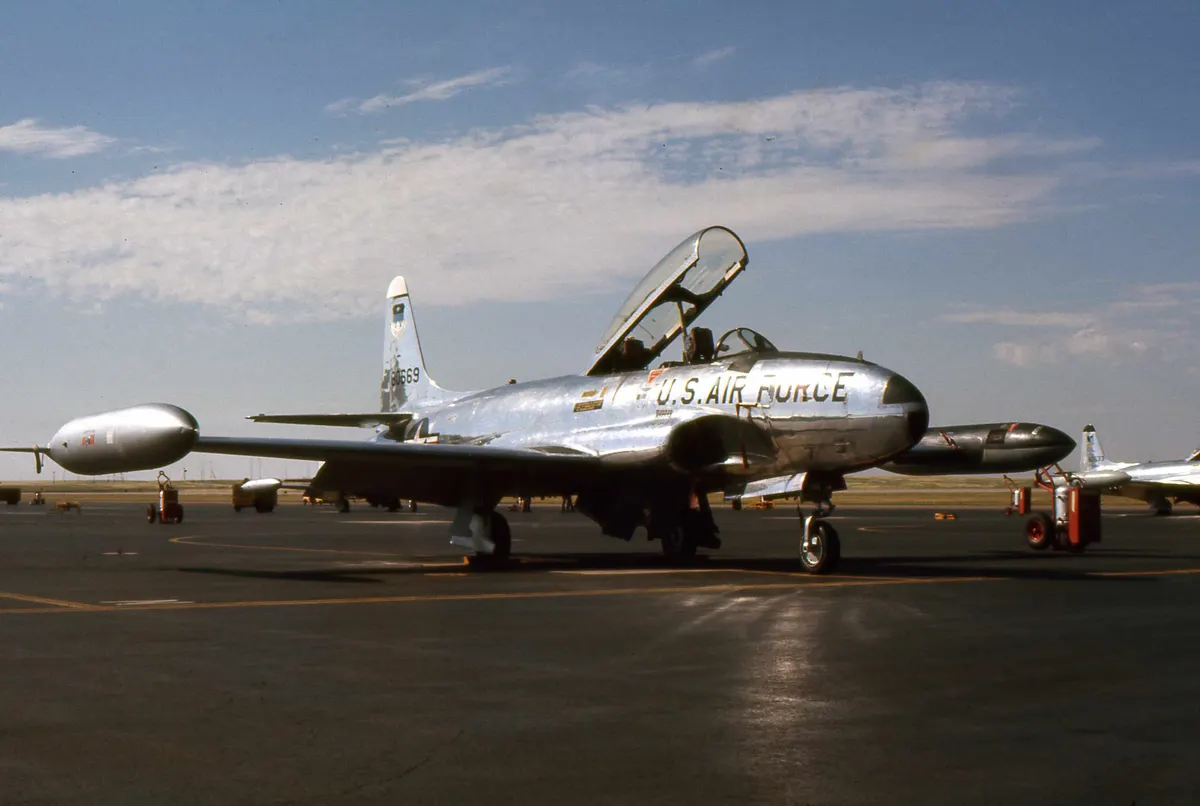
Land-based T-33 trainers, flown by the Navy as the TV-2, had been in fleet service since 1949, but the type's handling at low speed made carrier qualification impractical.1 Rather than wait for a Navy specification, Lockheed built its demonstrator, later registered N125D, from an incomplete T-33A airframe (serial 52-9255) as a private venture in 1952-53.3,5 It first flew on 16 December 1953, and the Navy, sufficiently impressed, ordered eight T2V-1s for evaluation the following May.2
Carrier Qualification Aboard USS Antietam
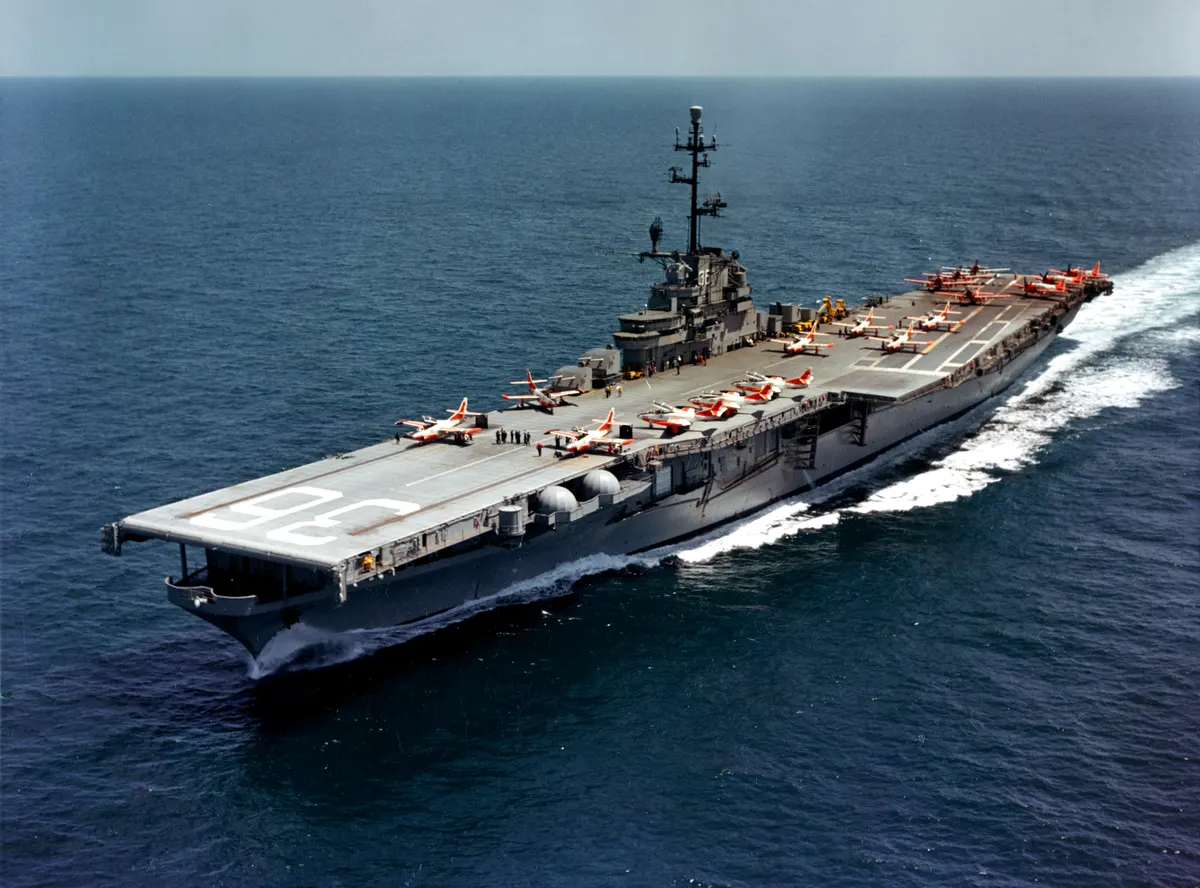
The first production aircraft flew on 20 January 1956, and about eighteen months of testing followed before carrier qualification trials aboard USS Antietam, an Essex-class carrier used through the 1950s as the Navy's dedicated deck-trials ship.2,3 The trials succeeded, and the T2V-1 entered fleet training service at Naval Air Station Pensacola late in 1957, alongside further evaluation at the Naval Air Test Center and the Naval Test Pilot School.2,3
Fleet Service and the Boundary-Layer Control Problem
In service, the SeaStar flew with training squadrons VT-9 and VT-10, Naval Air Reserve Training Units at NAS Anacostia and NAS Quonset Point, and Marine Corps maintenance squadrons.3 Records list roughly a dozen hull losses between 1957 and 1970, all peacetime training accidents, since the type never carried weapons or saw combat.8 One flamed out and crashed near West Milford, New Jersey, on 15 July 1962, probable cause fuel starvation, and another was destroyed in a January 1962 runway overrun at Naval Air Facility Andrews that also killed a ground crewman.9,8 The last recorded loss came in November 1970, near Big Sur, California, killing both crew.8 Sources differ on why the type left so quickly: some credit the Grumman TF-9J Cougar, which combined deck-landing and weapons training in one airframe, others the North American T-2 Buckeye; accounts do not agree on which displaced the SeaStar first.2,1
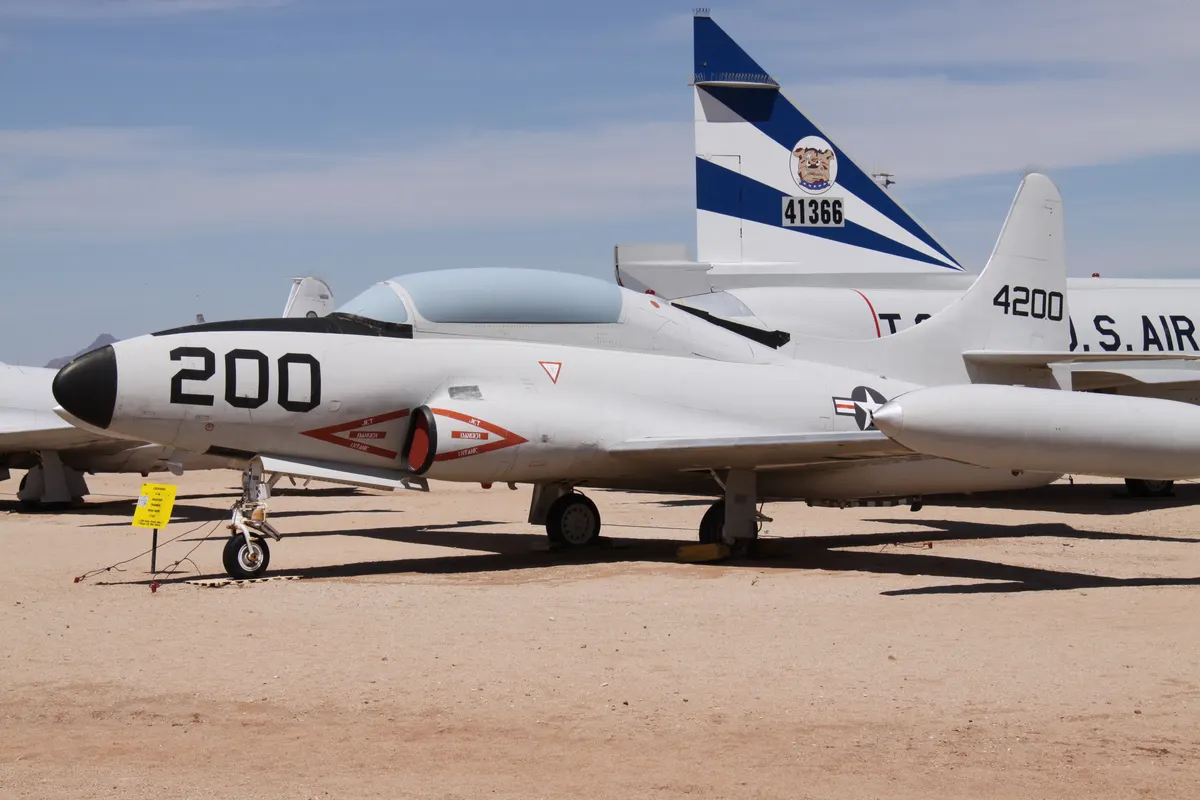
Lockheed built only one operational version. The company demonstrator, unofficially called a "T-33B" by some, was the sole prototype, registered N125D and never assigned a Navy bureau number.3 Production aircraft were built to a single T2V-1 standard, with 150 delivered across four contract batches out of 390 originally ordered before the remaining 240 were cancelled.2 The only later change was administrative rather than technical: the entire fleet was redesignated T-1A SeaStar on 18 September 1962, under the new Tri-Service designation system unifying Army, Navy, and Air Force naming, with no corresponding hardware change.10

The SeaStar flew only with the United States Navy and Marine Corps, based at NAS Pensacola, NAS Anacostia, NAS Quonset Point, and other Naval Air Reserve Training Units.3 It was never exported, a sharp contrast with the parent T-33, which equipped dozens of air forces worldwide and was license-built in Canada and Japan.4 Its naval-specific systems and narrow deck-training role gave it essentially no export market.
Against the T-33 it was built from, the SeaStar traded performance for carrier capability, and the trade was not cheap. Empty weight rose by nearly 43 percent for a 13-percent gain in engine thrust, leaving a lower service ceiling (40,000 ft against 48,000 ft) and shorter range (970 mi against 1,275 mi).1,4 What the extra weight and BLC system bought was a genuinely lower approach speed and the strength for an arrested landing, which the standard T-33/TV-2 could not attempt. The two were not really competing on the same axis: the T-33 optimized for basic jet instruction at the lowest cost and highest numbers, the SeaStar for one specialized task, in a run 2 percent the size of its parent's.
| Spec | Lockheed T2V-1 SeaStar | Lockheed T-33A |
|---|---|---|
| Engine | Allison J33-A-24/-24A, ~6,100 lbf2 | Allison J33-A-35, ~5,400 lbf4 |
| Empty weight | 11,965 lb (5,427 kg)1 | 8,365 lb (3,794 kg)4 |
| Service ceiling | 40,000 ft (12,190 m)1 | 48,000 ft (15,000 m)4 |
| Range | 970 mi (1,560 km)1 | 1,275 mi (2,052 km)4 |
| Total built | 1502 | 6,5574 |
The Grumman TF-9J Cougar, credited by some as eventually taking over the SeaStar's deck-landing role, offers a second comparison. Where the SeaStar was a 1948 land trainer awkwardly adapted for the boat, the swept-wing Cougar was designed from the outset as a carrier fighter, needing no such re-engineering, at the cost of being heavier and more expensive to fly as a basic trainer.2

How many Lockheed T2V-1 SeaStars were built? 150, out of an original order for 390; the remaining 240 were cancelled.2
What is the difference between the T2V-1 SeaStar and the T-33? The SeaStar added an arrestor hook, catapult fittings, a strengthened fuselage and undercarriage, a taller tail, leading-edge slats, boundary-layer control for lower approach speed, and a raised instructor's seat, at the cost of nearly 43 percent more empty weight.1,5
Why couldn't the standard T-33 land on a carrier? It lacked an arrestor hook and the structural strengthening for arrested landings, and its approach speed was too high for safe carrier recoveries, which is why Lockheed built the SeaStar to fix those two problems.1
Is the T-1A SeaStar still in service? No. It was retired from Navy and Marine Corps use by 1970, after its 1962 redesignation from T2V-1 to T-1A.1,3 At least one airframe, BuNo 144735, remained airworthy in civilian hands decades later.7
What was the SeaStar's top speed? About 580 mph (933 km/h) at 35,000 ft, slightly below the standard T-33 at comparable altitude, a result of the extra weight of its naval equipment.1
- "Lockheed T2V SeaStar", Wikipedia — en.wikipedia.org ↩
- "Lockheed T2V-1/ T-1 SeaStar", History of War — historyofwar.org ↩
- "Lockheed T2V-1 (T-1A) Seastar", Forgotten Jets, Warbirds Resource Group — forgottenjets.warbirdsresourcegroup.org ↩
- "Lockheed T-33", Wikipedia — en.wikipedia.org ↩
- "Seastar", Warplane Data — warplanedata.com ↩
- "Boneyard Files: Lockheed T-1A SeaStar - The Navalized Shooting Star Lost to Time", Vintage Aviation News — vintageaviationnews.com ↩
- "Airframe Dossier: Lockheed T2V-1 Sea Star, BuNo 144735, N447TV", Aerial Visuals — aerialvisuals.ca ↩
- "Lockheed T2V-1 Seastar accident records", Aviation Safety Network — asn.flightsafety.org ↩
- "Accident Lockheed T2V-1 Seastar 142540, Sunday 15 July 1962", Aviation Safety Network — asn.flightsafety.org ↩
- "Aircraft Redesignations in 1962", Designation Systems — designation-systems.net ↩