

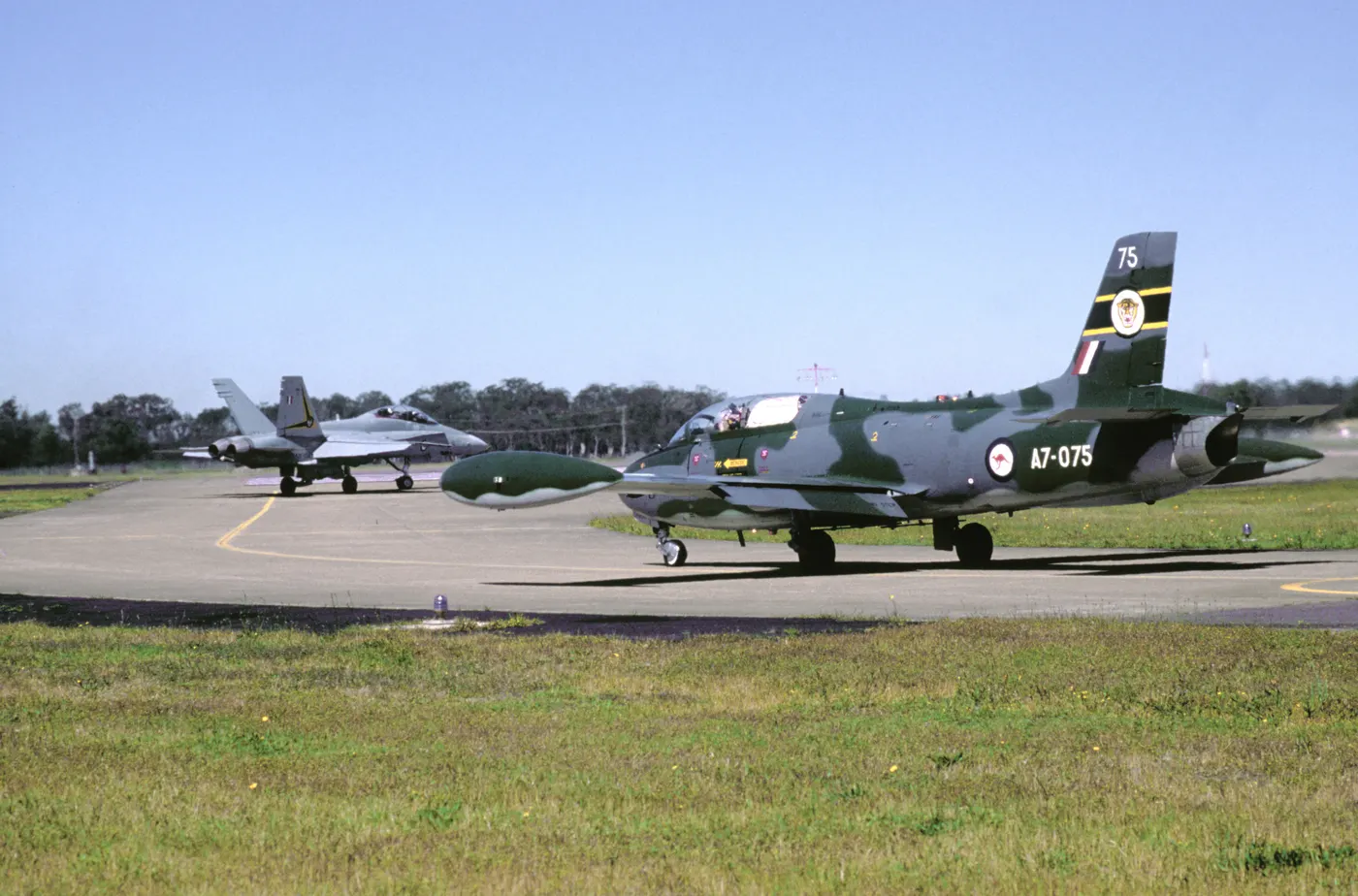

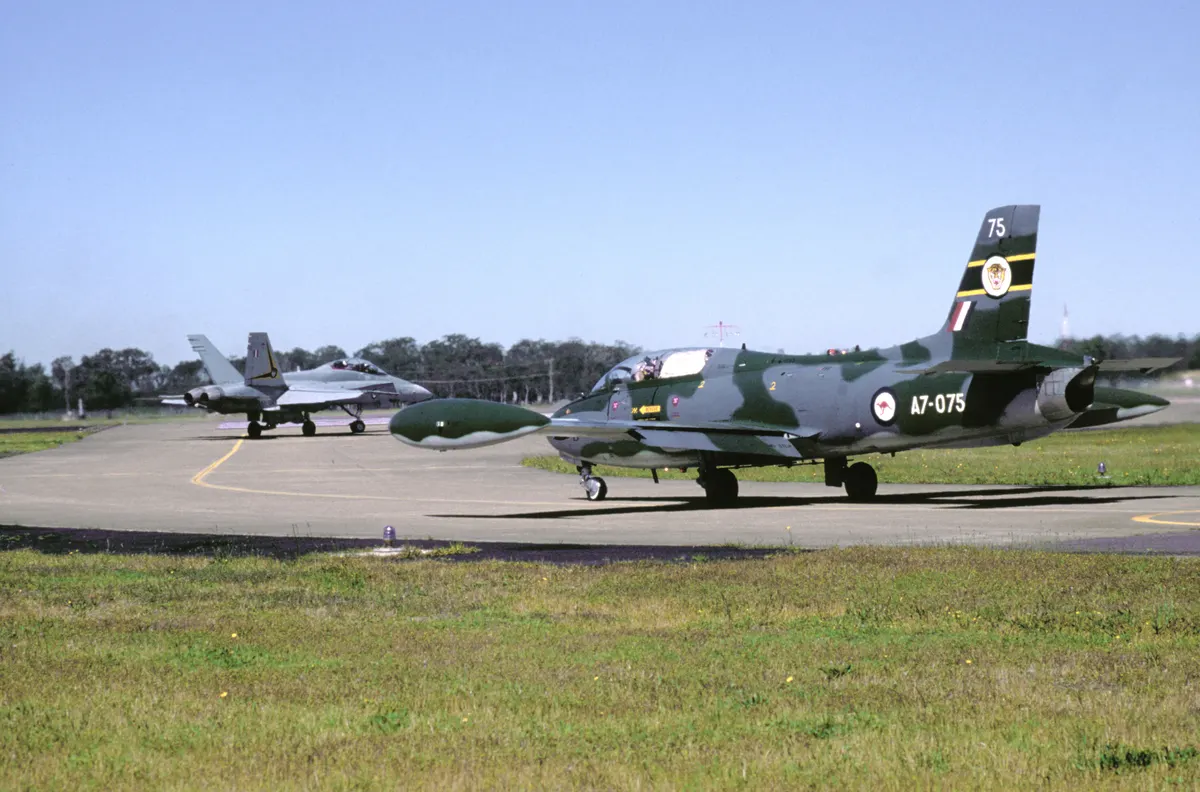
The Aermacchi/CAC MB-326H is the Australian production version of the Italian Aermacchi MB-326 jet trainer, built under licence by the Commonwealth Aircraft Corporation (CAC) with Hawker de Havilland as a major subcontractor, at Fishermans Bend, Victoria. The RAAF selected the type in August 1965 to replace its de Havilland Vampire and CAC Winjeel trainers, eventually taking 97 airframes — 12 delivered complete from Italy, 18 assembled locally from kits, and 67 built from Australian components as the CA-30 — split between an 87-aircraft RAAF order and a 10-aircraft Royal Australian Navy order added in July 1969.1,2 Deliveries ran from October 1967 to September 1972; the type remained on strength until 2001.
- Simple, forgiving handling well suited to student pilots
- Genuine weapons-training fit (guns, practice bombs) built into the trainer role
- Deep local manufacturing base (CAC/HDH) simplified spares and overhaul
- Long, well-documented service life with detailed local fatigue data
- Structural fatigue eventually forced fleet-wide flight restrictions
- Never developed into an armed strike variant, unlike South Africa's Impala Mk II
- Modest performance next to the Viper-20/632-powered export G/K models
- Poor rear-seat forward visibility inherited from the base MB-326 design

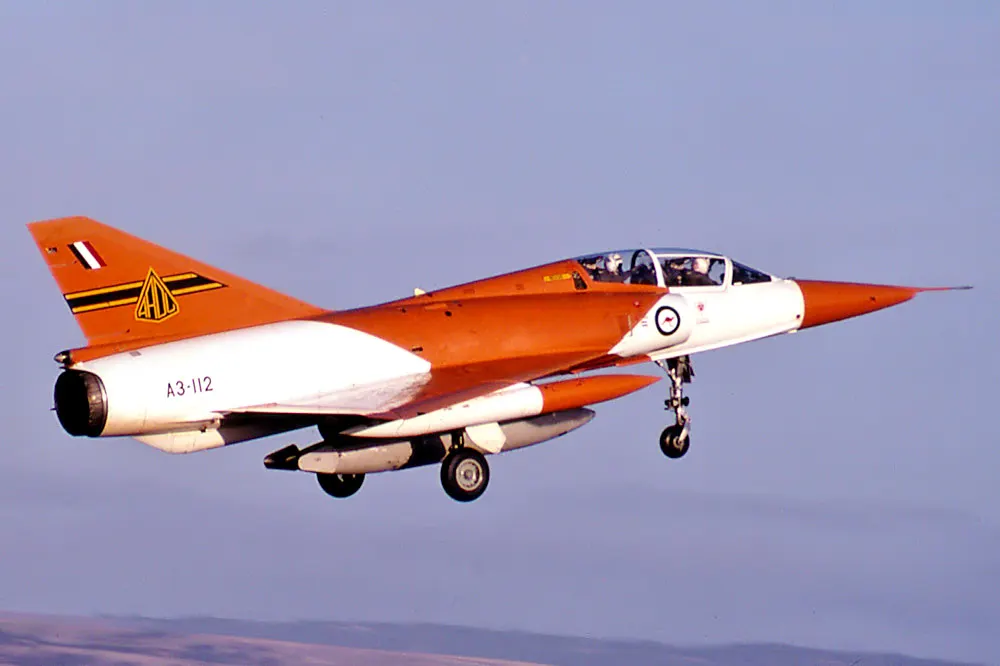
Beyond the manufacturing split, the MB-326H differed from the Italian baseline in ways that mattered day-to-day. It carried an improved avionics fit, and unlike the unarmed trainer flown by the Aeronautica Militare at Lecce, Australian Macchis had a genuine weapons-training capability from the outset.2,3 Where South Africa took the same airframe down a combat road with the single-seat MB-326K/Impala Mk II, Australia never built an armed derivative; the MB-326H stayed a two-seat trainer throughout, its closest brush with a front line being the aircraft RAAF and RAN students flew immediately before converting onto the Dassault Mirage IIIO or the A-4 Skyhawk.4
The aircraft's 34-year career — trainer, weapons trainer, aerobatic mount, then fatigue case study — is unusually well documented, thanks to detailed RAAF and Defence Science and Technology Organisation reporting on its structural life.13
The Viper 11 and Why the Australian Macchi Was Never the Fastest
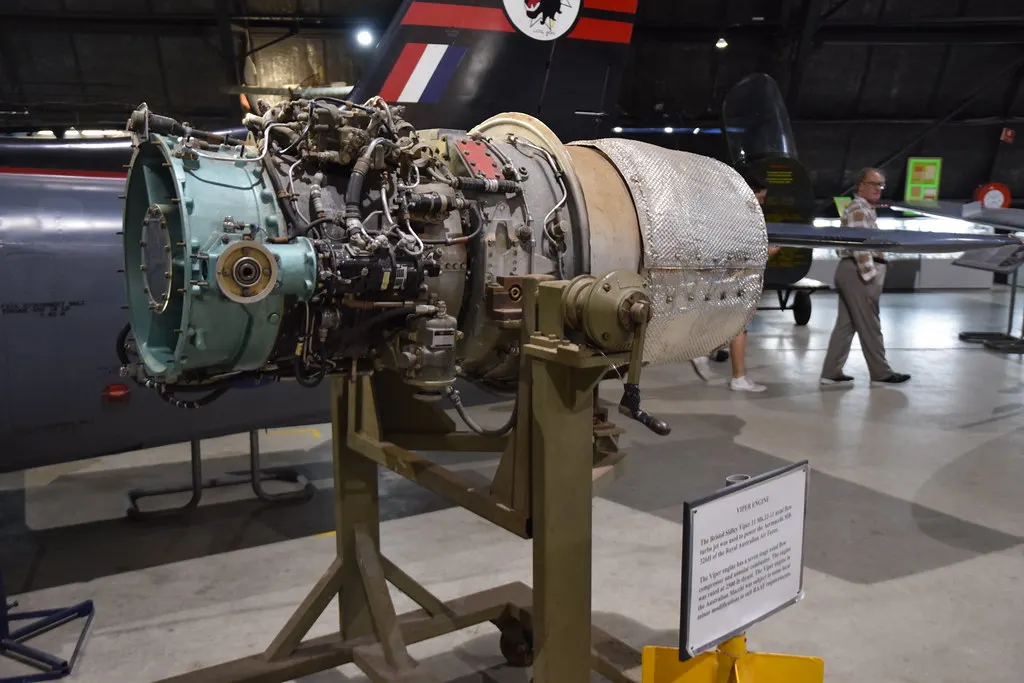
The MB-326H used the same lower-powered Rolls-Royce (Bristol Siddeley-designed) Viper 11 Mk.22 turbojet as Italy's original AMI trainers, rated at roughly 11.1 kN (2,500 lbf), rather than the uprated Viper 20 or 632 series (15.2–17.8 kN) fitted to export MB-326G/K/M models.5,6 That puts the Australian aircraft's genuine performance below figures often quoted for the type: sources for the RAAF/RAN airframe give a maximum speed around 806 km/h, a service ceiling near 12,500 m and a range of roughly 1,665 km, all lower than the 898 km/h / 14,600 m / 1,850 km sometimes attributed to the family's more powerful variants.5
- İlk Uçuş1957
- Hizmete Giriş Yılı1962
- Mürettebat (koltuk)2
- Eğitim Uçağı Tipiİleri eğitim uçağı
- HizmetteHayır
That modest power plant didn't stop the RAAF using the aircraft as a genuine weapons trainer. Australian Macchis carried six underwing hardpoints and were regularly flown with the General Electric SUU-11A 7.62 mm minigun pod and Mk 12 Light Series Bomb Carriers loaded with four 25 lb BDU-33 practice bombs, supporting gunnery, bombing and air-combat training at bases such as Williamtown.7,8 Ground crews often left the bomb carriers fitted but unloaded, since removing them was a lengthy job.
- Motor TipiRolls-Royce Viper turbojet
- İtki14,9
Dimensionally the Australian aircraft tracked the Italian baseline closely — length 10.65 m, height 3.72 m, a slightly narrower wingspan around 10.56 m, and a loaded weight in the region of 3,800–4,300 kg depending on fit and source.5 Crew sat in tandem under a single canopy on Martin-Baker ejection seats, the student normally forward, an arrangement that gave the rear-seat instructor the same restricted forward view that dogged every MB-326 operator.
- Azami Hız898 km/sa
- Hizmet Tavanı14.630 m
- Menzil1.850 km
- Tırmanma Hızı20,3 m/sn
- G Limiti7
- Havada/Görevde Kalış Süresi3
The "improved avionics" the RAAF specified over the Italian baseline were mainly better navigation and radio fit for Australian distances between training bases, not a combat-sensor upgrade.2,4
- Kokpit DüzeniTandem iki koltuklu
- Cam KokpitHayır
- Gömülü SimülasyonHayır
- Hafif Taarruz KabiliyetliHayır
- Silah İstasyonları0
- Fırlatma KoltuklarıEvet
CAC's Fishermans Bend line, with Hawker de Havilland as principal subcontractor, built the bulk of the fleet's airframes domestically and produced Viper turbojets under sub-licence rather than importing every engine — further toward local content than several other MB-326 licensees managed.2,9 Even so, the program depended on imported technical data, some kit-built airframes, and components traceable to Bristol Siddeley/Rolls-Royce in Britain and Aermacchi in Varese, so a meaningful share of the aircraft's value, concentrated in the engine and core systems, stayed foreign even on the most Australian-built examples.
- Uzunluk10,65 m
- Kanat Açıklığı10,85 m
- Yükseklik3,72 m
- Maks Kalkış Ağırlığı4.190 kg
- Toplam Üretim97
- Kullanıcılar2
- Hizmetten Çıkış Yılı2001
- Üretim Başlangıcı1961
- Üretim Bitişi1975
- Operasyonel DurumHizmet dışı
From Vampire Replacement to Lead-In Fighter Trainer
The RAAF's decision to licence-build an Italian jet at home set up a training pipeline that lasted three decades: basic instruction on the piston Winjeel, advanced and weapons training on the Macchi, then conversion onto the Mirage IIIO or, for Fleet Air Arm pilots, the Skyhawk.4 During the Vietnam War era the RAAF briefly tried "all-through" jet training — starting students on the Macchi with no Winjeel stage — but abandoned it after two courses and reverted to Winjeel-then-Macchi for the rest of the type's career.4
The RAAF's aerobatic team, the Roulettes, adopted the Macchi in December 1970 for the service's fiftieth anniversary and flew it for nearly two decades, growing from four aircraft to seven at its largest before settling back to five.10 Display flying pushed airframes hard: two Roulettes Macchis collided near East Sale in December 1983, killing both pilots, and a second collision in March 1988 saw one pilot eject safely while the other flew a damaged aircraft to a gear-up landing.10,11 The team re-equipped with the Pilatus PC-9 in late 1989, driven as much by the fleet's tightening fatigue limits as by any wish for a newer aircraft.10
By the early 1980s the fleet was ageing structurally rather than mechanically. CAC ran a Life Of Type Extension program from 1972 into 1984 to manage fatigue already showing up in wing-structure inspections.13
LOTEX did not end the problem. On 22 November 1990 the port wing of A7-076 separated in flight during an air-combat manoeuvre at an estimated 6.5g, within a margin the RAAF had believed safe.13 The fleet was grounded while investigators recovered wreckage from the sea and traced the failure to a crack starting at a poorly drilled bolt hole in the wing spar cap — a build-quality flaw, not a design fault, that routine inspections had missed. A new inspection method followed, and surviving airframes were re-winged and returned to service under tighter g-limits.13,14
The fleet flew on for another decade under this more conservative regime. The PC-9/A had already taken advanced training in 1989, and the Hawk 127 replaced the Macchi in front-line lead-in-fighter squadrons in 2000; its last public appearance came at the 2001 Avalon Airshow, closing 34 years of RAAF and RAN service.4,14
Within the MB-326H designation, Australia's fleet split into three production batches rather than distinct sub-variants: 12 delivered airworthy from Varese, 18 assembled locally from kits, and 67 built from Australian components as the CA-30, the batch giving CAC and Hawker de Havilland the deepest domestic manufacturing experience.1,2 Unlike South Africa, which developed the single-seat, six-hardpoint MB-326K/Impala Mk II attacker from the same airframe, Australia never pursued an armed derivative; every Australian-built Macchi kept the tandem two-seat layout, its only combat-adjacent role weapons training.3


Two Australian services flew the MB-326H. The RAAF was the larger user by far, operating it through No. 2 Flying Training School, the Central Flying School and later lead-in-fighter units including Nos. 2, 5, 25, 76, 77 and 79 Squadrons.4 The Navy's ten aircraft flew with 724 Squadron at Nowra, preparing Fleet Air Arm pilots for the A-4 Skyhawk; when the RAN's fixed-wing arm was wound down in the early 1980s, its surviving Macchis were absorbed into the RAAF's own serial pool rather than retired separately.15
The most instructive comparison is not a foreign rival but the MB-326H's own South African cousin, the MB-326K/Impala Mk II: the same airframe taken in opposite directions. South Africa built a single-seat attacker with six hardpoints and twin 30 mm cannon and flew it in real combat over Angola and Namibia. Australia, with no counter-insurgency need, kept the MB-326H a two-seat trainer, its "weapons" role limited to minigun pods and practice bombs against a towed banner. The gap follows from that choice as much as engineering: the Impala's Viper 632 gave it meaningfully higher speed and war load than the Viper 11-powered Australian aircraft ever needed.5,3
The more relevant local comparison is generational — the MB-326H against its replacement, the turboprop Pilatus PC-9/A. The PC-9 traded jet speed for lower running costs, a safer stall/spin margin, and an airframe with none of the fatigue history that grounded the Macchi fleet in 1990, which says as much about the Macchi's late-career structural troubles as about the PC-9's own merits.


How many MB-326Hs were built for Australia? 97: 12 delivered complete from Italy, 18 assembled locally from kits, and 67 built from Australian components as the CAC CA-30, covering an 87-aircraft RAAF order and a 10-aircraft RAN order.1,2
How is the MB-326H different from the standard Aermacchi MB-326? It kept Italy's original lower-powered Viper 11 engine rather than the uprated engines of later export models, added an improved avionics fit, and — unlike Italy's unarmed trainer — carried a genuine weapons-training role with minigun pods and practice bombs from the start.2,5,7
Did the RAAF's Macchi ever see combat? No. Unlike South Africa's armed MB-326K/Impala Mk II, the MB-326H stayed a two-seat trainer throughout its service and was never deployed operationally.3,4
Why was the MB-326H retired? Obsolescence and fatigue together. The PC-9/A took over advanced training from 1989 and the Hawk 127 took the lead-in-fighter role in 2000, while a 1990 fatigue-driven wing failure had already forced a fleet-wide grounding and re-winging that limited the fleet's remaining life.13,14
Is the MB-326H still in service? No. The RAAF retired it in 2001, with a last public appearance at the Australian International Airshow at Avalon that year; surviving airframes are preserved in Australian museums.4,14
- "Aermacchi MB-326H [A7]", Australian Military Aviation History — raafdocumentary.com ↩
- "Commonwealth Aircraft Corporation", Wikipedia — en.wikipedia.org ↩
- "Aermacchi MB-326", Wikipedia — en.wikipedia.org ↩
- "Aermacchi MB-326H brought on charge with the RAAF", Royal Australian Air Force — airforce.gov.au ↩
- "Macchi MB-326H Jet", Aviation Heritage Museum — aviationmuseumwa.org.au ↩
- "Viper publicity: Rolls-Royce Bristol Engine Division Viper Mk.522, 526 for HS.125 & Viper 11 for Macchi MB.326", The National Archives — discovery.nationalarchives.gov.uk ↩
- "High Planes Plus Aermacchi MB-326H RAAF Weapons Trainers Detail Set", Freightdog Models — freightdogmodels.co.uk ↩
- "Macchi Mb-326", The Encyclopedia of Aircraft, David C. Eyre — aeropedia.com.au ↩
- "CAC Aermacchi MB-326H (Macchi)", Sea Power Centre Australia — seapower.navy.gov.au ↩
- "Roulettes", Wikipedia — en.wikipedia.org ↩
- "Roulettes History", Aerobatic Teams Resource — aerobaticteams.net ↩
- "The Macchi MB-326H", Phil Frawley, Jet Fighter Pilot — fighterjet.com.au ↩
- "Recovery of the RAAF MB326H Fleet; the Tale of an Aging Trainer Fleet", ResearchGate — researchgate.net ↩
- "RAAF A7 CAC CA-30 Macchi MB-326H", ADF Serials — adf-serials.com.au ↩
- "Aerial Visuals — Airframe Dossier, Aermacchi MB-326H, s/n A7-077 RAAF", Aerial Visuals — aerialvisuals.ca ↩