


The Hongdu JL-8, sold abroad as the K-8 Karakorum, is a tandem two-seat, single-engine jet trainer developed jointly by China's Nanchang Aircraft Manufacturing Corporation (later folded into Hongdu Aviation Industry Corporation) and Pakistan Aeronautical Complex (PAC). It flew for the first time on 21 November 1990 and entered service with the Pakistan Air Force and the People's Liberation Army Air Force (PLAAF) within a few years of each other, the PLAAF taking its first examples on 21 September 1994.1,2 The Chinese air force version, designated JL-8 ("Jiaolian-8"), and the export K-8 differ in engine, avionics, and at times structure, and both have been modernized repeatedly since the early 1990s.
- Low unit and operating cost relative to Western/Russian equivalents
- Strong thrust-to-weight and climb for a non-afterburning trainer[^6]
- Genuine light-attack capability, not just a trainer with pylons
- Wide, mature global support and spares network after three decades of exports
- No radar or advanced sensors, limiting realistic fighter-lead-in training
- Engine sourcing has been politically fragile (US embargo, Ukraine-Russia disruption)
- Airframe is now over 30 years old in basic aerodynamic design
- Safety record has drawn scrutiny from several operators in the 2020s
What makes the type notable is less its performance than its business outcome. It became one of the most commercially successful jet trainers of the post-Cold War period, out-selling most Western and Russian rivals in the market that actually matters for a trainer — air forces with small budgets. More than 735 airframes had been built across all variants by the mid-2020s, flying with roughly fifteen air forces across Asia, Africa, and Latin America.2,3 It was designed from the outset with a light-attack role in mind, carrying up to 1,000 kg of external stores and a removable 23 mm gun pod, and several operators have used it that way in earnest rather than only on the syllabus.4
The program's origin is diplomatic as much as technical. Pakistan and China agreed in 1986 to co-develop a shared replacement for their aging first-generation trainers, splitting engineering work between Nanchang and PAC's Kamra complex. The export name is reportedly a deliberate gesture: Pakistani President Zia-ul-Haq is credited with suggesting "Karakoram" — the mountain range straddling the China-Pakistan border — to symbolize the partnership, rather than a plainer factory designation.5 That framing stuck; almost every export customer since has bought the aircraft as "K-8," never "JL-8."
The K-8/JL-8 is a conventional low-wing monoplane of mostly aluminum-alloy construction, with a stepped tandem cockpit, tricycle gear, and a single turbofan buried in the rear fuselage fed by fuselage-side intakes. It is not aerobatically extreme by fighter standards, but pilots transitioning from earlier piston or turbojet trainers describe the jump in performance as abrupt. Former Pakistan Air Force Mirage pilot Fahad Mahsood, who flew the type as an instructor, rated its sustained turn rate, climb, and handling at the top of his scale, crediting the turbofan's throttle response; his one persistent complaint was the "too light" feel of the landing gear lever, a control-feel detail rather than a performance flaw.6
The Engine Swap That Followed Tiananmen
The most consequential design event in the aircraft's history had nothing to do with aerodynamics. The original 1980s design called for a Garrett (later Honeywell) TFE731 turbofan and American cockpit displays and communications equipment, reflecting how open Sino-American defense trade briefly was that decade.5 The 1989 Tiananmen Square crackdown triggered a US arms embargo that closed off that supply chain before production aircraft could be delivered in volume. The program's answer was the Ukrainian-designed Ivchenko-Progress AI-25TLK turbofan, rated around 16.9 kN (3,800 lbf) dry thrust, for the Chinese-market JL-8, while TFE731-powered K-8 variants continued to export customers not affected by the embargo — provided Washington approved each individual sale.7,8 China later reverse-engineered the AI-25TLK into a license-built copy, the Guizhou-produced WS-11, letting later JL-8 and L-11 airframes fly on a fully domestic engine.9 Depending on customer and delivery date, the same aircraft family has therefore flown behind three distinct engines from three different countries.

Dimensionally the aircraft is small: length 11.6 m, wingspan 9.63 m, height around 4.1 m, empty weight near 2,687 kg, and maximum takeoff weight of about 4,330 kg.2,10 It cruises up to roughly Mach 0.75 and holds a service ceiling of 13,000 m, figures that exceed most low-cost rivals of the 1990s, thanks largely to the turbofan's efficiency at altitude compared with the pure turbojets of older-generation trainers.2,10
Weapons carriage runs to five stores stations — four underwing plus a fuselage centerline mount usually reserved for the gun pod — with a combined external load of about 1,000 kg.10,11
Domestic Content and the Foreign Engine
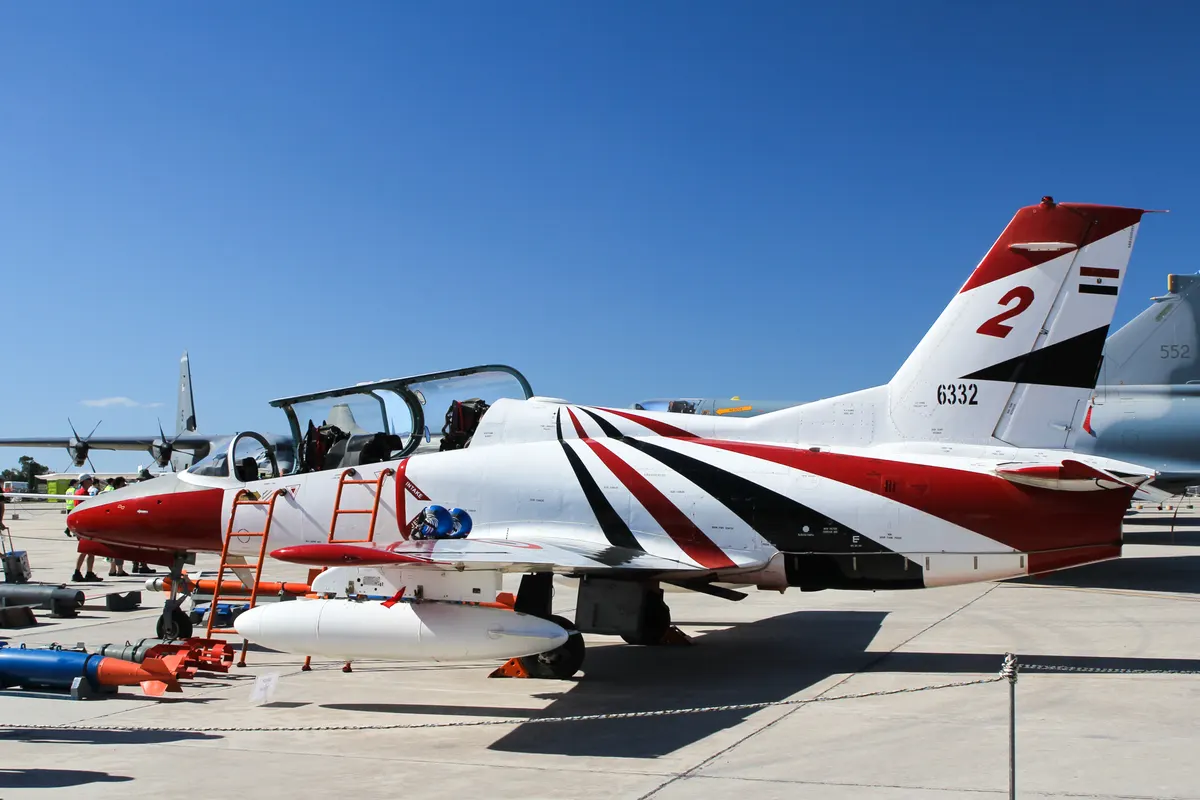
The airframe, wing, and tail are designed and largely built in China by Hongdu, with Pakistan Aeronautical Complex at Kamra contributing structural sections and, for the K-8P, a locally produced glass cockpit through its Avionics Production Factory.12,5 The single biggest imported item by value is the engine: the baseline Ivchenko-Progress AI-25TLK is Ukrainian, and even China's own WS-11 copy began as a reverse-engineered foreign design.9,7 Some early export batches instead carried the American Honeywell/Garrett TFE731, a second, separate foreign supply chain. Egypt is the outlier: after a $347 million 1999 contract, the Arab Organisation for Industrialization built up its own K-8E line until it was manufacturing roughly 97-98 percent of each airframe locally, far more self-sufficient than the Chinese-Pakistani baseline.13,14
Design work began in 1987 at Nanchang under chief designer Shi Ping, with a Pakistani team of over twenty led by Air Commodore Muhammad Younas alongside more than a hundred Chinese engineers.5 Four prototypes were built from January 1989, the first flying in November 1990; the design was finalized in December 1992, and first deliveries — six aircraft each to China and Pakistan — were completed by 1996.5,1 It debuted internationally at the 1993 Singapore Airshow and has since been a fixture at Dubai, Paris, and Zhuhai.15
Export sales followed a familiar pattern for Chinese defense hardware: financing terms that Western and Russian competitors struggled to match at the low end of the trainer market. Egypt became by far the largest customer, importing kits from 2000 and eventually manufacturing the K-8E domestically under the Arab Organisation for Industrialization, completing an initial batch of 80 aircraft by December 2005.13,14 Pakistan's own K-8P received a further avionics overhaul around 2010 — HUD, multi-function displays, Martin-Baker zero-zero ejection seats — turning a basic trainer into a modern intermediate jet for PAF flying schools.12
Latin American sales came later and skewed toward internal-security and counter-narcotics missions rather than classic pilot training. Venezuela placed an initial order for 18 aircraft in 2008, with deliveries beginning in 2010 and a follow-on order the same year bringing its total to 36; Bolivia bought six K-8P-derived aircraft (designated K-8VB) for roughly $58 million in 2009, explicitly citing anti-narcotics operations.18,19 Both purchases drew some domestic controversy over cost and over closer defense ties with China, but both fleets remained in service into the 2020s.
The K-8/JL-8's combat record is almost entirely counterinsurgency rather than conventional war, and Myanmar supplies most documented cases. The Myanmar Air Force received its first K-8s from 1998 and has used a fleet Myanmar Witness estimates at 50-62 aircraft as the "workhorse" ground-attack platform against ethnic armed organizations, particularly before the Yak-130 entered service in 2022.20,4 Open-source investigators documented repeated strikes in Kayah, Shan, and Kachin States between late 2021 and 2023, typically using the aircraft's 23 mm underbelly gun pod and unguided rockets against village and forest targets, with local reports of casualties and displacement.4 Lacking air-intercept radar or a targeting pod, this has been visual-attack, low-altitude work against targets with no meaningful air defense — tolerable given the low cost per flight hour, but a role that has drawn criticism over civilian harm.
Sri Lanka's K-8 fleet suffered a rare instance of the aircraft as target rather than shooter: Tamil Tiger fighters destroyed one on the ground during a 2007 raid on an air force facility, part of a wider LTTE pattern of attacking parked military aircraft late in that civil war.21 More recently, Sudan's military government signed a reported $1.5 billion arms package with Pakistan including K-8s for the ongoing civil war against the Rapid Support Forces — a deal that, if delivered, adds a considerably higher-intensity conflict to the type's history.22 Bolivia's and Venezuela's fleets, by contrast, have mainly flown counter-narcotics patrols, though Bolivian pilots have ejected safely from at least one K-8 lost during training.23
The family's variant list reflects its two parallel production tracks — Chinese domestic and joint export — more than any single upgrade path. The baseline K-8 prototypes flew with the Garrett TFE731 before the post-Tiananmen embargo forced a split: the JL-8 became the PLAAF's Ivchenko/WS-11-engined domestic version, while the plain K-8 designation continued for TFE731-powered export airframes where US clearance was granted.7,5 The L-11 is a further Chinese variant built around the mature indigenous WS-11 engine, used for advanced training.9
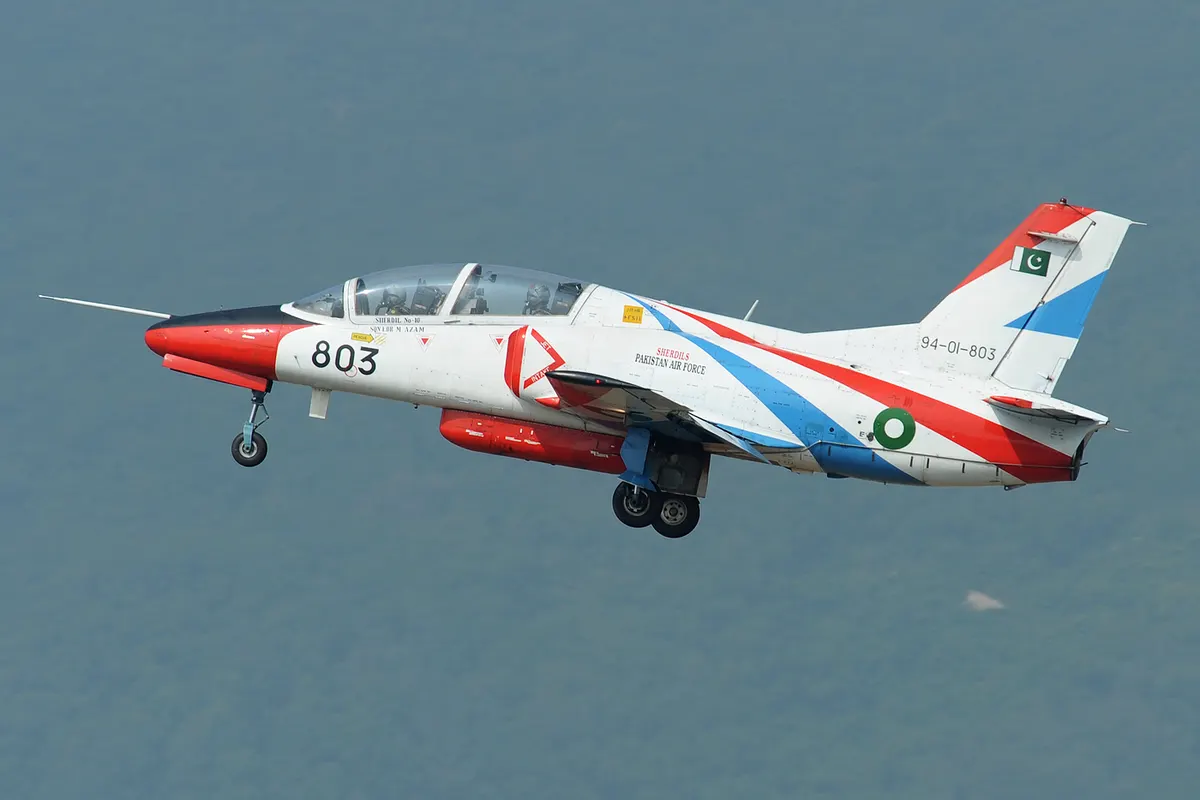
Export customization produced several country-specific marks. The K-8E is Egypt's locally built version; the K-8P is Pakistan's, eventually upgraded with a glass cockpit, HUD, and modern ejection seats; the K-8W added an improved cockpit and HUD for later customers including Venezuela, Bangladesh, and Myanmar; the K-8VB is Bolivia's dedicated mark; and a small number of K-8S aircraft went to Sudan.12,24 The K-8V, separately, is not operational at all but an integrated flight-test simulation airframe used to validate systems changes before new-build prototypes.24

| Yıl | Alıcı | Adet | Tutar | Bugünkü Değer (2025) |
|---|---|---|---|---|
| 2009 |  Bolivya | 6 | — | — |
| 2009 | Bolivya | 6 | — | — |
| 2008 |  Venezuela | 18 | — | — |
| 2008 | Venezuela | 18 | — | — |
| 1999 |  Mısır | 120 | — | — |
| 1995 |  Pakistan | 75 | — | — |
| — | Pakistan | 6 | — | — |
Roughly fifteen air forces fly the K-8/JL-8 family today: China, Pakistan, Egypt, Myanmar, Bangladesh, Venezuela, Bolivia, Sri Lanka, Sudan, Zimbabwe, Zambia, Ghana, Namibia, Angola, and Laos.2,16 China and Pakistan remain the anchor customers, having co-developed the design, while Egypt's locally built K-8E line makes it the program's biggest export success by unit count. Africa is where the low price shows most: beyond individual fleets in Zambia, Zimbabwe, Ghana, and Namibia, Chinese officials cite an estimated 80 percent share of jet trainers across African air forces belonging to the K-8 family, a scale no Western competitor has matched.16
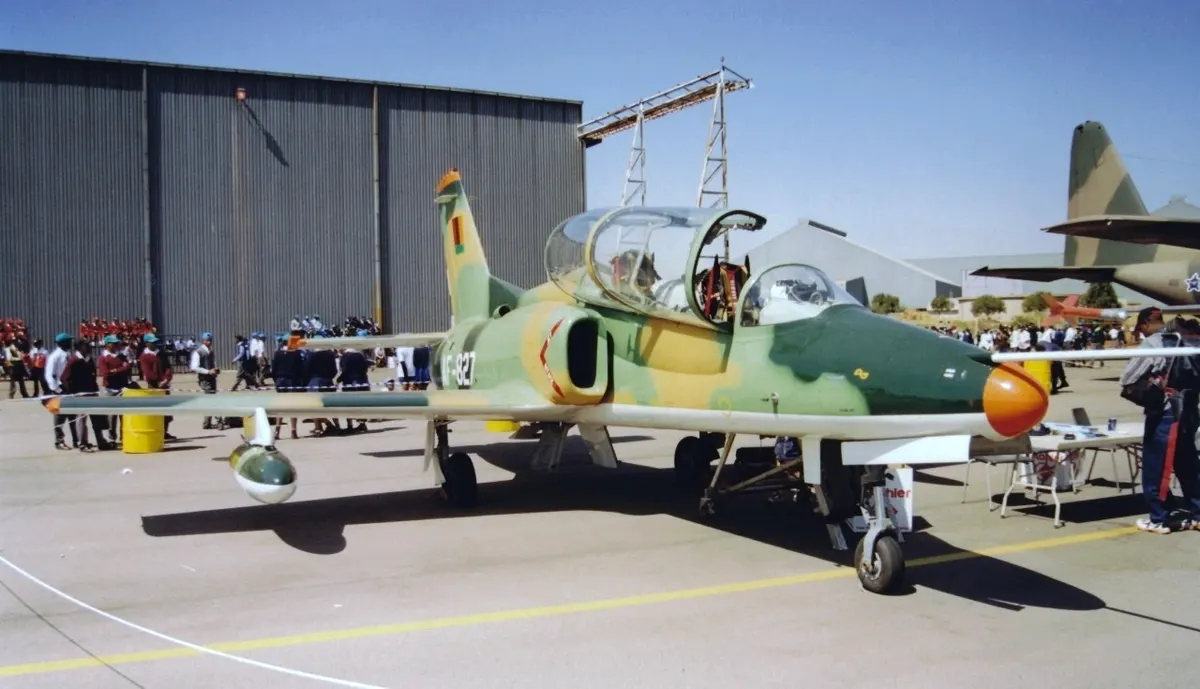
Sri Lanka and Myanmar represent the Asian side of the customer base and, with Sudan, are the operators that have used the aircraft in anger rather than purely for training. Venezuela and Bolivia form a Latin American cluster acquired mainly for internal-security and counter-narcotics roles, reflecting how the type's low operating cost suits air forces with little budget room for a dedicated attack jet on top of a trainer fleet.
The K-8/JL-8's closest historical rival is the Czechoslovak-designed Aero L-39 Albatros, and the two aircraft essentially split the global low-cost jet-trainer export market from the 1990s onward. Both are single-engine, tandem-seat, non-afterburning jets built for basic-to-intermediate training with a secondary light-attack role, pitched at the same customers: mid-size and smaller air forces that could not justify a dedicated advanced trainer like the BAE Hawk or Alenia Aermacchi MB-339. Where they differ is engine architecture and, consequently, altitude performance: the L-39 relies on the Ivchenko-Progress AI-25TL turbofan (the K-8's Chinese-built WS-11 is a direct copy of a close relative), giving both aircraft similar thrust class, but the K-8's airframe and intakes were optimized a decade later and generally post better climb and sustained-turn figures at altitude, a gap Pakistani instructor pilots flying both types have noted directly.6
Price and political alignment have mattered more than raw performance in deciding which aircraft a given air force buys. The L-39 benefited for years from a glut of cheap secondhand ex-Warsaw Pact airframes after 1991, undercutting new-build K-8 pricing in some deals, but that surplus has thinned since, while Chinese and Pakistani export financing has stayed aggressive and unencumbered by the end-use conditions that sometimes complicate Czech or Western sales. The result is a rough geographic split: L-39s cluster in former Soviet-aligned states, while the K-8 has become the default choice across sub-Saharan Africa and much of South and Southeast Asia.
| Spec | K-8 / JL-8 | L-39 Albatros |
|---|---|---|
| Engine | Ivchenko-Progress AI-25TLK / WS-11, 16.9 kN7 | Ivchenko-Progress AI-25TL, ~16.9 kN |
| Max takeoff weight | ~4,330 kg2 | ~5,270 kg |
| Service ceiling | 13,000 m2 | 11,500 m |
| Total built | 735+2 | ~2,900+ |
The Albatros still holds a large lead in absolute numbers built, reflecting its head start and Soviet-bloc-wide standardization, but the K-8/JL-8 has closed much of that gap and, unlike the largely out-of-production L-39 lineage, remains in active new-build production for fresh orders such as Sudan's.22


How many Hongdu JL-8 / K-8 Karakorum aircraft have been built? Over 735 across all variants, spanning the Chinese JL-8/L-11 lines and the various export K-8 marks.2
Is the K-8 Karakorum still in service? Yes, with roughly fifteen air forces, and Sudan's recent arms deal shows it is still being newly ordered, not just retained by legacy operators.2,22
What is the K-8 Karakorum's top speed? Roughly Mach 0.75, or 800-950 km/h depending on altitude and load; it is not a supersonic aircraft, in keeping with its trainer role.2,10
What is the difference between the JL-8 and the K-8? Same basic airframe, different names for different customers: JL-8 is the PLAAF's Chinese-engined domestic version, while K-8 is the export designation, historically offered with either the Ukrainian-derived Ivchenko/WS-11 or the American Honeywell TFE731 depending on buyer and export-control clearance.5,7
How does the K-8 Karakorum compare to the L-39 Albatros? Both are similarly sized, similarly powered low-cost jet trainers aimed at the same export customers; the K-8 offers slightly better high-altitude performance and remains in production, while the L-39 has a far larger production run and secondhand market.6
- "Hongdu JL-8", Wikipedia — en.wikipedia.org ↩
- "Hongdu JL-8", Wikipedia (infobox specifications) — en.wikipedia.org ↩
- "Hongdu JL-8 / K-8 Karakorum Light Attack / Advanced Jet Trainer Aircraft", MilitaryFactory — militaryfactory.com ↩
- "K-8", Centre for Information Resilience / Myanmar Witness — info-res.org ↩
- "Nanchang/Pakistan Aeronautical Complex K-8 Karakorum", PAF SQK — pafsqk.yolasite.com ↩
- "Hongdu K-8: Pilot review of China's Kick-ass Karakorum jet trainer", Hush-Kit — hushkit.net ↩
- "Hongdu JL-8 — Grokipedia", Grokipedia — grokipedia.com ↩
- "CATIC / Hongdu / Nanchang K-8 / JL-8 / Karakorum — Specifications", Flugzeuginfo.net — flugzeuginfo.net ↩
- "WS11 turbofan", GlobalSecurity.org — globalsecurity.org ↩
- "Hongdu JL-8 / K-8 Karakorum Light Attack / Advanced Jet Trainer Aircraft", MilitaryFactory — militaryfactory.com ↩
- "K-8", Centre for Information Resilience / Myanmar Witness — info-res.org ↩
- "Karakoram-8 (K-8) Aircraft", Pakistan Aeronautical Complex Kamra — pac.org.pk ↩
- "K-8E Karakoram-8", GlobalSecurity.org — globalsecurity.org ↩
- "Egypt-based AOI reiterates making aircraft K8", Egypt Today — egypttoday.com ↩
- "Sherdils aerobatic team History", Aerobatic Teams Network — aerobaticteams.net ↩
- "These Are The Countries That Purchase Chinese Fighter Jets", Simple Flying — simpleflying.com ↩
- "Sherdils", Military Wiki / Fandom — military-history.fandom.com ↩
- "K-8 Karakorum Light Attack and Jet Trainer Aircraft", Airforce Technology — airforce-technology.com ↩
- "Venezuela Loses a K-8 Karakorum in Accident", History of PIA Forums — historyofpia.com ↩
- "China's K-8 Jets: A Killer for Myanmar", Defense Industry Daily — defenseindustrydaily.com ↩
- "Incident Hongdu K-8 Karakorum CTF747", Aviation Safety Network — aviation-safety.net ↩
- "Pakistan signs $1.5 billion deal to sell lethal combat weapons to Sudan's junta", ThePrint — theprint.in ↩
- "Accident Nanchang K-8P Karakorum 08-09-821", Aviation Safety Network — asn.flightsafety.org ↩
- "Hongdu JL-8 also known as the Karakorum-8 or K-8", Thai Military and Asian Region — thaimilitaryandasianregion.wordpress.com ↩