

The HAL HJT-16 Kiran is a two-seat, side-by-side jet trainer designed and built by Hindustan Aeronautics Limited (HAL) of India. First flown on 4 September 1964 and delivered to the Indian Air Force (IAF) from March 1968, it filled the intermediate stage of pilot training, the bridge between a propeller basic trainer and a fast jet.1 "Kiran" translates roughly as "ray of light"; almost the entire production run stayed in Indian service.2 It became the longest-serving jet in the IAF training fleet, still flying more than six decades after its maiden flight even as the IAF works through a repeatedly delayed replacement program.1,6
- simple, forgiving handling for ab-initio jet transition
- armed Mk II variant doubled as a light-attack trainer
- decades of parts, maintenance and instructor experience built up
- low operating cost relative to a full advanced trainer
- persistently underpowered, especially the Mk I/IA
- recurring engine flameouts and reliability complaints late in service life
- dated cockpit avionics and instrumentation by modern standards
- no true replacement fielded despite retirement plans dating to the mid-2000s
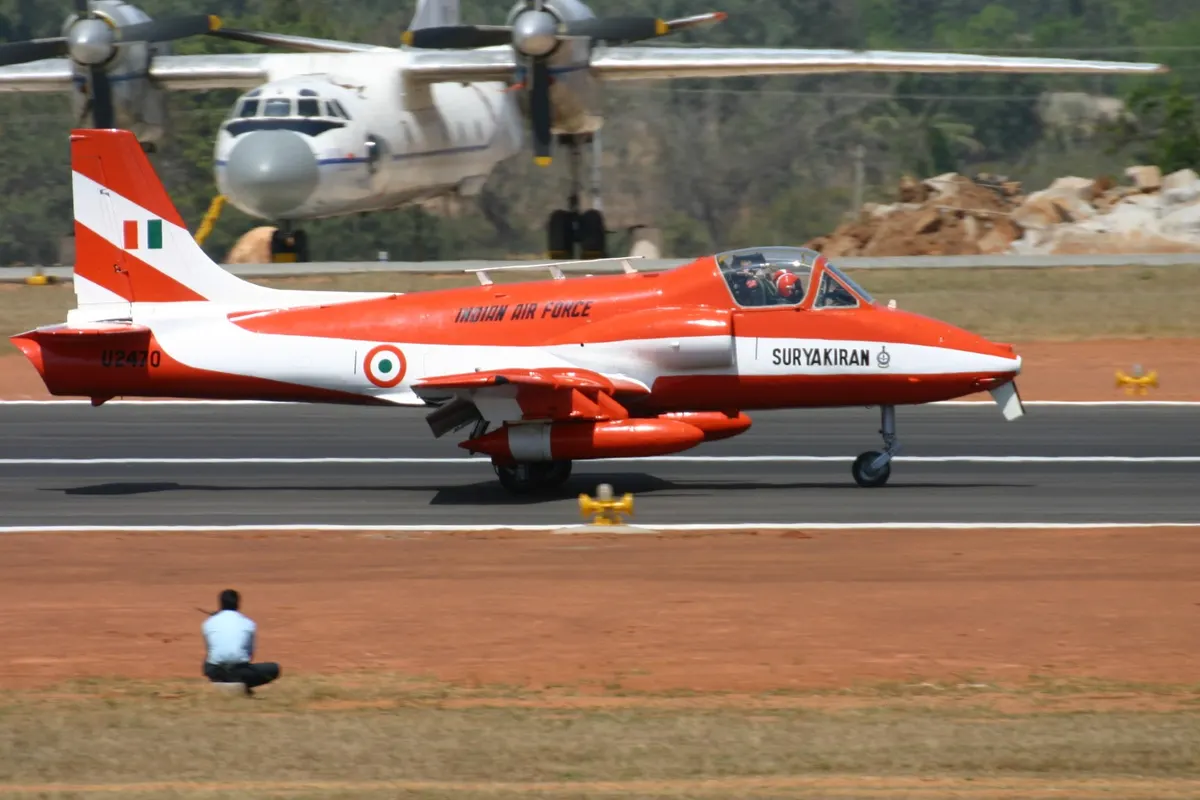
Three main versions were built. The basic Kiran Mk I had no weapons at all; the Kiran Mk IA added a pair of underwing hardpoints for gunnery and rocketry practice; the Kiran Mk II, powered by a more potent engine, added two more hardpoints and a pair of nose-mounted machine guns, giving it a genuine (if modest) light-attack capability alongside its training role.1,3 Roughly 250 Kirans of all marks were built between 1964 and 1989, split almost evenly between the unarmed/lightly armed Mk I/IA family (190 aircraft) and the improved Mk II (61 aircraft).3
The type never fought in a war. Its record instead is one of endurance: decades of basic and armament training for the IAF and Indian Navy, a stint fronting India's first military aerobatic display team, a fatal airshow crash, and — very recently — a second act as the flying testbed for an unmanned-combat-aircraft program. The Kiran's slow-motion retirement, still unfinished in 2026, says as much about the difficulties of India's indigenous trainer programs as about the aircraft itself.
The Rolls-Royce Viper and the Later Switch to the Orpheus
The Kiran I and IA were powered by a single Rolls-Royce Viper 11 turbojet (originally a Bristol Siddeley design) rated at 2,500 lbf (11.1 kN) of thrust, a modest figure that shows up directly in the aircraft's performance: a top speed of about 695 km/h (431 mph) at sea level and a fairly leisurely climb.1,2 Pilots and IAF assessments repeatedly flagged the type as underpowered for its training syllabus, and HAL's response, developed through the 1970s, was the Kiran Mk II: essentially the same airframe re-engined with a Bristol Siddeley/Rolls-Royce Orpheus turbojet delivering 4,200 lbf (18.7 kN), first flown on 30 July 1976 and delivered to squadrons from 1985.1,3
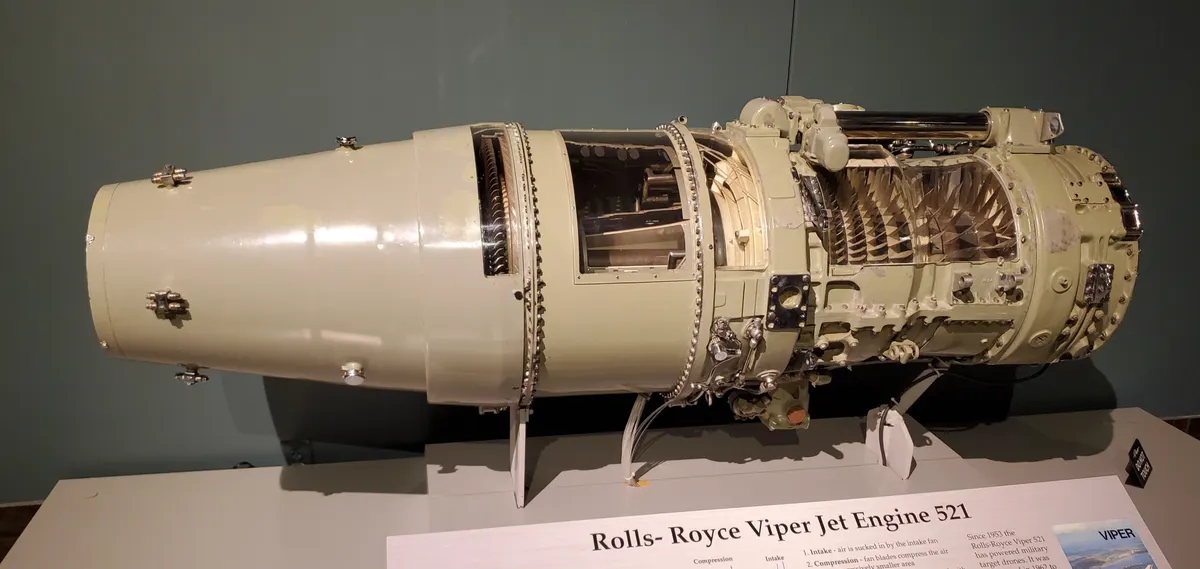
Even with the extra thrust, the Kiran stayed a straightforward subsonic trainer: top speed for the Mk II is still generally quoted in the 690–700 km/h band, with a service ceiling around 9,150 m (30,000 ft) and under two hours' endurance on internal fuel.1 That was adequate for teaching instrument flying, formation, aerobatics, navigation and basic weapons delivery, but it left a widening gap to the supersonic fighters that graduating pilots would eventually fly — a gap the IAF has spent two decades trying to close with a proper advanced jet trainer.
Side-by-Side Seating and the Martin-Baker Ejection Seat
Like its evident design ancestor, the British BAC Jet Provost, the Kiran uses side-by-side seating rather than the tandem arrangement common on later trainers. The layout lets an instructor watch a student's hands and instrument scan directly rather than through a mirror or camera, at the cost of a wider, higher-drag fuselage.1 Both crew sit on Martin-Baker ejection seats — the lightweight Mk.4 in early aircraft, with Mk II airframes fitted with the improved H4HA — a British safety system retained across the aircraft's whole service life even as other systems were adapted or replaced.13
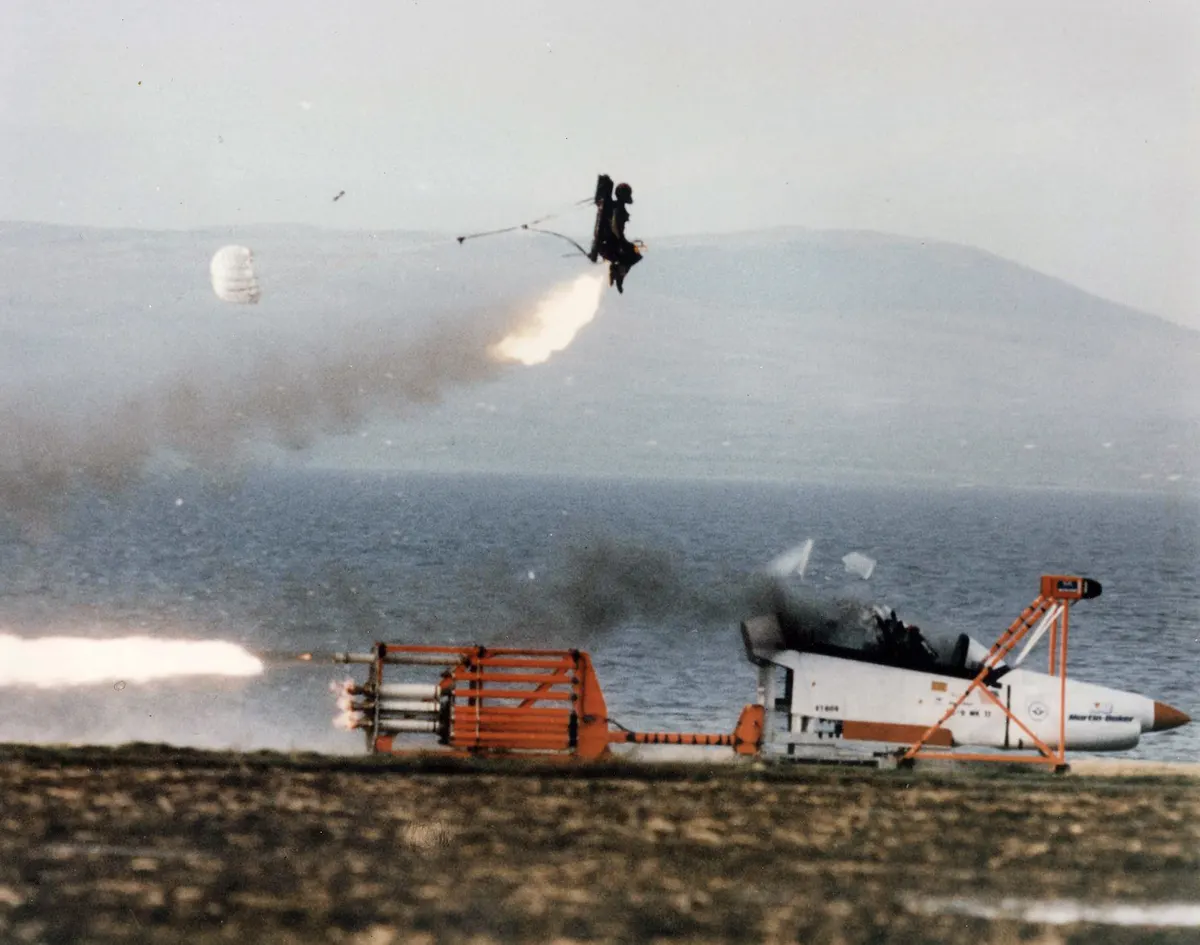
The rest of the cockpit stayed deliberately simple: analogue instruments, a basic radio and radio-compass fit, none of the mission computers or multi-function displays that define later trainers. That simplicity aged badly — an Indian assessment of the fleet found the radio compass and radio transmission equipment "a weak area," and separately logged eleven engine flameouts, in the air or on the ground, from 1989 onward.9
The Kiran's airframe was HAL's own design work, built at its Bangalore and Kanpur facilities, giving India full domestic control of the structure. The engines were the largest imported element: the early Viper turbojet came from Britain's Bristol Siddeley/Rolls-Royce, while the Mk II's Orpheus was built under a licence HAL had held since 1956, when its Bangalore Engine Division was set up to produce Orpheus engines for the HF-24 Marut fighter — the same line that later supplied Kiran Mk II engines.11 The Martin-Baker ejection seat, radio and some flight instruments stayed British-sourced imports throughout the aircraft's life.13 Overall the airframe and a growing share of engine manufacture were domestic, while ejection seats, some avionics, and (for the Mk I/IA) complete Viper engines remained foreign.
A Trainer Modeled on the Jet Provost, Not Built Under Its Licence
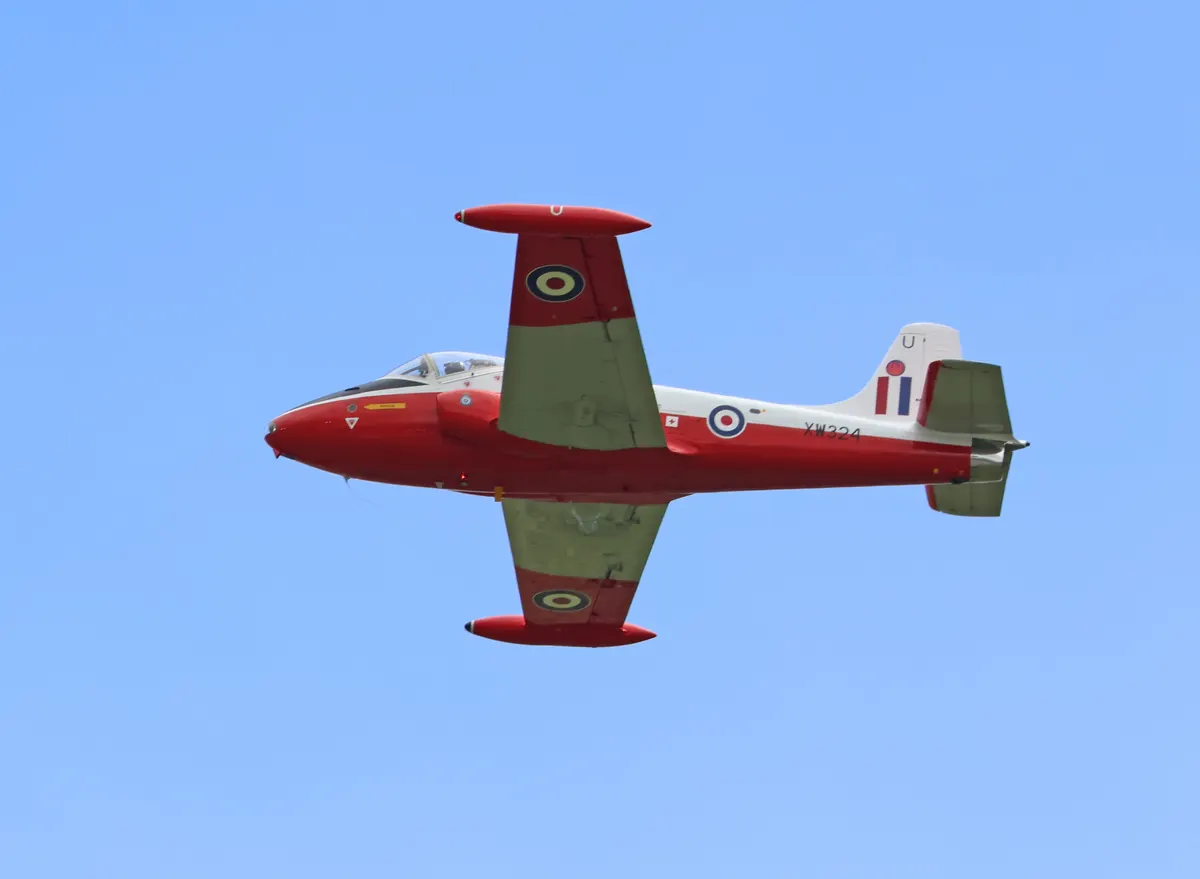
The IAF's requirement for a purpose-built intermediate jet trainer took shape in the early 1960s, as India sought to move students off piston trainers directly into a jet before fighter conversion. HAL's design team produced an airframe closely resembling the British BAC Jet Provost in layout, though — unlike the Kiran's engines — it was not manufactured under a Jet Provost licence; HAL credits it as an in-house design drawing heavily on the Jet Provost concept.1 The type first flew on 4 September 1964, and after a run of pre-production aircraft, deliveries to the IAF began in March 1968.1,3
The same HAL design office was subsequently redeployed onto the HF-24 Marut fighter-bomber, India's first indigenous jet fighter — a direct link between the trainer project and the country's larger combat-aircraft ambitions.9 Kiran I production ran to 118 aircraft, followed by 72 of the lightly armed Mk IA, which added two underwing hardpoints so students could begin weapons training on the same airframe they had learned to fly.1,3
By the mid-1970s, however, complaints about the Mk I/IA's power margins were serious enough that HAL committed to a re-engined version. The Kiran Mk II, fitted with the Orpheus turbojet and carrying four hardpoints plus twin 7.62 mm nose machine guns, first flew on 30 July 1976; deliveries to the IAF and Indian Navy ran from 1985 until production closed in 1989, after 61 had been built.1,3
When the IAF's HPT-32 Deepak basic trainer fleet was grounded in 2009 after a series of fatal crashes, Kiran squadrons were pressed into covering both Stage I and Stage II training at once, extending flying hours on an already aging fleet.1 That improvisation set the pattern for the Kiran's late career: each time a planned successor slipped, the Kiran absorbed the extra workload instead of retiring on schedule.
The designated successor, HAL's indigenous HJT-36 Intermediate Jet Trainer ("Sitara"), has been in development since the late 1990s and was dogged by spin-recovery problems serious enough that the IAF judged an earlier version unfit for service in 2017. A redesigned rear fuselage and tail, developed with BAE Systems, led HAL to rebrand it as the HJT-36 "Yashas" at Aero India 2025; the IAF had still not placed a firm production order, opting instead to lease a handful of aircraft while evaluation continued.7 The Kiran, originally expected to retire in the 2000s, remains a live line item in IAF training plans into the mid-2020s.
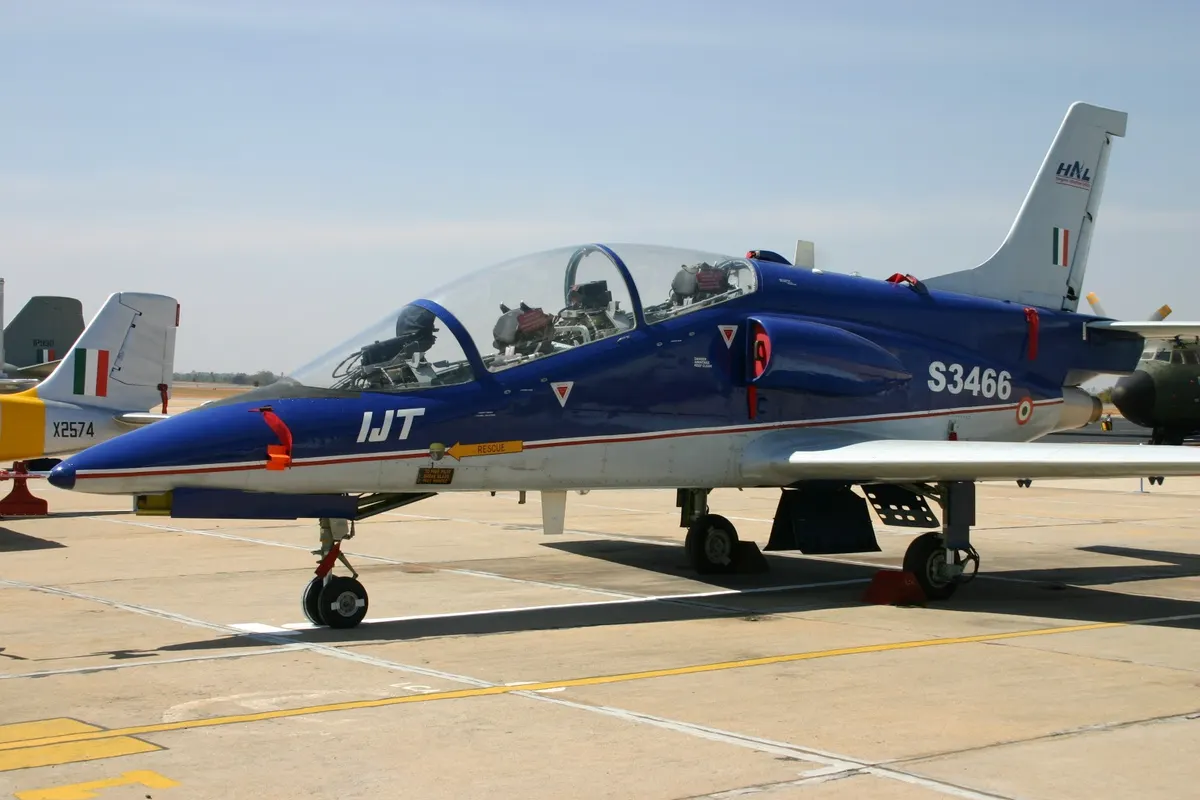
The most unexpected turn came in the mid-2020s. Rather than scrapping every retired airframe, HAL rebuilt one Kiran Mk II as an "optionally manned combat aircraft," replacing the instructor's seat with a mission-control station carrying data links and computers able to command HAL's CATS Warrior drone. The modified jet flew for the first time in this configuration in January 2025, meant to prove out manned-unmanned teaming ahead of the CATS Warrior's own first flight, expected in 2026.7,8 A trainer built to teach basic instrument flying now doubles, on at least one airframe, as a testbed for one of India's most forward-looking combat-aviation programs.
Kiran I, IA and II: The Slow Move Toward a Warplane
The Kiran I was a pure trainer: no hardpoints, no gun armament, built solely for basic and intermediate flying instruction.1 The Kiran IA kept the same Viper-11 engine but added two underwing hardpoints, enough to carry practice bombs, rocket pods or gun pods so students could begin weapons-delivery training on the same airframe.1,3 Typical Mk IA stores were pairs of 500 lb practice bombs, SNEB rocket pods with seven 68 mm rockets each, 7.62 mm gun pods, or drop tanks.2
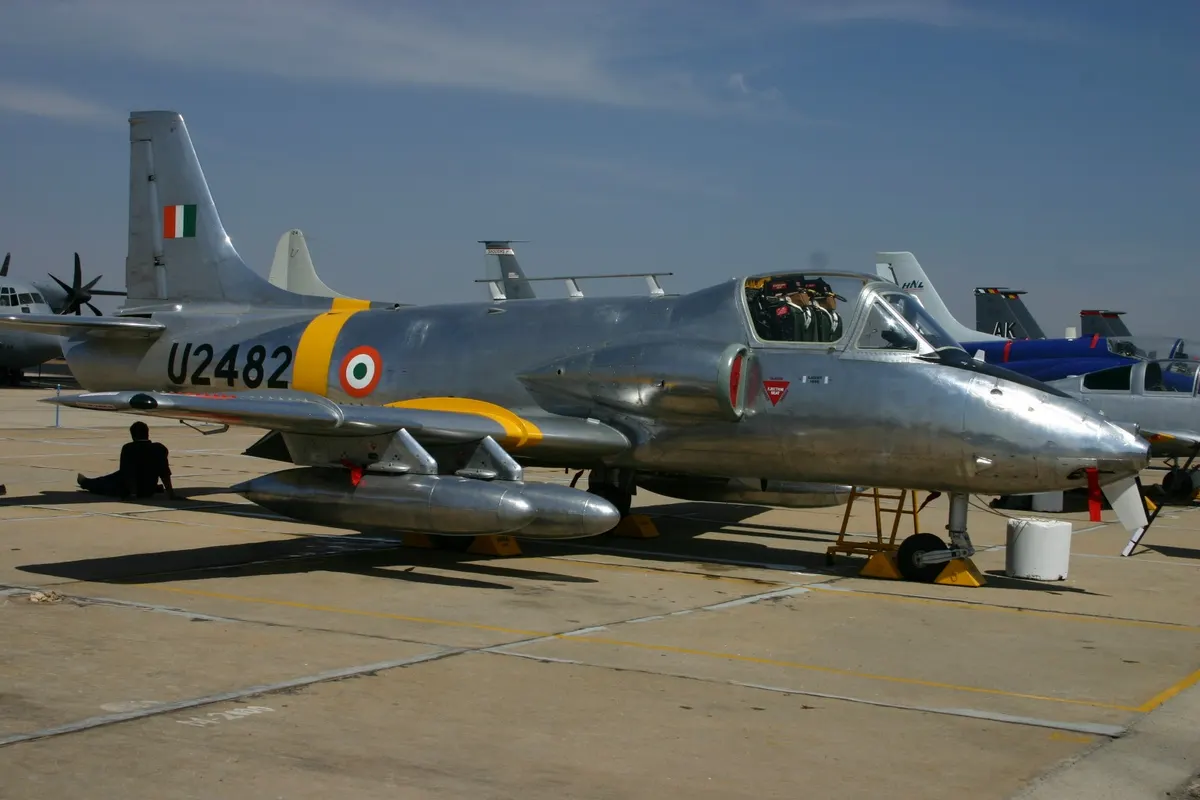
The Kiran Mk II went a step further, pairing the Orpheus engine with four hardpoints and integral twin 7.62 mm machine guns built into the nose — fixed armament, unlike the Mk IA's purely underslung weapons.1,3 That made the Mk II a credible, if lightly armed, light-attack aircraft as well as a trainer, a dual identity reflected in its later selection for aerobatic display duty and, decades on, for the unmanned-teaming conversion described above.
Indian Air Force and Navy: Five Decades of Basic Training
The Indian Air Force was always the Kiran's principal operator, running the type through its flying training schools for intermediate pilot instruction from 1968 onward.1 The Indian Navy also adopted the Kiran for basic training and armament practice; INS Garuda at Kochi and No. 551 Squadron flew Kiran Mk IIs split between a basic-training flight and an armament-training flight, distinguished by different tail colours.12
In December 2018, India donated six retired Kirans to Myanmar, with a training team to help Myanmar's pilots and ground crew operate them — read partly as a counterweight to Chinese influence there and partly as reciprocity for cooperation against insurgent groups along the shared border.10 Beyond India and Myanmar, the Kiran was never exported or licence-built abroad, unlike some of its trainer contemporaries.
Two Aerobatic Teams, One Fatal Common Thread
The IAF's Surya Kiran Aerobatic Team, formed in 1996 within No. 52 Squadron and based at Bidar, flew the Kiran Mk II for fifteen years, building a reputation through hundreds of displays before it was suspended in February 2011, when its aircraft were needed for fighter-pilot training rather than air shows; the team was reconstituted in 2015 on BAE Hawks.4 A Surya Kiran aircraft was lost in a 2006 practice-flight crash near Bidar that killed both crew.4
The Indian Navy ran a parallel team, Sagar Pawan, formed in 2003 within No. 551 Squadron and flying four specially painted Kiran Mk IIs from INS Hansa in Goa — at the time, one of only two dedicated naval aerobatic teams in the world alongside the U.S. Navy's Blue Angels.5 On 3 March 2010, a Sagar Pawan Kiran crashed into a building during a display at the Indian Aviation air show in Hyderabad, killing both crew and injuring four people on the ground; the team was stood down later that year, officially for lack of spare Kiran airframes for both display and training duties.5
Kiran vs BAC Jet Provost: Shared Layout, Different Fates
The Kiran and the Jet Provost are close enough in configuration — side-by-side seating, a straight wing, a single Viper-family turbojet — that observers have long debated how much of the Kiran was HAL's own work versus a close copy of the British design; HAL frames it as an indigenous airframe influenced by the Jet Provost rather than a licenced derivative, a distinction some outside commentators dispute given how closely the two resemble each other.1 Performance-wise the two were near-twins: the late-model Jet Provost T.5 reached about 440 mph on the same 2,500 lbf Viper thrust class that powered the Kiran I/IA.14 Their careers diverged sharply — the RAF retired its Jet Provosts by 1993, a quarter-century into service, while India kept flying Kirans for more than fifty years, a gap that reflects less on the airframe than on how much harder it proved for India to field and certify an indigenous successor.
| Spec | HAL Kiran (Mk I/IA) | BAC Jet Provost T.5 | BAE Hawk Mk132 |
|---|---|---|---|
| Engine | Rolls-Royce Viper 11 | Rolls-Royce Viper 202 | Rolls-Royce/Turbomeca Adour 871 |
| Thrust | 2,500 lbf1 | 2,500 lbf14 | 5,730 lbf15 |
| Top speed | ~695 km/h (431 mph)1 | ~708 km/h (440 mph)14 | ~1,065 km/h (662 mph)15 |
| Seating | Side-by-side | Side-by-side | Tandem |
| Retired (primary user) | From 2025 (ongoing)6 | 1993 (RAF)14 | In service |
Kiran vs BAE Hawk Mk132: The Generational Leap
The aircraft that has actually displaced the Kiran, function by function, is the BAE Systems Hawk Mk132, licence-built by HAL from 2007. Where the Kiran's Viper- or Orpheus-powered airframe tops out under 700 km/h with analogue instruments, the Hawk's Adour turbofan pushes it past 1,000 km/h with a glass cockpit and a genuine weapons-training suite, and it inherited both the advanced-training syllabus and, from 2015, the Surya Kiran display role outright.15,4 The comparison underlines what the Kiran actually was: not a failed attempt at a modern trainer, but a basic/intermediate type asked, by the slow pace of its replacement programs, to soldier on for decades past the point a comparable Western air force would have retired it.
How many HAL Kiran aircraft were built? Production ran from 1964 to 1989: 118 Kiran I, 72 Kiran IA, and 61 Kiran II, for roughly 250 aircraft in total, plus a small number of pre-production examples.1,3
Is the HAL Kiran still in service? As of 2026, a shrinking number remain in Indian Air Force and Navy use while the IAF works through a phased retirement announced for 2025, delayed in part because its planned successor, the HJT-36, had not yet entered full squadron service.6,7
What is the top speed of the HAL Kiran? The Viper-powered Mk I/IA reaches about 695 km/h (431 mph) at sea level; the more powerful Orpheus-engined Mk II is broadly similar, with the extra thrust used mainly for climb performance and weapons carriage rather than a large increase in top speed.1
What replaced the HAL Kiran? Functionally, the BAE Hawk Mk132 has already absorbed the Kiran's advanced-training and display-team roles since the late 2000s. The intended direct successor for intermediate training is HAL's own HJT-36, renamed "Yashas" in 2025 after years of spin-recovery problems delayed its certification.7,15
Was the Kiran a licence-built copy of the Jet Provost? No — HAL describes it as an indigenous design that drew heavily on the Jet Provost's layout, not a licenced Jet Provost derivative. The engines, by contrast, genuinely were British designs, imported and later partly built under licence in India.1,11
- "HAL HJT-16 Kiran", Wikipedia — en.wikipedia.org ↩
- "HAL HJT-16 Kiran (Ray of Light)", War Wings Daily — warwingsdaily.com ↩
- "HAL HJT-16 Kiran (Ray of Light) Intermediate-Advanced Trainer / Light Attack Aircraft", Military Factory — militaryfactory.com ↩
- "Surya Kiran", Wikipedia — en.wikipedia.org ↩
- "Sagar Pawan", Wikipedia — en.wikipedia.org ↩
- "After 21 years wait for Sitara IJT, IAF Set to Retire Kiran Trainers", Indian Defence Research Wing — idrw.org ↩
- "HAL HJT-36 Sitara", Wikipedia — en.wikipedia.org ↩
- "HAL to Repurpose Retired Kiran MkII Trainer into Optional Mothership for CATS Warrior Drone's MUM-T Role", Defence.in — defence.in ↩
- "Trainer - IAF in a Dilemma", SP's Aviation — sps-aviation.com ↩
- "Myanmar Air Force", Wikipedia — en.wikipedia.org ↩
- "Engine Division Bangalore", Hindustan Aeronautics Limited — hal-india.co.in ↩
- "HAL HJT-16 Kiran – Indian Navy", Bharat Rakshak — bharat-rakshak.com ↩
- "Martin-Baker Mk.4", Wikipedia — en.wikipedia.org ↩
- "BAC Jet Provost", Wikipedia — en.wikipedia.org ↩
- "British Aerospace Hawk Mk132 – Indian Air Force", Bharat Rakshak — bharat-rakshak.com ↩