

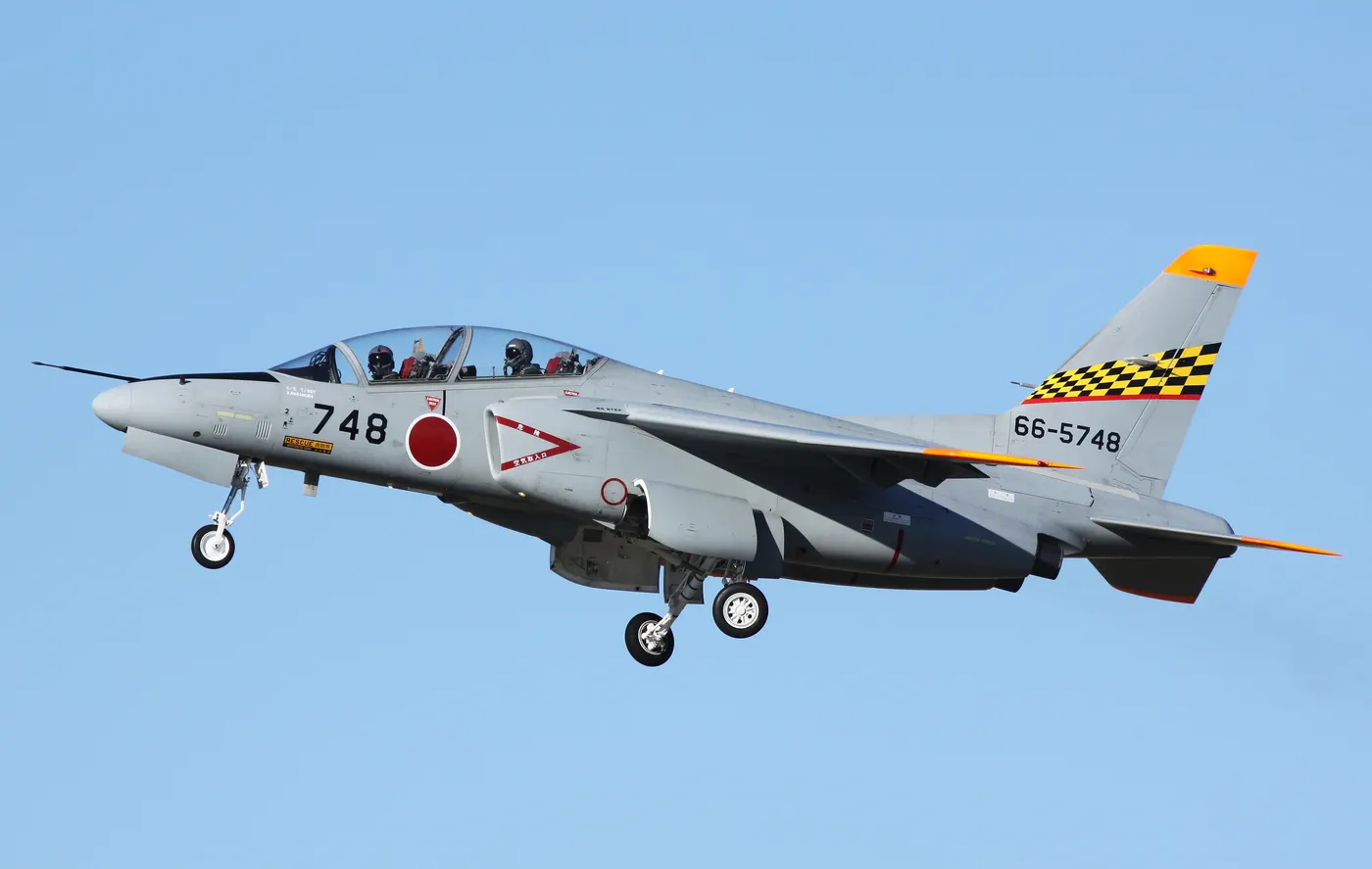

- Fully domestic engine, a rare feat for a Japanese military aircraft
- Twin-engine layout built around safety, not raw power
- LERX-enhanced handling, reportedly more agile subsonically than the F-15J
- Consistently low accident rate over a long service life
- Flexible use as trainer, display aircraft, and liaison hack
- Never exported; the arms-export ban shut out every foreign customer
- Fully unarmed, with no fielded light-attack derivative
- Subsonic only, limiting lead-in value for supersonic fighter conversion
- Small production run of roughly 212 airframes kept unit costs high
- Fleet now aging toward a 2030s retirement with no confirmed replacement yet ordered
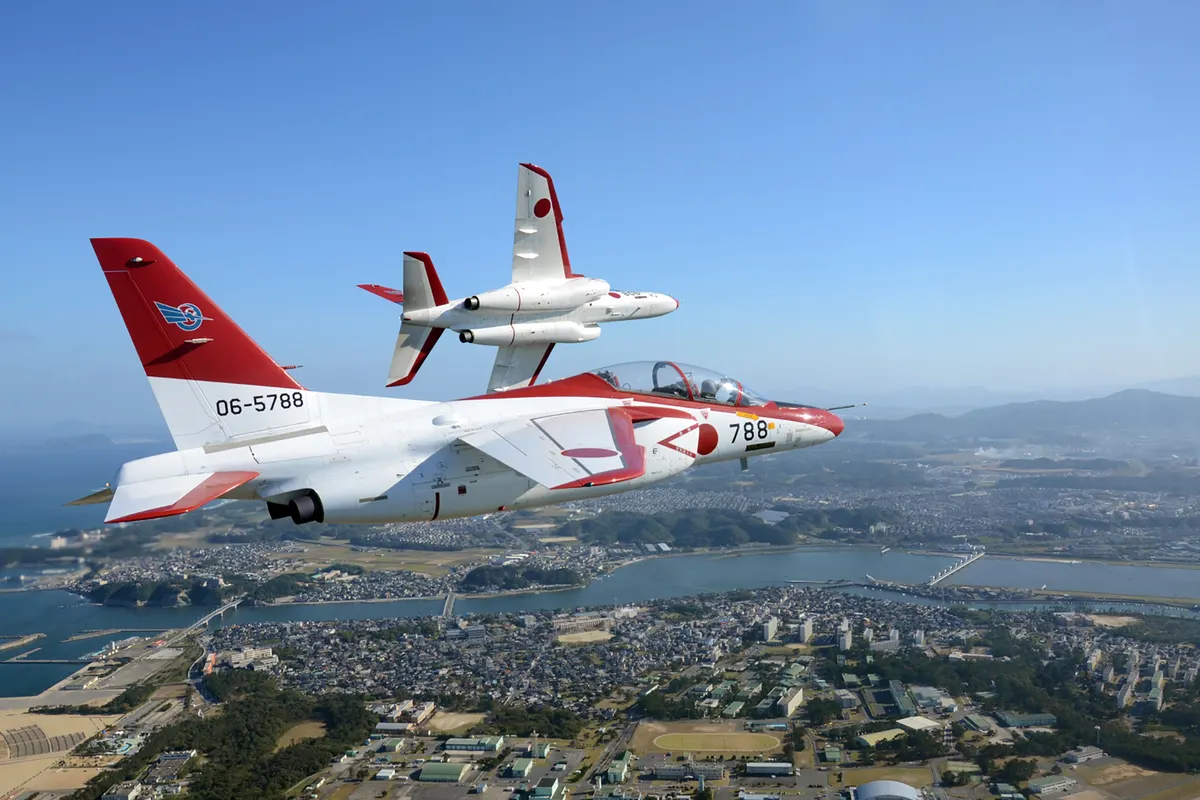
The Kawasaki T-4 is a twin-engine, tandem-seat intermediate jet trainer built for the Japan Air Self-Defense Force (JASDF), and it remains the only aircraft the service has ever flown for that role.1 Kawasaki led a three-company consortium, with Fuji and Mitsubishi each building large structural sections, to meet a 1981 requirement for a T-33 and T-1 replacement.12 The first of four XT-4 prototypes flew on 29 July 1985; deliveries to line units began in September 1988, and production continued in small annual batches until the last airframe left the factory in March 2003.1,12
Two Ishikawajima-Harima F3-IHI-30 turbofans, each rated at roughly 16.4 kN, power the T-4, and both engine and airframe were designed and manufactured in Japan.3,10,12 That matters more than it might for most trainers: Japan's aerospace industry has spent decades building airframes under license or around imported powerplants, and a fully domestic engine reaching squadron service was, and remains, unusual.3 The design was deliberately kept unarmed, a choice tied as much to postwar policy as to mission needs, and no combat variant or export version was ever produced.5 Beyond training, the T-4 has flown as the mount of the JASDF's Blue Impulse aerobatic team since 1996 and as an informal liaison and "squadron hack" aircraft at fighter bases across Japan.2,11
The F3-IHI-30 Turbofan and Japan's Rare Home-Grown Engine
Ishikawajima-Harima Heavy Industries (IHI) developed the F3-IHI-30 specifically for the T-4 program, and it is one of the few jet engines Japan has designed, built, and fielded entirely on its own rather than under license.3 The two-shaft, low-bypass turbofan produces about 16.4 kN (roughly 3,680 lbf) of thrust each, giving the T-4 a combined output modest by fighter standards but adequate for a trainer built around agility rather than speed.3,12
- İlk Uçuş1985
- Hizmete Giriş Yılı1988
- Mürettebat (koltuk)2
- Eğitim Uçağı TipiOrta seviye jet eğitim uçağı
- HizmetteEvet
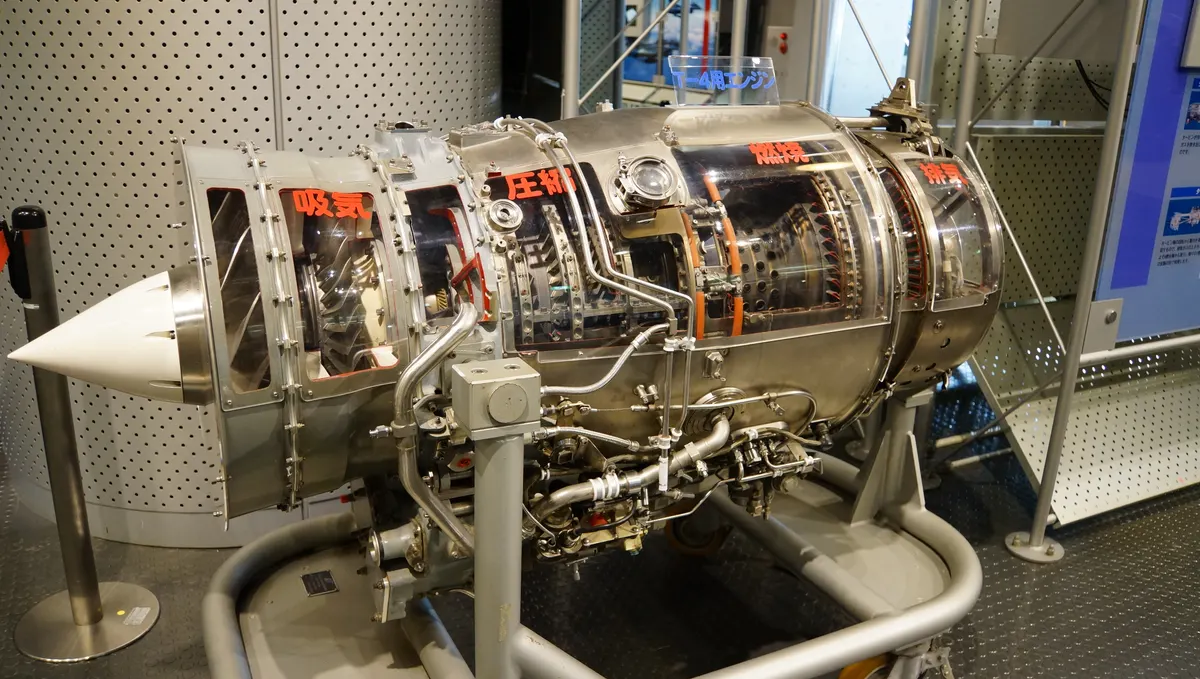
IHI later fielded the improved F3-IHI-30B, with a redesigned high-pressure turbine for longer service life, and the FADEC-equipped F3-IHI-30C, both retrofitted into the existing fleet rather than sold as a distinct new engine.3
- Motor TipiIshikawajima-Harima F3-IHI-30
- İtki16,37
Because the F3 was funded and developed under Japan's own budget rather than licensed from Rolls-Royce, Pratt & Whitney, or another Western house, program managers avoided the technology-transfer strings that usually come with a foreign powerplant, even though the finished airframe was still bound by Japan's own restrictive export policy.3,5
- Azami Hız1.038 km/sa
- Seyir Hızı800 km/sa
- Hizmet Tavanı15.240 m
- Menzil1.668 km
- Tırmanma Hızı45,72 m/sn
- G Limiti7,33
- Havada/Görevde Kalış Süresi3,2
Leading-Edge Root Extensions and a Cockpit Built for Fighter Conversion
The T-4's forward fuselage carries small leading-edge root extensions (LERX) just ahead of the wing roots, a feature meant to generate vortex lift and sharpen handling at high angles of attack, and a thick-section transonic airfoil was developed jointly with Japan's National Aerospace Laboratory to preserve manoeuvrability near the speed of sound.1 Kawasaki's own test pilots reported subsonic handling that compared favorably with the far heavier McDonnell Douglas F-15J, a claim that reflects the aircraft's light wing loading more than any exotic technology.1 The tandem cockpit carries a head-up display and an early form of digital instrumentation rather than an all-analog panel, a configuration meant to ease the transition into the glass cockpits of the F-15J and later the F-2.13 An onboard oxygen generation system (OBOGS), which removed the need to service separate oxygen bottles between sorties, was an unusual investment for a trainer of this class in the 1980s and one that simplified flight-line turnaround considerably.1
- Kokpit DüzeniTandem
- Cam KokpitEvet
- Gömülü SimülasyonHayır
- Hafif Taarruz KabiliyetliHayır
- Silah İstasyonları5
- Fırlatma KoltuklarıEvet
The airframe is entirely Japanese: Kawasaki built the forward fuselage and handled final assembly, Fuji supplied the rear fuselage, wings, and tail, and Mitsubishi produced the center fuselage and engine intakes, with Fuji and Mitsubishi each holding a 30 percent program share.12 The F3-IHI-30 engines, built by Ishikawajima-Harima, are likewise fully domestic, as is most of the avionics suite, sourced from Mitsubishi Electric, NEC, Toshiba, Japan Aviation Electronics, and Shimadzu.12 The clearest imported element is the ejection seat: the T-4 uses the American Stencel SIIS-3 design, built under license in Japan by Daicel Chemical Industries rather than developed from scratch.12 Taken together, domestic content by value is high, likely in the low 90-percent range, with the seat and a handful of smaller subsystems as the main foreign-origin exceptions.
- Uzunluk13 m
- Kanat Açıklığı9,94 m
- Yükseklik4,6 m
- Maks Kalkış Ağırlığı4,7 kg
- Toplam Üretim208
- Kullanıcılar1
- Üretim Başlangıcı1981
- Operasyonel Durumaktif
The MT-X Program and a Three-Way Industry Fight
Japan launched the MT-X requirement in the late 1970s to replace the Lockheed T-33A and Fuji T-1, and to absorb part of the syllabus then carried by the supersonic Mitsubishi T-2.1,4 Kawasaki, Mitsubishi, and Fuji all submitted competing proposals, and in November 1981 the Japan Defense Agency picked Kawasaki's design, then designated KA-850, as the winner, folding the two losing bidders into the program as risk-sharing subcontractors rather than cutting them out entirely.1,12
The plan called for roughly 220 aircraft entering service by 1988, a target the program mostly hit: four XT-4 prototypes flew between December 1985 and July 1986, series production began in Japanese fiscal year 1986, and the first production-standard T-4 flew on 28 June 1988, with deliveries starting that September.1,12 By the time the line closed in March 2003, Kawasaki, Fuji, and Mitsubishi had built 212 airframes counting the four prototypes, with Wikipedia and most JASDF-facing sources citing 208 as the production-only figure.1,12
The aircraft went first to the training wings at Hamamatsu and Ashiya, and from there spread to nearly every JASDF fighter wing as a liaison type, a role that eventually eclipsed pure training in sheer number of airframes assigned.1,11
Blue Impulse and the Long Run as a Squadron Hack
Blue Impulse, the JASDF's aerobatic display team, retired its Mitsubishi T-2s after 175 shows in December 1995 and flew its first display with the T-4 on 5 April 1996, a switch that also meant swapping a supersonic mount for a subsonic one purely for cost and reliability reasons.2 The team has flown the T-4 continuously since, aside from a roughly two-year pause after Matsushima was wrecked by the tsunami, with the squadron returning to its repaired home base in March 2013.2
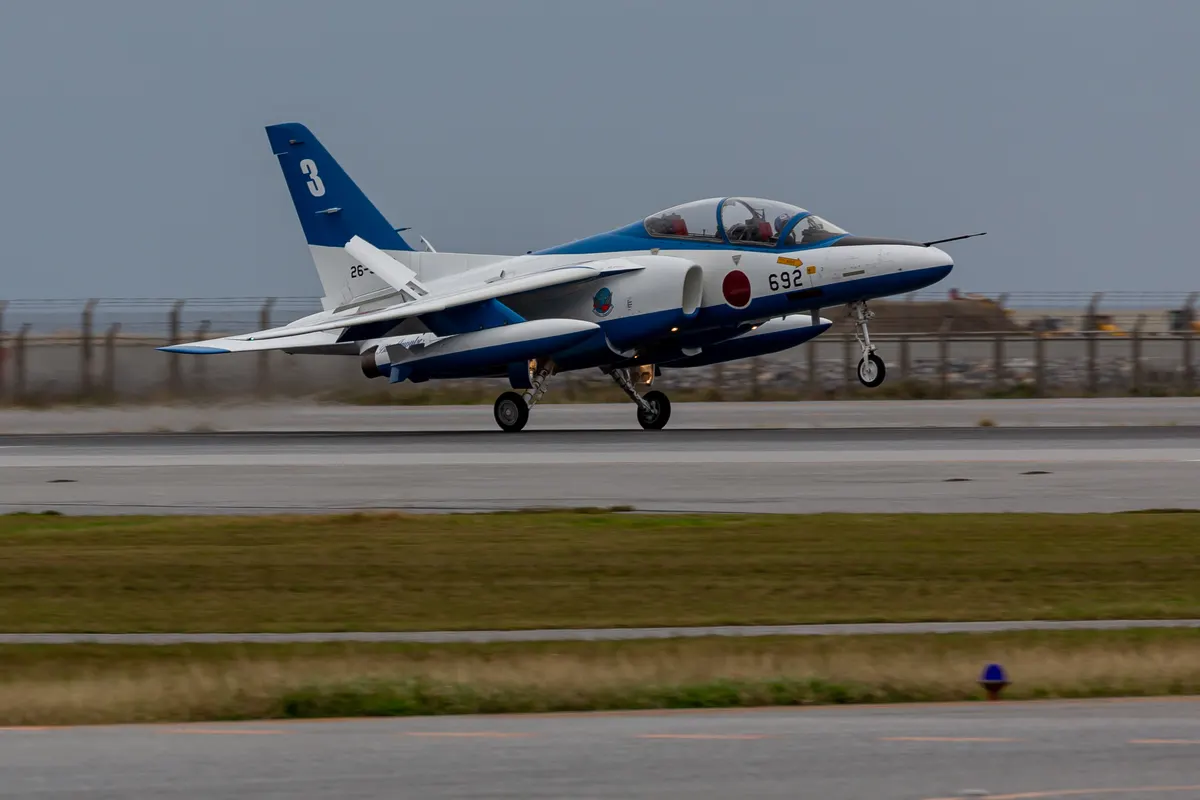
The team's most unusual mission had nothing to do with airshows: on 29 May 2020, six Blue Impulse T-4s flew a low pass over central Tokyo to salute frontline medical workers during the coronavirus pandemic, with hospital staff stepping onto rooftops to watch.14 It was a small, largely symbolic gesture, ordered directly by the defense minister, but it put the T-4 in front of a domestic audience that had never had reason to notice a training jet before.14
Blue Impulse keeps seven specially painted T-4s on strength, six for the standard display formation and one as a spare, supported by eleven pilots and roughly thirty ground crew based at Matsushima.2 Pilots arrive on loan from operational squadrons for a tour of two to three years, working up from solo aerobatics through two-ship work before joining the full six-ship routines, a pipeline that means the team is always training replacements even while touring.2
Away from the display circuit, the T-4's second career as a liaison aircraft, the "hack" flown by fighter squadrons for courier runs, instrument currency, and cross-country transport, arguably did more to keep the type visible across the JASDF than training alone.11 That secondary role also meant the airframe kept flying past the point where a purely training-focused type might have been retired sooner, and accidents involving the type in JASDF service overall have stayed rare given the size and age of the fleet.8,9 A T-4 crashed into a lake in May 2025 with its two crew reported missing, one of the few fatal losses recorded outside the Blue Impulse accidents.8
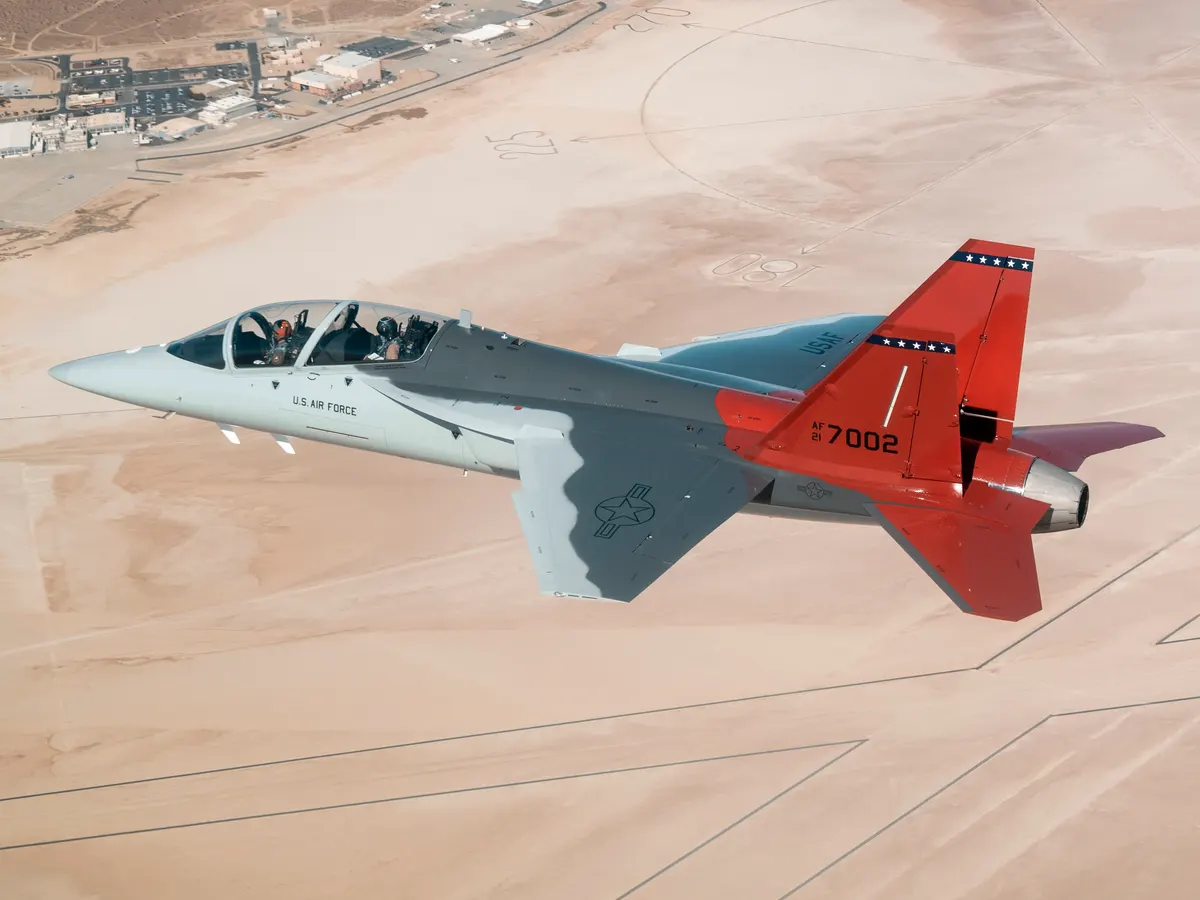
By the mid-2020s the fleet was visibly aging, and in October 2024 Japan's defense ministry issued a request for information toward a successor, with Tokyo and Washington having already agreed in April 2024 to explore co-developing the next JASDF trainer rather than Japan building one alone.6,7 The T-7A Red Hawk, already in production for the US Air Force, is the reported front-runner, though Mitsubishi put forward a rival domestic T-X concept in 2025, and no contract had been signed as of this writing.6,7
Until that decision lands, the T-4 has no announced retirement date, and JASDF planners have given no public timeline for standing the type down beyond the vague expectation that a successor will arrive sometime in the 2030s.6
The T-4 has not flown in combat, and under current planning it is unlikely to. Japan's postwar constitution and the associated arms-export and use-of-force restrictions kept the aircraft unarmed by design, and the JASDF has not deployed it, or any other aircraft, in an offensive role since the type entered service.5 Proposals in the 1980s to adapt the airframe for a light-attack role using its five hardpoints went nowhere, and no armed variant reached even prototype status.1 The closest the T-4 has come to operational tension is routine liaison and training flights near contested airspace, which is not a combat use in any meaningful sense.
Kawasaki built no major production variant beyond the baseline T-4; the four XT-4 prototypes differed from series aircraft mainly in instrumentation rather than airframe design, and all were eventually brought up to a similar standard or retired outright.12
The engine saw more variation than the airframe: IHI's F3-IHI-30B, introduced from 1999, added a redesigned high-pressure turbine for a longer service life, and the F3-IHI-30C, from 2003, added a modern FADEC, with both retrofitted into existing airframes rather than issued as a distinct aircraft model.3 A light-attack derivative was studied during the original MT-X competition and briefly afterward but never entered production, leaving the T-4 fleet uniformly unarmed across its entire service life.1
No export variant exists; Japan's arms-export policy of the period ruled out foreign sales outright, and unlike most of its Western contemporaries the T-4 was never marketed abroad.5

The Japan Air Self-Defense Force is the T-4's only operator and has been since delivery began in 1988.1 The bulk of the training fleet is assigned to the 1st Air Wing at Hamamatsu and the 13th Flying Training Wing at Ashiya, where student pilots fly the intermediate syllabus before moving on to fighter conversion.2,11 Blue Impulse, based at Matsushima Air Base as the 11th Squadron of the 4th Air Wing, flies a small dedicated group of specially painted T-4s separate from the training fleet, and beyond these dedicated units the type is scattered in ones and twos across nearly every JASDF fighter wing as a liaison aircraft.2,11
That wide distribution has kept total T-4 flight hours high relative to the size of the dedicated training fleet, and more than 200 airframes were still listed as active as of the mid-2020s, worn down only gradually by accident attrition rather than any early retirement.7
No foreign air arm has ever operated the T-4. Japan's long-standing restrictions on defense exports foreclosed the kind of sales that made contemporaries like the BAE Hawk common across a dozen air forces, and by the time those restrictions began loosening in the 2010s, the T-4 was already approaching the end of its production life and was not seriously marketed abroad.5
The T-4's closest domestic comparison is its own predecessor, the Mitsubishi T-2, Japan's first supersonic jet and the aircraft the T-4 was partly built to replace.4 The T-2 could exceed Mach 1 and doubled as the basis for the Mitsubishi F-1 strike fighter, giving JASDF cadets a supersonic type to master before ever reaching front-line fighters.4 The T-4 gave that up deliberately: it is subsonic, unarmed, and cheaper to fly per hour, reflecting a 1980s judgment that most of the T-2's advanced syllabus could be taught more cheaply on a smaller, twin-engine airframe, with true supersonic handling deferred until students reached the F-15J or F-2 simulators and cockpits directly.1,4 The T-2 soldiered on in parallel with the T-4 until 2006, by which point the newer type had already absorbed most of its training load.4
Internationally, the more useful comparison is the BAE Systems Hawk, a single-engine British trainer of similar era and role that Flight International once judged broadly comparable in performance to the T-4.1 The difference is commercial rather than technical: the Hawk sold to roughly eighteen operators worldwide and became the mount of the Royal Air Force's Red Arrows, while the T-4 never left Japan.1 That gap traces almost entirely to policy rather than capability, since Japan's arms-export rules of the 1980s and 1990s ruled out the kind of government-to-government sales that carried the Hawk abroad.5


What are the Kawasaki T-4's specifications? The T-4 is 13.0 m long with a 9.94 m wingspan, weighs 3,700 kg empty and up to 7,500 kg at maximum takeoff weight, and is powered by two F3-IHI-30 turbofans producing about 16.4 kN each.1,12
How many Kawasaki T-4s were built? Kawasaki, Fuji, and Mitsubishi built 212 airframes in total, including four XT-4 prototypes, with most references citing 208 as the production-aircraft count and the line closing in March 2003.1,12
What is the Kawasaki T-4's top speed? The T-4's maximum speed is 1,038 km/h (roughly 645 mph, Mach 0.85 to 0.9 depending on altitude) at low level.1
Is the Kawasaki T-4 still in service? Yes. It remains the JASDF's standard intermediate trainer and the mount of the Blue Impulse display team, though Japan issued a request for information in October 2024 toward a next-generation trainer, with the Boeing-Saab T-7A Red Hawk seen as a front-runner and a rival Mitsubishi domestic proposal also in the mix as of 2025.6,7
How does the Kawasaki T-4 compare to the BAE Hawk? The two aircraft are broadly similar in performance and era, but the Hawk sold to about eighteen air forces while the T-4, kept out of the export market by Japanese policy, never flew for anyone but the JASDF.1,5
- "Kawasaki T-4", Wikipedia — en.wikipedia.org ↩
- "Blue Impulse", Wikipedia — en.wikipedia.org ↩
- "Ishikawajima-Harima F3", Wikipedia — en.wikipedia.org ↩
- "Mitsubishi T-2", Wikipedia — en.wikipedia.org ↩
- "Japanese arms-export ban", Wikipedia — en.wikipedia.org ↩
- "Japan Wants T-7 Red Hawk As Its Next Trainer: Report", The War Zone — twz.com ↩
- "New jet trainer in the cards as Japan seeks training fleet refresh", Breaking Defense — breakingdefense.com ↩
- "A T-4 training aircraft crashed in Japan", Militarnyi — militarnyi.com ↩
- "Kawasaki T-4 96-5625", Aviation Safety Network — aviation-safety.net ↩
- "T-4 Intermediate Trainer", Kawasaki Heavy Industries — global.kawasaki.com ↩
- "Kawasaki T-4 Subsonic Intermediate Jet Trainer Aircraft", Military Factory — militaryfactory.com ↩
- "Kawasaki T-4", Jane's All the World's Aircraft (via Migavia) — janes.migavia.com ↩
- "Kawasaki T-4", Aircraft Recognition Guide — aircraftrecognitionguide.com ↩
- "Blue Impulse flies over Tokyo in support of medical workers", Nikkei Asia — asia.nikkei.com ↩