

The North American T-2 Buckeye was the United States Navy's intermediate jet trainer, the aircraft in which nearly every jet-qualified naval aviator and naval flight officer took their first carrier landing between 1959 and 2003.1 North American Aviation designed it under the company code NA-241 after winning a 1956 Navy competition for a jet-powered successor to the piston-engined T-28 Trojan and the Lockheed T2V SeaStar, and the prototype YT2J-1 first flew on January 31, 1958.2 The type entered fleet training service in July 1959 with Training Squadron VT-7 at NAS Meridian, Mississippi, initially as the single-engine T2J-1 (redesignated T-2A in 1962).1,3
- Extremely rugged, carrier-proven airframe
- Docile, predictable handling for first-time jet students
- Low-level zero-airspeed ejection capability
- Simple field maintenance, minimal ground support needed
- Long production run kept spares and instructor experience deep
- Underpowered relative to fleet aircraft students moved to next
- Analog cockpit gave no exposure to modern glass-cockpit systems
- Uncushioned ejection seat caused chronic back strain for instructors
- 1997 pitch-control grounding exposed a serious late-life defect

Across its production run North American built 609 airframes at Air Force Plant 85 in Columbus, Ohio, cycling through three US Navy variants and two direct export models before the last examples left the assembly line in the early 1970s.3,4 Roughly 11,000 Navy and Marine Corps aviators logged an estimated 3.4 million flight hours in the type before moving on to fleet aircraft, a scale of use matched by very few dedicated trainers anywhere.4 The airframe's core engineering brief never changed: give a student pilot with only propeller time a forgiving, structurally overbuilt jet that could absorb the abuse of field carrier landing practice and actual carrier traps without breaking or without punishing a shaky first attempt.1
The Buckeye was never fast or sophisticated by fighter standards, and it was not meant to be. Its straight, unswept wing and docile stall behavior were deliberate choices that prioritized predictability over performance, a tradeoff that let instructors trust students with the aircraft in the most dangerous phase of naval flight training: the approach to a moving, pitching deck.5 The design carried over so directly from the T-28 that North American reused elements of the earlier trainer's cockpit layout and instrument grouping, easing the transition for students coming out of propeller training.4 By the time the Navy retired the Buckeye from front-line training use in the early 2000s, it had outlasted several successor candidates and remained, for over four decades, the answer to the question of how to turn a propeller pilot into a carrier-qualified jet aviator.
The Twin General Electric J85 and the Single-Engine Problem It Solved
The first Buckeyes, the T2J-1/T-2A, flew on a single Westinghouse J34-WE-48 turbojet rated at roughly 3,400 lbf, an engine already considered dated by the late 1950s and prone to compressor problems.3,6 North American answered this in the T-2B, which replaced the single J34 with two Pratt & Whitney J60-P-6 turbojets of about 3,000 lbf thrust each; despite doubling the engine count, the pair weighed less than the single J34 they replaced, a genuine gain in power-to-weight ratio that also gave students single-engine-failure procedures relevant to fleet jets.6,7 The definitive T-2C, which became the Navy's standard trainer from the late 1960s and the version exported to Venezuela and Greece, switched again to two General Electric J85-GE-4 turbojets at roughly 2,950 lbf each, an engine family already proven in the T-38 Talon and F-5 Freedom Fighter and valued for its reliability and parts commonality across US and allied fleets.3,6
An Airframe Built to Survive Students, Not Just Fly
The T-2C measured 38 ft 3.5 in (11.67 m) long with a wingspan of 38 ft 1.5 in (11.62 m) over its wingtip fuel tanks, a wing area of 255 sq ft (23.7 sq m), and stood 14 ft 9.5 in (4.51 m) tall.3 Empty weight was about 8,115 lb (3,681 kg) against a maximum takeoff weight of 13,179 lb (5,978 kg), with roughly 691 US gallons of internal and tip-tank fuel giving a range around 900 nautical miles.3 Maximum speed was 522 mph (about 453 knots) at 25,000 ft, with a service ceiling near 40,400 ft and a stall speed close to 100 mph (87 knots) — deliberately gentle numbers for an aircraft whose entire purpose was surviving a student's first attempts at a carrier approach.3 Reinforced landing gear, a strengthened lower fuselage, and a retractable arresting hook were built in from the start rather than added later.3
Design engineers went further than most trainers by putting serviceable components at waist height or lower so that routine maintenance and refueling needed no stands or ladders, a small detail that mattered enormously for squadrons cycling dozens of student sorties a day.7 The low-altitude, rocket-propelled ejection seat could safely eject both crew at zero airspeed and zero altitude, a capability the Navy had not built into a jet trainer before the Buckeye.7
Pilots who flew it, however, remembered the seat itself as a mixed blessing. Former Navy A-7 pilot David Tussey, who logged roughly 1,500 hours in the T-2C, explained that its North American LS-1 ejection seat fired on an explosive charge rather than a gradual rocket motor, and by design could not carry a cushion — any padding would have let the seat accelerate before its structure had fully cleared the pilot's body, risking spinal injury on ejection.8 The result was that instructors flying several sorties a day sat on bare hard plastic, and Tussey and others associated the Buckeye with chronic lower-back complaints even as they rated the aircraft itself as "highly maneuverable, forgiving, fully acrobatic ... and carrier capable."8
Domestic Content
The T-2 Buckeye was an almost entirely US-sourced design. North American Aviation built the airframe at Air Force Plant 85 in Columbus, Ohio, and every production engine across its life, the Westinghouse J34, Pratt & Whitney J60, and General Electric J85, was likewise a US powerplant.3,6 Export airframes for Venezuela (T-2D) and Greece (T-2E) were built to the same US-sourced standard and used the J85, with only minor role-specific avionics changes made for the customer.4,6 The one meaningfully foreign-sourced subsystem across the type's life was engine-adjacent: some later Hellenic Air Force T-2Es received US-supplied overhaul and support contracts rather than any non-US components, keeping the airframe close to fully domestic in its country of origin even decades into foreign service.9
From a 1956 Competition to the Deck of USS Antietam
North American's NA-241 beat rival submissions in the Navy's 1956 competition for a jet intermediate trainer, and the YT2J-1 prototype flew in January 1958, remarkably with North American skipping a dedicated prototype-refinement phase and going straight to six pre-production evaluation aircraft, an unusually confident bet that paid off.2,7 Early T2J-1s reached VT-7 in mid-1959, and the type's real proving ground came the following year: the first students to carrier-qualify in the Buckeye did so aboard USS Antietam on June 2, 1960, establishing a pattern that would hold for the next four decades — the T-2 as the jet in which a Navy or Marine student pilot made their very first arrested landing at sea.5,9
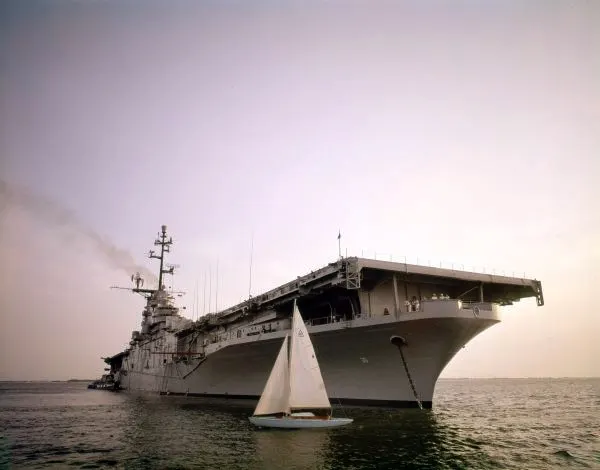
A second Meridian training squadron, VT-9, stood up in 1961 to absorb growing student demand, and by the mid-1960s the Buckeye was the sole intermediate jet trainer for both Navy and Marine Corps student aviators, a status it held unchallenged for roughly three decades.1
Pilots nicknamed the type "Attack Guppy" and "Trusty Tubbyjet" for its portly fuselage, terms that stuck through decades of squadron slang, and by the time the last training-command examples were retired an estimated 11,000-plus naval aviators and flight officers had flown it, accumulating roughly 3.4 million flight hours between them.4
The Long Drawdown and a Second Career in Flight Test
By the 1990s the Buckeye was showing its age. In 1997 the entire T-2 training fleet was grounded three separate times over uncommanded pitch events later traced to the elevator boost actuator, and the Navy did not begin fleet-wide modifications to fix it until early 1999, a multi-year gap between diagnosis and fix that stretched the aircraft's already long service life under a known defect.9 The Navy's Student Naval Aviator strike pipeline flew its final T-2C carrier qualifications aboard USS Harry S. Truman on July 17, 2003, with the last Buckeye carrier landing on July 25 that year closing out roughly 43 years of Buckeye carrier training.10 The type continued a few more years in the Naval Flight Officer syllabus and support roles before Training Command retired its remaining Buckeyes around 2008, replaced throughout by the McDonnell Douglas/British Aerospace T-45 Goshawk.1 A small number soldiered on even after that: NAS Patuxent River's test squadron VX-20 flew Buckeyes in support and chase roles until finally retiring its last examples in late 2015, the true end of Navy Buckeye flying, 56 years after the type's introduction.11
The T-2 Buckeye was designed as a trainer and never flew a combat sortie for the US Navy, but its export variant saw real operational tasking abroad. Venezuela's T-2Ds, built with a six-station armament option for bombs, rockets, and gun pods on top of their training role, were pressed into an active deployment in October 1978: four armed T-2Ds from Grupo de Entrenamiento Aéreo No. 14 flew to Enrique Malek Airport in David, Panama, under Colonel Balbino Silva Granados, in a show of force tied to regional tension along the Costa Rica–Nicaragua border as the Nicaraguan civil conflict escalated.12 It was a limited, short deployment rather than a shooting engagement, but it is one of the few times an armed Buckeye derivative operated outside a training syllabus.12
Within the US Navy itself, Buckeyes also flew adversary and aggressor support sorties for fleet training exercises in their later service years, though — unlike purpose-built aggressor jets — this was a secondary, low-intensity use of aircraft already committed primarily to the training syllabus.4 No Buckeye is documented as having fired in anger against another aircraft or ground target in a declared conflict; its closest brush with hostilities remained the 1978 Central American deployment.
That absence is notable given the aircraft's calendar span. The Buckeye's US Navy service, from 1959 into the 2010s, runs across the Vietnam War, the Gulf War, and the post-9/11 conflicts, yet in none of them did the Navy field it as anything other than a stateside schoolhouse aircraft.1 That is by design rather than oversight: a jet built to be forgiving toward a nervous student on a first carrier approach is, almost definitionally, not the aircraft a fleet commander reaches for when a real threat is on the other end of the intercept.
The single-engine T2J-1, redesignated T-2A in 1962, was the original production version, powered by one Westinghouse J34-WE-48 turbojet; 217 were built and it served as the Navy's basic-to-intermediate jet trainer through the early-to-mid 1960s.3,6 The T-2B followed in December 1965, replacing the single J34 with two Pratt & Whitney J60-P-6 turbojets to give students twin-engine procedures and a useful power-to-weight improvement despite the extra engine; 97 were built.6 The T-2C, the definitive and longest-serving version, switched to two General Electric J85-GE-4 turbojets and became the Navy's standard intermediate trainer from the late 1960s onward, with 231 built; it was also the version exported abroad.3,6
Export derivatives kept the T-2C's twin-J85 layout with local modifications. The T-2D went to Venezuela, delivered in two batches of twelve — the first in 1973, the second in 1977, for 24 total — and unlike the US Navy version was fitted for the six-station armament option that let it double as a light attack and border-patrol aircraft.12,13 The T-2E went to Greece starting in 1976, with 40 built for the Hellenic Air Force; it remains, decades later, the last T-2 variant still flying operationally anywhere in the world.9,14
A small number of retired T-2Bs and T-2Cs were separately converted into DT-2B and DT-2C drone-director aircraft, used to control target drones for fleet air-defense exercises rather than to fly students, a quiet third career for airframes already too old for the training syllabus.4,6
The United States Navy and US Marine Corps were the type's original and largest operators, flying Buckeyes continuously from 1959 through the Training Command's retirement of the type around 2008, with a handful of Naval Air Warfare Center test aircraft flying on with VX-20 until 2015.1,11 The Venezuelan Air Force (Aviación Militar Bolivariana) operated 24 T-2Ds from the 1970s, based with its training and light-attack squadrons, before gradually retiring the type as spares grew scarce.12,13

The Hellenic Air Force became the T-2's final active-service operator, flying T-2Es (and a handful of ex-US T-2Cs) with 362 and 363 Mira at Kalamata Air Base as its jet-familiarization and advanced tactics trainer since 1976.9,14 Greece began retiring the Buckeye in 2023 as its Leonardo M-346 Master replacements arrived, but delivery delays meant roughly 35 T-2Es and 5 T-2Cs were still flying as of late 2025, keeping the type in frontline use well past its 50th anniversary in Greek service.9
Beyond military operators, a number of ex-US Navy Buckeyes now fly on the US civil register as privately owned warbirds, still carrying their original Navy markings at airshows.7
The T-2 Buckeye's natural point of comparison is its direct successor, the McDonnell Douglas/British Aerospace T-45 Goshawk, which the Navy selected in the 1980s specifically to replace both the T-2 and the TA-4J Skyhawk in a single combined intermediate/advanced syllabus.15 Where the Buckeye's analog cockpit and straight wing gave students a gentle, forgiving introduction to jets, the Goshawk — built around a navalized version of BAE's Hawk trainer — was designed from the outset to feel closer to a fleet fighter, with the T-45C's digital "glass cockpit" (delivered from December 1997) far better preparing students for the F/A-18 and other modern types they would fly next.15 The Goshawk's single Rolls-Royce Turbomeca F405-RR-401 turbofan produces roughly 5,527 lbf of thrust, nearly matching the combined output of the Buckeye's two J85s from a single, more fuel-efficient engine, and its swept wing and higher approach speeds deliberately narrowed the performance gap to fleet aircraft that the Buckeye had left wide open.15 In practice this meant the Goshawk cut a step out of the training pipeline: rather than an intermediate jet followed by a separate advanced trainer, the T-45 covered both, a consolidation that simply wasn't possible with 1950s-era Buckeye technology.
| Spec | T-2C Buckeye | T-45C Goshawk |
|---|---|---|
| Engines | 2x General Electric J85-GE-4 (2,950 lbf each) | 1x Rolls-Royce/Turbomeca F405-RR-401 (5,527 lbf) |
| Max speed | 522 mph (453 kt) at 25,000 ft3 | approx. 645 mph (560 kt)15 |
| Cockpit | Fully analog instrumentation | Digital "glass cockpit" (T-45C)15 |
| Entered Navy service | 1969 (T-2C) | 1991 (T-45A) / 1997 (T-45C)1,15 |
A secondary, less obvious comparison is with the US Air Force's contemporary Cessna T-37 Tweet, which filled a broadly similar intermediate role for Air Force students from 1957 into the 2000s. Both were twin-engine, straight-wing, side-by-side or tandem jet trainers built around forgiving handling rather than performance, but the Buckeye's carrier-specific reinforcement, arresting hook, and six-station armament option for export customers gave it a versatility outside pure classroom training that the land-based Tweet never needed or received.
How many T-2 Buckeyes were built? North American built 609 Buckeyes in total across the T-2A, T-2B, T-2C, and export T-2D/T-2E variants between 1958 and the early 1970s.3,4
What was the T-2 Buckeye's top speed? The definitive T-2C had a maximum speed of about 522 mph (453 knots) at 25,000 feet — modest by fighter standards, a deliberate design choice for a trainer.3
Is the T-2 Buckeye still in service? Yes, in very limited numbers. The US Navy retired its last Buckeyes (test-squadron VX-20 examples) in 2015, but the Hellenic Air Force still flew roughly 35 T-2Es and 5 T-2Cs as of late 2025 while its Leonardo M-346 Master replacements arrive.9,11
How is the T-2 Buckeye different from the T-45 Goshawk that replaced it? The Goshawk uses one modern turbofan instead of two 1960s-era turbojets, offers a much faster and higher-fidelity approach to fleet-jet performance, and (in its T-45C form) has a digital glass cockpit versus the Buckeye's fully analog instruments.15
Did the T-2 Buckeye ever see combat? Not with the US Navy. Venezuela's armed T-2D export variant was deployed to Panama in October 1978 amid regional tension, but no confirmed instance exists of a Buckeye firing on another aircraft or target in a declared conflict.12
- "North American T-2 Buckeye", Wikipedia — en.wikipedia.org ↩
- "Today in Aviation History: First Flight of the North American T-2 Buckeye", Vintage Aviation News — vintageaviationnews.com ↩
- "North American T-2 Buckeye - Specifications", flugzeuginfo.net — flugzeuginfo.net ↩
- "Attack Guppy: The T-2 Buckeye Was The First Jet Generations Of Aviators Flew", AvGeekery — avgeekery.com ↩
- "T-2 Buckeye", Naval History and Heritage Command — history.navy.mil ↩
- "T-2 Buckeye: Military Training Aircraft Specs & Operators", GlobalMilitary.net — globalmilitary.net ↩
- "North American T-2 Buckeye - Teton Aviation Center", Teton Aviation Center — tetonaviation.com ↩
- "Naval Aviator explains why the T-2C Buckeye trainer aircraft had the most uncomfortable ejection seat he ever sat in", The Aviation Geek Club — theaviationgeekclub.com ↩
- "Last of the Buckeyes - 120 Air Training Wing", Dirk Jan de Ridder — ridder.aero ↩
- "North American T-2C Buckeye 158876", Aviation Safety Network — aviation-safety.net ↩
- "The AMARC Experience - North American T-2 Buckeye", AMARC Experience — amarcexperience.com ↩
- "Operation 'Buena Voluntad': When Venezuela's Wings Shielded Costa Rican Democracy", Latin American Aviation Historical Society — laahs.com ↩
- "North American T-2 Buckeye - Foreign Operators", AMARC Experience — amarcexperience.com ↩
- "Hellenic Air Force T-2 Buckeye Photo Report", UK Airshow Review — airshows.co.uk ↩
- "McDonnell Douglas T-45 Goshawk", Wikipedia — en.wikipedia.org ↩