

The Soko G-4 Super Galeb is a single-engine, tandem two-seat jet trainer and light attack aircraft built by SOKO in Mostar, in what was then Yugoslavia. It first flew on 17 July 1978 as the G-4 PPP prototype, entered production in 1983, and was built at a rate that yielded 85 airframes before the Mostar line closed with the country's breakup in 1991.1,2 It was designed from the outset as the direct successor to the older, straight-winged Soko G-2 Galeb, correcting that aircraft's outdated cockpit layout and subsonic-era aerodynamics with swept flying surfaces and a modern avionics fit for its time.1
- Simple, robust airframe with low operating cost
- Domestic Yugoslav production reduced import dependence
- Genuine light-attack capability, not just a trainer
- Long service life; still flying after four decades
- Underpowered Viper engine limits payload and climb
- Small user base outside former Yugoslavia (one export customer)
- Airframes and spares increasingly hard to source since Mostar's closure
- Avionics obsolete without the still-unfunded G-4MD upgrade
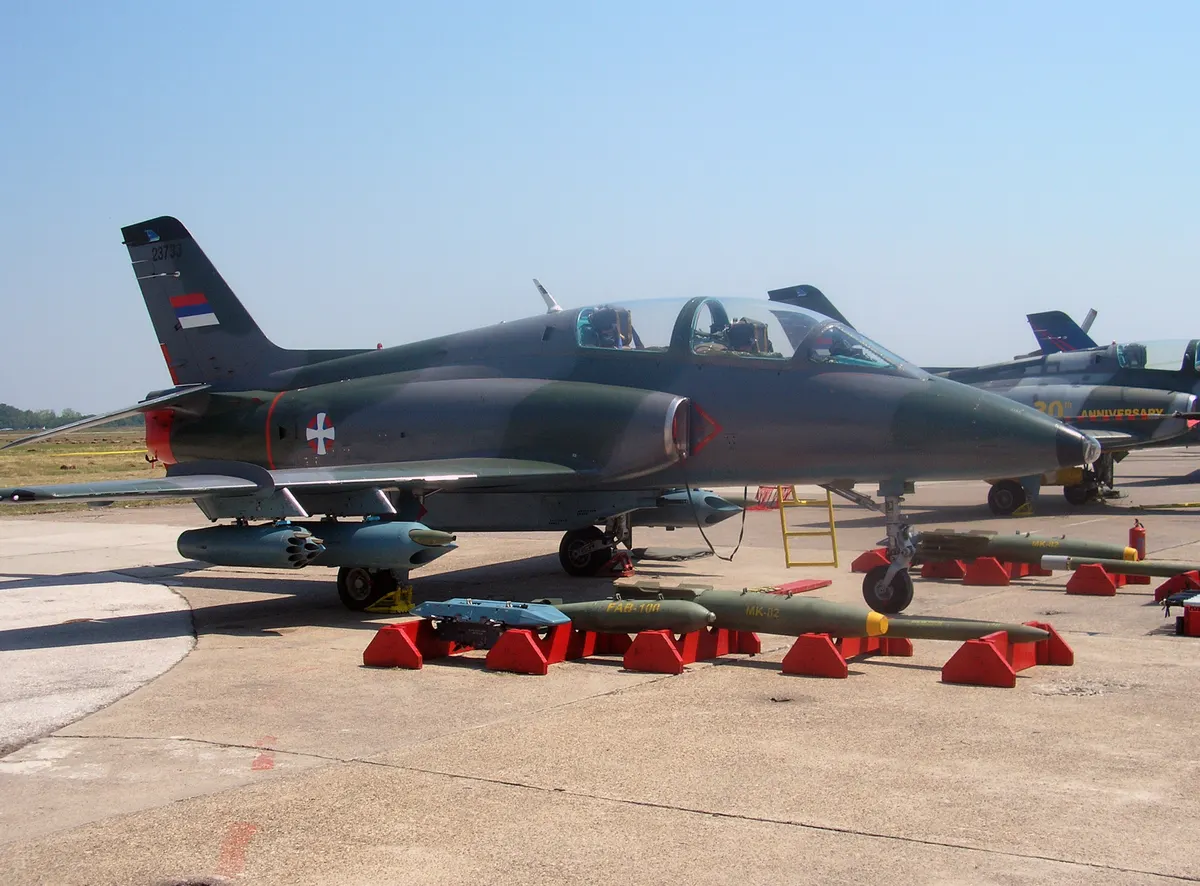
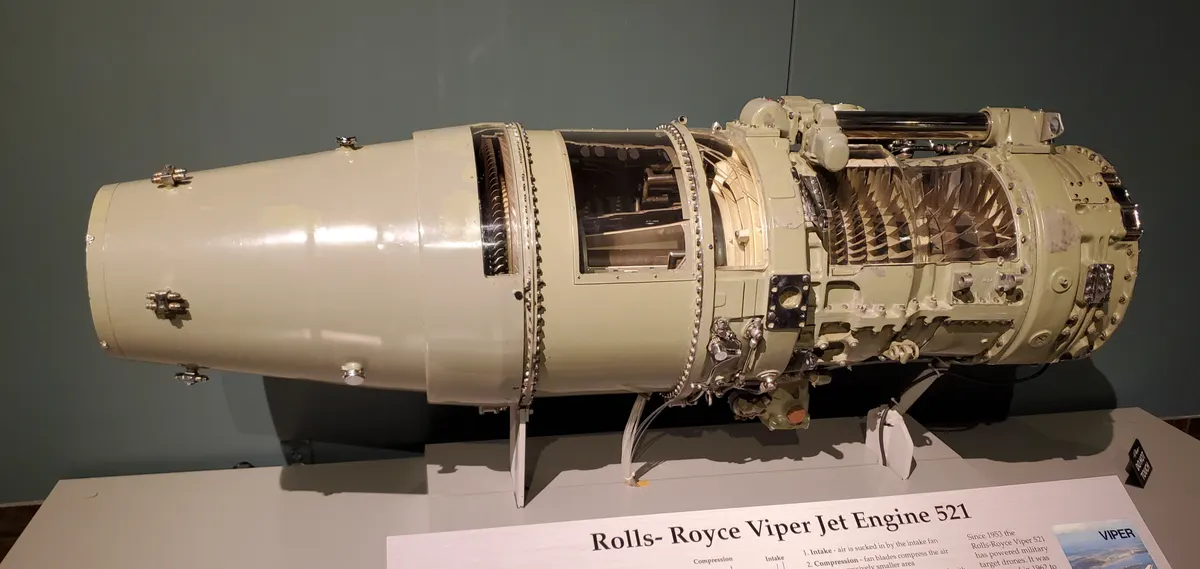
Power comes from a single Rolls-Royce Viper Mk 632-46 turbojet, a British engine license-built domestically, rated at around 17.79 kN (4,000 lbf) dry thrust.13,10 That is a modest figure by the standards of contemporary Western jet trainers, and it caps the Super Galeb's performance envelope: a maximum speed near 910 km/h, a service ceiling around 12,850 m, and an internal-fuel range of roughly 1,900 km.6,9 For a nonaligned air force building its own aircraft industry largely outside NATO and Warsaw Pact supply chains, though, the combination of adequate performance, a domestically produced airframe, and a single imported engine type shared with the J-22 Orao fighter-bomber was judged good enough.10
Roughly two-thirds of the production run went to the standard advanced-trainer role, with the balance built or later modified as armed light-attack aircraft carrying a centerline 23 mm cannon pod and underwing stores.9,6 That dual identity mattered: unlike most NATO advanced trainers of the period, the G-4 saw genuine combat, first in low-level ground-attack sorties during the Croatian and Bosnian wars of the early 1990s, then again over Kosovo in 1999, and it suffered catastrophic losses on the ground during the NATO bombing campaign that followed. Serbia remains the type's principal operator today, alongside a small, less-documented fleet in Myanmar.1,6
The Rolls-Royce Viper 632-46 and Its Modest Thrust
The G-4's single Viper 632-46 turbojet sits in a simple axial-flow, single-shaft layout that traces back to a 1950s British design intended for cheap, short-life trainer and target-drone applications.13 Yugoslavia had already built the non-afterburning Viper under license for the Soko J-22 Orao program, and reusing the same engine family for the G-4 simplified the domestic supply chain considerably, even though the Viper's roughly 17.79 kN of dry thrust is noticeably less punchy than the afterburning engines fitted to rival trainers of the same generation.10,13 The tradeoff shows up directly in the aircraft's rate of climb and hot-and-high payload figures, both of which sit behind aircraft like the MB-339 that carry more powerful engines.
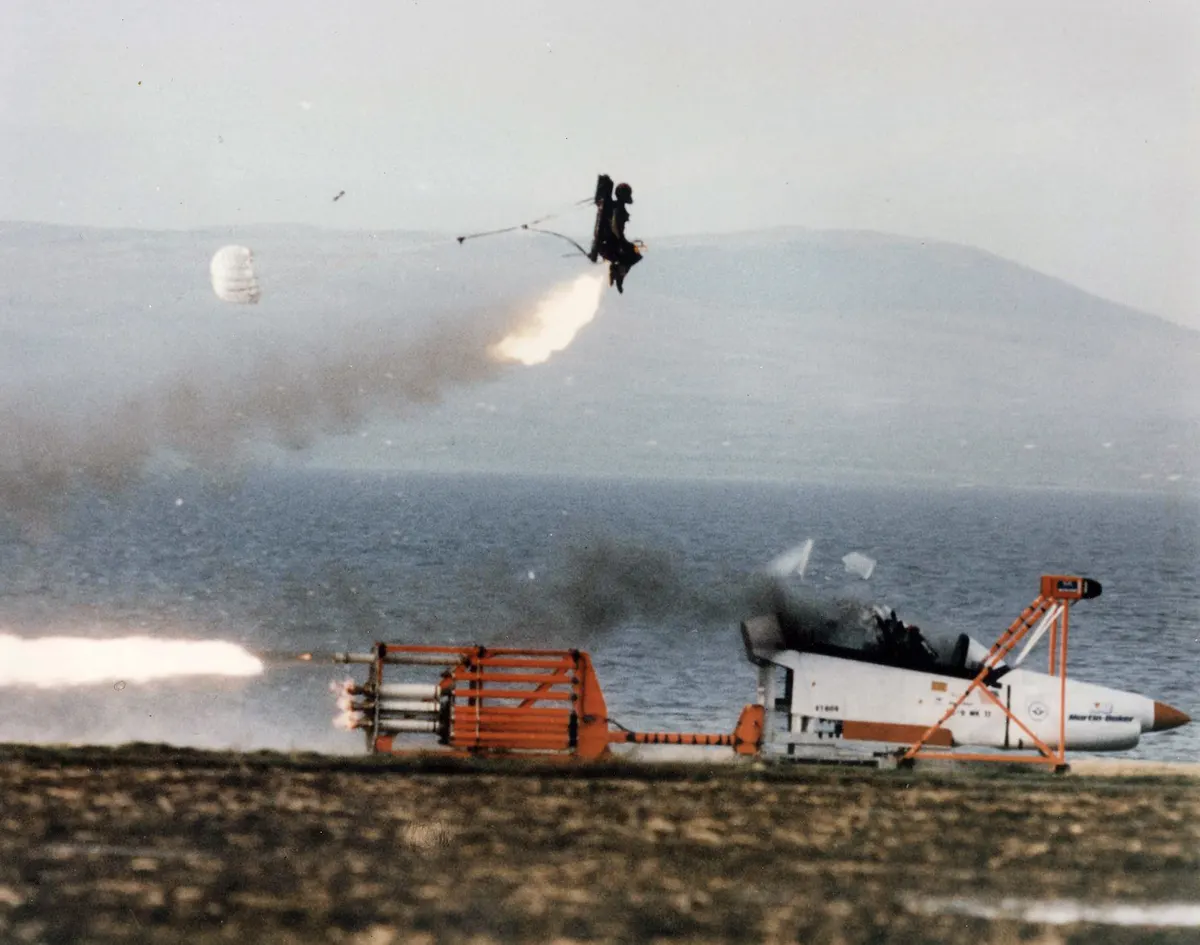
Structurally, the Super Galeb is a low-wing monoplane with swept wing and tail surfaces, a marked departure from the G-2 Galeb's straight wing.7 Production aircraft (the G-4, as distinct from the pre-production G-4 PPP batch) use an all-moving anhedral tailplane, squared-off wing and fin tips, and higher-mounted intakes than the prototype, changes driven mostly by handling problems found in early flight testing.1 The two crew sit in tandem under separate, side-hinged canopies, each on a Martin-Baker ejection seat, a British safety-critical component that Yugoslavia never attempted to reproduce domestically.2
Both cockpits carry full flight and engine instrumentation, letting either the student or the instructor fly a complete sortie from either seat, a conventional tandem-trainer arrangement Yugoslavia carried over from the G-2 Galeb rather than redesigning from scratch.7
Armament and the Centerline Gun Pod
In its light-attack configuration the G-4 carries a Soviet-designed GSh-23L twin-barrel 23 mm cannon in a ventral pod, with up to four underwing hardpoints (two inner rated at 350 kg, two outer at 250 kg) able to carry bombs, rocket pods, or air-to-ground ordnance of both Eastern and Western origin.9,6 Maximum takeoff weight in this configuration reaches around 6,330 kg, against an empty weight of about 3,250 kg.6 The mixed heritage of the loadout, a British engine, a Soviet gun, and locally sourced ordnance and airframe, was typical of Yugoslavia's nonaligned procurement posture during the Cold War.
The airframe also carries attachment points for jet-assisted takeoff (JATO) rocket bottles, shortening the ground run from short or hot-and-high airstrips, and a tail-mounted drogue parachute to cut landing roll on the same runways, both practical concessions to a mixed fleet of long paved bases and smaller dispersal fields across Yugoslavia.2
The G-4 Super Galeb's airframe was designed by the Vazduhoplovno-tehnički institut (Aeronautical Technical Institute) at Žarkovo and built at SOKO's Mostar plant, making the structure, tooling, and final assembly entirely domestic to Yugoslavia.1 The single largest imported item by value is the Rolls-Royce Viper Mk 632-46 turbojet, a British engine that Yugoslavia produced under license rather than importing complete, which narrows but does not eliminate the foreign-content gap.10,13 The fixed cannon, a Soviet GSh-23L, was imported rather than domestically produced, and the Martin-Baker ejection seats were sourced directly from the United Kingdom.2,9 Overall domestic content by value is estimated at roughly three-quarters, with the engine representing the largest single foreign line item even after accounting for license production.
Development began in the 1970s as Yugoslavia sought to replace the aging, subsonic-era G-2 Galeb, which had entered service back in 1965 and lacked both the speed and instrumentation needed for modern advanced flight training.7
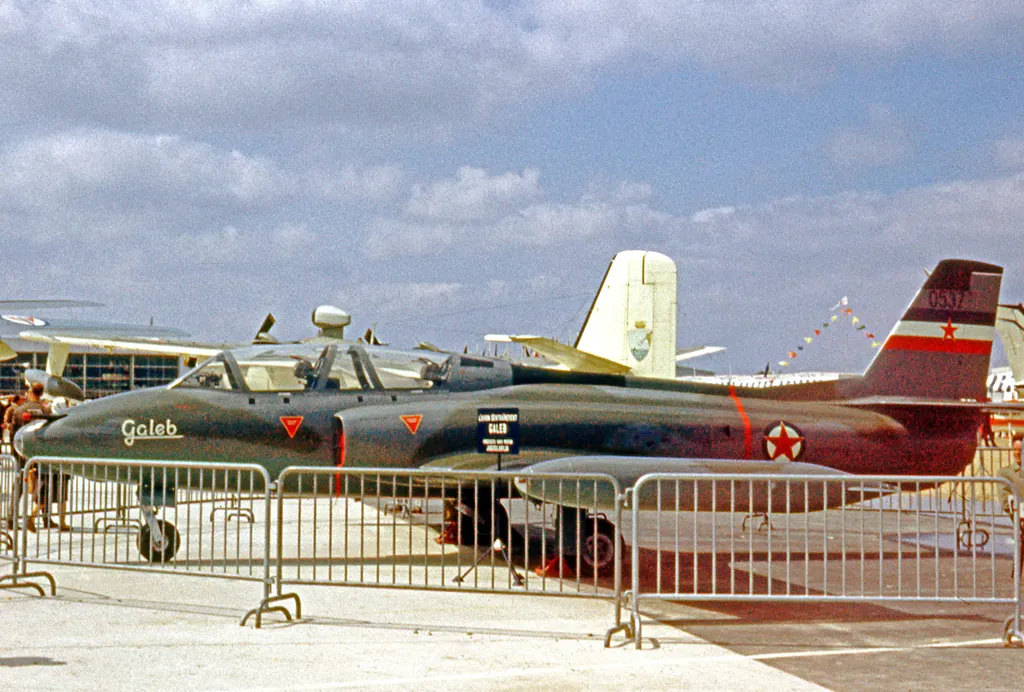
The G-4 PPP prototype, with fixed tailplanes and inset elevators inherited conceptually from the G-2, flew for the first time on 17 July 1978.1 Flight testing exposed handling shortcomings that were addressed on the second prototype and all production aircraft, which received an all-moving, anhedral tailplane and a broader avionics update; this configuration is what carries the plain G-4 designation.1
The first production-standard aircraft flew in 1983, and series production ran from 1984 until the Yugoslav federation's collapse forced the Mostar line to close in 1991, by which point 85 aircraft, including a handful of unarmed G-4Š trainer variants, had been completed.1,9 Most entered service with the Yugoslav Air Force and Air Defence (RV i PVO), split between the advanced-training syllabus and armed light-attack squadrons.6
Only one export order was ever placed. In 1990, with international sanctions already looming, Yugoslavia agreed to sell Super Galebs to Myanmar's ruling military junta for use against domestic insurgencies; six aircraft were delivered in 1991 before the collapsing Yugoslav state could complete the rest of the contract.1,6 No other country bought the type, a sharp contrast with the hundreds of L-39 Albatros trainers Czechoslovakia sold across the developing world in the same years.
Combat use began almost immediately after the aircraft's most productive years in service, when Yugoslavia itself fragmented. During the wars in Croatia and Bosnia in the early 1990s, RV i PVO G-4s flew ground-attack sorties against separatist and opposing forces; four Super Galebs were lost to enemy air defences across this period, with all ejecting pilots reported to have survived.1,4 One aircraft was hit by a Croatian-fired FIM-92 Stinger shoulder-launched missile over Lički Ribnik and managed to land safely at Udbina despite the damage.4 Three more were shot down for violating the United Nations no-fly zone over Bosnia on 28 February 1994, again with all crews ejecting safely.4,1
The heaviest single episode of losses came without any air-to-air engagement at all. During the 1999 Kosovo War, Yugoslav G-4s and J-22 Oraos flew an estimated 20 to 30 low-level ground-attack sorties against Kosovo Liberation Army positions, often at treetop height to avoid detection, both before and during the opening days of NATO's air campaign.12 Once NATO's bombing began on 24 March 1999, the surviving G-4 fleet was largely grounded and dispersed to shelters, a precaution that ultimately failed. NATO strikes destroyed seven armed and sixteen unarmed G-4s outright and damaged a further fourteen; a single missile that struck near the entrance to an underground shelter at Tuzi accounted for a disproportionate share of the losses, wiping out the aircraft of the Leteće zvezde ("Flying Stars") aerobatic display team along with several unarmed trainers sheltered alongside them.4,5 The Flying Stars, reconstituted in 1997 after an earlier team had flown the type from 1990, never recovered their dedicated aircraft and were formally disbanded in 2000.5
Losses from the 1990s wars were not confined to enemy action. A Serbian G-4 crashed near Batajnica Air Base on 24 September 2008 while rehearsing for an airshow, killing the pilot, and another went down near Kovačica, northeast of Belgrade, on 11 April 2018; in the 2018 crash both crew ejected, but the pilot from Serbia's Technical Testing Center later died of his injuries while the co-pilot survived.11
The base production standard is simply designated G-4, distinguished from the pre-production G-4 PPP by its all-moving anhedral tailplane and revised avionics.1 A small batch of five G-4Š aircraft were built as unarmed pure trainers, stripped of the attack wiring and cannon pod fitted to combat-capable airframes.9 A number of G-4s were also converted to the G-4T target-tug configuration for towing aerial gunnery targets, extending the type's usefulness well past its original training role.9
The most significant post-Yugoslav variant is the G-4M, an avionics-focused upgrade fitted with a Zrak ENP-MG4 head-up display, a Rudi Čajavec ENS-MG4 electronic sighting system, a gyro platform, and multifunction cockpit displays, along with an additional centerline pylon and wingtip rails for short-range air-to-air missiles on some airframes.9 Since 2008 the Serbian Air Force, as the largest remaining operator, has proposed a further, deeper modernization intended to redesignate roughly fifteen aircraft as G-4MD, adding LCD flight displays, hands-on-throttle-and-stick controls, an integrated mission computer, GPS navigation, identification-friend-or-foe equipment, and provision for guided weapons, with the stated goal of keeping the fleet viable into the 2030s.9 As of the most recent reporting the program remains a funding-limited proposal rather than a fully executed fleet-wide upgrade. A separate, unofficial "Turga" configuration was reportedly explored to meet a potential Turkish specification, though it did not lead to an order.9
Serbia inherited the bulk of the surviving Yugoslav fleet and remains the type's principal operator, flying G-4 and upgraded G-4M airframes from bases including Batajnica; it has also acquired additional airframes from other former Yugoslav republics through barter arrangements to keep the fleet flying as spares grow scarce.9 Montenegro inherited a share of the fleet after independence, later transferring some aircraft to Serbia and selling others to private operators, while Bosnia and Herzegovina holds a single example inherited from Republika Srpska forces.9
Myanmar remains the sole export operator, with a small number of the six aircraft delivered in 1991 reportedly still airworthy, used for training and light counter-insurgency work by the Myanmar Air Force; documentation of the type's specific role in Myanmar's post-2021 civil war is thin compared with the country's more numerous Yak-130s and Chinese-built jets, and claims about its current activity there should be treated cautiously pending better sourcing.1,6
The closest contemporary to the G-4 Super Galeb is Czechoslovakia's Aero L-39 Albatros, another single-engine, tandem two-seat advanced trainer developed for a nonaligned or Eastern-bloc air force rather than for NATO. The comparison flatters the G-4 on paper: it is faster (about 910 km/h against 750 km/h), it flies higher (roughly 12,850 m versus 11,500 m), and it carries more fuel for a longer unrefueled range (1,900 km versus 1,100 km).8 That gap partly reflects the Albatros's smaller, less powerful Ivchenko AI-25TL turbofan, chosen for cheap operating costs rather than outright performance, against the G-4's harder-running Viper turbojet.
Production numbers tell the opposite story. Aero built roughly 2,900 L-39s, exported across the Warsaw Pact and into Africa, Asia, and Latin America, against just 85 Super Galebs built for one domestic air force and a single export customer.8 The Albatros benefited from Czechoslovakia's established export machinery and CMEA-wide standardization; the G-4 was designed for a country that, by the time production matured, was already sliding toward the political fragmentation that would end its own air force's ability to buy in quantity. Where the L-39 became a generic, globally traded trainer still flown by dozens of operators and a thriving Western warbird market, the G-4 stayed a niche, almost entirely Balkan aircraft, better performing in isolation but starved of the scale that made its rival ubiquitous.
Against the Italian Aermacchi MB-339, which Yugoslav planners reportedly evaluated during the G-4's development, the Super Galeb was consistently the cheaper option but the weaker performer, lacking the MB-339's more powerful Viper 632-43 variant thrust margin and its wider export success with air forces from Argentina to Malaysia.9 Yugoslavia's insistence on domestic production over a foreign design, even one it may have preferred on performance grounds, is a recurring theme across the country's Cold War-era aircraft programs.
What are the Soko G-4 Super Galeb's specifications? The G-4 is 12.25 m long with a 9.88 m wingspan and 4.3 m height, weighing about 3,250 kg empty and up to 6,330 kg at maximum takeoff weight in the armed configuration. It is powered by a single Rolls-Royce Viper Mk 632-46 turbojet producing around 17.79 kN of thrust.6,13
How many Soko G-4 Super Galebs were built? SOKO built 85 aircraft at its Mostar plant between 1983 and 1991, when the production line closed with the breakup of Yugoslavia.1,9
What is the G-4 Super Galeb's top speed? Approximately 910 km/h (about 565 mph) at altitude, roughly 160 km/h faster than its L-39 Albatros contemporary.6,8
Is the Soko G-4 Super Galeb still in service? Yes. Serbia continues to operate a fleet of G-4 and upgraded G-4M aircraft as its principal advanced trainer and light-attack type, and Myanmar is understood to still fly some of the six examples it received in 1991, though public reporting on the Myanmar fleet's current status is limited.1,9
How does the G-4 Super Galeb compare to the L-39 Albatros? The G-4 is faster, flies higher, and has longer range on paper, but the L-39 was built in far greater numbers (about 2,900 against 85) and achieved a much wider export footprint thanks to Czechoslovakia's Warsaw Pact-era production and sales network.8
- "Soko G-4 Super Galeb", Wikipedia — en.wikipedia.org ↩
- "Soko G-4 Super Galeb: Development, Combat, and Future Upgrades", Combat Operators — combatoperators.com ↩
- "Soko G-4 Super Galeb", Balkan War History — balkanwarhistory.com ↩
- "Leteće zvezde", Wikipedia — en.wikipedia.org ↩
- "Soko G-4 Super Galeb: Military Training Aircraft Specs & Operators", GlobalMilitary.net — globalmilitary.net ↩
- "G-2 Galeb vs Soko G-4 Super Galeb: Aircraft Full Comparison", GlobalMilitary.net — globalmilitary.net ↩
- "Soko G-4 Super Galeb vs L-39 Albatros: Specs, Speed & Range Compared", GlobalMilitary.net — globalmilitary.net ↩
- "SOKO G-4 Super Galeb (Super Seagull) Light Attack / Advanced Trainer Aircraft", Military Factory — militaryfactory.com ↩
- "Soko J-22 Orao", Wikipedia — en.wikipedia.org ↩
- "Military Plane Crashes in Serbia: One Pilot Dead, Another Injured", Sputnik International — sputnikglobe.com ↩
- "NATO bombing of Yugoslavia", Wikipedia — en.wikipedia.org ↩
- "Armstrong Siddeley Viper", Wikipedia — en.wikipedia.org ↩