


The Microjet 200 was a French two-seat light jet trainer built in small numbers by Microjet SA of Toulouse between 1980 and 1986: one all-wood prototype plus three metal/composite pre-production aircraft designated 200B, flown as a combined test program that never produced a single order.1 No air force adopted it, no company licensed it, and the type never carried a squadron code in service.
- very low unit and operating cost
- twin-turbojet redundancy over a single-engine microjet
- side-by-side seating suited to instruction
- full aerobatic and instrument capability despite its size
- thrust class too marginal for realistic combat-representative training
- no ejection seats fitted to any airframe
- fatal accident during the flight-test program
- never reached a customer or production decision
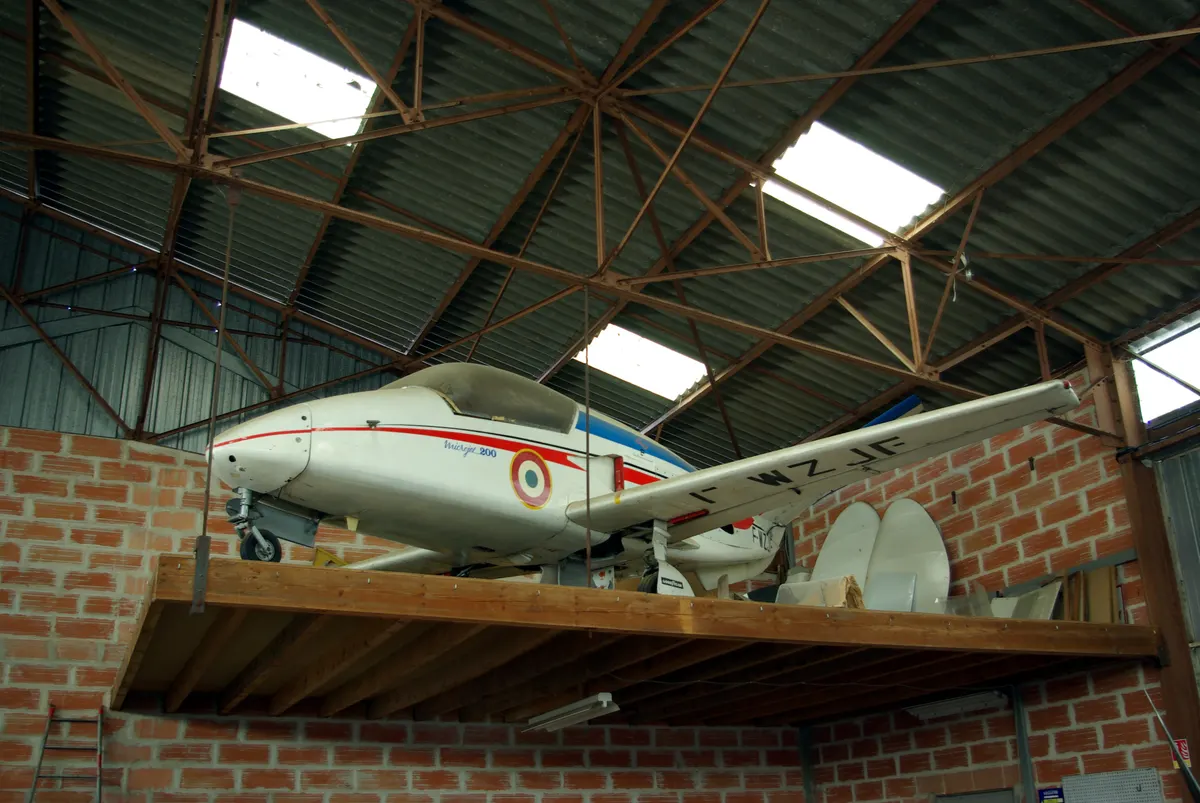
It began less as a trainer program in its own right than as a demonstrator for Microturbo's TRS 18 turbojet, a small reverse-flow engine of around 1 kN thrust originally built for self-launching motor gliders.2 Microturbo wanted a manned airframe to sell the engine to customers seeking something cheaper than a full-size jet trainer, and the Microjet 200 was that airframe, two TRS 18s slung under a low wing with a V-tail.
Documentation on the program is thin and scattered across enthusiast and museum sites rather than official histories, and published figures for the aircraft (top speed, empty weight, even length) conflict between sources. Where the record is genuinely uncertain, that is flagged below rather than guessed at.
The 200B was a low-wing monoplane with retractable tricycle gear, a V-tail, and side-by-side seating under one canopy.3 The 1980 prototype was almost entirely wood; the three 200Bs built from 1983 switched to light alloy with glass and carbon-fibre composite skin, a longer fuselage, more V-tail sweep, and a reprofiled canopy.1,4
- İlk Uçuş1980
- Mürettebat (koltuk)2
Every major component was French. Microturbo (Toulouse) built the TRS 18-1 turbojets, Marmande Aéronautique (later part of the Creuzet/Turbomeca group) built the airframes at Marmande-Virazeil, and structural testing ran at CEAT.2,4 No imported subsystem is documented; even the evaluation avionics (UHF radio, TACAN, IFF) were standard French air force fit.3
The Microturbo TRS 18-1 and Its Marginal Thrust
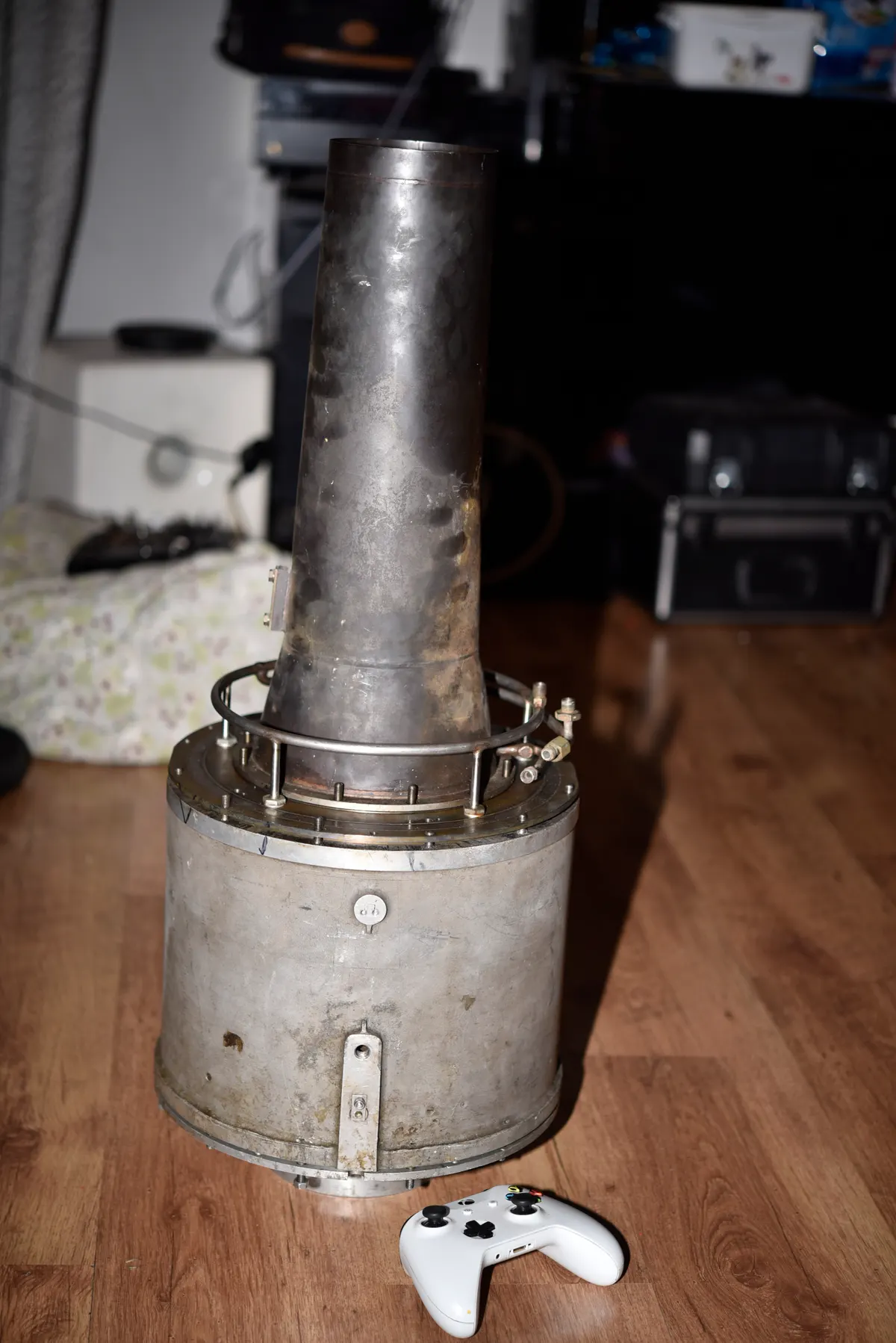
Each TRS 18-1 gave roughly 1.3 kN of takeoff thrust on the 200B, up from about 1.1 kN on the prototype's engines.1,2 That is marginal power for a 1,300 kg maximum-takeoff-weight airframe. Sources agree on a 9,150 m ceiling and roughly 2-hour endurance but disagree sharply on top speed: 463 km/h per Wikipedia against 555 km/h per Aviastar and Minijets, with no public flight-test report to settle it.1,5,3
- Motor TipiMicroturbo TRS 18-1 turbojet engines
- İtki1,3
Cockpit controls used small hand-held mini-sticks, and no airframe carried ejection seats.3 Empty-weight figures also disagree (650 kg versus 780 kg), likely why some databases list 650 kg as the maximum takeoff weight; both primary sources agree the true gross weight was 1,300 kg.1,4
- Azami Hız463 km/sa
- Seyir Hızı389 km/sa
- Hizmet Tavanı9.150 m
- Tırmanma Hızı8,7 m/sn
- Havada/Görevde Kalış Süresi2
- Uzunluk6,67 m
- Kanat Açıklığı7,56 m
- Yükseklik2,42 m
- Maks Kalkış Ağırlığı650 kg
- Toplam Üretim5
A Bede BD-5J Trial Turns Into a French Engine Demonstrator
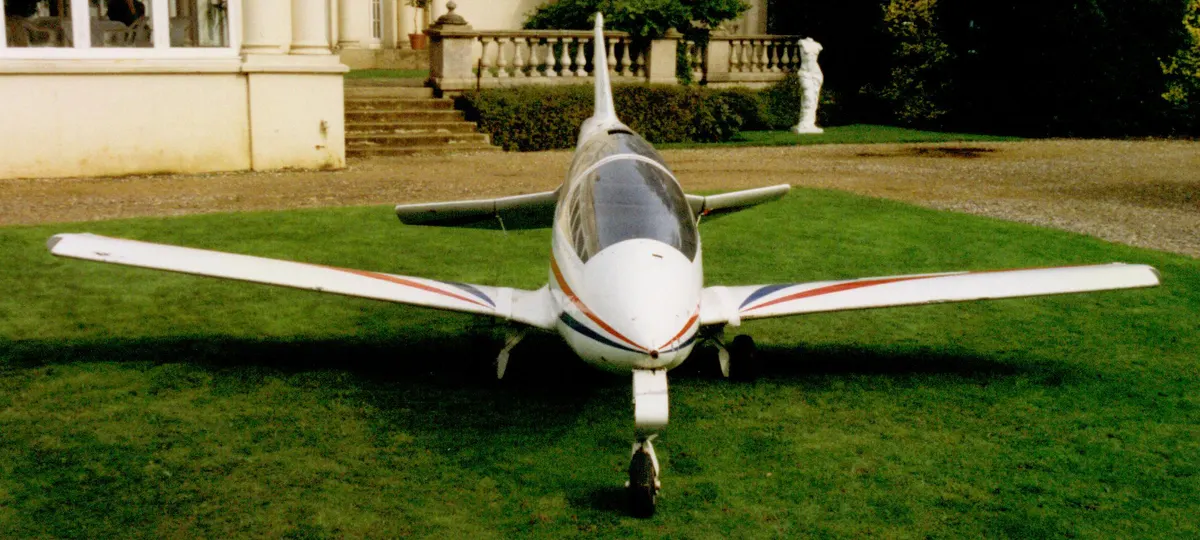
The Microjet 200 grew out of an unrelated success for the same engine. In the early 1980s the American Bede BD-5J homebuilt microjet, powered by a single TRS 18, drew interest from France's Armée de l'Air and was tested by the Centre d'Essais en Vol at Istres.6,10 That convinced Microturbo there was appetite for a low-cost jet trainer, so it formed Microjet SA and approached French military procurement over an ab initio design.6
The wooden prototype, F-WZJF, first flew from Toulouse-Blagnac on 24 June 1980 with Jacques Grangette at the controls; a separate structural airframe was static-tested at CEAT in Toulouse.1,6,7
It was shown at Farnborough in September 1982, drawing attention as a curiosity: French ab initio jet training still ran through the Fouga CM.170 Magister, a far larger, established type the Microjet was never going to displace.1,6
The 200B Redesign and the 1985 Saint-Brieuc Crash
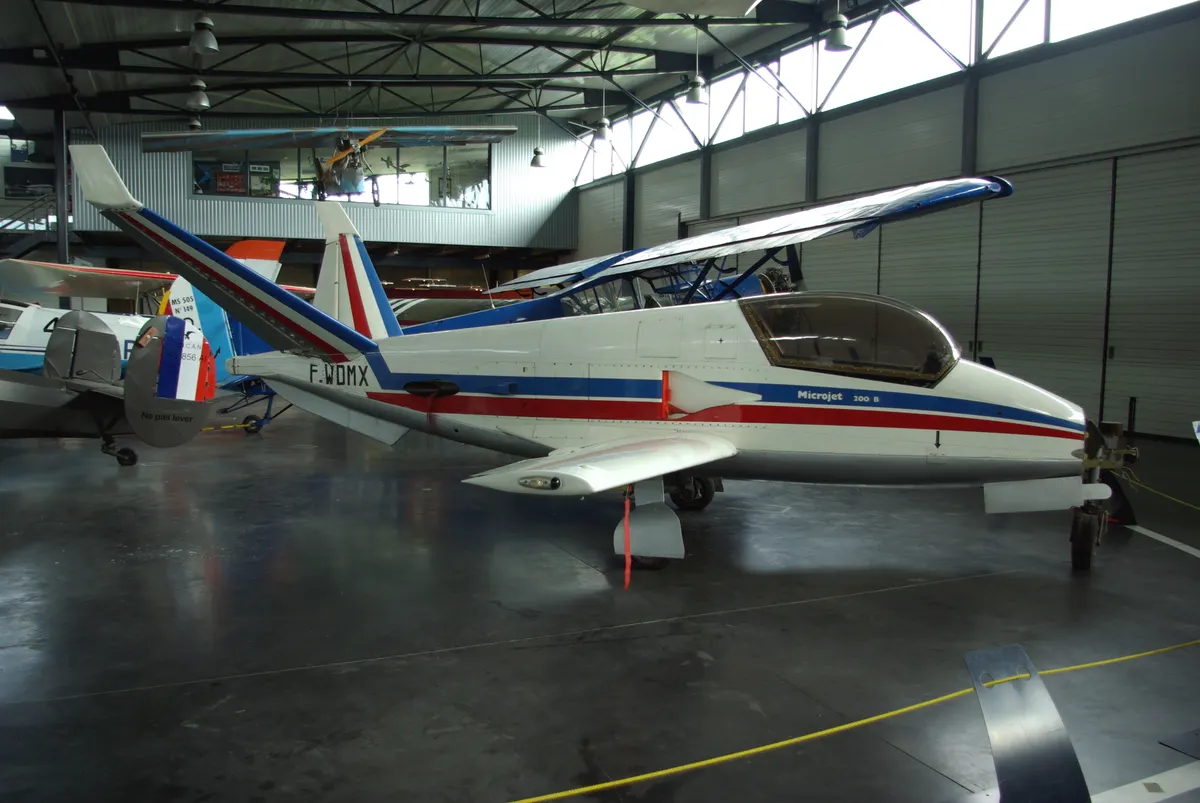
Redesigned as the metal-composite 200B with Marmande Aéronautique, the aircraft resumed testing on 19 May 1983 with pilots including Claude Lelaie, later Airbus's first A380 pilot in 2005.4 A second 200B (F-WDMX) added underwing hardpoints for an attack option pursued no further.
On 13 March 1985 the first 200B, F-WDMT, crashed into the sea in the Bay of Saint-Brieuc off Brittany, killing pilot Dominique Monguillot; his body was never recovered, though a trawler later retrieved wreckage.4
A third 200B, built solely by Marmande Aéronautique, flew on 4 November 1986 and appeared at Paris-Le Bourget in 1989, but no order followed; the program was shelved that year and the surviving airframes stored at Marmande-Virazeil.1,4
Only two configurations ever flew. The 1980 prototype used all-wood construction and the lower-thrust original TRS 18. The 200B standard, three built between 1983 and 1986, added a metal/composite structure, longer fuselage, more V-tail sweep, a reprofiled canopy, and uprated TRS 18-1 engines; one of the three, F-WDMX, also carried underwing hardpoints for a light-attack role never pursued.1,4
No further variant or licence-build followed. Of the four airframes, the prototype went into storage, the first 200B was destroyed in the 1985 accident, the second (F-WDMX) survives at Espace Air Passion, and the third's fate after 1986 is not clearly documented.4


The closest contemporary is the Belgian Promavia F.1300 Jet Squalus, another 1980s attempt to sell a jet trainer cheaper than an Alpha Jet or Hawk. The comparison shows how modest the French design was: Jet Squalus used a genuine turbofan rated near 5.9 kN, more than double the Microjet 200B's combined twin-turbojet thrust, and came close enough to a sale that Portugal's OGMA announced a 1989 deal for 100 aircraft before it collapsed.8 The Microjet never got that far, drawing no announced customer at all.
Both failed for the same reason: air forces already flying the Fouga Magister, Alpha Jet, or Hawk had little reason to adopt an unproven newcomer on price alone. The Microjet's failure came earlier and more completely, without even the near-miss export deal the Squalus achieved.
| Spec | Microjet 200B | Promavia Jet Squalus |
|---|---|---|
| First flight | 19831 | 19878 |
| Engines | 2× TRS 18-1 turbojet, ~1.3 kN each2 | 1× Garrett TFE109, ~5.9 kN8 |
| Max takeoff weight | 1,300 kg1,4 | approx. 2,060 kg8 |
| Built | 4 (1 prototype + 3 pre-production)1 | 1 flying prototype8 |
| Outcome | No order; shelved 1989 | Near-miss 1989 order; firm bankrupt 1998 |


How many Microjet 200s were built? Four: one all-wood prototype (1980) and three metal/composite 200B pre-production aircraft (1983-1986). No production series followed.1,4
Did the Microjet 200 ever enter military service? No. It was discussed informally with French officials but never ordered by the Armée de l'Air or any other air force.6
What was the Microjet 200's top speed? Sources disagree: Wikipedia gives 463 km/h; Aviastar and Minijets give 555 km/h. No public flight-test document settles which is correct.1,5,3
Is a Microjet 200 still flying today? No. One 200B (F-WDMX) is on static display at the Espace Air Passion museum in Angers-Marcé since 2015.4
What engines powered it? Two Microturbo TRS 18 turbojets, uprated to TRS 18-1 standard on the 200B, the same family used in the American Bede BD-5J homebuilt microjet.2,10
- "Microjet 200", Wikipedia — en.wikipedia.org ↩
- "Microturbo TRS 18", Wikipedia — en.wikipedia.org ↩
- "Microjet 200B", Minijets — minijets.org ↩
- "Un Microjet 200B à Angers-Marcé", aeroVFR — aerovfr.com ↩
- "Microturbo Microjet 200", Aviastar — aviastar.org ↩
- "Examining the Microjet trainer", Key.Aero — key.aero ↩
- "Aircraft Data F-WZJF, 1980 Microturbo Microjet 200", Airport-Data — airport-data.com ↩
- "Promavia Jet Squalus", Wikipedia — en.wikipedia.org ↩
- "BD-5J Acrostar Microjet", 007.com — 007.com ↩
- "Bede BD-5J TRS18", Minijets — minijets.org ↩