

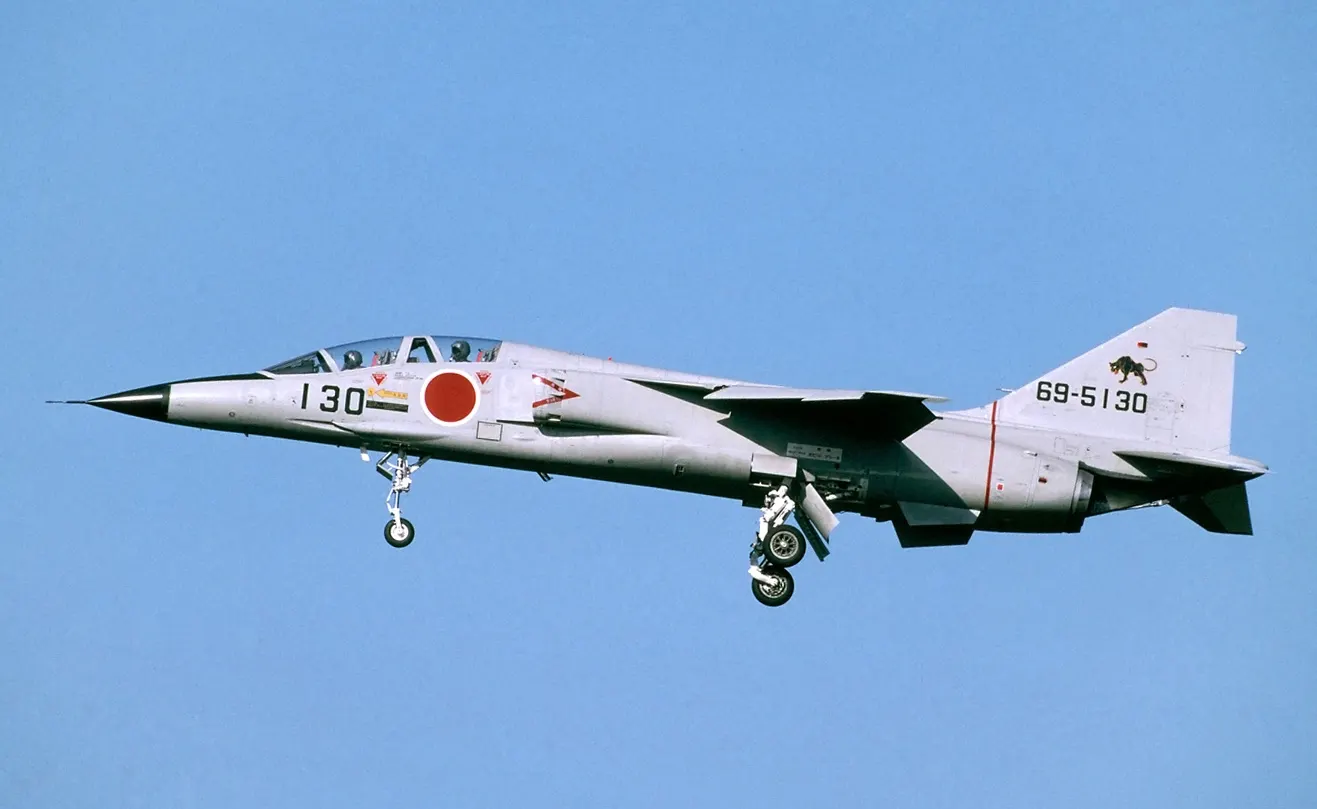

The Mitsubishi T-2 is a twin-engine advanced jet trainer built for the Japan Air Self-Defense Force, and it holds a specific historical distinction: it was the first aircraft of Japanese design to exceed the speed of sound in level flight.1 It should not be confused with the Fuji T-1, an earlier and entirely different Japanese trainer that was subsonic, single-engine, and already in service when the T-2 was conceived.2 The T-2 was designed from the outset to bridge a widening gap: JASDF pilots moving from basic training straight into Mach 2-class fighters like the F-104J Starfighter and F-4EJ Phantom II had no intermediate type fast or complex enough to prepare them.1
- First indigenous supersonic Japanese design, validated a domestic combat-aircraft industry
- Realistic weapons and radar training via the T-2(K) before pilots reached fighters
- Direct structural and systems basis for the F-1 strike fighter, cutting development risk
- Twin-engine redundancy valued for training safety over water and mountains
- Underpowered relative to its weight; Adour engines never received planned upgrades
- Never exported or adopted by any air force outside Japan
- High-wing-loading handling made for wide turning radii, criticized during Blue Impulse service
- Two fatal Blue Impulse accidents tied directly to the type's display-flying limits
Mitsubishi built the T-2 around two license-produced Rolls-Royce/Turbomeca Adour turbofans, manufactured in Japan by Ishikawajima-Harima Heavy Industries as the TF40-IHI-801A.1 The airframe's general layout, shoulder-mounted swept wings, twin ventral fins, and even the choice of engine trace directly back to a failed negotiation: Japan seriously explored license-building the Anglo-French SEPECAT Jaguar before opting to design its own aircraft instead, one that ended up looking and flying remarkably like the type it had rejected.1
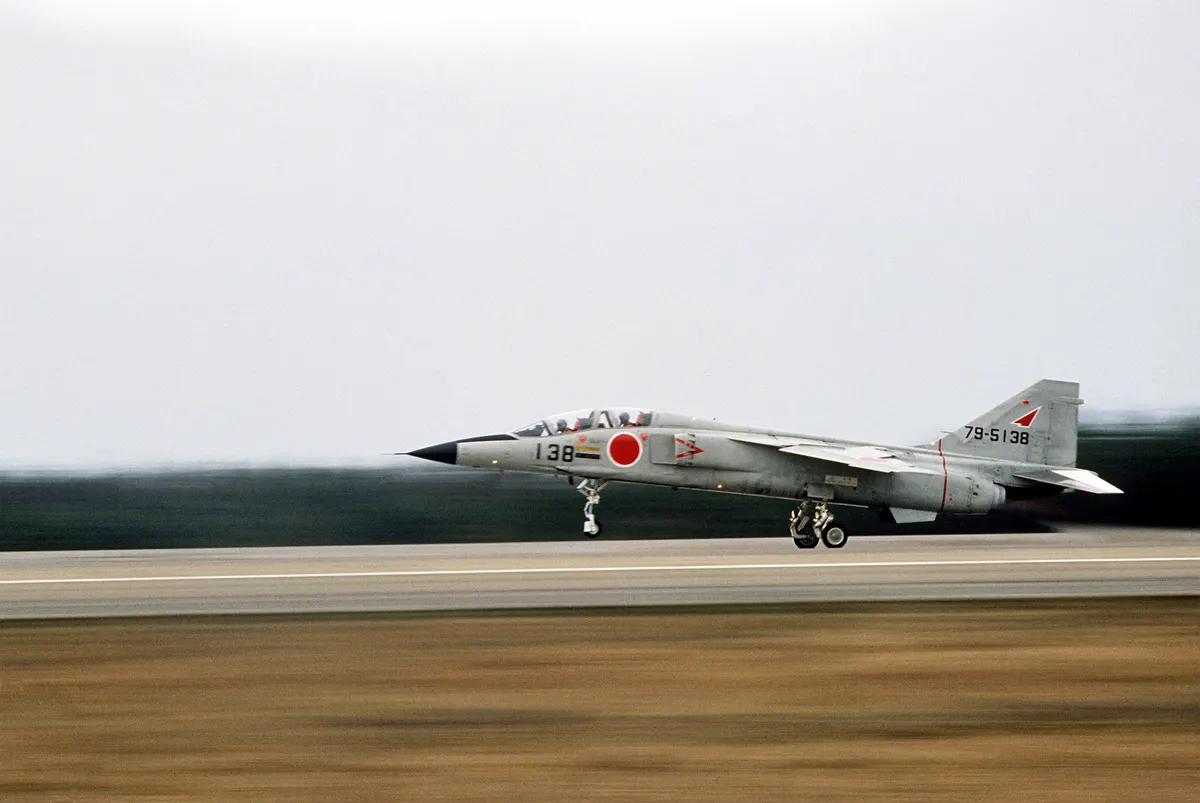
Two distinct sub-types were produced. The T-2(Z), unarmed, handled straightforward advanced flight instruction. The T-2(K) added a search-and-ranging radar, a head-up display, and weapons pylons, turning it into both a weapons-training aircraft and a conversion trainer.1 That armed lineage was not incidental: the JASDF had planned from the start to derive a single-seat strike fighter from the same airframe, and the T-2(K)'s systems fed directly into that follow-on aircraft, the Mitsubishi F-1.3 Production ran from 1971 to 1988, ninety operational aircraft plus prototypes, and the type stayed in front-line and training use for three decades before the last examples retired in March 2006.1
The Ishikawajima-Harima TF40 Adour Engines and Their Reputation
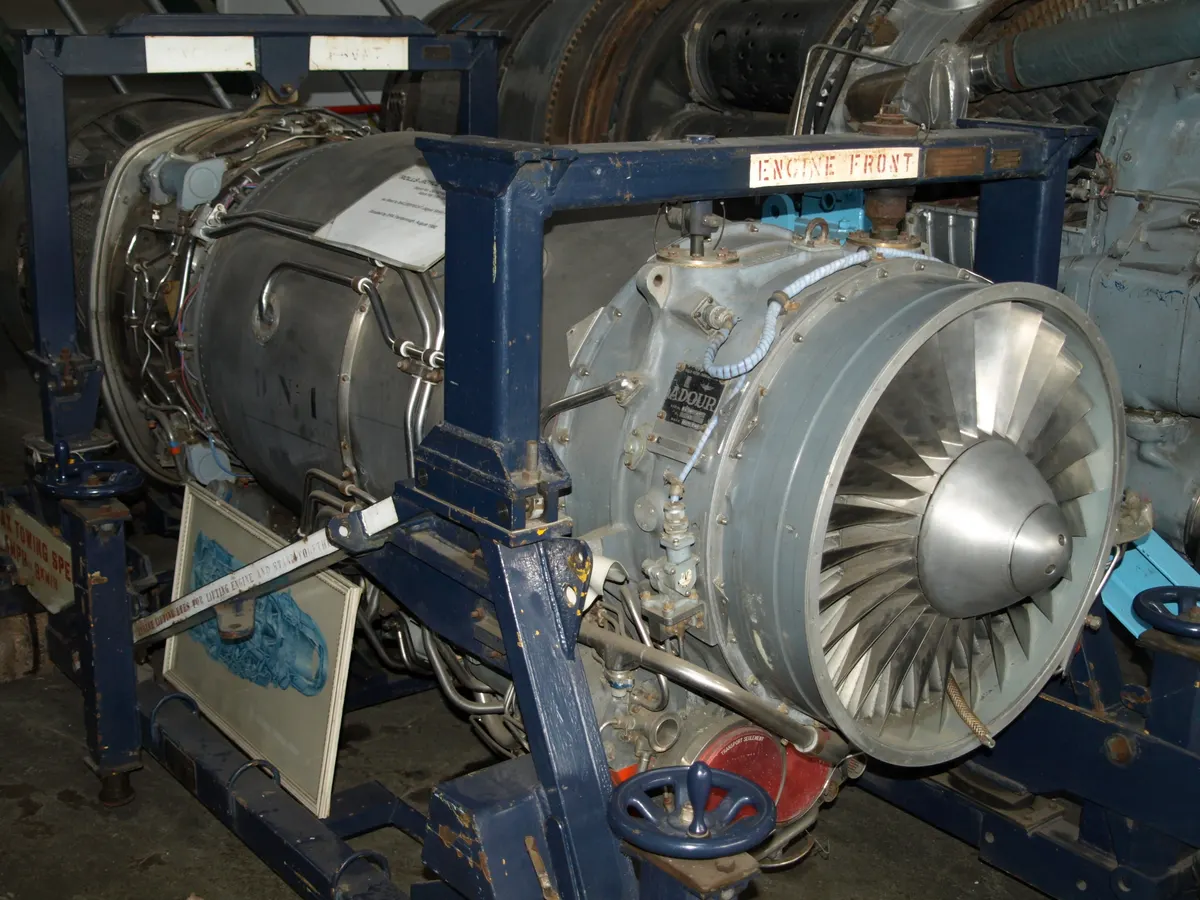
The T-2's two TF40-IHI-801A turbofans were built in Japan under license from the Rolls-Royce/Turbomeca Adour program, the same engine family that powers the SEPECAT Jaguar itself.1 Each engine produced roughly 22.75 kN dry and about 32.5 kN with afterburner, for a combined afterburning thrust in the mid-60 kN range.4,5 That was adequate but not generous for an aircraft with a maximum takeoff weight near 12,800 kilograms, and it became a lasting point of criticism: the T-2's Adours lacked the part-throttle reheat feature later fitted to more advanced Adour variants, and Mitsubishi never re-engined the fleet to correct it, leaving the type persistently described as underpowered for its class.1
- İlk Uçuş1971
- Hizmete Giriş Yılı1975
- Mürettebat (koltuk)2
- Eğitim Uçağı Tipiİleri eğitim uçağı
- HizmetteHayır
A Dart-Shaped Cousin of the Jaguar
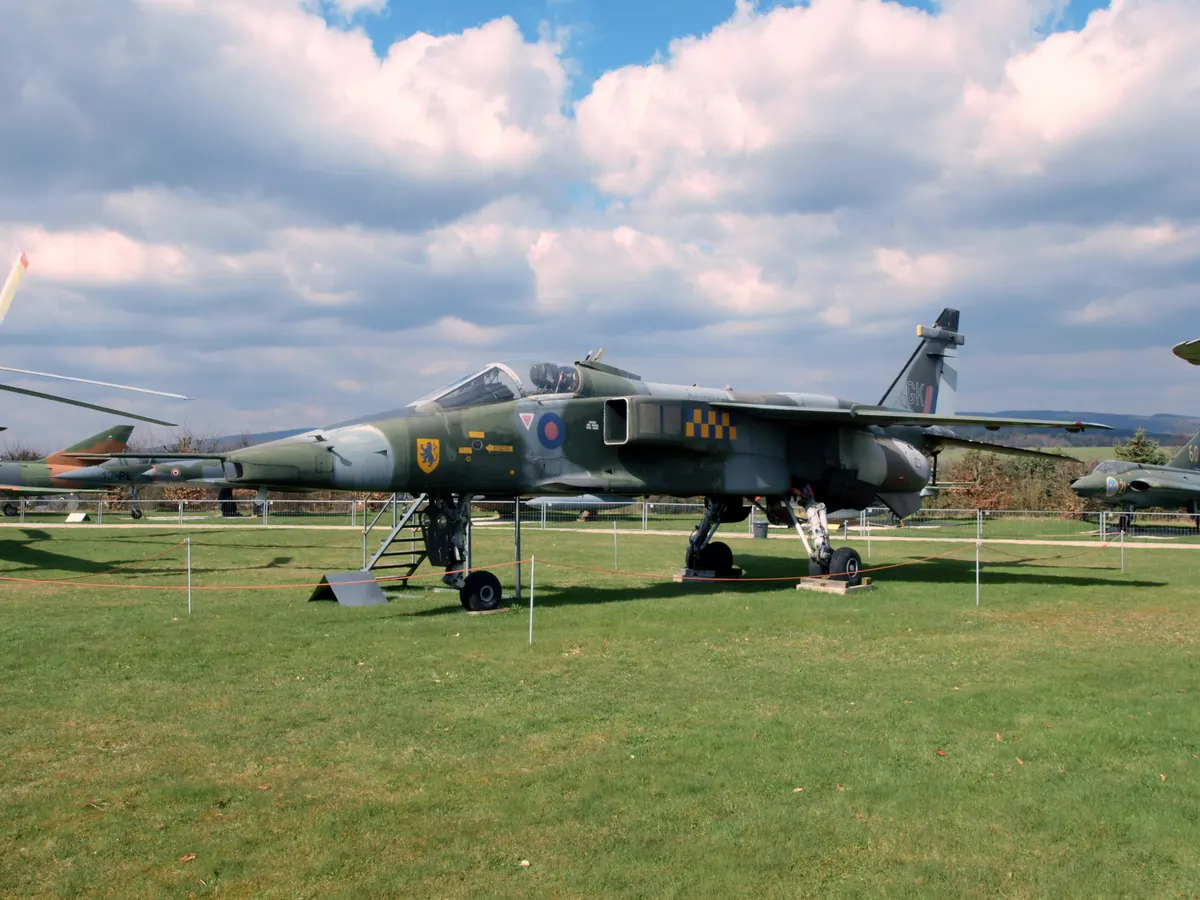
Visually and structurally, the T-2 invites direct comparison with the Jaguar it was designed to rival rather than buy. Both use the same engine family, a similar high-wing layout, leading-edge slats, and twin ventral fins ahead of the tailpipes.1 But the T-2 is not a copy: it is noticeably longer at 17.85 meters against a distinctly shorter wingspan of 7.88 meters, giving it a "dart-like" proportion the Jaguar does not share, and it uses conventional single-wheel tricycle landing gear rather than the Jaguar's rough-field-capable heavy-duty gear, since the JASDF had no requirement to operate off unprepared strips.1 Overall height is 4.39 meters. Top speed is Mach 1.6, about 1,700 km/h, reached at roughly 11,000 meters altitude, with a service ceiling of 15,240 meters.1,4
- Motor TipiIshikawa-Harima TF40-801A
- İtki97
Weber Ejection Seats and a Tandem Weapons-Training Cockpit
The tandem two-seat cockpit puts the instructor in a raised rear seat under a separate clamshell canopy, each crew position fitted with a Weber ES-7J zero-zero ejection seat built under license by Daicel.1 On the armed T-2(K), the rear cockpit's added systems, a Mitsubishi Electric J/AWG-11 search-and-ranging radar, a Thomson-CSF head-up display, and a Lear-Siegler AHRS, turned routine sorties into genuine weapons-employment training, backed by a single 20mm JM61A1 rotary cannon and provision for AIM-9 Sidewinders on wingtip rails plus underwing and centerline stores.1
- Azami Hız1.700 km/sa
- Hizmet Tavanı15.240 m
- Menzil1.500 km
- Tırmanma Hızı177,833 m/sn
The T-2's airframe was designed and built in Japan, with Mitsubishi as prime contractor and Fuji as the principal structural subcontractor, making the aircraft's aerodynamic design and manufacture almost entirely domestic.1 The single largest imported element by lineage is the engine: the TF40-IHI-801A is a Rolls-Royce/Turbomeca Adour built under license by Ishikawajima-Harima, so while the hardware was fabricated in Japan, the core engine design and intellectual property originated in Britain and France.1 Some avionics on the armed T-2(K), notably the Thomson-CSF head-up display and Lear-Siegler AHRS, were bought directly from French and American suppliers, while the radar was a Mitsubishi Electric product developed domestically.1 Taken together, the airframe and radar are Japanese, the engine is foreign-designed but locally built, and a handful of cockpit systems were imported outright.
- Kokpit Düzeniİki koltuklu
- Hafif Taarruz KabiliyetliEvet
- Silah İstasyonları4
- Fırlatma KoltuklarıEvet
- Uzunluk17,85 m
- Kanat Açıklığı8,5 m
- Yükseklik3,6 m
- Maks Kalkış Ağırlığı9.700 kg
- Toplam Üretim96
- Kullanıcılar1
- Hizmetten Çıkış Yılı2006
- Üretim Başlangıcı1971
- Üretim Bitişi1988
- Operasyonel Durumemekli
From the T-X Requirement to a Failed Jaguar Deal
By the mid-1960s the Fuji T-1, Japan's first mass-produced jet trainer, could no longer bridge the gap between basic flight instruction and JASDF's supersonic front line.2 The T-X requirement that followed considered both the American Northrop T-38 Talon and the Anglo-French SEPECAT Jaguar as off-the-shelf or license-production options; negotiations toward Jaguar production reportedly advanced before collapsing over cost and, by some accounts, nationalist resistance to buying a foreign design for such a strategically important role.1 Fuji, Kawasaki, and Mitsubishi each submitted proposals in 1967; Mitsubishi's, led by engineer Kenji Ikeda, was selected that September, and a formal development contract was signed on 30 March 1968 with Mitsubishi as prime contractor and Fuji as subcontractor.1
The first XT-2 prototype rolled out on 28 April 1971 and flew for the first time on 20 July 1971, becoming the first Japanese-designed aircraft to go supersonic in level flight.1,6 Four prototypes were built before the type was formally redesignated T-2 in August 1973 and entered squadron service in 1975; the 21st Hikotai reached full operational status in October 1976, followed by the 22nd Hikotai in 1978.1 Deliveries continued until 1988, for a total of roughly 90 production aircraft in addition to the prototypes.
The CCV Testbed and the Road to Fly-by-Wire
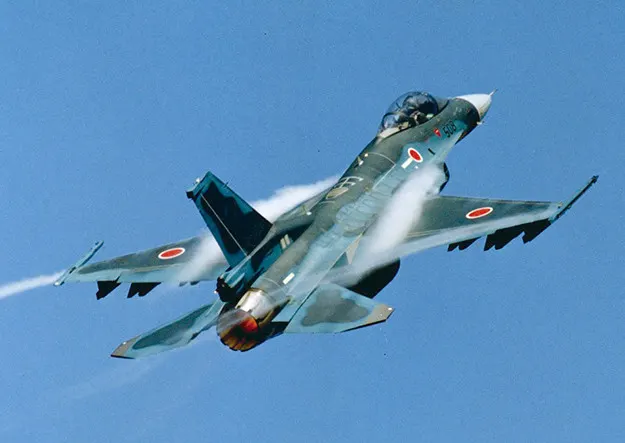
Beyond routine training duty, a single T-2 airframe became one of the more consequential research aircraft in Japanese aviation. Converted into the "Control Configured Vehicle," it carried extra canard surfaces on the forward fuselage and a triplex digital fly-by-wire control system, used to explore relaxed-stability handling years before Japan attempted an indigenous fighter with similar technology.1 The lessons from that single modified trainer are widely cited as an early step toward the digital flight-control work later used on the Mitsubishi F-2, giving the T-2 a research legacy well beyond its training role.
Blue Impulse and Two Fatal Accidents
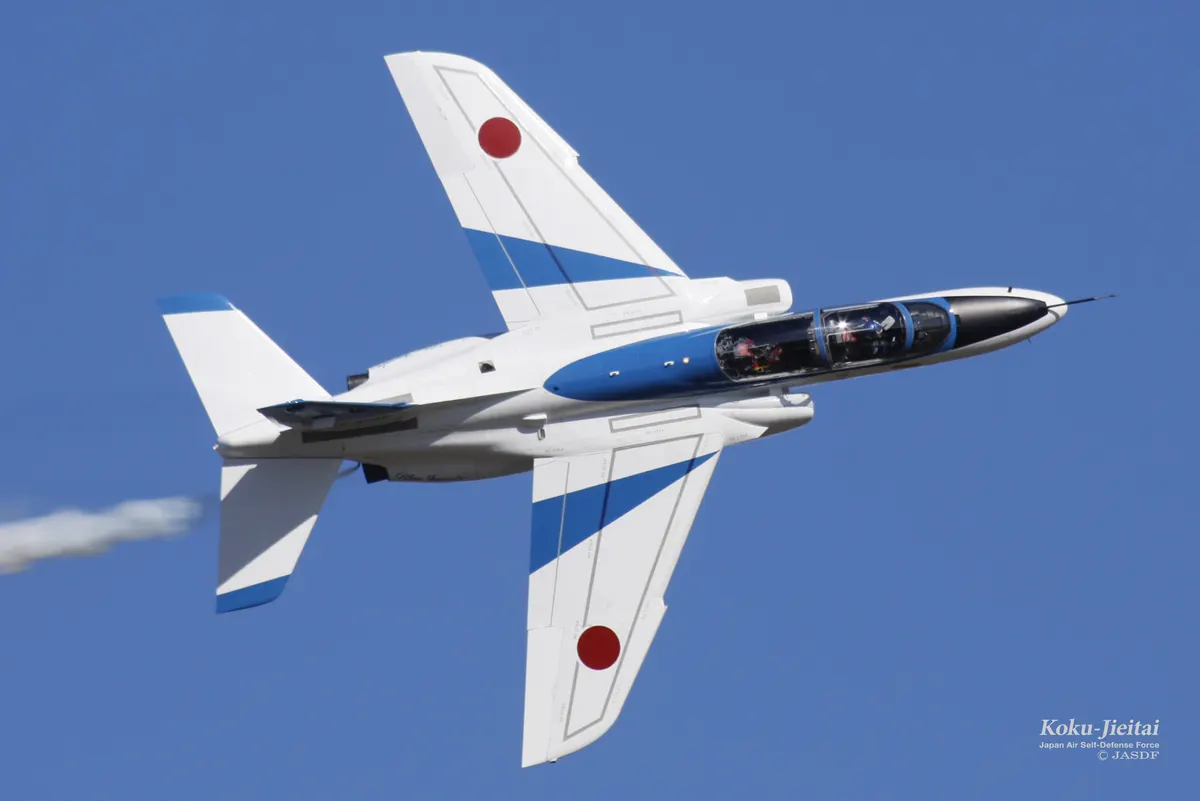
The JASDF's Blue Impulse display team, previously flying North American F-86F Sabres, converted to the T-2 in the winter of 1981-82 and gave its first public performance with the type on 25 June 1982 at Matsushima Air Base.7 The distinctive blue-and-white livery worn by the display aircraft was reportedly the winning design from a public submission by four Japanese high-school students, a detail that still gets repeated in Japanese aviation media.1 Blue Impulse flew the T-2 for 175 demonstrations before switching to the Kawasaki T-4 in December 1995.7
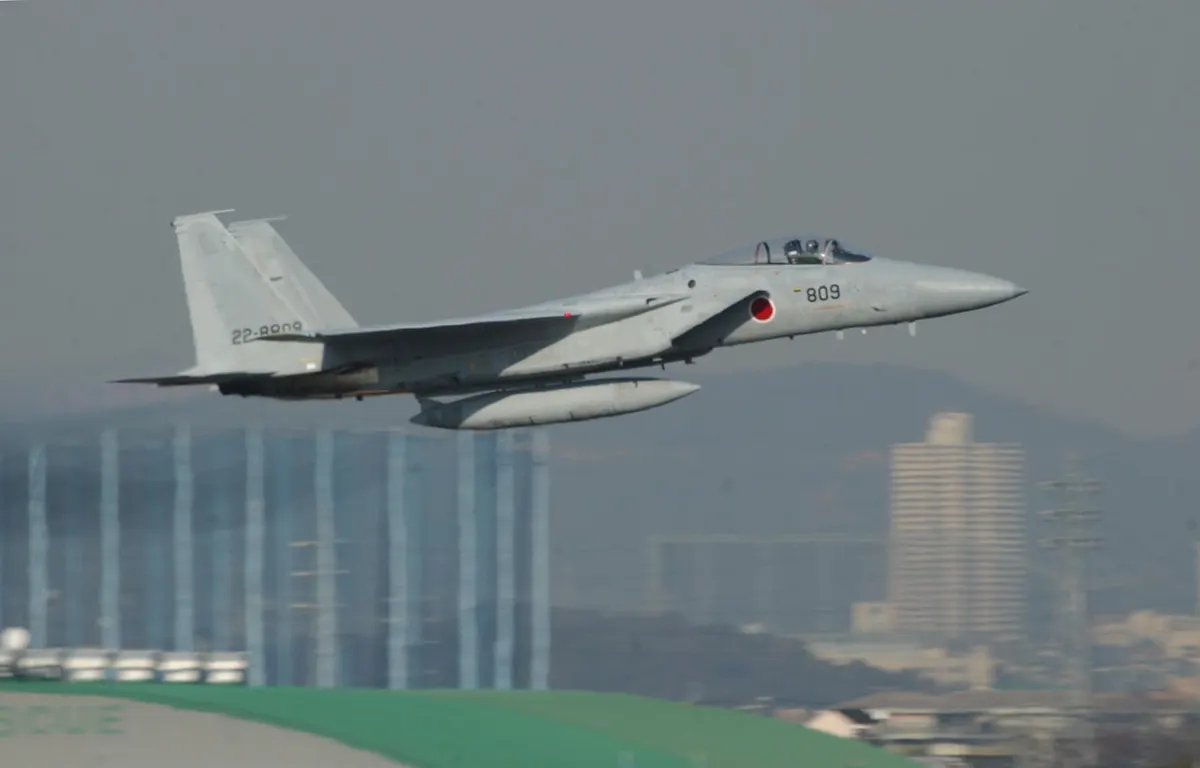
Japan's post-war constitution kept the T-2, and its combat derivative the F-1, out of any shooting war; the type's operational history is entirely one of training, adversary simulation, and Cold War-era readiness rather than combat.1 Its most direct brush with a "conflict" role came through the Hiko Kyodotai, the JASDF's dedicated aggressor squadron, formed at Nyutabaru in 1983 specifically to fly the T-2 in the adversary role against front-line fighter units, simulating the tactics of Soviet aircraft that regularly probed Japanese airspace during the period.8 Eleven T-2s served in that unit before it converted to the F-15DJ starting in 1990.8
Because the T-2 saw no combat and was never exported, it also never appeared in any foreign air force's order of battle or in any documented external conflict; its entire operational record sits inside Japanese airspace and training ranges.1
The baseline production split was between the T-2(Z), an unarmed advanced trainer without radar, and the T-2(K), which added the J/AWG-11 radar, a head-up display, and full weapons capability for gunnery and missile training.1 Twenty-eight T-2(Z) and sixty-two T-2(K) aircraft were built. Separately, the single T-2 CCV testbed, converted from an early production airframe, carried extra canard control surfaces and a triplex fly-by-wire system for handling-qualities research rather than any operational role.1 The most significant derivative was not a T-2 variant at all but a distinct type built on the same structure: the single-seat Mitsubishi F-1 strike fighter, which replaced the rear cockpit with an avionics bay, added two more hardpoints, and reinforced the airframe for heavier ordnance loads. Seventy-seven F-1s were built between 1975 and 1987, entering service in 1977 and retiring in March 2006, within months of the last T-2s.3

The Japan Air Self-Defense Force was the T-2's sole operator throughout its life; no export sale or foreign license-production deal was ever concluded, despite Japan's earlier flirtation with acquiring the Jaguar from the opposite direction.1 Within the JASDF, the type served with fighter training squadrons including the 21st and 22nd Hikotai, the Tactical Fighter Training Group's aggressor unit, and several tactical fighter squadrons that used the T-2(K) for weapons conversion ahead of F-1 or F-4EJ assignments, alongside its long stint with Blue Impulse.1
The most instructive comparison remains the SEPECAT Jaguar, the aircraft the T-2 was built to replace as a purchase. Both share the same Adour engine family and a similar high-wing, twin-ventral-fin silhouette, a direct consequence of Japan studying the Jaguar closely during the T-X evaluation before choosing to build its own aircraft rather than pay for a license.1 Performance is broadly comparable: the T-2 reaches about Mach 1.6, similar to Jaguar variants, but the two diverge sharply in intended role. The Jaguar was conceived and fielded primarily as a single- and two-seat strike aircraft with rough-field landing gear for dispersed operations, while the T-2 was built first as a trainer, with weapons capability added afterward on the T-2(K) sub-variant, and it uses conventional gear because the JASDF never needed unprepared-strip operation.1 The Jaguar also went on to a substantial export and combat career, including 1991 Gulf War strike sorties by both the Royal Air Force and French Air Force and further combat use over Bosnia in 1995, a record the T-2 could not match given Japan's export restrictions and its aircraft's purely training-oriented service life.9
| Spec | Mitsubishi T-2 | SEPECAT Jaguar (GR.1) |
|---|---|---|
| Engines | 2× Adour Mk 801A (license-built) | 2× Adour Mk 102 |
| Top speed | Mach 1.6 at altitude (~1,700 km/h) | Mach 1.6 at altitude, Mach 1.1 (~1,350 km/h) at sea level9 |
| Max takeoff weight | ~12,800 kg | ~15,600 kg9 |
| Primary role | Advanced/weapons trainer | Strike fighter |
| Combat record | None | Gulf War (1991), Bosnia (1995)9 |
A domestic comparison is just as revealing: against the Fuji T-1 it replaced, the T-2 was a generational jump, supersonic versus subsonic, twin-engine versus single, radar-equipped weapons trainer versus basic jet trainer, reflecting how quickly JASDF's front-line aircraft had outpaced the T-1's training envelope by the late 1960s.2


What were the Mitsubishi T-2's specifications? The T-2 was 17.85 meters long with a 7.88-meter wingspan, powered by two license-built Adour turbofans giving a combined afterburning thrust in the mid-60 kN range, for a top speed of Mach 1.6 (about 1,700 km/h) and a service ceiling of 15,240 meters.1,4
How many Mitsubishi T-2s were built? Mitsubishi built four XT-2 prototypes plus roughly 90 production aircraft (28 unarmed T-2(Z) and 62 armed T-2(K)) between 1971 and 1988.1
Is the Mitsubishi T-2 still in service? No. The JASDF retired its last T-2s in March 2006, replaced by the Kawasaki T-4 as the advanced trainer and by two-seat F-2s in the conversion-training role.1
How is the T-2 different from the Fuji T-1? The T-1 was Japan's first mass-produced jet trainer, single-engine and subsonic. The T-2 was designed a decade later specifically because the T-1 could no longer prepare pilots for supersonic front-line fighters; the T-2 is twin-engine, radar-capable in its armed version, and can exceed Mach 1.2
Mitsubishi T-2 vs the SEPECAT Jaguar: how closely related are they? They are not related by lineage, only by convergent design: Japan studied a Jaguar license deal, walked away from it, and then built an aircraft using the same Adour engine family and a similar aerodynamic layout, which is why the two are frequently mistaken for relatives.1
- "Mitsubishi T-2", Wikipedia — en.wikipedia.org ↩
- "Fuji T-1", Wikipedia — en.wikipedia.org ↩
- "Mitsubishi F-1", Wikipedia — en.wikipedia.org ↩
- "Mitsubishi T-2 - Specifications", flugzeuginfo.net — flugzeuginfo.net ↩
- "Mitsubishi T-2 Advanced Jet Trainer Aircraft", MilitaryFactory.com — militaryfactory.com ↩
- "Today in Aviation History: First Flight of the Mitsubishi T-2", Vintage Aviation News — vintageaviationnews.com ↩
- "Blue Impulse", Wikipedia — en.wikipedia.org ↩
- "Hiko Kyodotai: The JASDF's Aggressor Squadron", Global Aviation Resource — globalaviationresource.com ↩
- "SEPECAT Jaguar", Wikipedia — en.wikipedia.org ↩